
Wampum Belts Myth Meaning & Symbolism
A myth of cosmic weaving where memory becomes a living belt, binding spirits, people, and the land into a sacred, speaking pattern of peace.
The Tale of Wampum Belts
In the time before time, when the world was still soft with the breath of the Great Mystery, there was only sound and silence, movement and stillness. The people walked, but their words fell like stones into deep water, leaving only ripples that faded. Agreements were made with breath, and forgotten with the next wind. There was no memory in the hand, no truth that could be held.
Then, from the depths of the great eastern sea, a being arose. She was not a goddess of thunder or hunt, but of the deep, patient pulse of the earth. Some called her She Who Remembers. Grieved by the fragility of human promise, she walked among the shores where the water meets the land, the place of in-between. There, she gathered the broken gifts of the sea: the purple hinge of the quahog, the white spiral of the whelk. These were not mere shells; they were the captured echoes of the ocean’s song, solidified memory.
Under the cold, watchful eye of the winter moon, she began her work. With a awl made of eagle bone and thread spun from the sinew of a deer that had given itself willingly, she pierced each shell. The sound was a soft tock-tock-tock, a heartbeat against the silence. She dipped them in the sand of countless shores, polishing them until they held the sheen of twilight. Then, she began to weave.
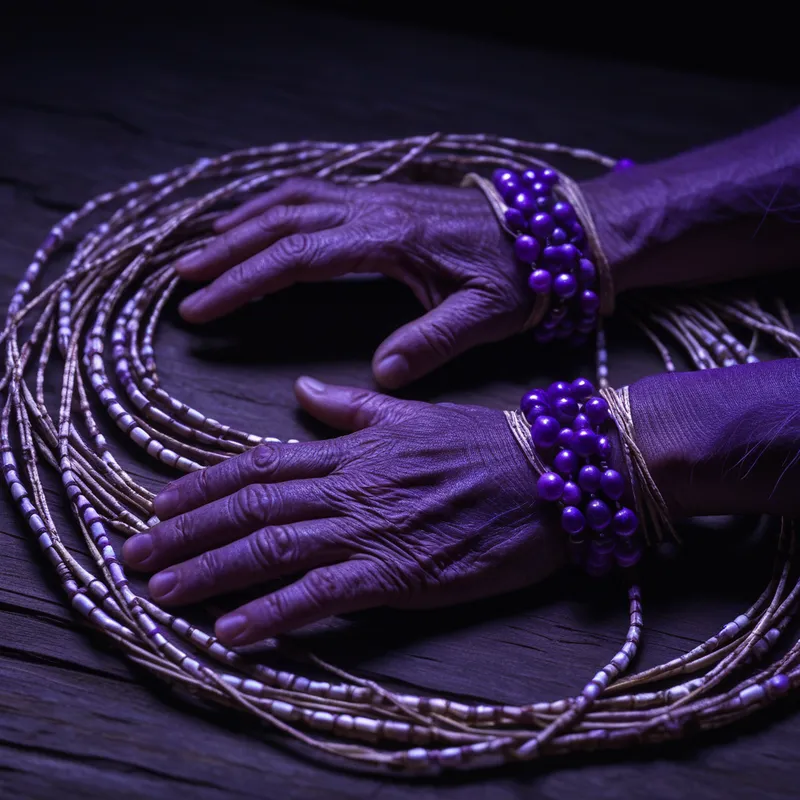
She did not weave a blanket or a basket. She wove a belt. As her fingers flew, the beads—purple for the solemn depths of truth and the blood of life, white for the purity of intent and the light of peace—began to form patterns. These were not arbitrary. A line of white became a river of agreement. A triangle of purple became a mountain of witness. Diamonds represented linked nations, zigzags the path of council fires. She wove the first treaty between the Wolf and the Deer, the pact between the River and the Stone, the understanding between the North Wind and the Pine.
When she was finished, she held it up to the first light of dawn. The Wampum Belt did not just lie in her hands; it spoke. It hummed with the weight of the promises it held. She brought it to the people gathered at the great council. “See,” her silence said. “Here, your words are no longer breath. They are woven. To break the pattern is to break the world you have agreed to live within.”
From that day, when nations met, they did not merely speak. They wove. Speaker after speaker would hold the belts, their fingers tracing the patterns, feeling the stories in the beads, speaking the words back into the air, made eternal by the loom of shared memory. The belts became living kin, witnesses that outlived the people who made them.
Cultural Origins & Context
The mythos of the Wampum Belt is rooted in the lifeways of Northeastern Woodlands nations, particularly the Haudenosaunee (Iroquois Confederacy) and Algonquian peoples. This is not a single, standardized myth with a pantheon of gods, but a profound cultural metaphor born from material practice and spiritual understanding. The “myth” is the lived reality of the belt’s power.
The belts themselves, meticulously crafted from quahog and whelk shells, were far more than currency or ornament. They were the constitutional documents, the historical archives, and the sacred sacraments of diplomacy. Their creation and use were surrounded by ritual and solemnity. Special Wampum Keepers, individuals of great integrity and memory, were responsible for their care and for “reading” them aloud in council. The process of creating a belt to seal a treaty was itself a mythic act—a deliberate, physical manifestation of a spiritual and political reality, echoing the primordial act of She Who Remembers. The myth was passed down not just in story, but in the very performance of diplomacy, in the tactile act of handing a belt from one leader to another, transferring responsibility and memory through the weave.
Symbolic Architecture
At its core, the Wampum Belt myth is a profound meditation on the architecture of reality itself, built not on matter, but on agreement.
The world is not a given; it is a continuous, fragile weaving of understood relationships. To remember the pattern is to sustain the world.
The Belt symbolizes the pattern that binds. It represents the transformation of chaotic, fleeting experience (spoken words, emotions, conflicts) into an ordered, durable, and beautiful structure (treaty, law, shared history). The two colors—white and purple—are the fundamental binary of existence: light and dark, peace and war, clarity and profundity, sky and earth. Their union in the weave signifies that true order arises from the respectful integration of opposites, not the domination of one.
The act of weaving is the central psychic function. It is conscious, deliberate creation. Each bead is a moment of understanding, a vow, a fact. The sinew is the will and the relationship that connects them. The finished belt is the psyche of a community—or an individual—made visible: a complex, interconnected system of promises, memories, and identities that must be maintained to ensure integrity.

The Dreamer's Resonance
When the motif of the Wampum Belt appears in modern dreams, it often signals a profound process of psychic integration and truth-telling. The dreamer may be encountering fragmented beads scattered on the ground, trying to restring a broken belt, or witnessing a magnificent, glowing belt they cannot quite decipher.
Somatically, this can feel like a deep yearning for coherence, a pressure in the hands or chest—the body’s memory of “holding things together.” Psychologically, it indicates the unconscious working to weave together disparate parts of the self: conflicting values, broken promises to oneself, unintegrated traumas (the dark purple beads), and idealized aspirations (the white beads). The dream is an internal council fire, where various sub-personalities or memories are being called to account, seeking a new, sustainable treaty within the dreamer’s own psyche. The anxiety in such dreams comes from the fear of a permanent rupture—a pattern that cannot be repaired, a truth that cannot be faced and woven back into the whole.

Alchemical Translation
The alchemical journey modeled by the Wampum Belt is the opus of individuation as diplomacy. It is not a hero’s quest to slay a dragon, but a creator’s patient, meticulous work to build a lasting peace treaty between the warring nations of the inner world.
The prima materia is the raw, shell-like fragments of our experience: sharp memories, hard truths, beautiful but isolated insights. The nigredo, or blackening, is the recognition of our inner fragmentation—the broken promises, the contradictory beliefs, the parts of ourselves we have exiled or forgotten. The piercing of the shell with the eagle-bone awl is the painful but necessary act of confronting these truths, making them conscious.
The loom is the conscious ego, and the weaver is the Self. The act of weaving is the transcendent function, creating a third, new thing from opposing pairs.
The albedo, or whitening, is the purification of intent—the commitment to honesty and clarity (the white beads). The rubedo, the reddening, is the embodiment of this commitment in a lasting, living structure (the purple beads of deep, embodied truth). The final “belt” is the attained personality—not a rigid armor, but a flexible, strong, and beautiful pattern of one’s own values, history, and agreements with life. It is a sacred text of the self, which one must continually “read” and honor. To live authentically is to remember the pattern you have woven, and to have the courage to re-weave it when new truths emerge, ensuring the integrity of the whole being remains intact.
Associated Symbols
Explore related symbols from the CaleaDream lexicon: