Vodyanoy Myth Meaning & Symbolism
The myth of Vodyanoy, the ancient Slavic lord of waters, a capricious spirit embodying the untamed, dangerous, and fertile depths of the psyche and the natural world.
The Tale of Vodyanoy
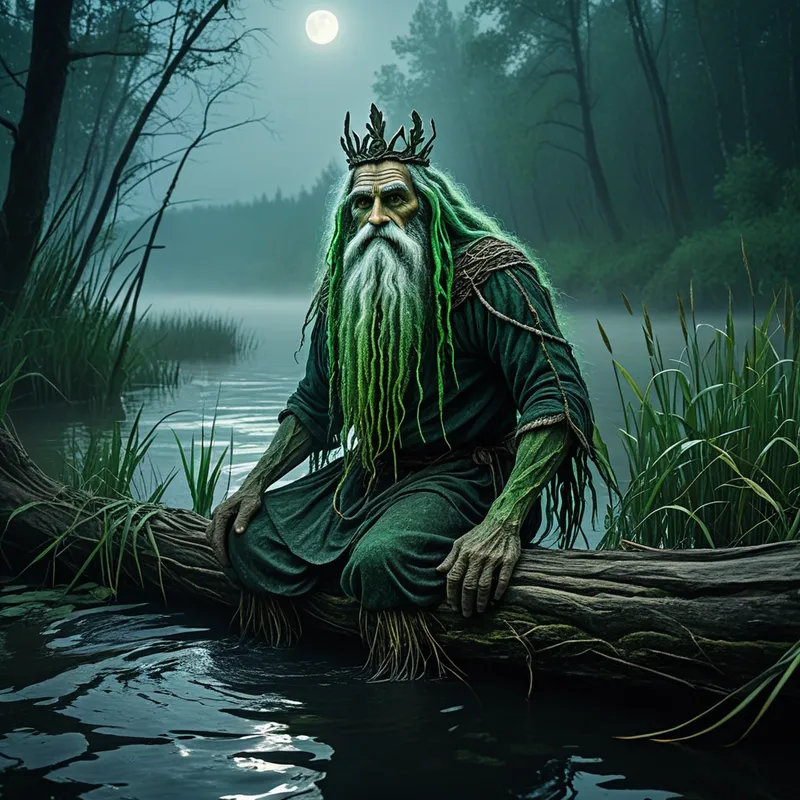
Listen, and hear the whisper of the reeds. Feel the cold seep of the riverbank mud between your toes. When the moon is a sliver of drowned silver and the mist clings to the black water like a shroud, that is when he stirs. He is the old one, the green-bearded king who was ancient when the first oak took root. They call him Vodyanoy.
His palace is not of marble, but of sunken logs, of silt-thick halls lit by the phosphorescent eyes of monstrous pike. His throne is the millstone dragged to the riverbed by his own tempestuous rage. He rules every eddy, every deep pool, every hidden spring that feeds the hungry earth. To cross his domain without offering is to invite a cold, grasping hand around your ankle.
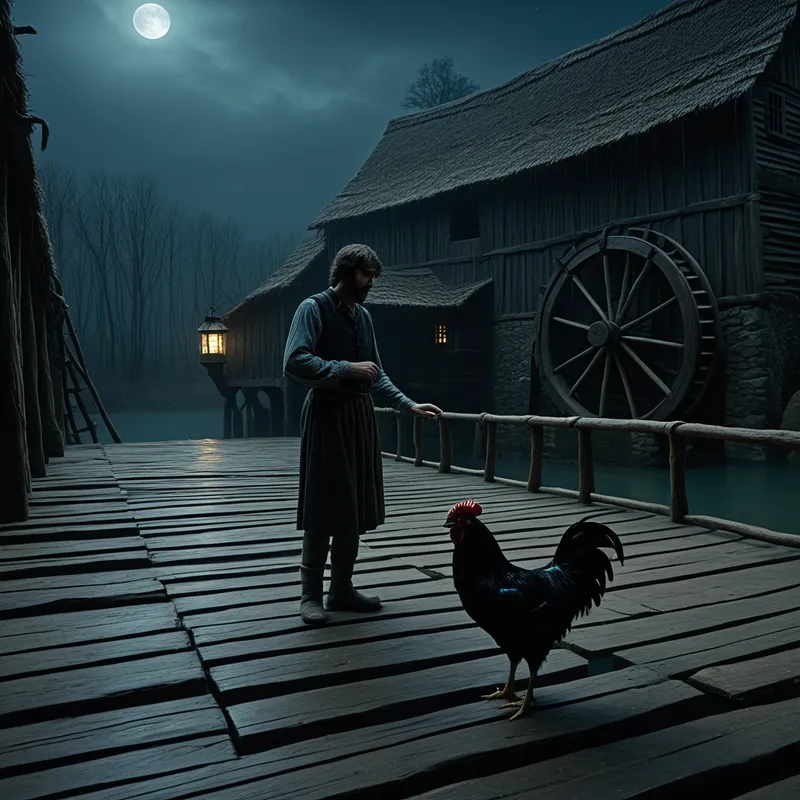
There was a miller once, proud and foolish, who built his mill upon a bend of the river without a single word of tribute. For a season, the wheel turned, the grain was ground, and coins clinked in his purse. But the miller forgot the true owner of the water that gave him life. The Vodyanoy watched, his patience as deep and cold as his abyss.
First, the mill-pond grew still and foul. Then, the fish floated belly-up, their eyes milky. The mill wheel groaned, then seized, as if gripped by an invisible, muddy fist. The miller’s luck turned. His flour was gritty with silt, his best horse stumbled into the river and vanished without a sound. Desperation, colder than the river, filled his heart.
An old grandmother, her face a map of bark and wisdom, found him weeping by the stagnant water. “You have built your house upon his beard,” she whispered. “You must pay the debt. At the dark of the moon, take a black rooster, the one that crows at midnight. Go to your mill. Pluck it alive, and let its blood fall upon the waters. Speak his name, and offer it all to him.”
Terror gripped the miller, but greater terror was the ruin of his life. He did as she said. The midnight air was thick and silent. The only sound was the frantic beating of the rooster’s heart against his palm and the terrible, wet plucking of feathers. As the first drop of black blood hit the inky water, the surface boiled. A great, gurgling sigh rose from the depths. Two points of sickly green light appeared, widening into the eyes of the old king himself.
The Vodyanoy emerged, water streaming from his matted beard, his mouth a grim line in a face of waterlogged clay. He said nothing, only stared at the trembling miller and the dying offering. Then, with a nod that sent ripples to the far bank, he sank back down. By morning, the water ran clear and strong. The wheel turned with a newfound, easy power. But the miller never again took a bucket from the river without a muttered prayer, a pinch of tobacco, a crust of bread. He had met the lord of the place, and his world was forever divided into the sunlit land and the sovereign, haunted dark beneath.
Cultural Origins & Context
The myth of the Vodyanoy was not a story told for mere entertainment in the long, dark winters of the Slavic world. It was a vital piece of ecological and psychological cartography, passed down by grandmothers, fishermen, and millers—those whose lives and livelihoods were intimately bound to the capricious will of rivers, lakes, and marshes. This lore functioned as a practical guide to living in a world alive with conscious, volatile forces.
Unlike the distant, organized gods of the pantheon, the Vodyanoy was a genius loci, a spirit of a specific place. Every deep pool had its own old man. This hyper-locality made the myth immediate and personal; it taught respect not for “Nature” in the abstract, but for this river, this bend, this spring. The offerings—bread, salt, tobacco, the blood of a black animal—were a ritual technology, a way of negotiating with an unpredictable and essential power. The myth enforced a code of conduct, a reminder that human enterprise (the mill) was always a guest upon a much older, wilder authority.
Symbolic Architecture
Psychologically, the Vodyanoy is a potent [symbol](/symbols/symbol “Symbol: A symbol can represent an idea, concept, or belief, serving as a powerful tool for communication and understanding.”/) of the unconscious itself—not the personal unconscious of repressed memories, but the older, collective, and instinctual strata of the psyche. He is the [lord](/symbols/lord “Symbol: The symbol of ‘Lord’ represents authority, mastery, and control, along with associated power dynamics in relationships.”/) of all that is fluid, emotional, deep, and beyond the control of the ego’s mill-wheel [logic](/symbols/logic “Symbol: The principle of reasoning and rational thought, often representing order, structure, and intellectual clarity in dreams.”/). His domain is the [Chaos](/symbols/chaos “Symbol: In Arts & Music, chaos represents raw creative potential, uncontrolled expression, and the breakdown of order to forge new artistic forms.”/) of potential that exists before and beneath the ordered structures of conscious [life](/symbols/life “Symbol: The symbol of ‘Life’ represents a journey of growth, interconnectedness, and existential meaning, encompassing both the joys and challenges that define human experience.”/).
The Vodyanoy does not hate humanity; he is indifferent to its schemes. He simply demands acknowledgment that his law—the law of the deep—is supreme in his realm.
His [appearance](/symbols/appearance “Symbol: Appearance in dreams relates to self-image, perception, and how you present yourself to the world.”/)—old, strong, bearded, often described as bloated or covered in muck—marks him as an [archetype](/symbols/archetype “Symbol: A universal, primordial pattern or prototype in the collective unconscious that shapes human experience, behavior, and creative expression.”/) of the [Senex](/symbols/senex “Symbol: The wise old man archetype representing spiritual authority, ancestral wisdom, and the integration of life experience into transcendent knowledge.”/), the Old [King](/symbols/king “Symbol: A symbol of ultimate authority, leadership, and societal order, often representing the dreamer’s inner power or external control figures.”/), but one submerged in the watery, feeling function. He is wisdom, but a dark, amoral, elemental wisdom concerned with [fertility](/symbols/fertility “Symbol: Symbolizes creation, growth, and abundance, often representing new beginnings, potential, and life force.”/), [dissolution](/symbols/dissolution “Symbol: The process of breaking down, dispersing, or losing form, often representing transformation, release, or the end of a state of being.”/), and the cyclical drag of the [depths](/symbols/depths “Symbol: Represents the subconscious, hidden emotions, or foundational aspects of the self, often linked to primal fears or profound truths.”/). The drowned souls he is said to keep in [clay](/symbols/clay “Symbol: Clay symbolizes malleability, creativity, and the potential for transformation, representing the foundational aspect of life and the ability to shape one’s destiny.”/) pots represent contents of the psyche that have been “swallowed” by the unconscious, lost to conscious [awareness](/symbols/awareness “Symbol: Conscious perception of self, surroundings, or internal states. Often signifies awakening, insight, or heightened sensitivity.”/) but still held in his [palace](/symbols/palace “Symbol: A palace symbolizes grandeur, authority, and the pursuit of one’s ambitions or dreams, often embodying a desire for stability and wealth.”/). His [trickster](/symbols/trickster “Symbol: A boundary-crossing archetype representing chaos, transformation, and the subversion of norms through cunning and humor.”/) [nature](/symbols/nature “Symbol: Nature symbolizes growth, connectivity, and the primal forces of existence.”/), causing mischief or granting bounty based on his [mood](/symbols/mood “Symbol: Mood in dreams often represents the emotional landscape of the dreamer, reflecting subconscious feelings that may not be acknowledged in waking life.”/), reflects the unpredictable, autonomous [behavior](/symbols/behavior “Symbol: Behavior encompasses the actions and reactions of individuals, often as a response to various stimuli or contexts.”/) of the unconscious as it impacts our conscious plans.
The Dreamer’s Resonance
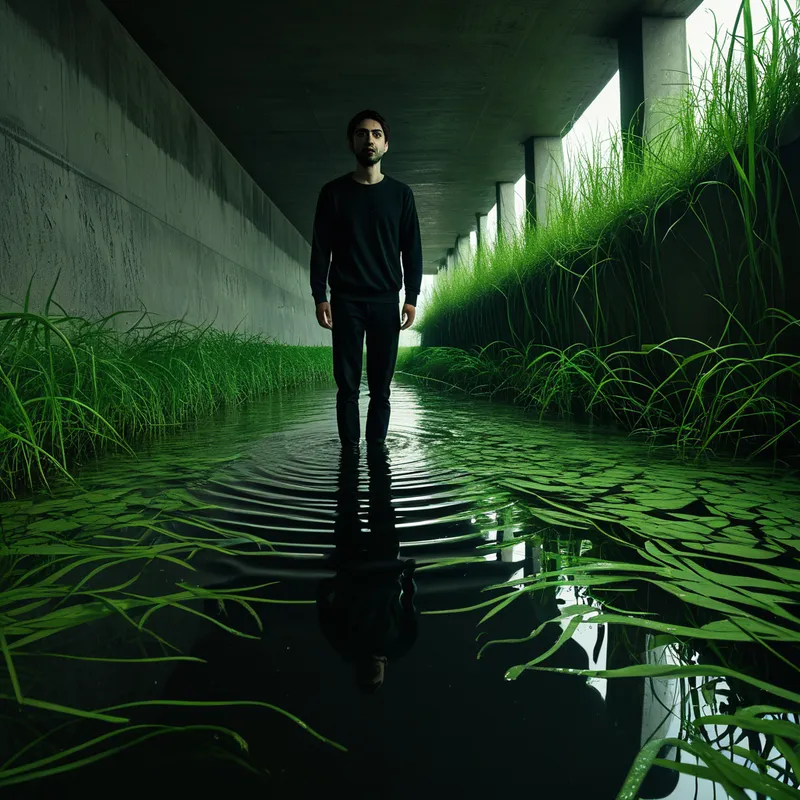
When the imagery of the Vodyanoy surfaces in modern dreams, it often signals an encounter with this deep, instinctual layer of the psyche. The dreamer may find themselves by a strangely still or threatening body of water, or see an old, powerful figure rising from a pool, basement, or even a bathtub.
Somatically, this can correlate with feelings of being “pulled under” by emotions, depression, or a flood of unprocessed psychic material. The Vodyanoy appears when the ego has built its “mill”—its identity, projects, or ambitions—upon the flow of libidinal or emotional energy without paying proper respect to its source. The dream is a notification of a debt owed to the soul. The rising dread is the intuition that a foundational, life-giving power is being ignored or exploited, and it is beginning to withdraw its support, leading to stagnation (the fouled pond) or sudden catastrophe (the drowned horse).
Alchemical Translation
The miller’s journey is a precise allegory for the alchemical process of nigredo, the blackening, and the beginning of transmutation. His initial success represents the ego’s inflation, building a prosperous identity. The fouling of his water is the nigredo itself—the depression, the stuckness, the realization that something vital has turned poisonous.
The sacrifice of the black rooster is not an act of cruelty, but the necessary ritual sacrifice of the solar, crowing, purely conscious attitude (the rooster) to the dark, lunar, instinctual power.
This is the critical moment of psychic alchemy: the conscious ego (the miller), in its state of despair, must actively engage the unconscious authority (the Vodyanoy). It must offer something of supreme value from its own domain—a symbol of its light and pride—to the dark. It must “name” the shadow power, acknowledging its sovereignty. This ritual, performed at the “dark of the moon” (the height of the unconscious cycle), initiates a reconciliation.
The resulting clear flow of water symbolizes the albedo, the whitening, where the life-energy of the psyche is purified and can move again. The mill turns, but the miller is changed. He now lives in conscious relationship with the depth. His individuation is not about conquering the Vodyanoy, but about learning his laws, paying his tolls, and thereby gaining the right to draw sustenance from the infinite, mysterious well of the soul without being destroyed by it.
Associated Symbols
Explore related symbols from the CaleaDream lexicon:
- Water — The primary element of the Vodyanoy, representing the unconscious psyche in all its fluid, emotional, life-giving, and dangerous potential.
- River — The specific, flowing manifestation of the watery domain, symbolizing the course of life, time, and psychic energy that the Vodyanoy governs and can disrupt.
- Sacrifice — The core ritual act required to appease the Vodyanoy, representing the ego’s necessary surrender of pride and control to gain access to deeper power.
- Chaos — The primordial state embodied by the Vodyanoy’s realm, the unstructured depth from which all form emerges and to which it may return.
- Shadow — The Vodyanoy himself as a personification of the autonomous, darker, instinctual part of the psyche that demands recognition.
- Moon — The celestial body governing the Vodyanoy’s power, linking him to cycles, tides, reflection, and the non-rational, nocturnal side of existence.
- Spirit — The Vodyanoy as a non-human consciousness inhabiting the natural world, representing the animistic perception of a universe alive with will.
- Fish — The creatures of the Vodyanoy’s court, symbolizing the thoughts, inspirations, and soul-fragments that swim in the depths of the unconscious.
- Dream — The medium through which the Vodyanoy’s domain most commonly communicates with the modern individual, a liminal space between his world and ours.
- Death — The constant companion of the Vodyanoy, lord of the drowned, representing the dissolution of ego necessary for psychological transformation and rebirth.