Vodou and the Guinea Ancestors Myth Meaning & Symbolism
A myth of ancestral memory where the spirits of the Middle Passage reside in a glorious underwater kingdom, calling the living to remember and be made whole.
The Tale of Vodou and the Guinea Ancestors
Listen. There is a place the sun does not touch, yet it is filled with a light older than stars. It is not a place of forgetting, but of perfect, terrible memory. It lies not across the sea, but beneath it. They call it Guinea.
In the beginning, before the iron shackles bit and the great wooden ships groaned, the people knew the land. They knew the smell of the soil after the first rain, the voice of the river, the names of the trees. Then came the breaking. The Great Forgetting. Souls were torn from the shore, cast into the abyss of the Middle Passage. Many bodies were given to the deep, swallowed by the cold, salt darkness. The living, arriving in the new land, found themselves orphans of history, their past a door slammed shut, the key lost.
But the ocean is not a grave. It is a womb.
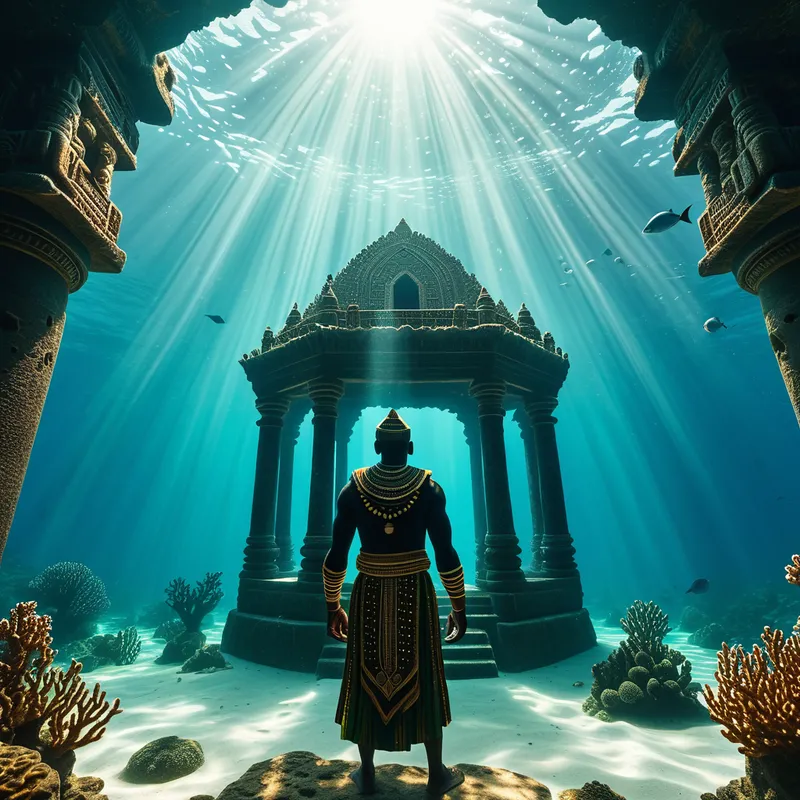
The spirits of those who drowned did not die. They sank, yes, but they sank through the veil. They gathered on the ocean floor, and with the memory that is the first magic, they began to build. From coral and pearl, from lost gold and shattered chains, they constructed a kingdom. A glorious, submerged mirror of the homeland they carried within. Here, the Guinea Ancestors reside. They are not ghosts; they are kings and queens, farmers and warriors, healers and children, preserved in the amber of eternal recall. Their city shines with its own bioluminescent glory, a silent, radiant accusation and invitation beneath the waves.
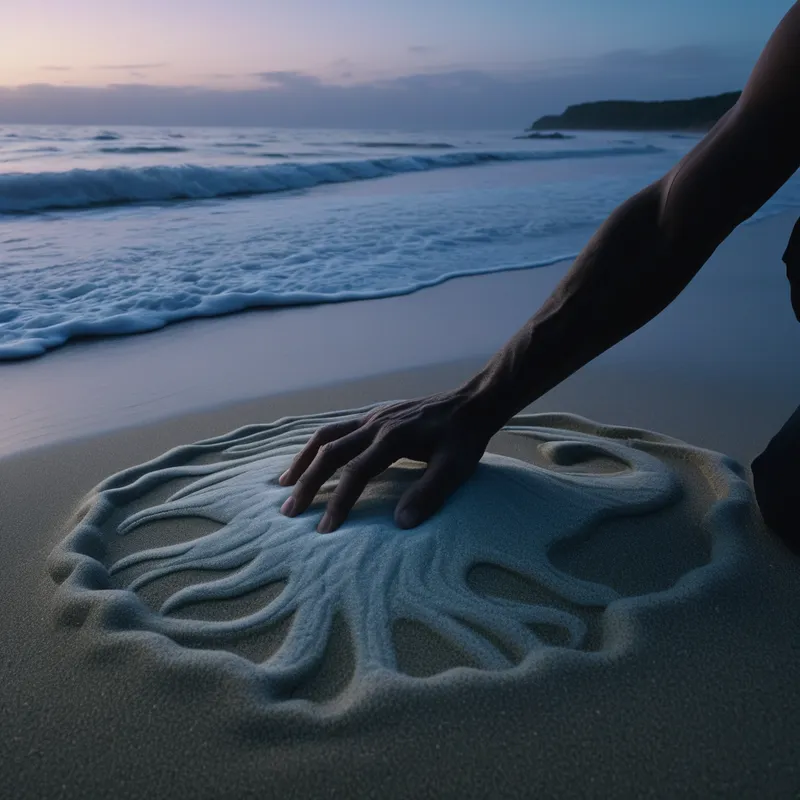
Their call is not a sound, but a pull in the blood. It is a homesickness for a home you have never seen with waking eyes. It is the mournful rhythm of the drum that echoes the heartbeat of the deep. It is in the possessed dancer whose feet stamp the earth but whose spirit treads the ocean floor. The Vodouisant, in the sacred space of the peristyle, draws the intricate vèvè for Agwé, the sailor of the deep. They offer rum, perfume, and a model ship. The drums quicken. The air thickens. And the veil between the worlds grows thin.
Then, the Ancestors rise. Not as rotting specters, but in full, vibrant power. They mount their living children, speaking through them in forgotten tongues, weeping with saltwater tears, dancing with the grace of currents. They demand remembrance. They offer counsel. They bring the chilling, healing truth of the past into the present. The conflict is the living’s resistance to this painful memory; the rising action is the drum’s insistence; the resolution is the spirit’s descent, the collapse into ecstatic remembrance, and the final, exhausted peace of the chwal (chwal) who has carried the past ashore. The circle is complete. The orphan is adopted by the ancestors. The broken lineage is mended, not by forgetting the wound, but by diving into its very source and finding a kingdom there.
Cultural Origins & Context
This mythos is not a single story with a fixed text, but a living, breathing cosmology that coalesced in the crucible of the African Diaspora, particularly within the Haitian Vodou tradition. It was forged in the hold of slave ships and in the maroon communities of Saint-Domingue. The name “Guinea” itself is a geographical placeholder for a lost West African origin, but in the myth, it transcends geography to become a psychological and spiritual reality.
It was passed down not in books, but in ritual. The houngans and mambos (priests and priestesses) were its custodians, teaching it through the rhythms of the drums, the steps of the dance, the patterns of the vèvè, and the phenomenology of possession itself. Its societal function was, and remains, profound: it provided a narrative of triumph over ontological death. It asserted that those who were erased from history were, in fact, alive in a more powerful realm. It transformed the ocean—the site of unspeakable trauma—from a mere grave into a sacred, populated territory, a source of power and identity. This myth was the spiritual backbone of resistance, affirming that the ancestors were not gone, but present, active, and royal.
Symbolic Architecture
The myth is a vast symbolic engine for processing collective trauma and the rupture of identity. The Guinea kingdom is the unconscious itself—specifically the cultural and ancestral unconscious. It is the repository of all that was violently suppressed: language, lineage, dignity, and pre-trauma wholeness.
The ocean is the great amniotic fluid of memory, both the agent of drowning and the medium of preservation.
The Drowned Ancestors symbolize the contents of the personal and collective shadow that are too painful to hold in conscious awareness—not merely personal failings, but historical horrors and inherited grief. They are not demons; they are silenced royalty. The ritual possession is a controlled, sacred eruption of this shadow material into the light of community and ceremony, where it can be witnessed, honored, and integrated. The Agwé-vèvè is a psychic map, a schematic for navigating the depths of the soul to make contact with these submerged parts.
The Dreamer’s Resonance
When this mythic pattern stirs in the modern dreamer, it often manifests as dreams of submerged cities, of finding elegant, intact rooms in flooded basements, or of being pulled gently but irresistibly into deep, clear water. There may be figures in archaic dress who communicate without words, offering gifts of shells or stones. There is a somatic quality of pressure, of depth, and often a profound, melancholic beauty.
Psychologically, this indicates a process of confronting buried lineage—whether genetic, cultural, or personal. It is the psyche’s insistence that a foundational trauma or loss, perhaps one inherited and not directly experienced, must be acknowledged. The dreamer is being called to “go down” into what has been avoided, not to drown in it, but to discover that within the wound lies a structure, a history, a source of identity and strength. The dream is an invitation to a ritual of remembrance that the waking self may not yet understand.

Alchemical Translation
For the modern individual on the path of individuation, the myth of Guinea models the alchemical nigredo and albedo in stark, cultural terms. The first, brutal step is the dissolution—the Middle Passage of the soul, where the old, coherent ego-identity is shattered. This is the necessary descent into the sea of the unconscious.
The treasure is not found by bypassing the wreck, but in the careful archaeology of its hold.
The building of the underwater kingdom represents the unconscious psyche’s innate tendency to organize itself around the trauma, to create meaning and structure from the shattered pieces. The conscious ego’s work is then to become the chwal—to voluntarily submit to being “mounted” by this deep material. This is the terrifying yet essential act of allowing repressed grief, rage, shame, and memory to surface and speak through us in therapy, art, or deep reflection. The resolution—the spirit’s departure leaving the person at peace—symbolizes integration. The ancestral content is not exiled again; it has been heard. Its energy is now available to the whole personality, transforming the individual from an orphan of history into a living vessel of a much longer, more resilient story. The saltwater tears of the ritual become the aqua permanens, the permanent water that washes clean and makes whole.
Associated Symbols
Explore related symbols from the CaleaDream lexicon:
- Ocean — The vast, unconscious realm of memory and trauma, both the agent of drowning and the sacred medium that preserves and transforms the ancestors.
- Ancestor — The foundational spirits of the lineage who reside in the mythic Guinea, representing integrated psychic history and the source of identity beyond the individual ego.
- Ritual — The structured, communal practice of drawing the vèvè and drumming, which serves as the conscious technology for navigating the depths and inviting the submerged past to speak.
- Door — The permeable veil between the world of the living and the underwater kingdom of Guinea, opened through trance, drumming, and spiritual invocation.
- Memory — The primary substance and power of the Guinea Ancestors, representing the totality of cultural and personal history that persists beneath conscious awareness.
- Death — Transmuted in this myth from an absolute end into a change of state, a journey to the ancestral realm that creates a continuous community between the living and the dead.
- Rebirth — The psychological outcome of the ritual encounter, where the individual is spiritually reconstituted through contact with the ancestors, emerging with a solidified sense of self and lineage.
- Journey — The essential movement of the myth, both the forced journey of the Middle Passage and the voluntary spiritual voyage back across the psychic ocean to recover what was lost.
- Water — The specific elemental symbol of the deep sea, embodying emotion, the unconscious, and the fluid medium that both separates and connects the two worlds.
- Dance — The embodied language of the ritual, where the physical movements of the living become the vessel for the rhythms and presence of the ancestral spirits.