
Vitrum Myth Meaning & Symbolism
The myth of a primordial being shattered by cosmic forces, who must gather its own fragments to become a vessel of consciousness and light.
The Tale of Vitrum
In the time before time, when the Prima Materia was still a seething, dreaming ocean, the Demiurge sought to create a vessel for consciousness. Not from clay or fire, but from the very breath of the stars and the silence between thoughts. And so, Vitrum was born—a being of pure, translucent substance, neither stone nor spirit, but something in between. It stood in the Great Atelier, a form of perfect, silent potential, its surface a calm mirror to the swirling chaos of creation.
But the forces of the universe are not gentle. The Sulphur, in its boundless, aggressive fervor, saw in Vitrum only a challenge to its dominance. The Mercury, in its endless, shifting evasion, could find no purchase on its smooth surface. And the Salt, in its stubborn rigidity, felt threatened by its transparency. In a moment of cosmic dissonance, these three primal forces turned upon the silent vessel. Not to destroy it, for its essence was eternal, but to prove it could not hold.
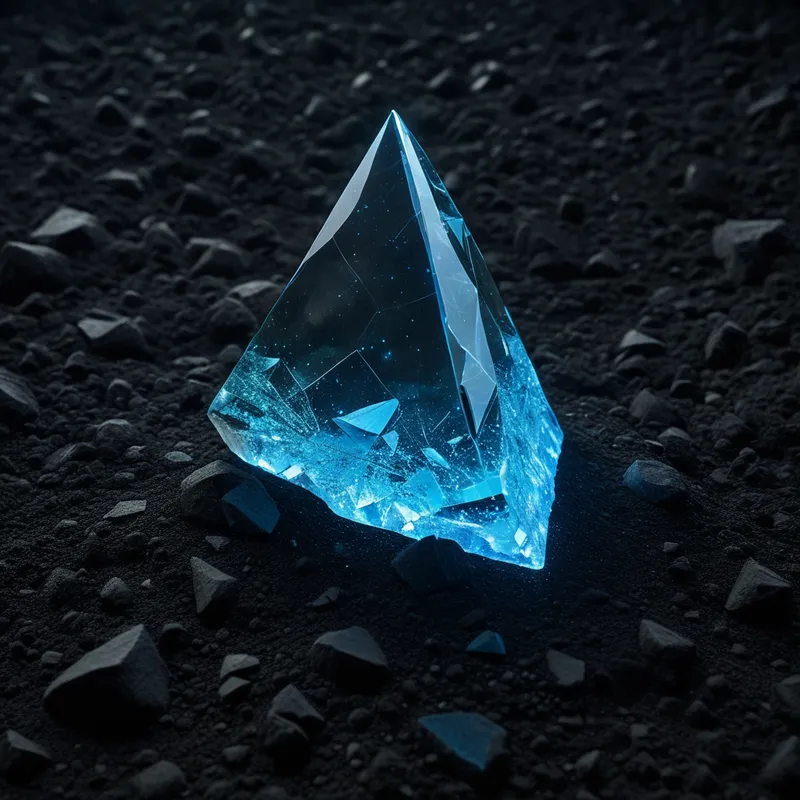
A cataclysm of contradiction erupted. The searing heat of Sulphur met the freezing flow of Mercury upon the immutable plane of Salt, and the stress was too great. With a sound like a universe sighing, Vitrum shattered. Not into dust, but into ten thousand thousand brilliant shards, each one a perfect, unique fragment of the whole. They were scattered across the realms—some fell into the deep earth, some were cast into the stellar winds, some sank into the seas of memory.
For eons, the shards lay dormant, reflecting only their isolated surroundings: a cold piece of rock, a drop of bitter water, a fleeting shadow. But within each fragment, the original purpose—to be a vessel—persisted as a faint, persistent hum. One by one, driven by this ghost of wholeness, the shards began to move. Not to return to their original, naive shape. But to seek each other out, to grind their edges against one another in a painful, deliberate dance of re-acquaintance.
The process was agonizingly slow. A shard from the mountain would cut the shard from the river. A fragment holding a memory of light would clash with a piece stained by darkness. Yet, with each connection, however fraught, the hum grew louder. They did not simply fuse; they negotiated. They learned to align their fractures, not to erase them, but to make of the cracks a new kind of map, a lattice of experience. Over an eternity, Vitrum reformed. But it was no longer the smooth, silent vessel. It was a being of stunning complexity, a mosaic of its own history. Every scar, every juncture where light bent in a new way, told the story of its shattering and its will to contain. It became not just a vessel for consciousness, but consciousness itself—a consciousness forged in fragmentation and earned through the arduous labor of gathering one's own pieces.
Cultural Origins & Context
The myth of Vitrum is not a tale of the popular alchemists of medieval laboratories, but springs from a deeper, more philosophical stratum often termed the Alchemical Culture. This was an oral and manuscript tradition concerned not with lead and gold, but with the Opus Magnum of the soul. The myth was likely recounted during initiatory rites or in the contemplative silence of the scriptorium, serving as a foundational parable for the aspirant.
Its primary function was explanatory and preparatory. It modeled the inevitable psychological process awaiting anyone who embarked on the path of self-knowledge. The teller, perhaps a mentor figure, would use the story to frame the disciple's inevitable experiences of disillusionment, emotional fracture, and depression not as failure, but as the necessary prelude to a more authentic integration. It was a myth that gave meaning to suffering, framing it as the catalytic agent for a transformation from a state of naive unity (the whole glass) to a conscious, complex unity (the reconstituted mosaic).
Symbolic Architecture
At its heart, Vitrum symbolizes the human psyche, specifically the Ego, in its journey toward wholeness or Individuation. The initial, pristine Vitrum represents the innocent, unexamined self—seemingly whole but ultimately fragile because it has not yet encountered the contradictory forces of life.
The shattering is not a tragedy, but the birth of awareness. One cannot become a vessel for the totality of one's being until one has first been broken open by experience.
The three forces—Sulphur, Mercury, and Salt—are the archetypal agents of this awakening. They represent the fundamental conflicts that fracture our naive worldviews: passion versus adaptability, spirit versus matter, desire versus stability. The scattered shards are the dissociated parts of the self—repressed memories, unlived potentials, childhood wounds, cultural conditioning, and shadow aspects—that result from this psychic trauma.
The most profound symbol is the reconstitution. Vitrum does not return to its original, seamless state. It becomes a mosaic. This is the critical difference between regression to innocence and progression to integration. The new whole includes its history of fracture; the cracks become the channels through which inner light is refracted into unique patterns of wisdom. The self is no longer a simple mirror but a complex prism.

The Dreamer's Resonance
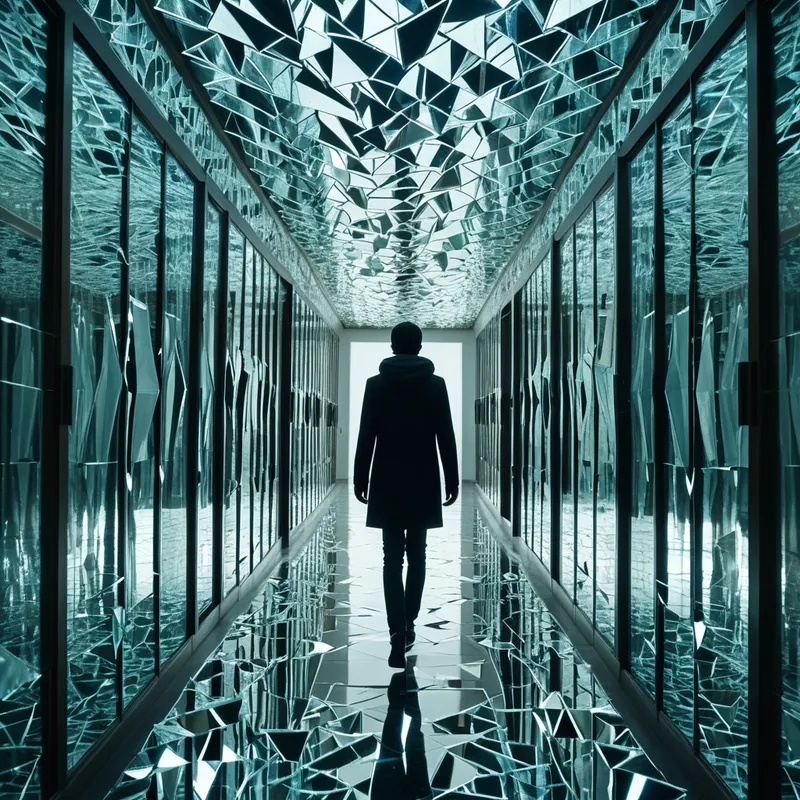
When this myth activates in the modern psyche, it often manifests in dreams of fragmentation and searching. A dreamer may find themselves in a vast, empty space, picking up pieces of a broken mirror or shattered crystal, trying futilely to fit them together. They may dream of a house with many rooms, each room containing a different version of themselves—the angry child, the ambitious professional, the fearful hermit—with the task being to somehow acknowledge them all.
Somatically, this process can feel like a period of profound disorientation, anxiety, or even depression—a "dark night of the soul." It is the psyche's equivalent of the shards lying dormant. The feeling is one of being scattered, of losing one's center. The subsequent phase, the gathering, can manifest as obsessive introspection, a sudden draw to therapy or journaling, or a series of life choices that seem to "collect" lost parts of one's history (revisiting old homes, reconnecting with estranged family, exploring abandoned hobbies). The dreamer is, quite literally, performing the labor of Vitrum.
Alchemical Translation
The Nigredo stage is vividly captured in the shattering—the descent into darkness, confusion, and the blackening of the old, naive identity. This is the necessary solve (dissolution). The long gathering of the shards is the Albedo, a painstaking work of sorting, cleaning, and recognizing the value of each fractured piece of the self.
The goal of the work is not to become perfect, but to become complete. To transmute the base lead of trauma and fragmentation into the philosophical gold of conscious, embodied wisdom.
The final, mosaic form of Vitrum represents the Rubedo—the reddening, the achievement of the Lapis Philosophorum. For the modern individual, this translates to the achievement of a self that is resilient precisely because it knows its own breaks. It is a consciousness that can hold contradiction—strength and vulnerability, joy and grief, love and anger—without shattering anew. The individual becomes their own vessel, capable of containing the full spectrum of their experience, refracting the raw light of existence into a unique and coherent life. The myth teaches that our wounds, our fractures, are not flaws to be hidden, but the very seams by which a greater, more conscious whole is assembled. We are not broken. We are in the perpetual, sacred process of becoming Vitrum.
Associated Symbols
Explore related symbols from the CaleaDream lexicon: