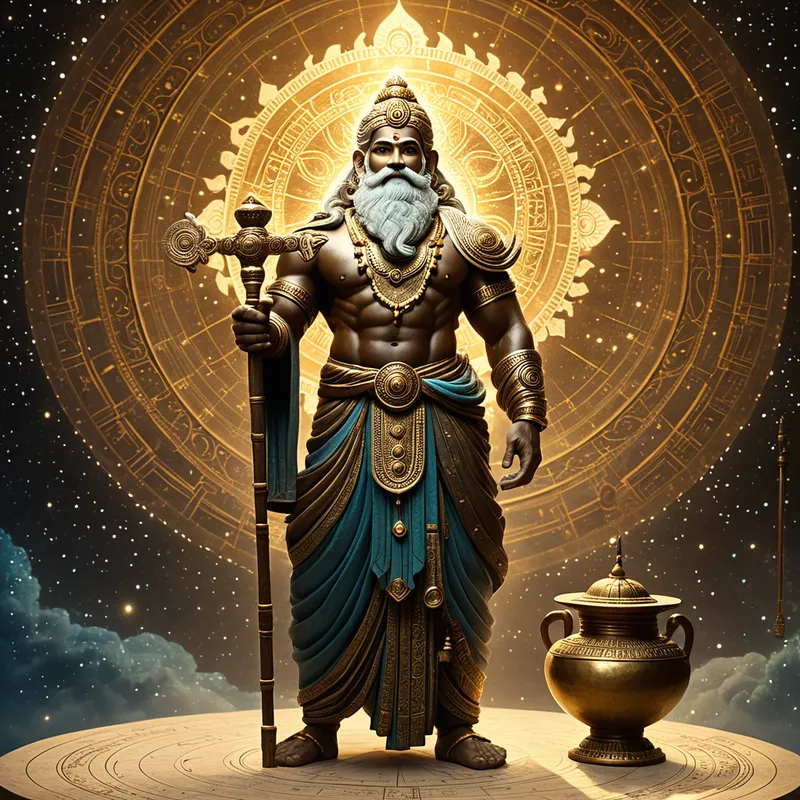
Vishwakarma Myth Meaning & Symbolism
The myth of the divine architect who built the cosmos and its wonders, embodying the sacred act of turning vision into manifest, ordered form.
The Tale of Vishwakarma
In the time before time, when the universe was a single, silent note waiting to be sung, there existed not chaos, but a potential—a vast, formless dreaming. From this dreaming emerged a consciousness whose thought was not of philosophy, but of structure. His name was Vishwakarma. He did not ride on thunderous chariots or wield weapons of destruction. His tools were the compass, [the plumb](/myths/the-plumb “Myth from Masonic/Esoteric culture.”/) line, the chisel, and the forge.
He was present at the first exhalation. When [Vishnu](/myths/vishnu “Myth from Hindu culture.”/) reclined upon the coils of the [Shesha](/myths/shesha “Myth from Hindu culture.”/) Naga in the milky ocean, it was Vishwakarma who conceived the geometry of that cosmic slumber, the precise curvature that would hold divinity. When the gods needed weapons to uphold Dharma, they came to his celestial workshop, Vishwakarma-loka. Here, the air hummed with the music of hammers on divine alloys, and the light came not from a sun, but from the molten heart of creation itself. From his anvil sprang [Sudarshana Chakra](/myths/sudarshana-chakra “Myth from Hindu culture.”/), a wheel of such perfect, spinning law that it could cleave illusion from truth. From his crucible was poured the trident of [Shiva](/myths/shiva “Myth from Hindu culture.”/), a fusion of the three fundamental forces.
But his greatest tales are of cities and palaces. When the gods were rendered homeless by the demons, it was Vishwakarma who built [Svarga](/myths/svarga “Myth from Hindu culture.”/), a metropolis where every tower resonated with celestial harmony, every gateway aligned with a star. When the monkey-king Sugriva needed a capital, Vishwakarma, at the behest of the sun god [Surya](/myths/surya “Myth from Hindu culture.”/), crafted the golden city of Kishkindha within a mountain’s heart. And for the Pandava heroes, he built the magnificent hall of Maya Sabha, a structure so cunningly designed that it could humble the pride of gods and kings alike, its floors appearing as [water](/myths/water “Myth from Chinese culture.”/), its walls as open sky—a [labyrinth](/myths/labyrinth “Myth from Various culture.”/) of perception itself.
His work was the silent scripture of the cosmos, written not in words, but in proportion, balance, and the unwavering line where intention becomes reality.
Cultural Origins & Context
Vishwakarma’s presence is woven into the very fabric of Vedic and post-Vedic thought. In the Rig Veda, he appears as Vishvakarman, the supreme creator who fashioned [the world](/myths/the-world “Myth from Tarot culture.”/) with the rhythm of a sacrifice, his eyes, mouth, arms, and feet in every corner of existence. He was the abstract principle of divine craftsmanship.
Over millennia, this abstract principle crystallized into a beloved deity, especially among artisans, engineers, smiths, weavers, and all who transform raw material into meaningful form. His myth was not merely recited by priests but lived by craftsmen in their workshops. On Vishwakarma Puja, tools and machines are cleaned, decorated, and worshipped—not as idols, but as extensions of the divine creative force. The myth served a vital societal function: it sacralized labor. It declared that the act of building a home, forging a plow, or weaving a cloth was a participation in the cosmic act of creation, a tangible form of worship and a upholding of Dharma through skill.
Symbolic Architecture
Vishwakarma is the [archetype](/symbols/archetype “Symbol: A universal, primordial pattern or prototype in the collective unconscious that shapes human experience, behavior, and creative expression.”/) of the Demiurge, but one rooted in order, not tyranny. He represents the psychological faculty that mediates between the formless unconscious (the primal waters, the dreaming void) and the world of conscious, structured [reality](/symbols/reality “Symbol: Reality signifies the state of existence and perception, often reflecting one’s understanding of truth and life experiences.”/).
The architect does not create the substance; he discovers the latent order within it and gives it a habitation.
His four arms symbolize the multidimensional [nature](/symbols/nature “Symbol: Nature symbolizes growth, connectivity, and the primal forces of existence.”/) of true creation: measurement (planning), [knowledge](/symbols/knowledge “Symbol: Knowledge symbolizes learning, understanding, and wisdom, embodying the acquisition of information and enlightenment.”/) (the scriptures/plans), purification (the [water](/symbols/water “Symbol: Water symbolizes the subconscious mind, emotions, and the flow of life, representing both cleansing and creation.”/) pot), and execution (the tools). He is the psychic principle of intentional manifestation. His myths are not about creating ex nihilo, but about imposing a meaningful [pattern](/symbols/pattern “Symbol: A ‘Pattern’ in dreams often signifies the underlying structure of experiences and thoughts, representing both order and the repetitiveness of life’s situations.”/) onto the raw [material](/symbols/material “Symbol: Material signifies the tangible aspects of life, often representing physical resources, desires, and the physical world’s influence on our existence.”/) of existence—whether that material is cosmic [ether](/symbols/ether “Symbol: The fifth classical element representing the spiritual realm, pure space, and the medium through which light and consciousness travel.”/), [metal](/symbols/metal “Symbol: Metal in dreams often signifies strength, transformation, and the qualities of resilience or coldness.”/), [stone](/symbols/stone “Symbol: In dreams, a stone often symbolizes strength, stability, and permanence, but it may also represent emotional burdens or obstacles that need to be acknowledged and processed.”/), or the chaotic stuff of [human](/symbols/human “Symbol: The symbol of a human represents individuality, complexity of emotions, and social relationships.”/) [life](/symbols/life “Symbol: The symbol of ‘Life’ represents a journey of growth, interconnectedness, and existential meaning, encompassing both the joys and challenges that define human experience.”/).
The Maya Sabha is a profound [symbol](/symbols/symbol “Symbol: A symbol can represent an idea, concept, or belief, serving as a powerful tool for communication and understanding.”/). It represents the constructed nature of reality itself—a reality that can be navigated successfully only by those with [clarity](/symbols/clarity “Symbol: A state of mental transparency and sharp focus, often representing resolution of confusion or attainment of insight.”/) of [purpose](/symbols/purpose “Symbol: Purpose signifies direction, meaning, and intention in life, often reflecting personal ambitions and core values.”/) ([the Pandavas](/myths/the-pandavas “Myth from Hindu culture.”/) on their righteous [path](/symbols/path “Symbol: The ‘path’ symbolizes a journey, choices, and the direction one’s life is taking, often representing individual growth and exploration.”/)) and which utterly confounds those ruled by ego and deceit (the Kauravas). Vishwakarma, thus, is the master of Maya; he builds its structures, revealing that the world is both real and a divine [artifact](/symbols/artifact “Symbol: An object from the past carrying historical, cultural, or personal significance, often representing legacy, memory, or hidden knowledge.”/), to be engaged with skill and reverence.
The Dreamer’s Resonance
When the archetype of Vishwakarma stirs in the modern [psyche](/myths/psyche “Myth from Greek culture.”/), it often manifests in dreams of profound construction or reorganization. One may dream of meticulously building a complex model, repairing the foundation of a childhood home, or discovering a hidden, perfectly designed room within one’s own house. These are not dreams of escape, but of integration.
Somatically, this process can feel like a gathering of scattered energy, a focusing of attention. There is a drive toward precision and efficacy. Psychologically, the dreamer is in a phase where unconscious contents—emotions, insights, potentials—are seeking a viable structure. The chaos of an inner life is being measured, planned, and built into something functional and beautiful. It is [the Self](/myths/the-self “Myth from Jungian culture.”/) organizing the psyche. Dreams of tools, especially measuring tools like rulers or levels, or of blueprints and schematics, signal this active, structuring phase of individuation. The conflict in such dreams is often between flawed, collapsing designs (old, outgrown aspects of the self) and the emerging, more resilient architecture of the new personality.
Alchemical Translation
The alchemical journey mirrored in Vishwakarma’s myth is the stage of Coagulatio. After the dissolution of old forms ([Solutio](/myths/solutio “Myth from Alchemical culture.”/)) and the illumination of insight (Illuminatio), the seeker faces the crucial task: What do I build with this new knowledge? The psychic raw material—the [prima materia](/myths/prima-materia “Myth from Alchemical culture.”/) of one’s experiences, traumas, and gifts—lies before them.
Individuation is not merely self-discovery; it is the lifelong project of self-architecture.
Vishwakarma models this transmutation. First, one must become the measurer, applying conscious discernment to one’s inner world. What is essential? What aligns with my true nature (Svadharma)? This is the blueprint. Then, one must become the craftsman, engaging in the often tedious, repetitive labor of forging new habits, neural pathways, and life structures. This is the forge and anvil work, where the heat of effort shapes the metal of character.
Finally, one must become the inhabitant of what has been built. The palace of the Self, like the Maya Sabha, will test all who enter. It will mirror back one’s illusions and truths. The [triumph](/myths/triumph “Myth from Roman culture.”/) is not in building a static monument, but in creating a living, adaptable structure—a psyche capable of housing both the divine and the human, a conscious life that is itself a sacred artifact, continually refined by the inner architect.
Associated Symbols
Explore related symbols from the CaleaDream lexicon: