Vishnu's Serpent Myth Meaning & Symbolism
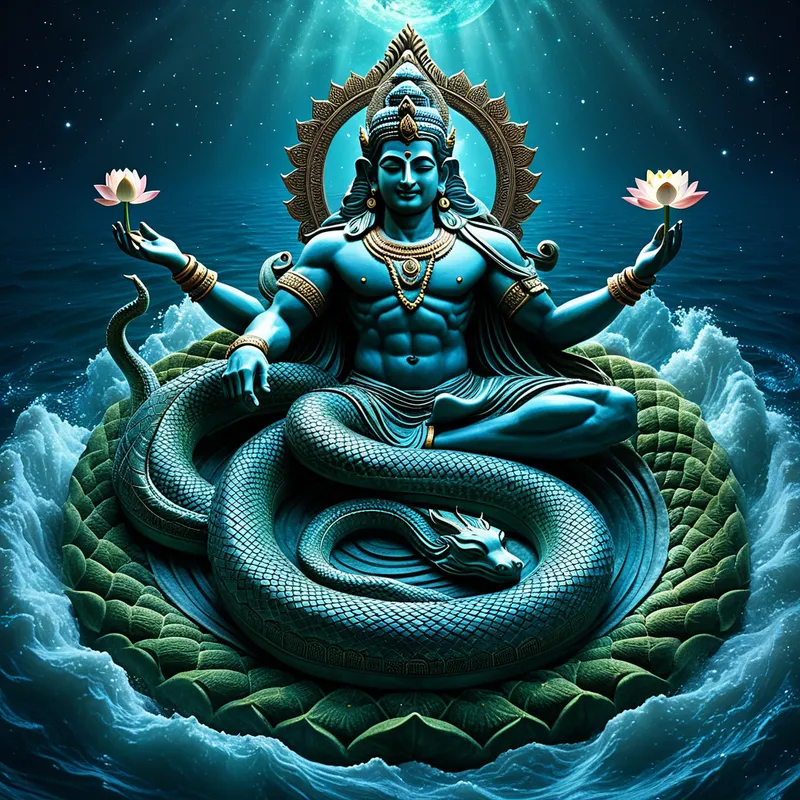
The endless serpent Shesha forms the bed for Lord Vishnu, supporting the universe in the cosmic ocean between cycles of creation and dissolution.
The Tale of Vishnu’s Serpent
Listen. Before time was counted, before the first breath was drawn, there was only the ocean. Not an ocean of [water](/myths/water “Myth from Chinese culture.”/) as we know it, but the Karana Samudra, the ocean of cause. It was dark, silent, and infinite. And upon its boundless, placid surface, a presence stirred.
It was [Vishnu](/myths/vishnu “Myth from Hindu culture.”/), the all-pervading one. But he was not standing, not watching. He was sleeping. A sleep so profound it was the very womb of potential. And beneath him, serving as his divine couch, was the serpent. Not a beast of malice, but a being of majestic, coiled eternity. His name was Ananta [Shesha](/myths/shesha “Myth from Hindu culture.”/), which means “The Endless Remainder.”
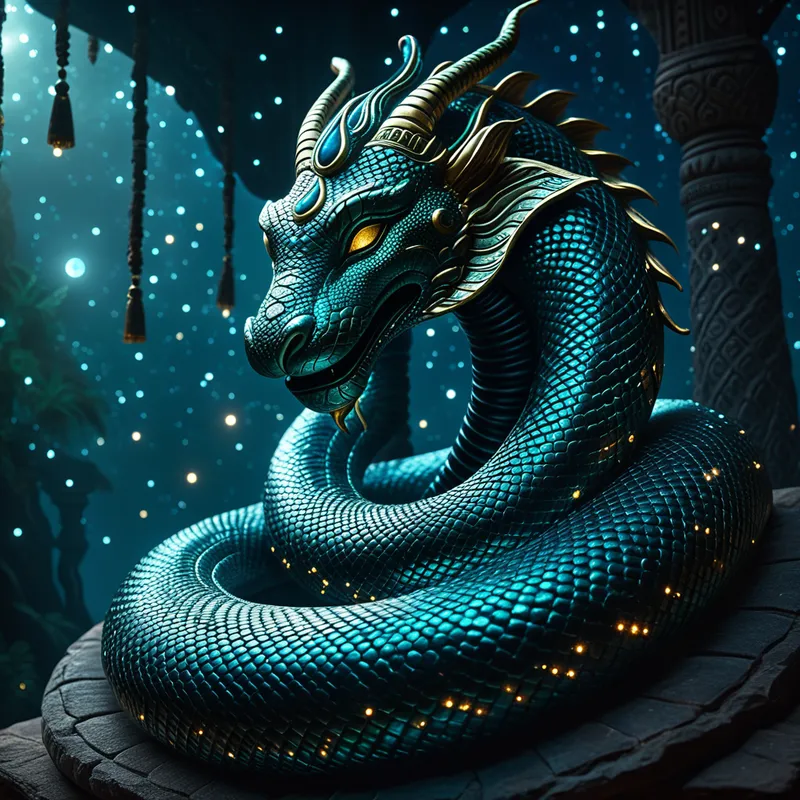
Feel the scene: the cool, milky waters, utterly still. The scent of potential, like ozone before a storm. The only sound is the slow, cosmic rhythm of Vishnu’s breath. And there is Shesha, his body a mountain range of luminous scales, blue as a twilight sky, coiled into a perfect, supportive bed. His thousand hoods rise like a living canopy, each hood bearing a glittering jewel that casts a soft, star-like light upon the sleeping god. In the tranquil space of Vishnu’s navel, a [lotus](/myths/lotus “Myth from Hindu culture.”/) stem emerges, growing upward until it blossoms, and from that flower, the four-faced creator Brahma is born, tasked with fashioning [the world](/myths/the-world “Myth from Tarot culture.”/).
This is not a moment, but an acon. Vishnu dreams the universe into being. Shesha holds him, unwavering. The serpent’s gaze is watchful, patient, directed inward and outward simultaneously. He is the foundation upon which the dreamer rests, the stable ground in the formless waters. When the dream reaches its conclusion, when the created world has run its course and dissolves back into the causal waters, it is Shesha who remains. He is the “remainder,” the essence that persists when all names and forms are withdrawn. He will be there again, ready to coil and support, when Vishnu dreams the next universe into existence. The cycle is eternal: dissolution, sleep, support, dream, creation.
Cultural Origins & Context
The image of Vishnu reclining upon Shesha in the cosmic ocean is one of the most iconic and enduring in Vedic and post-Vedic cosmology. Its earliest iterations appear in texts like the Brahmanas and are fully elaborated in the great epics, the Mahabharata and Puranas, such as the Vishnu Purana and Bhagavata Purana.
This myth was not merely a story but a cosmological model and a theological anchor. It was passed down through an oral tradition of sages and storytellers, depicted in temple sculptures from Ellora to Angkor Wat, and described in devotional poetry. Its societal function was multifaceted: it explained the cyclic nature of time (Kalpas and [Yugas](/myths/yugas “Myth from Hindu culture.”/)), provided a visual for the concept of divine preservation (Dharma), and offered a profound metaphor for the relationship between the transcendent divine (Vishnu) and the foundational substance of reality (Shesha). It answered the human question of “what was before?” with an image of serene, supported potential.
Symbolic Architecture
The myth is a dense [tapestry](/symbols/tapestry “Symbol: The tapestry represents interconnected stories, creativity, and the weaving of personal and collective experiences into a cohesive narrative.”/) of interlocking symbols. Vishnu represents pure, conscious [awareness](/symbols/awareness “Symbol: Conscious perception of self, surroundings, or internal states. Often signifies awakening, insight, or heightened sensitivity.”/)—[the witness](/symbols/the-witness “Symbol: A figure observing events without direct participation, representing conscience, memory, or societal judgment.”/), the preserver, the [source](/symbols/source “Symbol: The origin point of something, often representing beginnings, nourishment, or the fundamental cause behind phenomena.”/) from which the dream of [reality](/symbols/reality “Symbol: Reality signifies the state of existence and perception, often reflecting one’s understanding of truth and life experiences.”/) emanates. His sleep is not unconsciousness but a state of potential, of unmanifest creativity.
Shesha is the supportive ground of being itself, the necessary foundation upon which consciousness can rest to engage in the act of creation.
The [serpent](/symbols/serpent “Symbol: A powerful symbol of transformation, wisdom, and primal energy, often representing hidden knowledge, healing, or temptation.”/), in almost all global mythologies, is a [symbol](/symbols/symbol “Symbol: A symbol can represent an idea, concept, or belief, serving as a powerful tool for communication and understanding.”/) of duality: [death](/symbols/death “Symbol: Symbolizes transformation, endings, and new beginnings; often associated with fear of the unknown.”/) and [rebirth](/symbols/rebirth “Symbol: A profound transformation where old aspects of self or life die, making way for new beginnings, growth, and renewal.”/), poison and [medicine](/symbols/medicine “Symbol: Medicine symbolizes healing, transformation, and the pursuit of knowledge, addressing both physical and spiritual health.”/), the chthonic [depths](/symbols/depths “Symbol: Represents the subconscious, hidden emotions, or foundational aspects of the self, often linked to primal fears or profound truths.”/) and awakened wisdom. Shesha sublimates this duality. He is not the tempting [serpent](/symbols/serpent “Symbol: A powerful symbol of transformation, wisdom, and primal energy, often representing hidden knowledge, healing, or temptation.”/) of the garden, but the supportive serpent of the cosmic [womb](/symbols/womb “Symbol: A symbol of origin, potential, and profound transformation, representing the beginning of life’s journey and the unconscious source of creation.”/). His endless coils symbolize infinite time and the cyclical [nature](/symbols/nature “Symbol: Nature symbolizes growth, connectivity, and the primal forces of existence.”/) of existence. His thousand hoods represent omnipresence and vigilant protection. The primordial [ocean](/symbols/ocean “Symbol: The ocean symbolizes the vastness of the unconscious mind, representing deeper emotions, intuition, and the mysteries of life.”/) is the unformed, chaotic potential of the unconscious, the Prakriti, awaiting the order of conscious [spirit](/symbols/spirit “Symbol: Spirit symbolizes the essence of life, vitality, and the spiritual journey of the individual.”/) ([Purusha](/myths/purusha “Myth from Hindu culture.”/)). [The lotus](/myths/the-lotus “Myth from Hindu culture.”/) from Vishnu’s navel is the [birth](/symbols/birth “Symbol: Birth symbolizes new beginnings, transformation, and the potential for growth and development.”/) of ordered, beautiful manifestation from the [muddy waters](/symbols/muddy-waters “Symbol: Muddy waters symbolize confusion, moral ambiguity, and the challenges of navigating through life’s complexities and vices.”/) of potential, supported by the stem of [connection](/symbols/connection “Symbol: Connection symbolizes relationships, communication, and bonds among individuals.”/) to the source.
Psychologically, this is a map of the [psyche](/myths/psyche “Myth from Greek culture.”/). The conscious self (Vishnu) cannot function without a stable, supportive [structure](/symbols/structure “Symbol: Structure in dreams often symbolizes stability, organization, and the framework of one’s life, reflecting how one perceives their environment and personal life.”/) from the unconscious (Shesha upon the ocean). [The ego](/myths/the-ego “Myth from Jungian culture.”/) is born (the lotus/Brahma) from this symbiotic rest. The entire process is one of serene, supported [emergence](/symbols/emergence “Symbol: A process of coming into being, rising from obscurity, or breaking through a barrier, often representing birth, transformation, or revelation.”/), not violent conquest.
The Dreamer’s Resonance
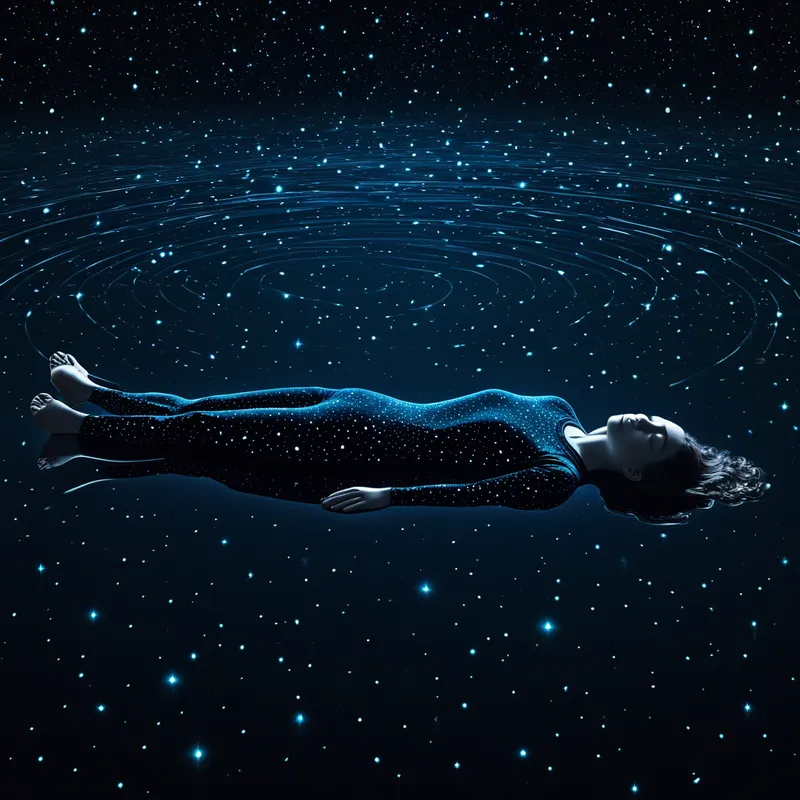
When this mythic pattern stirs in the modern dreamer, it often signals a profound process of psychic reorganization. To dream of being peacefully asleep or floating on water, especially if supported by a large, benevolent serpent or coiled creature, points to a somatic experience of deep trust in the unconscious.
The dreamer may be in a life transition—after an ending (a dissolution) and before a new beginning (a creation). The psyche is in its “cosmic sleep” phase. The supportive serpent in the dream represents the dreamer’s own foundational psychic structures, their core resilience and innate wisdom, holding them as they integrate experiences and prepare for a new phase of life. It is the opposite of an anxiety dream. The feeling upon waking is often one of deep calm, safety, and a mysterious sense of being fundamentally “held.” This dream pattern suggests the ego is learning to rest, to stop striving, and to allow the deeper, supportive intelligence of [the Self](/myths/the-self “Myth from Jungian culture.”/) to bear the weight for a time. It is a dream of surrender to a larger order.
Alchemical Translation
The alchemical process modeled here is not one of fiery calcination or violent separation, but of serene [solutio](/myths/solutio “Myth from Alchemical culture.”/)—dissolution into the supportive waters—followed by a coagulatio that arises naturally from rest. For the individual on the path of individuation, the myth instructs a crucial, often overlooked step.
We are taught to strive, to create, to be the hero battling dragons. Vishnu’s Serpent teaches us to first be the one who rests upon [the dragon](/myths/the-dragon “Myth from Chinese culture.”/). The psychic transmutation occurs in the space of supported stillness.
The modern individual must learn to identify not only with Vishnu (the conscious creator) but also with Shesha (the supportive foundation), and to recognize the ocean (the unconscious) not as a threat, but as the medium of all possibility.
The “alchemical translation” is this: before you can create your world (the lotus), you must find your supportive coil. What are the non-negotiable practices, truths, or inner structures that hold you? You must allow your conscious, striving mind (Vishnu) to rest, to enter a creative sleep, trusting that your own “endless remainder”—your core essence that survives all life’s dissolutions—is fully capable of supporting you. From that place of profound trust and rest, creation does not come from frantic effort, but blossoms naturally from the navel of your being. You dream your world into existence from a foundation of deep, serpentine resilience. The cycle of burnout and frantic rebirth is replaced by the eternal rhythm of dissolution, restorative rest, and supported emergence.
Associated Symbols
Explore related symbols from the CaleaDream lexicon: