Vishnu's Kurma Avatar Myth Meaning & Symbolism
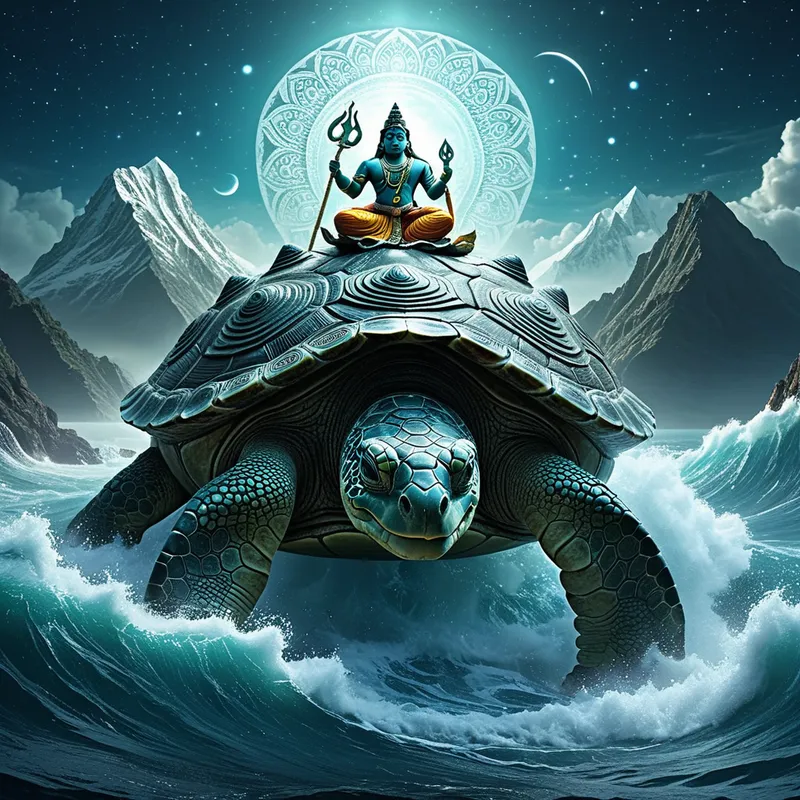
The story of Vishnu as the cosmic turtle, who supports the world mountain during the churning of the primordial ocean to recover the nectar of immortality.
The Tale of Vishnu’s Kurma Avatar
In the twilight of a world grown weary, a silence fell upon the three realms. It was not a peaceful quiet, but the heavy hush of exhaustion. The Devas walked with bowed heads, their radiance dimmed. The Asuras grumbled in their halls, their strength turning brittle. A curse of lethargy had seeped into the marrow of creation. The cause was known to all, a whispered dread: the nectar of immortality, Amrita, was lost, swallowed by the depths of the primordial, milky ocean, [Kshirasagara](/myths/kshirasagara “Myth from Hindu culture.”/).
The great preserver, [Vishnu](/myths/vishnu “Myth from Hindu culture.”/), whose eyes hold the birth and death of universes, saw the cosmic balance teetering. He spoke, and his voice was the sound of a foundation being laid. “The ocean must be churned. From its depths, you shall recover the Amrita, and fourteen treasures besides. But the task is beyond any one of you. Devas and Asuras must work as one, for only your combined strength can move the unmovable.”
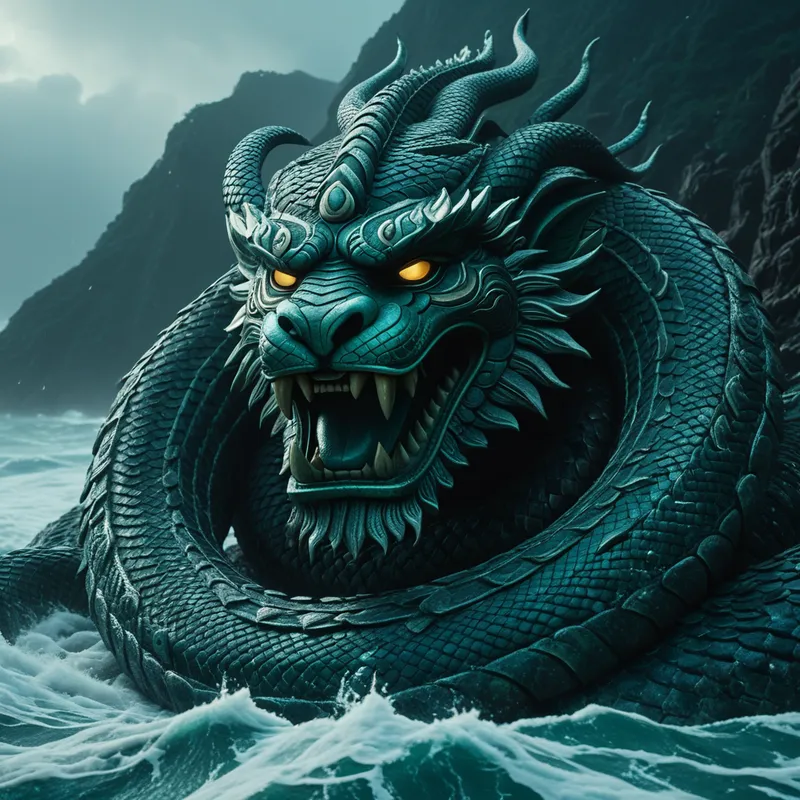
A desperate alliance was forged. They uprooted the mighty mountain Mandara. They persuaded the king of serpents, the mighty Vasuki, to coil himself around the mountain’s peak. The Devas took hold of his tail, the Asuras his head, and with a great heave, they began to spin the mountain upon the ocean’s breast.
But the foundation was soft. The great mountain, unsupported, began to sink. It tilted, groaned, and plunged into the watery abyss, threatening to drag all of creation down with it. Despair, colder than the ocean deep, gripped every heart.
Then, from the still center of the chaos, a presence emerged. Not with a flash of light or a clap of thunder, but with the slow, inevitable certainty of a continent rising. Vishnu had taken a form of ultimate steadfastness. He became [Kurma](/myths/kurma “Myth from Hindu culture.”/), the cosmic turtle. His shell, vast as a world-plate, was a dome of unyielding patience. He dove into [the abyss](/myths/the-abyss “Myth from Kabbalistic culture.”/) and placed his back beneath the sinking peak of Mandara. The mountain found its footing. The churning could begin anew.
Back and forth they pulled, gods and demons locked in a titanic tug-of-war. The ocean, agitated to its very soul, began to yield its secrets. First came a deadly poison, Halahala, dark enough to end all worlds. Then, wonders emerged: the wish-fulfilling cow [Kamadhenu](/myths/kamadhenu “Myth from Hindu culture.”/), the goddess of wine Varuni, [the moon](/myths/the-moon “Myth from Tarot culture.”/) Chandra, the celestial physician Dhanvantari holding the pot of Amrita aloft, and finally, the goddess of prosperity, [Lakshmi](/myths/lakshmi “Myth from Hindu culture.”/), who rose from the waves and chose Vishnu as her eternal consort.
The churning was complete. The treasures were distributed, the Amrita secured by the Devas through Vishnu’s cunning. [The world](/myths/the-world “Myth from Tarot culture.”/) was renewed, not by conquest, but by a foundational act of support that made all action possible.
Cultural Origins & Context
The myth of the Kurma Avatar is a foundational narrative within the Puranic literature, most prominently detailed in texts like the Vishnu Purana and the Bhagavata Purana. It belongs to the cycle of stories concerning the Dashavatara, which map a symbolic evolution of consciousness. As an oral tradition, it would have been recited by storytellers and priests (purohits) during festivals and rituals, serving not just as entertainment but as cosmological instruction.
Its societal function was multifaceted. It explained the origin of various celestial beings and objects (the moon, Lakshmi, the divine cow). More profoundly, it modeled a template for cosmic and social order. The story legitimizes the necessity of temporary alliances between opposing forces (Deva and Asura, order and chaos, light and shadow) to achieve a greater cosmic good. It reinforces the Hindu concept of Dharma as a dynamic balance maintained by a supportive, often hidden, divine foundation. The myth taught that before any great endeavor—be it a ritual, a battle, or the creation of a kingdom—a stable, sacrificial foundation (the Kurma) is essential.
Symbolic Architecture
At its [heart](/symbols/heart “Symbol: The heart symbolizes love, emotion, and the core of one’s existence, representing deep connections with others and self.”/), the Kurma [Avatar](/symbols/avatar “Symbol: The Avatar represents identity, self-expression, and the exploration of different aspects of the self.”/) is a myth about the necessary [foundation](/symbols/foundation “Symbol: A foundation symbolizes the underlying support systems, values, and beliefs that shape one’s life, serving as the bedrock for growth and development.”/). Every element is a profound [symbol](/symbols/symbol “Symbol: A symbol can represent an idea, concept, or belief, serving as a powerful tool for communication and understanding.”/) in the [psyche](/myths/psyche “Myth from Greek culture.”/)‘s [drama](/symbols/drama “Symbol: Drama signifies narratives, emotional expression, and the exploration of human experiences.”/).
The Kshirasagara represents the unmanifest, potential-filled unconscious—the [source](/symbols/source “Symbol: The origin point of something, often representing beginnings, nourishment, or the fundamental cause behind phenomena.”/) of all creative and destructive possibilities. The churning (Manthana) is the conscious [effort](/symbols/effort “Symbol: Effort signifies the physical, mental, and emotional energy invested toward achieving goals and personal growth.”/) to agitate this [depth](/symbols/depth “Symbol: Represents profound layers of consciousness, hidden truths, or the unknown aspects of existence, often symbolizing introspection and existential exploration.”/), to bring latent contents (treasures and poisons) to the surface of [awareness](/symbols/awareness “Symbol: Conscious perception of self, surroundings, or internal states. Often signifies awakening, insight, or heightened sensitivity.”/). The [mountain](/symbols/mountain “Symbol: Mountains often symbolize challenges, aspirations, and the journey toward self-discovery and enlightenment.”/) Mandara is the [axis](/symbols/axis “Symbol: A central line or principle around which things revolve, representing stability, orientation, and the fundamental structure of reality or consciousness.”/) mundi, the central pillar of the psyche or the disciplined focus required for inner work.
The serpent Vasuki is the binding, energizing force of desire and life energy (Prana) itself, which can be used by both our noble (Deva) and base (Asura) impulses.
But the central symbol is Kurma. The [turtle](/symbols/turtle “Symbol: The turtle symbolizes wisdom, longevity, and the importance of taking one’s time.”/) is [earth](/symbols/earth “Symbol: The symbol of Earth often represents grounding, stability, and the physical realm, embodying a connection to nature and the innate support it provides.”/), [stability](/symbols/stability “Symbol: A state of firmness, balance, and resistance to change, often represented by solid objects, foundations, or steady tools.”/), and infinite patience. Its [shell](/symbols/shell “Symbol: Shells are often seen as symbols of protection, transition, and the journey of personal growth.”/) is the containing [vessel](/symbols/vessel “Symbol: A container or structure that holds, transports, or protects something essential, representing the self, emotions, or life journey.”/), [the ego](/myths/the-ego “Myth from Jungian culture.”/)-[structure](/symbols/structure “Symbol: Structure in dreams often symbolizes stability, organization, and the framework of one’s life, reflecting how one perceives their environment and personal life.”/) or the [body](/symbols/body “Symbol: The body in dreams often symbolizes the dreamer’s self-identity, personal health, and the relationship they have with their physical existence.”/) itself, which must become strong enough to support the tremendous pressure of transformation. Vishnu as Kurma represents [the Self](/myths/the-self “Myth from Jungian culture.”/) (the total, integrating center of the psyche) in its [role](/symbols/role “Symbol: The concept of ‘role’ in dreams often reflects one’s identity or how individuals perceive their place within various social structures.”/) as the silent, supportive substratum of existence. He does not do the work; he enables the work. The myth tells us that before we can claim our “nectar” (wholeness, immortality of the [spirit](/symbols/spirit “Symbol: Spirit symbolizes the essence of life, vitality, and the spiritual journey of the individual.”/)), we must first acknowledge and integrate the “poison” (our [shadow](/symbols/shadow “Symbol: The ‘shadow’ embodies the unconscious, repressed aspects of the self and often represents fears or hidden emotions.”/), our repressed [trauma](/symbols/trauma “Symbol: A deeply distressing or disturbing experience that overwhelms the psyche, often manifesting in dreams as unresolved emotional wounds or psychological injury.”/)). And [none](/symbols/none “Symbol: The absence represented by ‘none’ can signify emptiness, potential, or a yearning for substance.”/) of this is possible without the foundational [capacity](/symbols/capacity “Symbol: A measure of one’s potential, limits, or ability to contain, process, or achieve something, often reflecting self-assessment or external demands.”/) to endure, to hold, and to support the process from below.
The Dreamer’s Resonance
When this myth stirs in the modern unconscious, it often manifests in dreams of foundational crisis or support. One might dream of a house whose foundation is crumbling, or of trying to build a tower on shifting sand. Conversely, one might dream of discovering a massive, ancient stone slab beneath one’s home, or of feeling an unshakeable solidity during an earthquake.
Somatically, this can correlate with issues in the lower back, legs, and feet—the body’s own foundation. Psychologically, the dreamer is likely in a phase where they are attempting a significant “churning”: perhaps therapy, a creative project, or a life transition that requires dredging up old material. The feeling is one of being overwhelmed, of the process threatening to collapse because there is no internal “container” strong enough to hold the tension.
The dream of Kurma is the psyche’s announcement that a quality of profound, patient self-support must be cultivated. It is a call to develop the “turtle shell”—not as a rigid defense, but as a resilient, grounded capacity to bear the weight of one’s own transformation. The dream asks: What in your life is the unmoving center? What part of you can endure without needing to be seen or praised?

Alchemical Translation
The process modeled by the Kurma myth is the alchemical opus of individuation. The “Ocean of Milk” is the [prima materia](/myths/prima-materia “Myth from Alchemical culture.”/), the confused, unconscious mass of the personality. The conscious ego (the alliance of Devas and Asuras) decides to engage in the difficult work ([magnum opus](/myths/magnum-opus “Myth from Alchemical culture.”/)). But the ego alone is insufficient; its tools (the mountain of focus, the serpent of libido) sink without a base.
The Kurma represents the emergence of the Self as the lapis philosophorum, the philosopher’s stone—not as a dazzling gem, but first and foremost as the fundamentum, the base. It is the realization that the transformative process itself must be grounded in something deeper than willpower.
The churning is the confrontation with [the shadow](/myths/the-shadow “Myth from Jungian culture.”/) (the poison Halahala) and the retrieval of psychic treasures: the nourishing Anima/Animus (Lakshmi), the healing function (Dhanvantari), and the reconciling symbol (the moon Chandra). The final goal, the Amrita, is the integrated state of Self-realization, where mortal anxiety is transcended.
For the modern individual, the myth instructs: you cannot think or effort your way to wholeness. You must first become [the turtle](/myths/the-turtle “Myth from Chinese culture.”/). You must develop the capacity to sit with discomfort, to hold the tension between opposites (your inner gods and demons), and to provide a silent, steadfast support for your own psyche’s chaotic churning. The treasures—insight, creativity, peace—emerge not from striving, but from the quality of foundational presence you bring to the process. The world-mountain of your life’s work can only be turned if you first learn to be the bedrock upon which it rests.
Associated Symbols
Explore related symbols from the CaleaDream lexicon: