
The Dream of Cooperation: The Inner Alliance
The Somatic Echo
Before the mind can parse the symbols, the body registers the theme. It is not the warm flush of camaraderie, nor the anxious clench of forced teamwork. The true somatic echo of cooperation is a deep, tectonic settling. It is the feeling of a long-held tension across the shoulders—the burden of a solitary stance—beginning to dissolve into a grounded, bilateral support. The breath, once held in the chest to maintain a fragile control, finds a new rhythm, descending into the diaphragm, creating a stable center. There is a quiet hum in the solar plexus, not of excitement, but of resonant alignment, as if two internal tuning forks, long vibrating on dissonant frequencies, have finally found a shared harmonic. It is the visceral relief of an internal civil war reaching its armistice, where the energy once spent on internal vigilance is now available for creation.
The Dreamer's Log
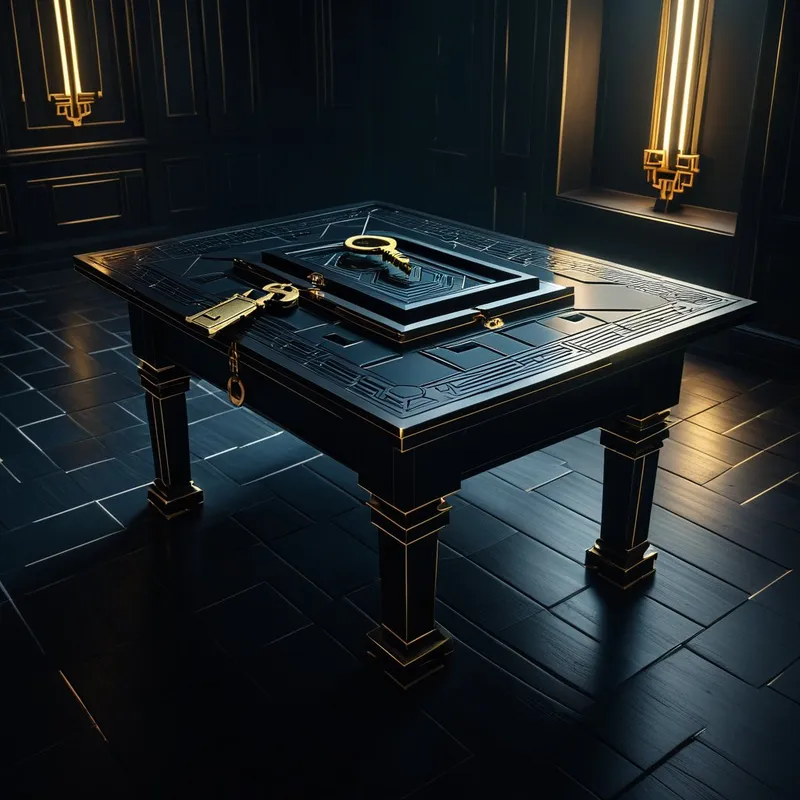
I am standing before a vast, dark, polished table. On it rests an impossibly complex lock, its mechanisms glowing with a soft, internal light. I hold a key, but I know it is only half of the solution. From the shadows, a figure I have long considered my adversary steps forward. Without a word, they produce the second half of the key. Our hands meet in the center; the pieces click together with a sound like a perfect chord. The lock opens, not to reveal a treasure, but a pathway of light leading deeper into the architecture of the dream itself.
This dream is an alchemical invitation: the treasure is not an object, but the newly formed capacity to navigate the deeper structures of the self.
The False Lead
Cooperation in dreams is not a simplistic mandate to “play nice” or a warning about unreliable allies in the waking world. It is not the ego’s strategy of compromise, where parts of the self are bartered away for a temporary, resentful peace. To mistake this profound inner process for a lesson in social etiquette is to remain on the surface of a deep ocean. The dream is not concerned with the politics of the boardroom or the family dinner table; it is orchestrating a parliament of the psyche. The conflict presented is rarely about external others, but about the internalized “other”—the exiled parts, the dominant managers, the firefighter impulses—all seeking representation in a new, more sovereign government of the soul.
Psychological Architecture
Beneath the narrative lies the silent, strenuous work of Shadow integration and Individuation. We are not unitary beings, but ecosystems. The dream of cooperation emerges when the central, conscious identity—the “I” we present to the world—can no longer unilaterally govern the inner realm. The Rebel’s fury, the Orphan’s grief, the Caregiver’s smothering anxiety: these are not enemies to be defeated, but delegations from forgotten territories of the self, demanding a seat at the table. The architecture here is one of recognition without capitulation. It is the ego’s courageous descent from the lonely throne of total control to become the facilitator of a council. This is the core of the work: to feel the Orphan’s legitimate fear without becoming the Victim, to acknowledge the Rebel’s justified rage without letting it burn down the internal city. Cooperation is the psyche’s move from autocracy to a conscious, collaborative sovereignty.
Mythic Resonance
This universal firmware runs through our oldest stories. Consider the Sumerian myth of Inanna’s Descent. The goddess of heaven and earth does not journey to the underworld as a conqueror, but to witness the funeral of her sister, Ereshkigal, the Queen of the Great Below. To enter, she must surrender her symbols of power at each of the seven gates. Stripped bare, she is killed and hung on a hook. She is only revived when Enki, the god of wisdom, creates two subtle, genderless beings who do not confront Ereshkigal, but witness her raw, agonized pain. Their silent empathy moves her, and she agrees to release Inanna. The cooperation here is not between allies, but between absolute opposites—the conscious and the unconscious, the light and the dark—facilitated by the nuanced, empathetic witness. The psyche’s revival depends not on a battle, but on a negotiated treaty between its own heaven and hell.
Symbolic Nodes
- Interlocking Gears or Puzzles: The precise, necessary fit of disparate functions.
- Two Rivers Merging: The loss of individual current to form a new, more powerful flow.
- A Chorus or Orchestra: Individual voices contributing to a harmony greater than any single part.
- A Handshake or Joined Hands: The somatic seal of an agreement, often between dream figures in conflict.
- A Bridge: The architecture of connection built over a chasm of internal division.
- A Council Table: The internal space where different aspects convene.
Archetypal Resonance
The energy here resonates most powerfully with The Ruler Archetype, specifically in its journey from the Shadow to the integrated form. The Shadow Ruler operates through tyranny and rigid control, insisting on a brittle, singular order where all parts must serve the ego’s narrow vision. The dream of cooperation is the crisis of this failing regime. The somatic echo—the dissolving tension—is the body feeling the Shadow Ruler’s grip falter. The alchemical potential lies in the Ruler’s true purpose: to create order and prosperity for the entire kingdom of the self. The integrated Ruler does not dominate, but orchestrates. It provides the stable, conscious space (the council chamber) where the Caregiver, the Rebel, the Orphan, and all others can bring their gifts and grievances, forging alliances that lead to a more resilient, adaptable, and prosperous inner realm. Sovereignty is earned not by suppression, but through skillful, internal diplomacy.
The Alchemical Process
The transmutation here is from internal civil war to collaborative sovereignty. The prima materia is the raw experience of inner conflict: the paralyzing indecision, the self-sabotage, the parts of you that seem to work at cross-purposes. The heat and pressure are applied by the conscious ego’s willingness to endure the terrifying vulnerability of relinquishing total control. This is the nigredo, the blackening—the feeling of the inner world falling into chaos as old hierarchies break down. The albedo, the whitening, is the moment of clear-eyed recognition: seeing each internal part not as a flaw or an enemy, but as a citizen with a legitimate need and function. The rubedo, the reddening, is the birth of the new order—not a static peace, but a dynamic, internal ecosystem where leadership is fluid, communication is possible, and energy is shared. The gold is the profound, effortless efficacy that arises when you are no longer fighting yourself, but are led by a collaborative intelligence.
The Integration Protocol
Question 1: In the dream, who or what was cooperating? What quality did each party represent in your waking life (e.g., stubbornness and flexibility, logic and intuition, passion and caution)?
Question 2: What is the oldest, most entrenched "rule" or "way of being" in your inner kingdom that this cooperative act seems to challenge or redefine?
Question 3: If the newly cooperative alliance in your dream formed a joint statement of purpose, what would its first line be?
Action 1 (Somatic Council): Sit quietly and bring to mind two conflicting feelings or impulses you often experience (e.g., drive to work vs. need to rest). Instead of choosing one, place your right hand where you feel the first in your body, and your left hand where you feel the second. Breathe into the space between your hands, allowing your awareness to hold both simultaneously without judgment for five minutes.
Action 2 (Expressive Treaty): Take two sheets of paper. On one, let one internal "voice" or part of you write or draw its demands, fears, and gifts. On the second, let the opposing "voice" do the same. Then, on a third sheet, without forcing agreement, draft a simple "treaty" that acknowledges the validity of both and outlines one small, practical way they can share your energy this week.
Action 3 (Ritual of the Shared Tool): Find a simple, neutral object—a smooth stone, a particular pen, a cup. Designate it as the "Council Object." When you feel internal conflict or need to make a decision, hold the object. Let it symbolize that the decision is not for one part to win, but for the collaborative self to find the wisest path forward. Place it where you can see it as a reminder of your inner alliance.
Final Validation
It is profoundly difficult to lay down the arms you have carried for a lifetime, even when the war is within. The fear that chaos will reign if you stop controlling every internal impulse is a legitimate terror of the psyche. Honor that fear; it has protected you. And then, consider the dream’s deeper intelligence: it does not show you chaos, but a precise, elegant key fitting into a lock. It is showing you that the order you crave is not born from domination, but from the courageous, meticulous work of inner diplomacy. The cooperation it heralds is the foundation of your true authority—an authority so secure it is built on consensus, and a sovereignty so profound it welcomes every part of you home.