Vishnu Myth Meaning & Symbolism
The story of the cosmic guardian who descends into chaos to restore order, embodying the timeless principle of preservation and conscious intervention.
The Tale of Vishnu
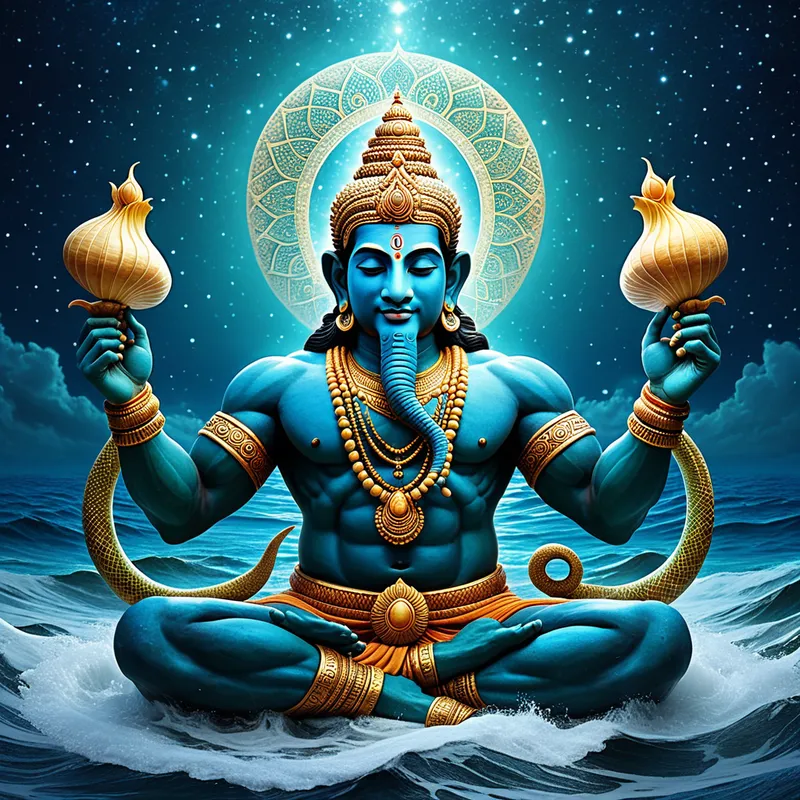
Listen. Before the beginning, and after every end, there is a deep and resonant hum. It is the sound of the ocean—not of water, but of potential, of unformed cause and effect. This is the Kshirasagara, the ocean of milk. Upon its endless coils rests Ananta Shesha, the serpent of eternity. And upon the serpent’s hood rests He.
He is blue as a twilight sky, as a deep monsoon cloud. He is Vishnu. His eyes are closed in yogic sleep, yet they see all that was, is, and will be. In his four hands he holds the tools of cosmic maintenance: the conch that sounds the primeval vibration, the discus that slices through illusion, the lotus of unstained emergence, and the mace of unwavering authority. This is the pause between universes, the breath held in the lungs of the divine.
But the hum changes. A dissonance enters the dream. A weight tilts the scales of Dharma. Somewhere in the worlds that sprout from his navel, a shadow grows too bold. A Daitya or a Rakshasa, drunk on a boon of near-invincibility, stretches its will across the three realms. Heaven trembles. Earth groans. The underworld echoes with tyranny. The cosmic order, delicate as a spider’s web, begins to fray.
Then, the eyes open.
They are not the eyes of wrath, but of profound, sorrowful necessity. The Preserver must act. The sleeper awakens to dream a new form into being. He does not march from heaven. He descends. He folds his infinite nature into a finite vessel—a wild man, a perfect king, a wandering sage, a fierce lion, a captivating enchantress, a humble dwarf. These are his Avataras.
Perhaps he arrives as Varaha, plunging his tusks into the abyss to lift the drowned world. Or as Narasimha, emerging from a pillar at twilight to deliver a terrible, loving justice. Or as Krishna, whose flute-song enchants the soul even as he guides a warrior through the battlefield of his own duty.
The conflict is never mere battle. It is a surgical strike against a specific form of imbalance—against pride that denies the divine in others, against greed that hoards the cosmos, against ignorance that mistakes the part for the whole. The avatar meets the shadow on its own terms, plays by the twisted rules of its boon, and in a flash of impossible grace, reveals a loophole in the fabric of reality itself: love where there should be hate, humility where there should be arrogance, a question where there should be a declaration.
The demon falls, not always in annihilation, but often in recognition. The weight lifts. The cosmic sigh is heard across creation. The frayed threads of Dharma are gently re-woven. And the avatar, his purpose fulfilled, dissolves—not into nothingness, but back into the watchful, blue-skinned form upon the serpent, whose eyes close once more. The hum returns. The preservation is complete. Until the next dissonance. Until the next necessary descent.
Cultural Origins & Context
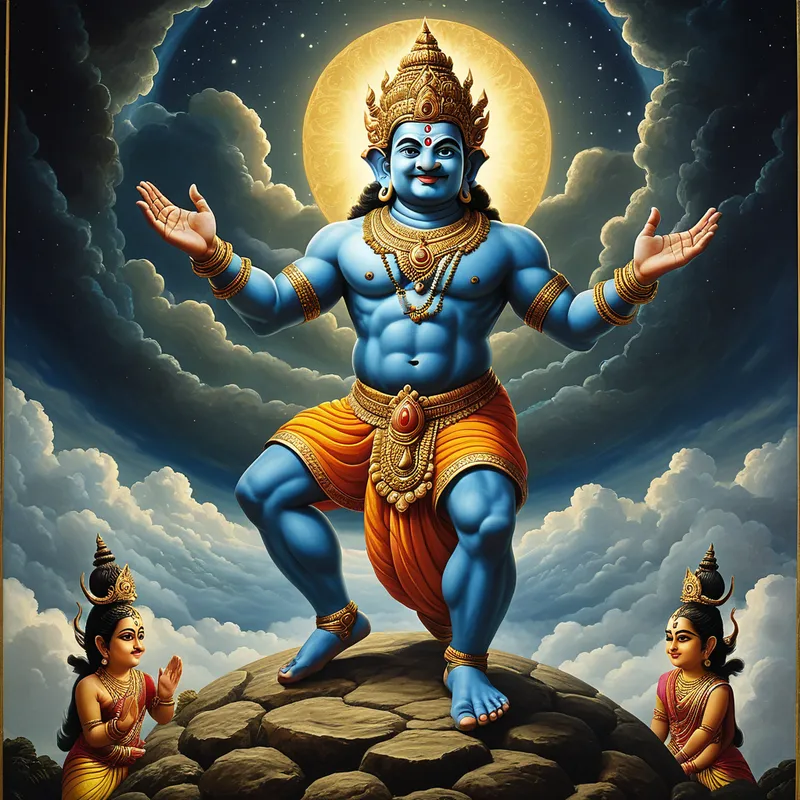
The myth of Vishnu is not a single story but a vast, living tapestry woven over millennia. Its threads begin in the ancient hymns of the Rig Veda, where Vishnu is a solar deity taking three mighty strides to measure and claim the cosmos. This foundational act of benevolent expansion prefigures his later role as the all-pervading sustainer.
The myth truly blossomed in the epic narratives—the Ramayana and the Mahabharata—and in the dedicated texts known as the Puranas. Here, the abstract principle became a personal, narrative God. These stories were not confined to temples or priestly classes; they were the lifeblood of culture, recited by traveling bards, enacted in village plays, illustrated in temple sculptures, and whispered in household rituals.
Societally, the Vishnu myth functioned as a grand pedagogical and psychological framework. It encoded the principle of Dharma—not as a rigid, external law, but as a dynamic, living balance that required active, conscious preservation. The Avataras taught that the divine is not remote but imminently present, capable of manifesting in any form, at any time, to guide and correct. It offered a theology of hope and intervention, assuring devotees that when darkness seems absolute, a transformative grace is already in motion, often in the most unexpected of forms.
Symbolic Architecture
At its core, the myth of Vishnu is a master symbol of conscious, loving intervention in the service of wholeness. Vishnu is not the creator who begins the process, nor the dissolver who ends it. He is the sustainer who midwives the process through its most critical phases. He represents the psyche’s own preserving, integrative function.
The Preserver does not fight the chaos from afar; he dreams himself into its very heart, taking on its colors and contours to perform a healing from within.
His blue skin symbolizes the infinite, all-pervading consciousness, like the sky or the deep ocean that contains all yet remains untouched. His four arms represent his omnipresent power to act in all directions simultaneously—a symbol of total capability. His primary weapons, the Sudarshana Chakra and the Panchajanya, are not mere tools of destruction but of discernment: the discus cuts through the cyclical knots of ignorance, and the conch sounds the call to awaken to one’s true nature.
The Ananta Shesha upon which he rests is perhaps the most profound symbol: it is the residue of past universes, the coiled potential of all that has been, serving as the stable foundation for the Preserver’s work. It tells us that our past, our karma, our history, is not a burden to be discarded but the very ground upon which consciousness rests to perform its work of integration.
The Dreamer’s Resonance
When the archetype of Vishnu stirs in the modern dreamer, it often signals a profound internal process of re-balancing. One does not typically dream of a blue, four-armed god. Instead, one dreams of the pattern of the avatar.
You may dream of a powerful, tyrannical figure (a boss, a parent, a shadowy force) dominating your psychic landscape. The dream-ego feels powerless. Then, an unexpected figure arrives—a quiet friend, a forgotten memory, a stray animal, or even a previously weak part of yourself. This figure engages the tyrant not with brute force, but with a paradoxical action: offering a gift to the bully, speaking a simple truth that unravels a complex lie, or setting a boundary from a place of calm authority.
This is the avatara at work in the personal psyche. The “demon” is a disproportionate complex—perhaps unchecked ambition, crushing guilt, or paralyzing fear—that has secured a “boon” (a rationalization, a habit, a belief) making it seem invincible. The Preserver function of the psyche mobilizes, not to wage a civil war of suppression, but to incarnate as the precise quality needed to restore balance: humility to counter arrogance, compassion to counter ruthlessness, clarity to counter confusion. The resolution brings not violent death, but a somatic sense of release, a deep sigh, as internal order is restored.

Alchemical Translation
The psychic alchemy modeled by the Vishnu myth is the transmutation of passive suffering into active, conscious preservation. It is the journey from being a victim of internal and external chaos to becoming the steward of your own wholeness.
The first step is the recognition of the Ocean of Milk—the foundational, unconscious psyche (Kshirasagara) where all potentials swim. Here, one must learn to rest upon the Serpent of Time (Ananta Shesha)—to make peace with one’s personal and collective past, using it as a supportive base, not an identity.
The alchemical fire is ignited by the Dissonance—the felt sense that something in one’s life is fundamentally out of alignment with one’s soul’s truth (Dharma). This is the call.
Individuation is not a single heroic victory, but a series of necessary descents, each avatar dissolving once its specific task of integration is complete.
The crucial, active phase is the Descent or Incarnation (Avatara). This is the ego’s conscious decision to “dream a form” into the troubled area. It asks: “What specific, incarnated quality is needed here? Not general ‘goodness,’ but the precise medicine for this poison.” It may be the disciplined warrior (Krishna/Arjuna), the boundary-setter (Narasimha), or the humble negotiator (Vamana). One must fully embody this quality, engaging the “demon” complex on its own ground, using its own rules against it through higher wisdom.
The final transmutation is Restoration and Return. The complex is not destroyed but integrated; its energy is reclaimed for the psyche’s totality. The specialized “avatar” self then dissolves, its purpose served. One returns to the state of the Preserver—no longer identified with the conflict or the savior role, but resting in a broader, watchful consciousness that knows it can and will descend again whenever the balance is threatened. The ultimate goal is to become the vessel through which this preserving, integrating consciousness operates, achieving not a static perfection, but a dynamic, compassionate equilibrium—a universe in sustained, graceful balance.
Associated Symbols
Explore related symbols from the CaleaDream lexicon: