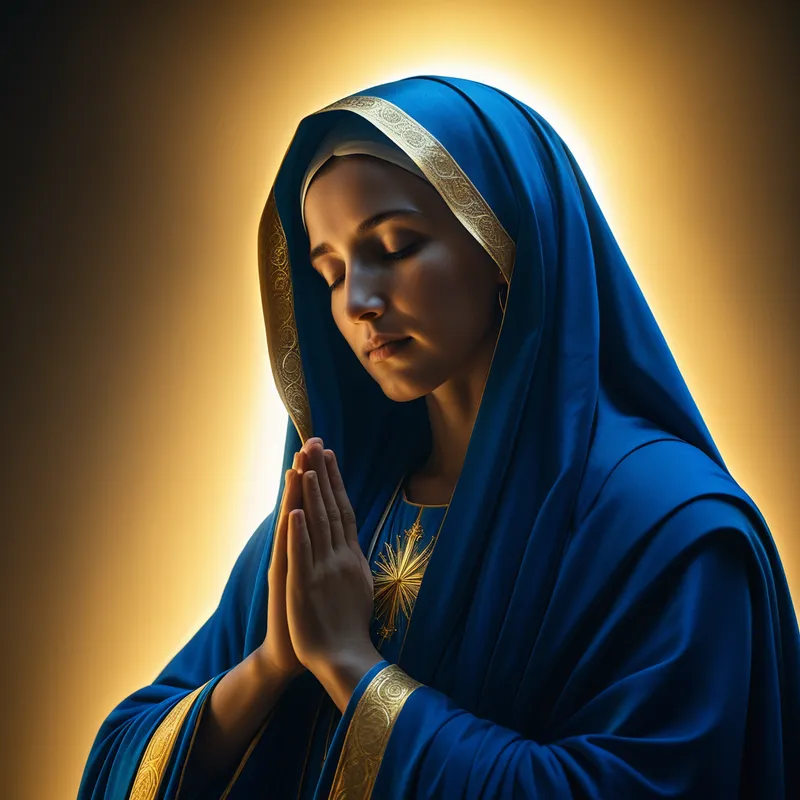
Virgin Mary Myth Meaning & Symbolism
The story of a young woman chosen to bear the divine, embodying grace, sorrow, and the sacred union of human and transcendent will.
The Tale of Virgin Mary
In the quiet, sun-baked town of Nazareth, where dust settled on olive leaves and life moved to the rhythm of ancient promises, there lived a girl named Mary. She was of the house of David, a lineage heavy with prophecy, yet her days were woven from the simple threads of [water](/myths/water “Myth from Chinese culture.”/) drawn from wells and bread kneaded for the oven. She was betrothed to a righteous man, [Joseph](/myths/joseph “Myth from Biblical culture.”/), a carpenter whose hands shaped wood as his heart shaped prayers.
Then came the visitation. It was not with thunder, but in a silence so profound it became a sound. An angel, a being of distilled light named [Gabriel](/myths/gabriel “Myth from Biblical culture.”/), stood before her. The air did not stir, yet the very substance of the room seemed to bow. “Hail, O favored one,” the voice was not a sound heard by ears, but a knowing planted in the soul. “The Lord is with you.”
Mary was deeply troubled, not with fear of the messenger, but with the terrifying weight of the address. What manner of favor could this be? Gabriel spoke of a son, to be named [Jesus](/myths/jesus “Myth from Christian culture.”/), who would be called Son of the Most High, inheriting the throne of his father David forever. Her question was the humble, practical logic of a human body: “How can this be, since I have no husband?”
The answer shattered the order of [the world](/myths/the-world “Myth from Tarot culture.”/). “[The Holy Spirit](/myths/the-holy-spirit “Myth from Christian culture.”/) will come upon you, and the power of the Most High will overshadow you; therefore [the child](/myths/the-child “Myth from Alchemy culture.”/) to be born will be called holy—the Son of God.” The infinite sought a dwelling in the finite. The eternal word sought to be clothed in flesh, and the portal was to be her own being. The angel offered a sign: her aged kinswoman Elizabeth was also with child, for with God, nothing is impossible.
In that suspended moment, the cosmos held its breath. All of history, from the first promise in a garden to the longing of prophets, converged on the will of one young woman. Her fiat—her “let it be”—was not passive acceptance, but the most active, creative, and courageous consent imaginable. “Behold, I am the handmaid of the Lord; let it be to me according to your word.” And with those words, the divine seed was sown in the soil of humanity.
Her story unfolded as a tapestry of luminous joy and piercing shadow. She visited Elizabeth, and the unborn John leaped in his mother’s womb. She sang a song that turned the world’s order upside down, praising a God who scatters the proud and lifts the lowly. She gave birth in a stable, the scent of hay and animals mingling with the ineffable presence of the holy. She pondered these things in her heart, a keeper of mysteries.
Yet a sword, as the elder Simeon prophesied, would pierce her own soul. She fled to Egypt to save her child from a king’s jealousy. She watched her son grow, and later, she stood at the foot of a rough-hewn cross, witnessing the agony of the one she had carried, nursed, and loved. Her motherhood encompassed the cradle and the grave, the jubilant hymn and the silent, world-shattering grief. In the end, tradition holds she was assumed, body and soul, into heaven, the human vessel finally and fully united with the divine source she had borne.
Cultural Origins & Context
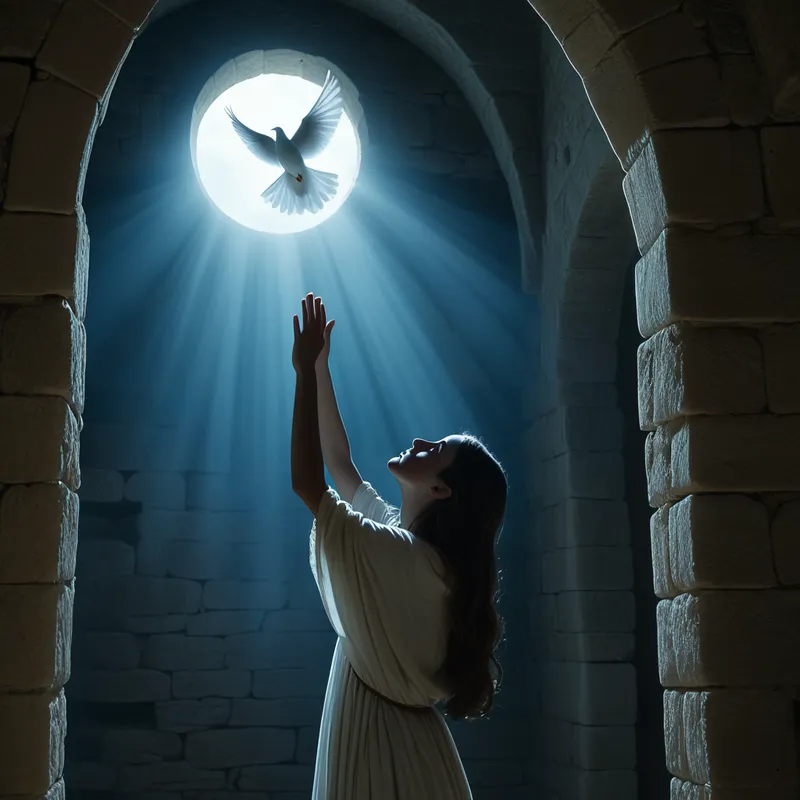
The myth of [the Virgin Mary](/myths/the-virgin-mary “Myth from Christian culture.”/) emerges from the fertile ground of Second Temple Judaism, a culture steeped in messianic expectation and prophetic tradition. The primary sources are the Gospels of Matthew and Luke, written in the latter half of the first century. These were not dry historical reports but theological narratives composed for early Christian communities, designed to proclaim Jesus as the Messiah.
The concept of a virginal conception, while unique in its specific Christological purpose, resonated with broader Hellenistic and Near Eastern motifs where divine figures were often born of unions between gods and mortal women. For the early Christians, however, it served a crucial theological function: it affirmed Jesus’s divine origin while rooting him firmly in human lineage and Jewish prophecy (citing [Isaiah](/myths/isaiah “Myth from Abrahamic culture.”/) 7:14). The story was passed down orally within worshipping communities before being codified in scripture.
Over centuries, especially after Christianity became the state religion of the Roman Empire, Mary’s figure expanded far beyond the Gospel accounts. The title Theotokos was dogmatically affirmed, cementing her role as the one who gave birth to God incarnate. Her cult grew immensely in the Middle Ages, with countless apparitions, hymns (like the Stabat Mater), and devotional practices centering on her as a compassionate intercessor, a queen of heaven, and the ultimate model of piety for the faithful. Societally, she functioned as a bridge—between the terrifying transcendence of God and human need, between the clergy and the laity, and as an exalted, yet accessible, embodiment of the feminine within a patriarchal religious structure.
Symbolic Architecture
Psychologically, the [Virgin Mary](/symbols/virgin-mary “Symbol: A central figure in Christianity representing divine purity, maternal compassion, and miraculous intervention. Often symbolizes spiritual guidance and unconditional love.”/) represents the [archetype](/symbols/archetype “Symbol: A universal, primordial pattern or prototype in the collective unconscious that shapes human experience, behavior, and creative expression.”/) of the sacred [vessel](/symbols/vessel “Symbol: A container or structure that holds, transports, or protects something essential, representing the self, emotions, or life journey.”/). She is the [human](/symbols/human “Symbol: The symbol of a human represents individuality, complexity of emotions, and social relationships.”/) [psyche](/myths/psyche “Myth from Greek culture.”/) in its most receptive, purified, and creative state, capable of containing and giving form to the transcendent.
She symbolizes the ego that does not assert its own will, but makes itself perfectly available to the dictates of the Self—the totality of the psyche. Her virginity is not primarily physical, but symbolic of an inner wholeness and integrity not yet penetrated by the chaos of worldly or egotistical desires.
She is the [Anima](/symbols/anima “Symbol: The feminine archetype within the male unconscious, representing soul, creativity, and connection to the inner world.”/) in its most developed form, the [soul](/symbols/soul “Symbol: The soul represents the essence of a person, encompassing their spirit, identity, and connection to the universe.”/)-figure that guides toward [integration](/symbols/integration “Symbol: The process of unifying disparate parts of the self or experience into a cohesive whole, often representing psychological wholeness or resolution of internal conflict.”/). The Annunciation represents the sudden, overwhelming irruption of the numinous into conscious [life](/symbols/life “Symbol: The symbol of ‘Life’ represents a journey of growth, interconnectedness, and existential meaning, encompassing both the joys and challenges that define human experience.”/). The fiat is the critical, conscious act of assent to this transformative, often disruptive, call from the deeper unconscious. The Immaculate [Conception](/symbols/conception “Symbol: The beginning of new life, ideas, or projects; a moment of profound creation and potential.”/) (a later doctrinal development) symbolizes the precondition for such a [reception](/symbols/reception “Symbol: The symbol of ‘reception’ often signifies the act of welcoming or accepting new ideas, experiences, or people into one’s life.”/): a psyche cleared of the automatic, compulsive patterns of the personal and collective [shadow](/symbols/shadow “Symbol: The ‘shadow’ embodies the unconscious, repressed aspects of the self and often represents fears or hidden emotions.”/), making it a clean vessel.
Her perpetual sorrow, the mater dolorosa, embodies the necessary suffering that accompanies profound transformation. To bear the divine is also to bear the cross of [consciousness](/symbols/consciousness “Symbol: Consciousness represents the state of awareness and perception, encompassing thoughts, feelings, and experiences.”/), to hold the [tension](/symbols/tension “Symbol: A state of mental or emotional strain, often manifesting physically as tightness, pressure, or unease, signaling unresolved conflict or anticipation.”/) of opposites—joy and [agony](/symbols/agony “Symbol: Intense physical or emotional suffering, often representing unresolved pain, internal conflict, or profound transformation.”/), life and [death](/symbols/death “Symbol: Symbolizes transformation, endings, and new beginnings; often associated with fear of the unknown.”/), humanity and divinity—within one’s own [heart](/symbols/heart “Symbol: The heart symbolizes love, emotion, and the core of one’s existence, representing deep connections with others and self.”/). Her Assumption signifies the ultimate goal: the complete integration of the [material](/symbols/material “Symbol: Material signifies the tangible aspects of life, often representing physical resources, desires, and the physical world’s influence on our existence.”/) and spiritual, the human person wholly sublimated and taken up into the wholeness of the psyche.
The Dreamer’s Resonance
When the figure of Mary appears in modern dreams, she rarely comes as a doctrinal icon. She manifests as an atmosphere, a presence, or a symbolic event related to the dreamer’s inner process of sacred reception and creative gestation.
Dreaming of a serene, luminous feminine figure offering a gift or simply being present often signals a moment of grace. It suggests the unconscious is offering a healing balm, a new potential, or a profound insight. The dreamer may be in a period of quiet incubation, where a new aspect of [the Self](/myths/the-self “Myth from Jungian culture.”/) is preparing to be born. Somatic sensations might include a feeling of warmth in the chest, deep calm, or a sense of being “overshadowed” by a benevolent presence.
Conversely, dreaming of a sorrowful Mary, or of a sacred child in danger, points to a crisis in this process. It reflects anxiety about a nascent creative project, a spiritual calling, or a vulnerable new feeling that feels threatened by the “Herod” of the dreamer’s critical intellect, worldly pressures, or old psychological complexes. The piercing sword represents the acute pain of holding a fragile new consciousness in a world (both internal and external) that is hostile to its growth. Such dreams call for the dreamer to adopt the mater dolorosa’s stance: not to flee the suffering, but to stand witness at the foot of the cross, to consciously contain the pain of transformation.

Alchemical Translation
The myth of Mary provides a profound blueprint for the alchemical process of individuation—the journey toward psychic wholeness. It models the opus contra naturam, the work against one’s natural, ego-centric instincts.
[The first stage](/myths/the-first-stage “Myth from Alchemical culture.”/) is purificatio (purification), symbolized by her immaculate state. This is the difficult work of confronting and integrating the personal shadow, clearing out the psychic clutter of resentment, pride, and fear to create an inner space of humility and openness. [The Annunciation](/myths/the-annunciation “Myth from Biblical/Islamic culture.”/) is the informatio—the impregnation by the spirit. In psychological terms, this is the eruption of a powerful content from [the collective unconscious](/myths/the-collective-unconscious “Myth from Jungian culture.”/), a new ruling principle (the Self) that seeks to reorganize the personality. [The ego](/myths/the-ego “Myth from Jungian culture.”/)’s task is not to generate this but to recognize and consent to it.
The fiat is the supreme act of psychological courage: the conscious ego surrendering its illusion of control and agreeing to serve a purpose greater than itself. This is the essence of the “virgin birth” of new consciousness—it is not born of the ego’s will (the “husband”), but from the union of the prepared soul (the feminine) with the transcendent (the masculine spirit).
The ensuing life—the hidden years in Nazareth, the public ministry, [the passion](/myths/the-passion “Myth from Christian culture.”/)—represents the long, often painful, stage of mortificatio and [separatio](/myths/separatio “Myth from Alchemical culture.”/). The new consciousness must grow within the mundane reality of daily life, face conflict, and ultimately be crucified by the very world it seeks to redeem. Mary’s steadfast presence through it all models the essential attitude: to “ponder these things in the heart,” to hold the tension without collapsing into despair or denial.
Finally, the Assumption is the unio mystica, the goal of the alchemical work. It represents the total and lasting integration of the transformed personality. The body (the concrete, earthly reality of one’s life and instincts) is not discarded but is glorified, taken up into the wholeness of the spirit. The individual becomes a living vessel of the divine, not by being erased, but by being fully realized. Thus, the myth guides the modern seeker from purification through sacred surrender, through the sorrow of transformation, to the ultimate promise of a unified existence.
Associated Symbols
Explore related symbols from the CaleaDream lexicon: