Vimānas Myth Meaning & Symbolism
The myth of divine flying palaces and chariots, representing the ascent of consciousness, divine sovereignty, and the perilous journey of the soul.
The Tale of Vimānas
Listen, and let the mind take flight.
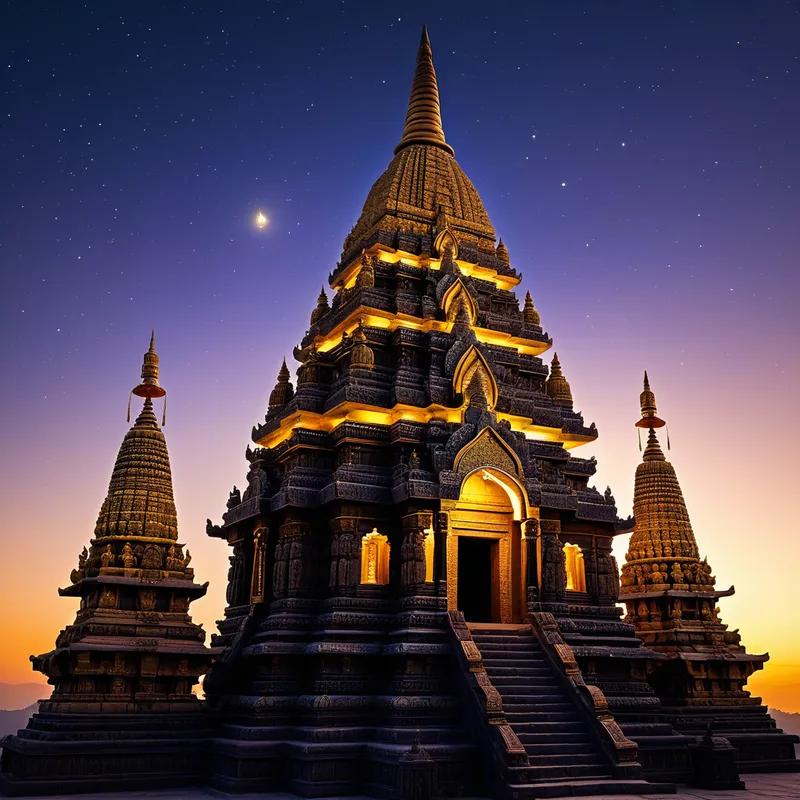
In the age when gods walked the earth and demons shook the pillars of heaven, the skies were not empty. They were highways for the sovereign, paths of light for the divine. The greatest of these was the Pushpaka Vimāna, wrought by the divine architect Vishvakarma himself. It was not merely a vehicle; it was a palace that flew, a moving citadel of spires and gardens, its timbers scented with celestial sandalwood, its surfaces inlaid with gems that caught the first and last light of the sun. It obeyed the will of its master, traveling at the speed of thought.
This magnificent craft first served Kubera, the Lord of Treasures. But desire has wings of its own. His half-brother, the ten-headed demon king Ravana</abbr, ruler of Lanka, gazed upon it with a covetous fire. His ambition was a furnace that could not be quenched. Through force and cunning, he seized the Pushpaka, making it the jewel of his tyrannical reign. From its soaring balconies, he surveyed a world he sought to conquer, the wind of his passage carrying the scent of conquest and marigolds.
But sovereignty stolen is a crown of thorns. The Vimāna became an instrument of his downfall, for it was aboard this very craft that he abducted Sita, the divine consort of Rama. The sky-chariot that symbolized his ultimate power became the vehicle of his ultimate transgression, leaving a trail of sorrow across the heavens that would lead a god-king to his very doorstep.
After a great war that shook the worlds, Ravana fell. The victorious Rama, with Sita restored, stood before the silent Pushpaka. The vehicle, sensing true royalty, bowed. Rama did not claim it as spoils of war. With a gesture of profound sovereignty, he commanded the Vimāna to return to its rightful owner, Kubera. The celestial palace, now a vessel of dharma instead of desire, ascended once more, carrying within it the quiet triumph of righteousness, leaving a stillness in the air that spoke of order restored.
Cultural Origins & Context
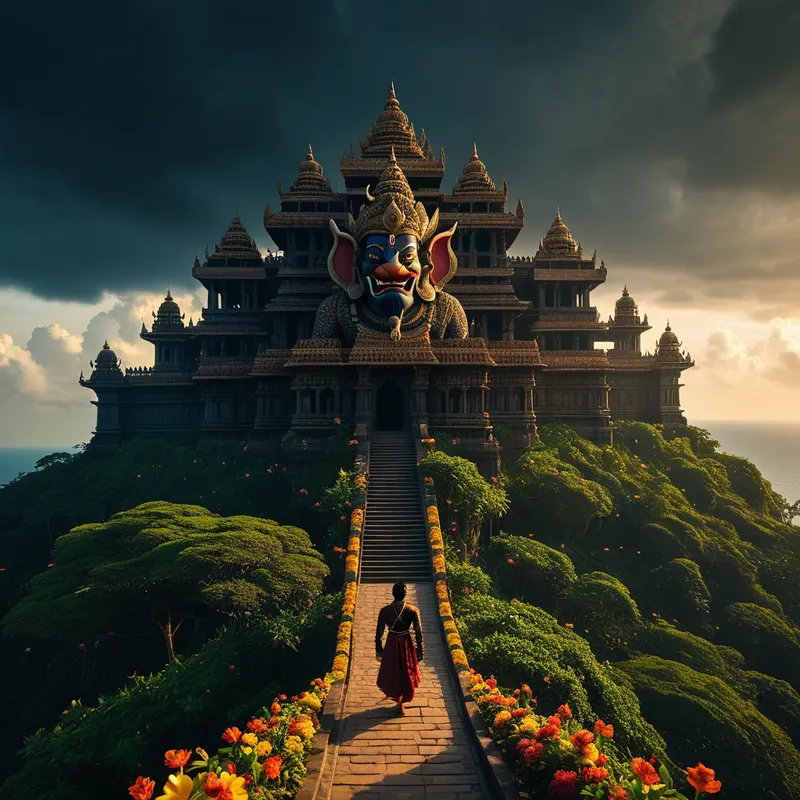
The lore of Vimānas is woven deeply into the epic fabric of Hindu literature, most prominently in the Ramayana and the Mahabharata, as well as in later Puranic literature. These were not mere fantastical insertions but narrative devices that served multiple cultural functions. Recited by bards and scholars, these stories cemented the cosmological vision of a multi-layered universe (Lokas), where travel between realms was possible for beings of sufficient power or purity.
The Vimāna underscored the majesty and technological/magical supremacy of the gods (Devas) and, by extension, the righteous kings who embodied divine principles on earth. They functioned as symbols of legitimate sovereignty—a king’s reach and vision should be as vast as the skies his myths described. Furthermore, in a culture with sophisticated traditions of architecture (Vastu Shastra) and astronomy, the detailed descriptions of these crafts, some found in texts like the Vaimanika Shastra, point to a profound human fascination with transcending earthly limitations, a fascination expressed through the language of sacred narrative.
Symbolic Architecture
At its core, the Vimāna is a [symbol](/symbols/symbol “Symbol: A symbol can represent an idea, concept, or belief, serving as a powerful tool for communication and understanding.”/) of the [vehicle](/symbols/vehicle “Symbol: Vehicles in dreams often symbolize the direction in life and the control one has over their journey, reflecting personal agency and decision-making.”/) of [consciousness](/symbols/consciousness “Symbol: Consciousness represents the state of awareness and perception, encompassing thoughts, feelings, and experiences.”/). It is the means by which the [soul](/symbols/soul “Symbol: The soul represents the essence of a person, encompassing their spirit, identity, and connection to the universe.”/) or the focused mind traverses the inner spaces of being.
The Vimāna is the psyche itself, engineered for journeying. Its pilot is the integrated Self; its destination, the summit of awareness.
The Pushpaka’s [journey](/symbols/journey “Symbol: A journey in dreams typically signifies adventure, growth, or a significant life transition.”/) from Kubera (divine [wealth](/symbols/wealth “Symbol: Wealth in dreams often represents abundance, security, or inner resources, but can also symbolize burdens, anxieties, or moral/spiritual values.”/)) to Ravana (egoic desire) to Rama (divine order) maps the [progression](/symbols/progression “Symbol: Symbolizes forward movement, development, or advancement through stages toward a goal or state of being.”/) of a sacred object through states of consciousness. Kubera represents the latent, rightful spiritual [wealth](/symbols/wealth “Symbol: Wealth in dreams often represents abundance, security, or inner resources, but can also symbolize burdens, anxieties, or moral/spiritual values.”/) within. Ravana symbolizes the ego’s identification with and hijacking of that power for personal aggrandizement, leading to [isolation](/symbols/isolation “Symbol: A state of physical or emotional separation from others, often representing a need for introspection or signaling distress.”/) and conflict. Rama represents the conscious, dharma-guided [application](/symbols/application “Symbol: An application symbolizes engagement, integration of knowledge, or the pursuit of goals, often representing self-improvement and personal development.”/) of that power, which ultimately requires relinquishing attachment to the vehicle itself. The Vimāna’s obedience to will highlights the intimate [connection](/symbols/connection “Symbol: Connection symbolizes relationships, communication, and bonds among individuals.”/) between consciousness and its directed focus—where the mind goes, the “self” follows.
The very [architecture](/symbols/architecture “Symbol: Architecture in dreams often signifies structure, stability, and the framing of personal identity or life’s journey.”/) of a Vimāna—often described as [palace](/symbols/palace “Symbol: A palace symbolizes grandeur, authority, and the pursuit of one’s ambitions or dreams, often embodying a desire for stability and wealth.”/)-like—suggests that the vehicle is not external but is the structured totality of one’s being: a mobile, sovereign self capable of navigating the vastness of [reality](/symbols/reality “Symbol: Reality signifies the state of existence and perception, often reflecting one’s understanding of truth and life experiences.”/).
The Dreamer’s Resonance
When a Vimāna appears in the modern dreamscape, it often signals a powerful activation of the Self archetype and the process of psychic ascension. The dreamer may be undergoing a rapid expansion of perspective, a “rise above” a previously confining situation. The somatic sensation can be one of weightlessness, exhilaration, or sometimes vertigo.
If the dream-Vimāna is damaged, stuck, or piloted by a hostile or shadowy figure (a modern Ravana), it reflects a conflict within the dreamer’s spiritual or intellectual authority. The sophisticated “technology” of the psyche has been co-opted by the ego for grandiosity, leading to a crash or a feeling of being lost in inner space. A dream of finding or being offered stewardship of a Vimāna can indicate the ego’s readiness to align with a higher, more integrative principle, to become a pilot rather than a hijacker of one’s own potential.
Alchemical Translation
The myth of the Vimāna models the alchemical process of psychic transmutation, where the base metal of unconscious identification is turned into the gold of conscious sovereignty. The initial state is Kubera’s ownership: spiritual wealth exists but is perhaps dormant, unused, or compartmentalized. The nigredo, or blackening, is Ravana’s theft—the ego’s inflation, its seizing of inner resources for selfish ends, which inevitably leads to the “great war” of inner conflict, the burning away of illusion.
The crisis of the hijacked Vimāna is necessary. Only by experiencing the chaos of misdirected power can one truly yearn for, and recognize, the grace of right direction.
The climax is Rama’s victory, the albedo (whitening) and rubedo (reddening), representing the integration of opposites and the emergence of the conscious ego-Self axis. The final, crucial stage is often overlooked: Rama returning the Vimāna. This is the citrinitas (yellowing), the stage of illumination and humble service. True individuation is not about possessing the ultimate vehicle of the Self, but about being in correct relationship to it. It is the ability to use one’s full potential (the Vimāna) in accordance with a transpersonal principle (dharma), and to ultimately let that power flow back to its sacred source, free from the stain of personal ownership. The enlightened individual does not cling to the craft; they become the clear space through which its purpose is fulfilled.
Associated Symbols
Explore related symbols from the CaleaDream lexicon:
- Sky — The primary domain of the Vimāna, representing the realm of consciousness, higher thought, spiritual aspiration, and limitless potential.
- Journey — The essential action of the Vimāna myth, symbolizing the soul’s progression through states of being, the quest for enlightenment, and the movement of consciousness.
- Hero — Embodied by Lord Rama, representing the conscious ego that engages with conflict to restore dharma and rightful relationship to the divine vehicle (the Self).
- Temple — The Vimāna as a mobile, soaring temple, representing the sacred architecture of the self and the idea that the vehicle of consciousness is itself a place of worship.
- Light — The radiant energy that often emanates from or propels divine Vimānas, symbolizing enlightenment, pure consciousness, and the illuminating power of truth.
- Pride — The fatal flaw of Ravana in seizing and misusing the Pushpaka Vimāna, symbolizing spiritual hubris and the ego’s identification with transcendent power.
- Order — The principle of dharma that Rama embodies and restores, representing the cosmic law that governs the rightful use of the Vimāna and the harmony of the psyche.
- Sovereignty — The core theme of the myth, representing legitimate kingship over one’s inner domain and the conscious piloting of one’s life force and potential.
- Mountain — Often the launching point or destination of Vimānas, representing a meeting point between earth and sky, the groundedness required for a stable ascent into higher consciousness.
- Hindu Mandir — The architectural blueprint mirrored in the palace-like structure of many Vimānas, grounding the celestial vehicle in sacred geometry and the principle of the universe as a divine dwelling.
- Dream — The Vimāna as a vehicle that traverses the liminal space between worlds, mirroring the dreamer’s own capacity for inner travel and exploration of non-ordinary reality.
- Destiny — The inevitable path set in motion by the misuse or rightful use of the Vimāna, representing the karmic consequences of how we steer the powerful vehicles of our minds and souls.
- Tektite Rock