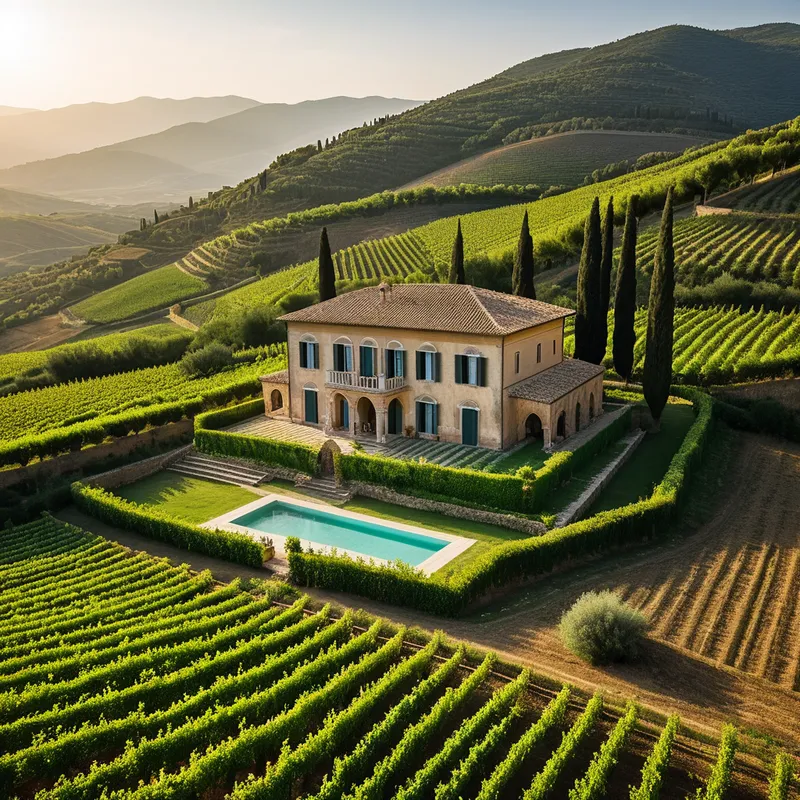
Villa Rustica Myth Meaning & Symbolism
A myth of a farmer who, through sacred labor, transforms wild land into a living sanctuary, forging a covenant between humanity, the divine, and the earth.
The Tale of Villa Rustica
Listen. Before the marble of the Forum echoed with speeches, before the legions marched on paved roads, there was the land. Raw, whispering, and wild. It was to such a place that a man, weary of city clamor, came. His name is lost, for he was every man who ever turned his back on the crowd to face the soil. He carried only an axe of iron, a bag of seed, and the stern blessing of [Terminus](/myths/terminus “Myth from Roman culture.”/).
He stood on a hillock, [the wind](/myths/the-wind “Myth from Various culture.”/) scouring his cloak. Before him stretched not a field, but a chaos of thorn and stone, a domain ruled by the old, untamed spirits of place. This was the realm of the Silvani, and they watched from [the shadow](/myths/the-shadow “Myth from Jungian culture.”/) of the trees with eyes like chips of flint. The man felt their gaze, a pressure on his skin like coming storm. But he also felt the patient, deep presence of Tellus beneath his feet, waiting.
He did not begin by building a house. He began by drawing a line. With solemn steps, he traced a square in [the earth](/myths/the-earth “Myth from Hindu culture.”/), driving stakes at the corners. At each, he poured a libation of wine and spoke the old words to Terminus. “This much,” he said to the land and the wild spirits, “is mine to tend. The rest remains yours.” The air crackled with the tension of a treaty made.
Then, the labor. The song of his axe against oak was the first new music in that place. Blisters rose and broke on his palms, staining the axe handle. He cleared not with rage, but with precision, leaving a sacred grove for the Silvani at the border. He turned the earth, and the scent of dark, loamy Tellus rose like a prayer. He planted wheat in straight rows, a golden scripture written on the land. He dug channels for [water](/myths/water “Myth from Chinese culture.”/), inviting the nymph of the spring into his new order.
Seasons wheeled. His back bent, his skin toughened like leather. Finally, from the stones he had cleared, he raised walls. Not a palace, but a villa rustica—a farmstead. Its heart was the courtyard, open to [the sky](/myths/the-sky “Myth from Persian culture.”/), where the family altar stood. One wing for the family, simple and strong. The other for the harvest: the olive press sat waiting, the wine vats stood in cool rows, the granary’s floor was swept clean.
The final act was the feast. The first bread from his wheat, the first oil from his olives, the first wine from his vines. He placed these not only on his family altar for the [Lares](/myths/lares “Myth from Roman culture.”/), but also on a rough stone at the edge of his cleared land, an offering to the Silvani. He stood between his ordered world and the enduring wild, and for a moment, all was still. Then, a breeze carried the scent of his hearth-fire into the woods, and the wind in the leaves sounded less like a threat and more like a distant acknowledgment. The covenant was complete. The man was no longer just a man; he was the paterfamilias of a small, self-made cosmos.
Cultural Origins & Context
The myth of the Villa Rustica is not a single, codified story from a text like Ovid’s [Metamorphoses](/myths/metamorphoses “Myth from Greek culture.”/). It is a foundational cultural narrative, woven from the fabric of daily Roman life and state ideology. It was “told” not by bards, but by action. Every Roman citizen who received a land grant, every colonist who marched beyond the frontier to parcel out territory, was re-enacting this myth. It was embodied in the rituals of the Pontifices who sanctified new settlements, and in the daily rites of every farmer at his [lararium](/myths/lararium “Myth from Roman culture.”/).
Its societal function was paramount. It was the psychic and spiritual justification for agriculture, which was the basis of Roman economy, morality, and identity. To work the land was not mere toil; it was a sacred duty that transformed chaos (silva) into cosmos (ager), replicating the divine act of creation. The villa itself was a microcosm of the ideal Roman state: ordered, productive, hierarchical, and in a state of perpetual, sacred negotiation with the forces beyond its walls. This myth cemented the connection between land ownership, piety, and Roman virtue (virtus), making the farmer-soldier the archetypal Roman hero.
Symbolic Architecture
Psychologically, the [Villa](/symbols/villa “Symbol: A large, luxurious house symbolizing wealth, privacy, and personal achievement, often representing the dreamer’s aspirations or inner sanctuary.”/) Rustica is not a place, but a process. It is the archetypal [blueprint](/symbols/blueprint “Symbol: A blueprint represents the foundational plan or design for something, often symbolizing potential, structure, and the mapping of one’s inner self or future.”/) for creating a conscious, bounded self from the raw [material](/symbols/material “Symbol: Material signifies the tangible aspects of life, often representing physical resources, desires, and the physical world’s influence on our existence.”/) of the unconscious.
The wild, thorny land represents the undifferentiated [psyche](/myths/psyche “Myth from Greek culture.”/)—the [prima materia](/myths/prima-materia “Myth from Alchemical culture.”/) of the [soul](/symbols/soul “Symbol: The soul represents the essence of a person, encompassing their spirit, identity, and connection to the universe.”/), full of potential but also of chaotic, autonomous complexes (the Silvani). The [farmer](/symbols/farmer “Symbol: Farmers symbolize hard work, nurturing, and the cultivation of not just crops, but also personal growth and community.”/) is the nascent ego, armed with will (the axe) and [purpose](/symbols/purpose “Symbol: Purpose signifies direction, meaning, and intention in life, often reflecting personal ambitions and core values.”/) (the seed). The first, crucial act is not conquest, but [boundary](/symbols/boundary “Symbol: A conceptual or physical limit defining separation, protection, or identity between entities, spaces, or states of being.”/)-making. The invocation of Terminus symbolizes the essential psychological act of delineation: “This is me. This is not-me.”
The sacred labor of cultivation is the slow, painful work of integrating unconscious contents into a structured consciousness, transforming wild impulse into nourishing fruit.
The villa’s [architecture](/symbols/architecture “Symbol: Architecture in dreams often signifies structure, stability, and the framing of personal identity or life’s journey.”/) is a perfect [symbol](/symbols/symbol “Symbol: A symbol can represent an idea, concept, or belief, serving as a powerful tool for communication and understanding.”/) of the individuated psyche. The [family](/symbols/family “Symbol: The symbol of ‘family’ represents foundational relationships and emotional connections that shape an individual’s identity and personal development.”/) quarters represent the developed [persona](/symbols/persona “Symbol: The social mask or outward identity one presents to the world, often concealing the true self.”/) and relational [life](/symbols/life “Symbol: The symbol of ‘Life’ represents a journey of growth, interconnectedness, and existential meaning, encompassing both the joys and challenges that define human experience.”/). The pars fructuaria (the productive wing) symbolizes the harnessed and organized creative energies—the libido made useful. The central [courtyard](/symbols/courtyard “Symbol: A courtyard in dreams represents a space of safety, reflection, and personal growth, often indicating the need for introspection.”/), open to the heavens, is the [temenos](/myths/temenos “Myth from Greek culture.”/), the sacred inner [space](/symbols/space “Symbol: Dreaming of ‘Space’ often symbolizes the vastness of potential, personal freedom, or feelings of isolation and exploration in one’s life.”/) where [the Self](/myths/the-self “Myth from Jungian culture.”/) (symbolized by the [altar](/symbols/altar “Symbol: An altar represents a sacred space for rituals, offering, and connection to the divine, embodying spirituality and devotion.”/) to the Lares) is honored. The entire [structure](/symbols/structure “Symbol: Structure in dreams often symbolizes stability, organization, and the framework of one’s life, reflecting how one perceives their environment and personal life.”/) exists in a state of [tension](/symbols/tension “Symbol: A state of mental or emotional strain, often manifesting physically as tightness, pressure, or unease, signaling unresolved conflict or anticipation.”/) and treaty with the surrounding wild, acknowledging that the unconscious can never be fully eradicated, only respectfully related to.
The Dreamer’s Resonance
When this myth stirs in the modern dreamer, it often manifests not as a Roman villa, but as its symbolic equivalents. Dreaming of renovating an old, neglected house; of tirelessly gardening in a wild yard; of building a secure room or wall—these are all manifestations of the Villa Rustica process.
Somatically, this may be a time of feeling “grounded” or, conversely, of deep fatigue in the limbs, echoing the farmer’s labor. Psychologically, it signals a phase of intense inner work. The dreamer is engaged in the difficult, unglamorous task of clearing out old, thorny thought-patterns (the silva), establishing healthy ego boundaries (Terminus), and attempting to build a sustainable inner structure. There is often a felt sense of isolation (“the man alone on the hill”) and a profound responsibility for one’s own psychic territory. The dream may also present figures of wildness or neglect that must be acknowledged, not slain—representing those parts of the self that resist cultivation but must be included in the final covenant.
Alchemical Translation
The alchemical journey of the Villa Rustica is [the opus](/myths/the-opus “Myth from Alchemical culture.”/) of Individuation rendered in earthy, practical terms. The [Nigredo](/myths/nigredo “Myth from Alchemical culture.”/) is the initial confrontation with the black, fertile, chaotic earth-self. The Albedo is the clearing, the setting of boundaries, the establishment of order—the white walls of the villa rising from the dark soil. The Citrinitas is the golden harvest, the moment when the labors yield their first fruits of insight, stability, and self-sufficiency.
The final stage, the [Rubedo](/myths/rubedo “Myth from Alchemical culture.”/), is the sacred feast. This is the moment of psychic wholeness, where the conscious ego (the farmer) does not hoard the harvest but offers it back. He offers thanks to the guiding principles of his inner home (the Lares) and, crucially, makes an offering at the border to the wild spirits (the Silvani).
This is the alchemical marriage: not the eradication of the unconscious, but the establishment of a living, respectful relationship between the cultivated self and the eternal wild within.
For the modern individual, the [triumph](/myths/triumph “Myth from Roman culture.”/) is not in building an impregnable fortress of [the ego](/myths/the-ego “Myth from Jungian culture.”/). It is in creating a villa rustica of the soul—a place that is productive and orderly at its heart, yet whose boundaries are permeable, whose existence depends on a sacred treaty with all that remains untamed, mysterious, and beyond its control. We become whole not by eliminating our wildness, but by building a sturdy home within its view, and sharing our bread with it at the edge of the woods.
Associated Symbols
Explore related symbols from the CaleaDream lexicon: