Valhalla Myth Meaning & Symbolism
The hall of the slain, where chosen warriors feast and fight until Ragnarök, embodying a fate of glorious, cyclical struggle.
The Tale of Valhalla
Listen, and hear the whisper on [the wind](/myths/the-wind “Myth from Various culture.”/) that carries the scent of iron and pine. It is the breath of the North, and it tells of a hall that is not for the living, but for the dead who died a certain way.
In the time before [the world](/myths/the-world “Myth from Tarot culture.”/)’s ending, the All-Father, Odin, sits upon his high seat, [Hliðskjálf](/myths/hliskjlf “Myth from Norse/Germanic culture.”/). His one eye sees across [the nine worlds](/myths/the-nine-worlds “Myth from Norse culture.”/), but his gaze is fixed on the fields of men. He sees the flash of swords, the spray of blood, the moment a warrior stands his ground, knowing he will fall. From this sight, a deep hunger grows in Odin’s heart—a hunger not for power, but for an army. For he has foreseen the final battle, [Ragnarök](/myths/ragnark “Myth from Norse culture.”/), the twilight of the gods, and he knows he will need the greatest fighters [the world](/myths/the-world “Myth from Tarot culture.”/) has ever known.
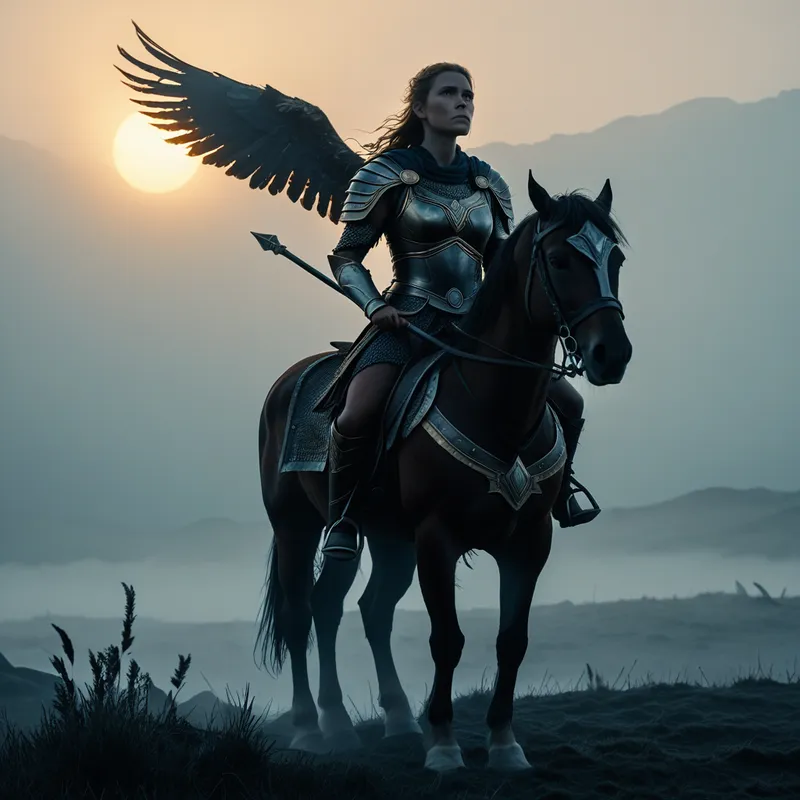
And so he sends his daughters, the Valkyries. They do not ride on gentle breezes but on the storm-winds of fate. Clad in gleaming armor that catches the dying sun, they descend onto the chaos of battlefields. Their spears do not strike; they point. Their task is not to kill, but to choose. With eyes that see the soul’s mettle, they select the bravest of the slain. A touch, and the warrior’s spirit is lifted from his broken body, soaring over [the rainbow bridge](/myths/the-rainbow-bridge “Myth from Global/Universal culture.”/), Bifröst, to a realm of the gods.
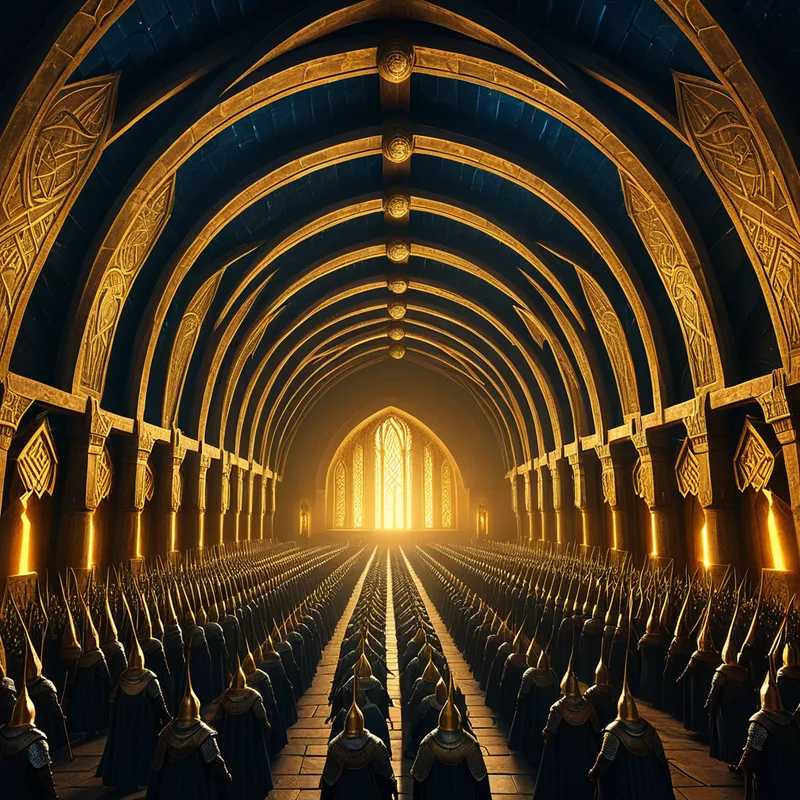
They arrive at a gate, immense and towering. This is Valhalla, the Hall of the Slain. Its roof is thatched with golden shields that blaze in the eternal twilight. Its rafters are spears, and its benches are strewn with breastplates. The air thrums with a low, joyous roar—the sound of five hundred and forty doors, each wide enough for eight hundred warriors to march through abreast.
Inside, the chosen dead, the Einherjar, find their afterlife. Their wounds are healed, their strength renewed. Each day, they don their armor and go out into the vast field before the hall. There, they fight. They clash with furious joy, hacking and hewing until every man is struck down. But this is no true death. When the field falls silent, they rise again, whole, their enmity forgotten. They walk back to the great hall, laughing and clasping arms with the very ones who “killed” them.
And then the feast begins. A great boar, [Sæhrímnir](/myths/shrmnir “Myth from Norse culture.”/), is cooked anew each day. A goat, [Heiðrún](/myths/heirn “Myth from Norse culture.”/), stands atop the hall, feeding on the leaves of [the world tree](/myths/the-world-tree “Myth from Celtic culture.”/), [Yggdrasil](/myths/yggdrasil “Myth from Global/Universal culture.”/), and from her udders flows an endless river of mead. The warriors drink from horns that never empty, served by [the Valkyries](/myths/the-valkyries “Myth from Norse culture.”/) themselves. They feast, they boast, they prepare. For this glorious, cyclical struggle is their training. They are being forged, day by eternal day, into a single, perfect weapon. They wait for the day the watchman’s horn will sound not for dinner, but for the final march. They wait for the day the gates of Valhalla will swing open not to the practice field, but to the plains of Vigrid, where they will stand beside Odin for one last, impossible fight against the giants and monsters of chaos. This is their destiny: to die gloriously, to live gloriously, and to die again, forever changing the fate of all things.
Cultural Origins & Context
This myth was not scripture, but story—a vital, breathing narrative woven into the fabric of pre-Christian Germanic and Norse societies, from the continental tribes to the Viking Age Scandinavians. It was preserved not in holy books, but in the oral poetry of skalds and the later texts of the 13th century, like the Poetic Edda and Snorri Sturluson’s Prose Edda. These sources, though written after Christianization, are our primary windows into a worldview where fate was supreme and glory was etched in action, not belief.
Valhalla served a profound societal function for a warrior aristocracy. It provided a cosmic rationale for a life of risk, violence, and short lifespans. In a culture where death in bed was often seen as a weak end, Valhalla offered a heroic alternative. It transformed the terror of mortality into a coveted prize, incentivizing the very bravery and loyalty upon which chieftains and kings depended. The myth was a social glue, binding the warrior to his lord (mirroring [the Einherjar](/myths/the-einherjar “Myth from Norse culture.”/)‘s service to Odin) and promising that ultimate loyalty would be rewarded in the grandest scheme imaginable. It was a myth for the hall, told by firelight to steel the hearts of those who would fight at dawn.
Symbolic Architecture
Beneath the epic feasting and fighting lies a profound symbolic [structure](/symbols/structure “Symbol: Structure in dreams often symbolizes stability, organization, and the framework of one’s life, reflecting how one perceives their environment and personal life.”/). [Valhalla](/symbols/valhalla “Symbol: In Norse mythology, Valhalla is the great hall where slain warriors chosen by Odin feast and prepare for Ragnarok.”/) is not a simple reward; it is a [paradox](/symbols/paradox “Symbol: A contradictory yet true concept that challenges logic and perception, often representing unresolved tensions or profound truths.”/). It is a [heaven](/symbols/heaven “Symbol: A symbolic journey toward ultimate fulfillment, spiritual transcendence, or connection with the divine, often representing life’s highest aspirations.”/) built on a [foundation](/symbols/foundation “Symbol: A foundation symbolizes the underlying support systems, values, and beliefs that shape one’s life, serving as the bedrock for growth and development.”/) of relentless, cyclical strife.
The ultimate reward for the heroic ego is not rest, but the perfection of its own struggle.
The hall itself is a [symbol](/symbols/symbol “Symbol: A symbol can represent an idea, concept, or belief, serving as a powerful tool for communication and understanding.”/) of the [psyche](/myths/psyche “Myth from Greek culture.”/) organized for a singular [purpose](/symbols/purpose “Symbol: Purpose signifies direction, meaning, and intention in life, often reflecting personal ambitions and core values.”/). The shields and spears are not mere decoration; they represent the internalization of one’s battles. The [warrior](/symbols/warrior “Symbol: A spiritual archetype representing inner strength, discipline, and the struggle for higher purpose or self-mastery.”/)’s external conflicts become the very [architecture](/symbols/architecture “Symbol: Architecture in dreams often signifies structure, stability, and the framing of personal identity or life’s journey.”/) of his eternal self. The daily battle and resurrection of the Einherjar symbolize a crucial psychological process: the constant engagement with one’s own inner conflicts, [shadow](/symbols/shadow “Symbol: The ‘shadow’ embodies the unconscious, repressed aspects of the self and often represents fears or hidden emotions.”/) aspects, and opposing forces. Each “[death](/symbols/death “Symbol: Symbolizes transformation, endings, and new beginnings; often associated with fear of the unknown.”/)” on the field is a temporary [dissolution](/symbols/dissolution “Symbol: The process of breaking down, dispersing, or losing form, often representing transformation, release, or the end of a state of being.”/) of [the ego](/myths/the-ego “Myth from Jungian culture.”/), followed by a reintegration—stronger, wiser, and more unified.
Odin’s [role](/symbols/role “Symbol: The concept of ‘role’ in dreams often reflects one’s identity or how individuals perceive their place within various social structures.”/) is key. He is not a dispassionate judge, but an active, hungry gatherer. He represents the part of the psyche—[the Self](/myths/the-self “Myth from Jungian culture.”/), in Jungian terms—that seeks wholeness by recruiting and integrating the most powerful, “warrior-like” complexes of the [personality](/symbols/personality “Symbol: Personality in dreams often symbolizes the traits and characteristics of the dreamer, reflecting how they perceive themselves and how they believe they are perceived by others.”/). The Valkyries, then, are not external angels of death, but internal agents of discernment. They are that acute, often ruthless, faculty of [consciousness](/symbols/consciousness “Symbol: Consciousness represents the state of awareness and perception, encompassing thoughts, feelings, and experiences.”/) that chooses which battles, which sufferings, which moments of courage are meaningful enough to be integrated into the larger structure of the [soul](/symbols/soul “Symbol: The soul represents the essence of a person, encompassing their spirit, identity, and connection to the universe.”/).
The Dreamer’s Resonance
When the imagery of Valhalla erupts into modern dreams, it rarely appears as a literal Viking hall. Instead, it manifests as the pattern of glorious, exhausting, and seemingly endless struggle.
A person may dream of being in a vast, impersonal corporation or institution (the modern “hall”) where they must engage in daily, ritualistic combat in meetings or projects (the daily battle), only to have everything reset the next day. They may dream of a gym, a courtroom, or a competitive arena that feels both magnificent and imprisoning. The somatic feeling is often one of immense, adrenalized fatigue—a body tired from eternal readiness. Psychologically, this signals that the dreamer’s ego has become identified with a “heroic” mode of operation that is no longer sustainable or truly serving the soul’s deeper purpose. The [Valkyrie](/myths/valkyrie “Myth from Norse culture.”/) in the dream might appear as a stern mentor, a demanding boss, or an inner critic—the chooser that keeps selecting the path of conflict. The dream is asking: For what final battle are you preparing? And who is the Odin within you, gathering this army at the cost of your peace?
Alchemical Translation
The myth of Valhalla models a critical, if severe, phase of psychic transmutation: the conscious gathering and tempering of one’s inner forces for a coming integration.
The first alchemical stage is the [Nigredo](/myths/nigredo “Myth from Alchemical culture.”/), the blackening, represented by the death on the battlefield. This is the necessary defeat of the old, naive ego. The Valkyrie’s choice symbolizes the moment of consciousness that extracts meaning from that defeat. The journey to the hall is the Albedo, the whitening—a purification and elevation of that heroic energy to a higher plane.
Individuation is not a peaceful retirement; it is the mobilization of the entire psyche for its most consequential engagement.
The daily cycle of battle and [feast in Valhalla](/myths/feast-in-valhalla “Myth from Norse culture.”/) is the Citrinitas, the yellowing or solar stage. Here, the warrior complexes are not repressed or discarded, but are deliberately, repetitively engaged and integrated. They fight (confrontation), “die” (surrender of ego-position), and are reborn in fellowship (reintegration into the larger Self). This is the arduous work of making the unconscious conscious, of turning raw, autonomous complexes into disciplined servants of the whole personality.
The final, awaited [Rubedo](/myths/rubedo “Myth from Alchemical culture.”/), the reddening, is Ragnarök itself. This is the ultimate confrontation with the totality of one’s shadow, chaos, and destiny. In the psychic landscape, this is not a literal end, but the epochal crisis that forces the fully assembled Self—all the integrated “Einherjar” of one’s being—into a final, transformative action. The old world of the gods (the previous psychic order) falls, but from it, a new, more conscious world is born. Thus, the myth translates to a profound truth: the soul’s highest purpose may require us to honor our inner warriors, not to let them rule in perpetual battle, but to train them, feast with them, and ultimately, lead them into the fire of transformation where all things are remade.
Associated Symbols
Explore related symbols from the CaleaDream lexicon: