Vajrapani Myth Meaning & Symbolism
The myth of the Bodhisattva who wields the diamond thunderbolt, embodying the fierce power that shatters ignorance and protects the path to awakening.
The Tale of Vajrapani
Listen. Before the world settled into its familiar rhythms, when the air itself thrummed with the potential for both bliss and terror, there walked a being of impossible resolve. He was not born of peace, but forged in the crucible of a vow. His name was Vajrapani, the One Whose Hand Holds the Thunderbolt.
The story unfolds not in a sun-drenched grove, but in the shadowed passes where perception fails. The Buddha, Shakyamuni, sat in profound meditation, a still point in the turning world. But around that point, the cosmos convulsed. Mara, the personification of delusion, sent his legions—a cacophony of desires, fears, doubts, and pride, taking form as monstrous shapes that blotted out the sky. They hurled mountains of attachment and rivers of craving. They whispered seductions and screamed threats, a tempest aimed at the heart of awakening.
And the Buddha… remained still. The storm broke against his silence like water on stone.
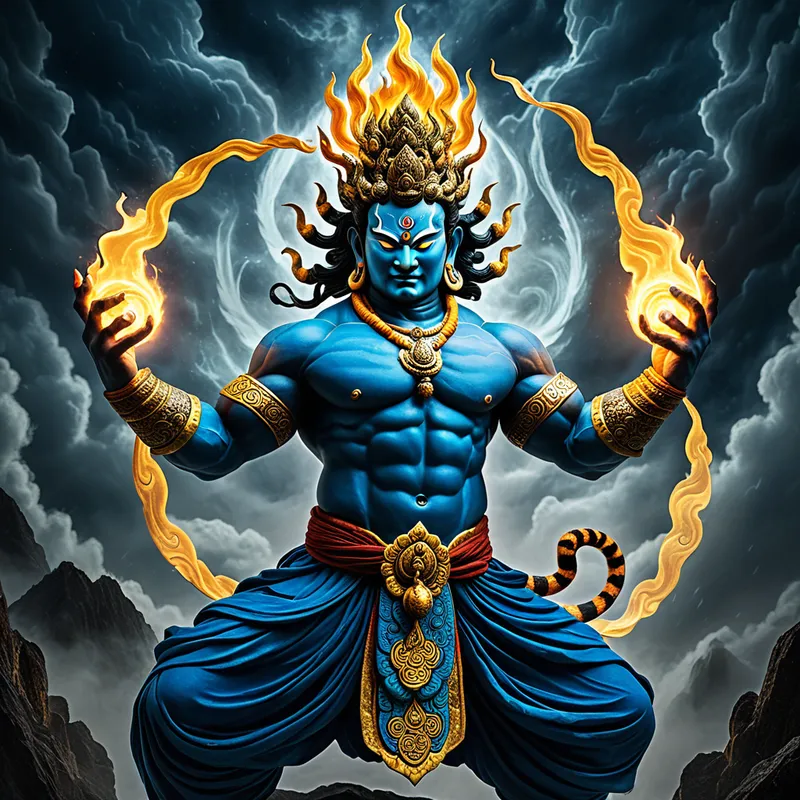
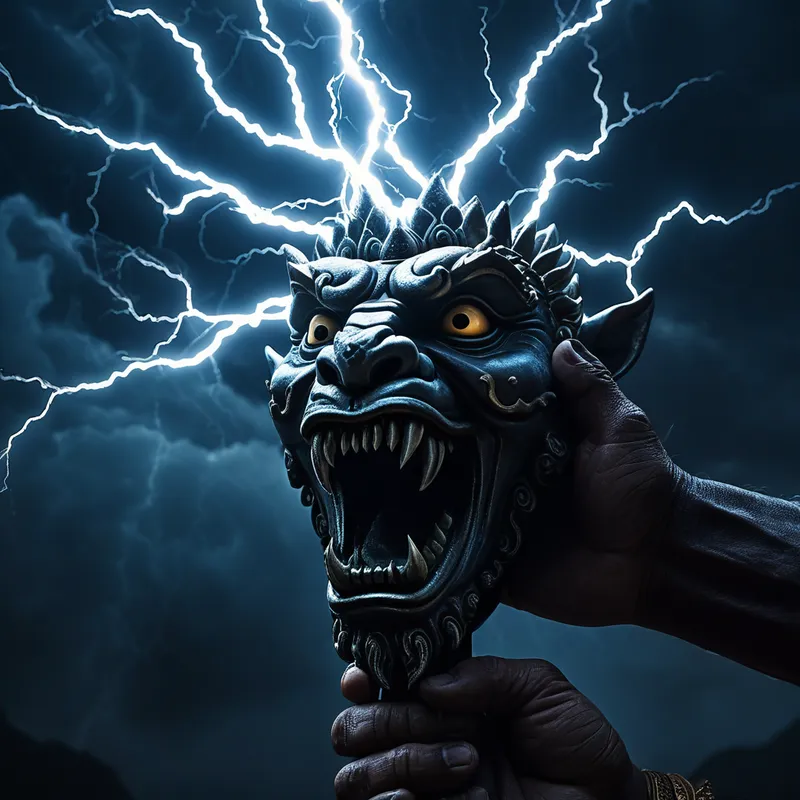
But from within that very silence, a response coalesced. It was not more silence. It was its active counterpart. From the Buddha’s boundless compassion, a fierce energy erupted. This was Vajrapani. He manifested not as a gentle attendant, but as a cosmic warrior of terrifying majesty. His body was the color of a thundercloud at midnight, muscles coiled like primordial rock. In his right hand, he gripped the vajra, its prongs crackling with the lightning of pure, non-conceptual wisdom. His roar was not of anger, but of ultimate truth shattering the walls of illusion.
Where Mara’s demons advanced, Vajrapani moved. He did not argue. He did not negotiate. With the vajra, he struck—not to destroy life, but to destroy the clinging to false life. Each blow was a bolt of reality, disintegrating projections of fear into empty space. He danced a dance of furious protection, his every gesture a mudra that sealed the sacred space around the Buddha. The tiger skin at his waist spoke of mastery over primal fear; the serpent necklace, of dominion over the coiled, kundalini-like energies of the psyche. The demons, seeing their own true nature reflected in his wrathful, empty gaze, fled not from violence, but from the unbearable clarity of their own non-existence.
When the last echo of Mara’s chaos faded, Vajrapani did not sheathe his vajra. He remained, a permanent, vigilant presence. He became the guardian of the teachings, the protector of practitioners, the embodied power that makes compassion effective in a world of obstructions. His story is not one of a battle won and forgotten, but of an eternal stance: the unwavering, active power of enlightenment, standing guard at the threshold of awakening.
Cultural Origins & Context
Vajrapani’s roots sink deep into the soil of Indian Buddhism, where he was known as a yaksha protector before evolving into a major Bodhisattva. However, it was in the high Himalayas, within Tibetan Vajrayana Buddhism, that his mythos reached its most elaborate and integrated expression. Here, he is not a peripheral figure but a central pillar of the pantheon, one of the three great Bodhisattvas alongside Avalokiteshvara and Manjushri.
His narratives were passed down through terma cycles, revealed by tertöns, and elaborated in monastic curricula and ritual manuals. He is the archetypal Dharma protector (Dharmapala), with specific forms like Chana Dorje being central to initiation rituals. For the Tibetan practitioner, Vajrapani is both a external protector against obstacles and an internal icon of the transformative, often fierce, energy required on the path. His myth provided a sacred blueprint for understanding power—not as worldly dominance, but as the indestructible (vajra) force of enlightened mind applied without hesitation to cut through inner and outer obscurations.
Symbolic Architecture
Vajrapani is the mythic personification of enlightened power, or upaya—the skillful means without which [compassion](/symbols/compassion “Symbol: A deep feeling of empathy and concern for others’ suffering, often involving a desire to help or alleviate their pain.”/) is impotent and wisdom is inert. He represents the necessary [fury](/symbols/fury “Symbol: An intense, overwhelming rage that consumes the dreamer, often representing suppressed anger or a primal emotional eruption.”/) that arises when boundless compassion confronts entrenched suffering and ignorance.
The vajra is not a weapon of destruction, but a tool of precision. It shatters only what is false, revealing the diamond-like reality beneath the stone of illusion.
His wrathful form is the ultimate psychological [paradox](/symbols/paradox “Symbol: A contradictory yet true concept that challenges logic and perception, often representing unresolved tensions or profound truths.”/): a face of [terror](/symbols/terror “Symbol: An overwhelming, primal fear that paralyzes and signals extreme threat, often linked to survival instincts or deep psychological trauma.”/) emanating from a [heart](/symbols/heart “Symbol: The heart symbolizes love, emotion, and the core of one’s existence, representing deep connections with others and self.”/) of boundless love. This symbolizes the fact that true spiritual growth is not always peaceful; it often involves a fierce confrontation with our own shadows, our addictions, our deeply held neuroses. The blue color of his [body](/symbols/body “Symbol: The body in dreams often symbolizes the dreamer’s self-identity, personal health, and the relationship they have with their physical existence.”/) represents the vast, unchanging sky of shunyata, within which the [lightning](/symbols/lightning “Symbol: Lightning symbolizes sudden insights or revelations, often accompanied by powerful emotions or disruptive change.”/) of his [activity](/symbols/activity “Symbol: Activity in dreams often represents the dynamic aspects of life and can indicate movement, progress, and engagement with personal or societal responsibilities.”/) flashes. The [serpent](/symbols/serpent “Symbol: A powerful symbol of transformation, wisdom, and primal energy, often representing hidden knowledge, healing, or temptation.”/) [necklace](/symbols/necklace “Symbol: A necklace signifies personal identity, the connections we maintain, and the adornment of the self.”/) signifies the harnessing and transformation of raw, instinctual [energy](/symbols/energy “Symbol: Energy symbolizes vitality, motivation, and the drive that fuels actions and ambitions.”/) ([kundalini](/symbols/kundalini “Symbol: A dormant spiritual energy coiled at the base of the spine, representing untapped potential and awakening consciousness through ascension.”/)) into wisdom. He is the dynamic [aspect](/symbols/aspect “Symbol: A distinct feature, quality, or perspective of something, often representing a partial view of a larger whole.”/) of the absolute, the roar of silence.

The Dreamer’s Resonance
When the archetype of Vajrapani stirs in the modern unconscious, it often manifests in dreams of formidable, intimidating figures or sudden, shocking power. One might dream of a towering, shadowy guardian at a doorway, a electrifying storm that feels personally directed, or discovering a potent, dangerous artifact within oneself.
Somatically, this can correlate with a surge of energy—adrenaline, a feeling of heat or electricity in the body, or a powerful, assertive impulse that feels foreign yet intrinsic. Psychologically, this marks a critical juncture. The dream ego is facing a profound internal or external obstruction—a “demon” of addiction, a paralyzing fear, a toxic pattern. The appearance of this fierce energy signals that the psyche’s own protective, transformative powers are mobilizing. It is the Self’s response to a threat against its own becoming. The fear felt in the dream is not of the figure, but of the immense, disruptive power required to break one’s own chains.
Alchemical Translation
The myth of Vajrapani models the individuation process as a heroic, internal guardianship. The initial stage is the Buddha’s stillness: the development of witness consciousness, the capacity to observe the “demons” of neurosis without identifying with them. But observation alone is not enough for transformation.
Individuation demands not only the sage who sees, but the warrior who acts. One must become the guardian of one’s own awakening.
The alchemical translation involves “taking up the vajra.” This means consciously wielding the power of one’s own discernment and will. It is the fierce commitment to break sentimental self-deceptions (mara), to say “no” to inner and outer forces that would divert one from one’s true path. It is the anger that says, “This suffering ends here.” It is the protective boundary that guards nascent psychological growth. This is not the ego’s aggression, but the Self’s empowered clarity. The ultimate goal is not to battle eternally, but to integrate this fearsome power so completely that one becomes, like Vajrapani, an embodied expression of compassionate ferocity—able to protect one’s own integrity and, by extension, contribute to clearing the space for awakening in the world around you.
Associated Symbols
Explore related symbols from the CaleaDream lexicon:
- Thunder — The audible manifestation of Vajrapani’s power, representing the shocking, disruptive force of truth that breaks the stagnant sky of ignorance.
- Lightning — The visible, instantaneous flash of the vajra’s wisdom, cutting through the darkness of confusion with brilliant, structuring clarity.
- Warrior — Vajrapani is the archetypal spiritual warrior, whose battlefield is the mind and whose weapon is enlightened resolve against the forces of delusion.
- Dragon — In Tibetan symbology, often associated with potent, primal earth energies and protectiveness, mirroring Vajrapani’s role as a guardian of sacred space and treasure.
- Shadow — He confronts and transmutes the collective and personal shadow, the demonic legions of Mara, integrating their energy into the path.
- Buddhist Stupa — As a protector of the Dharma, Vajrapani safeguards the symbolic and actual repositories of enlightened mind, of which the stupa is a primary architectural form.
- Buddhist Lotus — While he is wrathful, his power rises from the same mud of samsara as the lotus; his ferocity is an expression of purity unstained by the aggression it employs.
- Key — The vajra itself is a key, unlocking the indestructible, diamond-like nature of reality by shattering the locks of conceptual thinking.
- Mountain — Symbolizes his immovable, unwavering stance as a guardian and the monumental effort required to embody such transformative power.
- Fire — The blazing wisdom flames that surround him, representing the transformative energy that burns away impurity and obscuration.
- Circle — Represented in the central sphere of the vajra, symbolizing the wholeness and perfection of enlightened mind from which his active power emanates.
- Fear — He does not eradicate fear, but embodies its transmutation; his terrifying appearance masters fear, making it a tool for protection rather than an obstacle.