Vaitarani River Myth Meaning & Symbolism
A terrifying river of blood and filth that the soul must cross after death, representing the final confrontation with one's own accumulated karma and shadow.
The Tale of Vaitarani River
Listen, and hear of [the river](/myths/the-river “Myth from Buddhist culture.”/) that flows not on any map of the living world. Its waters are not for the thirst of the body, but for the dread of the soul. This is the tale of [Vaitarani](/myths/vaitarani “Myth from Hindu culture.”/), the final, terrible ford.
After the last breath has fled the body, and the pyre’s smoke has risen to the indifferent sky, the jiva begins its loneliest pilgrimage. Guided—or dragged—by the stern messengers of Yama, it descends a path growing ever darker, the warmth of the sun a forgotten dream. The air grows thick with sighs and the whispers of a billion forgotten deeds. And then, the traveler hears it before they see it: a low, thunderous roar, not of [water](/myths/water “Myth from Chinese culture.”/), but of a substance far more foul.
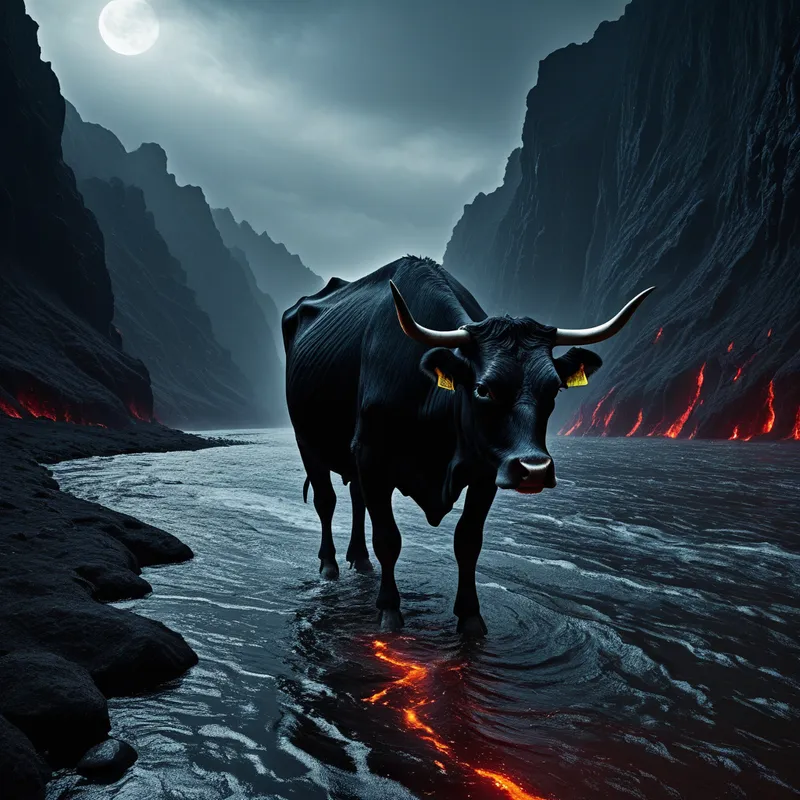
There it lies, spanning [the abyss](/myths/the-abyss “Myth from Kabbalistic culture.”/): the River Vaitarani. Its currents are clots of crimson blood, churning with pus, offal, and the molten residue of every wicked thought and cruel action. Its banks are not earth, but the compacted ash of burnt opportunities. The stench is a physical weight, a miasma of regret that claws at the very essence of the soul. In its depths, shrieking forms—those who attempted the crossing unprepared—are caught on hooks of their own making, eternally torn by the current.
This is the ultimate threshold. On this near shore lies the identity of a life just lived; on the far shore waits the court of Yama, where the ledger of that life, the [karma](/myths/karma “Myth from Hindu culture.”/), will be weighed. There is no ferryman for a price of gold. There is no bridge of stone. The soul stands utterly naked, all earthly wealth and power rendered meaningless dust.
For the wicked, the river rises as a wall of torment. They are plunged in, and the river itself becomes the judge and executioner, its viscous tides the embodiment of their own cruelty, greed, and hatred. They are not punished by an external hand, but dissolved in [the mirror](/myths/the-mirror “Myth from Various culture.”/) of their own creation.
But for the righteous, for those who lived with compassion and duty, a miracle manifests from the darkness. From the river of blood emerges a savior of gentle, solid black: a cow. Not a beast of burden, but [Kamadhenu](/myths/kamadhenu “Myth from Hindu culture.”/) in her most merciful form. She stands steady in the horrific flow, her back a broad, safe island. The virtuous soul, whose life was a gift to others, now receives the ultimate gift. They cling to her tail, and with divine, unhurried grace, the sacred cow bears them across the impossible divide. The filth cannot touch them. The river’s roar fades to a murmur. They are carried, not by their own power, but by the accumulated grace of a life well-lived, arriving on the far shore not in terror, but in humble awe.

Cultural Origins & Context
The myth of Vaitarani finds its roots in the later Brahmanas and Puranas, texts concerned with cosmology, ritual, and the moral architecture of the universe. It is not a myth of the grand cosmic cycles, but a deeply personal eschatology—a map of the individual soul’s destiny. It was passed down not merely as a scary story, but as a foundational ethical teaching.
Its primary societal function was as a moral compass and a social stabilizer. In a culture where the metaphysical consequences of action (karma) were paramount, Vaitarani provided a visceral, unforgettable image of the ultimate consequence. It was recounted by priests, woven into funeral rites, and elaborated upon by storytellers to reinforce dharma. The promise of the saving cow directly tied ethical behavior (particularly ahimsa and charity, especially toward cows) to post-mortem salvation. This myth made the abstract concept of karma terrifyingly concrete, serving as a powerful deterrent against adharmic actions and a profound encouragement for charity, truthfulness, and piety.
Symbolic Architecture
The Vaitarani is not a geographical [location](/symbols/location “Symbol: The symbol of ‘Location’ signifies a sense of place, context, and the environment in which experiences unfold.”/) but a psychic state. It is the ultimate [symbol](/symbols/symbol “Symbol: A symbol can represent an idea, concept, or belief, serving as a powerful tool for communication and understanding.”/) of the unintegrated [shadow](/symbols/shadow “Symbol: The ‘shadow’ embodies the unconscious, repressed aspects of the self and often represents fears or hidden emotions.”/)—the sum total of all the aspects of [the self](/myths/the-self “Myth from Jungian culture.”/) we refused to acknowledge, the pain we caused and ignored, the responsibilities we shirked. It is the [river](/symbols/river “Symbol: A river often symbolizes the flow of emotions, the passage of time, and life’s journey, reflecting transitions and movement in one’s life.”/) of our own denied [life](/symbols/life “Symbol: The symbol of ‘Life’ represents a journey of growth, interconnectedness, and existential meaning, encompassing both the joys and challenges that define human experience.”/).
The river you must cross after death is the river of the life you refused to live while alive.
The two shores represent profound psychological states. The near shore is the fragmented ego, clinging to the [identity](/symbols/identity “Symbol: Identity represents the sense of self, encompassing personal beliefs, cultural background, and social roles.”/) of a single lifetime. The far shore is the potential for [integration](/symbols/integration “Symbol: The process of unifying disparate parts of the self or experience into a cohesive whole, often representing psychological wholeness or resolution of internal conflict.”/), judgment, and the next phase of existence (whether [rebirth](/symbols/rebirth “Symbol: A profound transformation where old aspects of self or life die, making way for new beginnings, growth, and renewal.”/) or liberation). The crossing is the critical transition from a state of self-justification to a state of self-confrontation.
The cow is the most potent symbol of the myth. She represents the accumulated psychic substance of nourishing actions—[compassion](/symbols/compassion “Symbol: A deep feeling of empathy and concern for others’ suffering, often involving a desire to help or alleviate their pain.”/), selfless giving (dana), and non-violence. She is the embodied positive karma, the internal resource built from a life of conscious [choice](/symbols/choice “Symbol: The concept of choice often embodies decision-making, freedom, and the multitude of paths available in life.”/). She is not an external rescuer but the manifestation of the [soul](/symbols/soul “Symbol: The soul represents the essence of a person, encompassing their spirit, identity, and connection to the universe.”/)’s own saved-up integrity. To be saved by the cow is to be saved by one’s own better [nature](/symbols/nature “Symbol: Nature symbolizes growth, connectivity, and the primal forces of existence.”/).
The Dreamer’s Resonance
When this myth stirs in the modern [psyche](/myths/psyche “Myth from Greek culture.”/), it rarely appears as a literal river of blood. Instead, the dreamer encounters their own Vaitarani. It may manifest as:
- A terrifying, impassable body of water—a lake of black oil, a swamp of clinging mud, a raging, polluted flood.
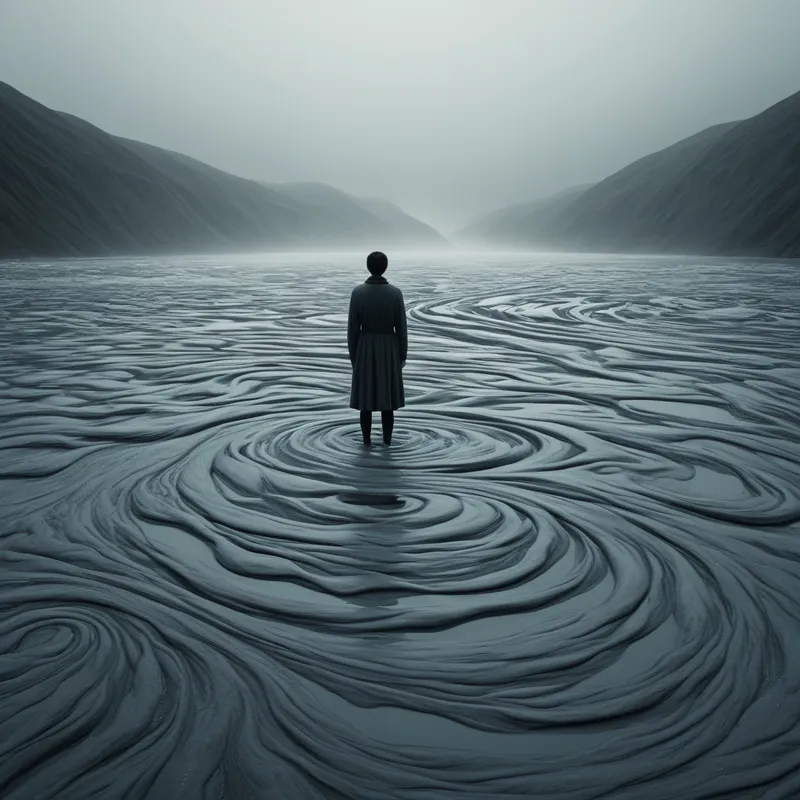
- Being stuck on one side of a chasm, bridge, or doorway, paralyzed by fear or shame, while something important waits on the other side.
- Drowning in a substance that feels like it is made of one’s own guilt, regret, or toxic memories.
Somatically, this dream often accompanies a feeling of profound stagnation, a “dark night of the soul,” or a life crisis where past actions (or inactions) are rising to the surface. The psyche is announcing that a critical transition is necessary, but [the way](/myths/the-way “Myth from Taoist culture.”/) forward is blocked by the unprocessed and unforgiven contents of the personal past. The dream is an urgent summons to shadow-work—to turn and face the very things from which the conscious ego has been fleeing.
Alchemical Translation
The alchemical journey of individuation mirrors the crossing of Vaitarani. The [nigredo](/myths/nigredo “Myth from Alchemical culture.”/) stage—the blackening, the descent into the unconscious—is the soul’s arrival at the riverbank. Here, all the illusions of the [persona](/myths/persona “Myth from Greek culture.”/) are stripped away. [The ego](/myths/the-ego “Myth from Jungian culture.”/) confronts the “filth” of its own unresolved complexes, repressed desires, and accrued cowardice.
The alchemical fire is not for burning away sin, but for cooking the raw material of experience until it yields its hidden gold.
The heroic task is not to avoid this river, but to prepare for the crossing while still alive. This is the practice of conscious living: every act of integrity, every moment of faced shadow, every choice made in alignment with one’s deeper truth is an offering to that inner, saving cow. We build our vessel through daily psychological honesty and ethical courage.
The triumphant crossing represents the albedo—the whitening. It is the moment of purification and integration, where the conscious self, having acknowledged and processed its shadow, is no longer at war with itself. It is carried by the strength of its own hard-won wholeness. The judgment before Yama then transforms from a fearful sentencing into a sober self-assessment, a necessary review before the soul can proceed, lighter and clearer, to its next stage of becoming. The myth teaches that the ultimate preparation for death is the full embrace of life, in all its moral complexity. We do not cross the river at the end; we are building the bridge, or nurturing the savior, with every conscious breath.
Associated Symbols
Explore related symbols from the CaleaDream lexicon: