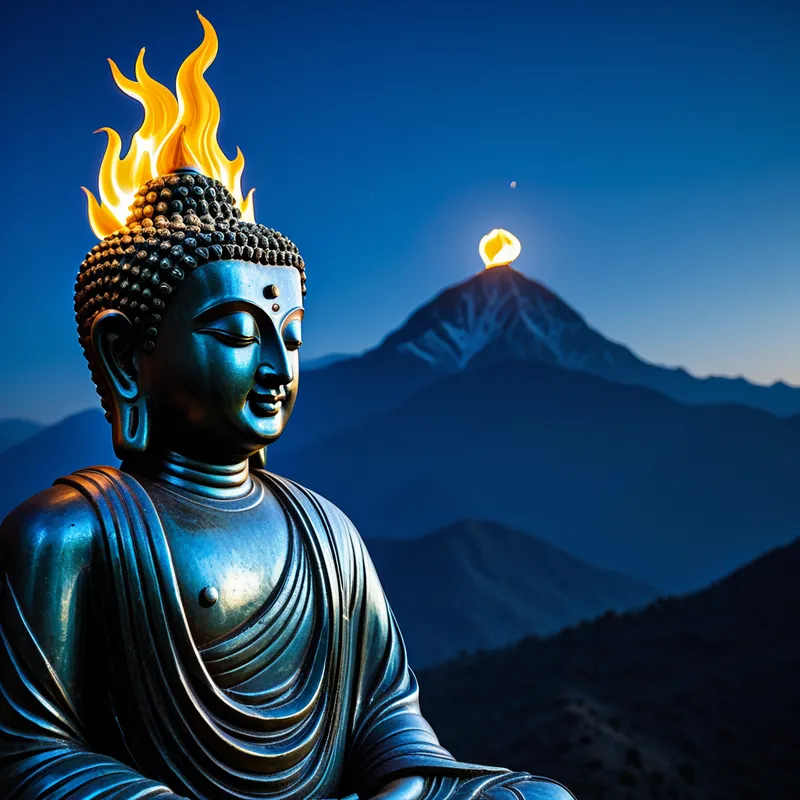
Ushnisha Myth Meaning & Symbolism
The story of the Ushnisha, a divine cranial swelling, symbolizing the eruption of ultimate wisdom and the transcendence of the conditioned mind.
The Tale of Ushnisha
Listen, and let the silence between the words speak. In a time before time was measured, when the world was a tapestry of raw potential, there walked among men and gods a being who had turned his gaze inward. He was not born a king, but he sought a kingdom—the sovereign realm of the mind itself. For years uncounted, he sat beneath the shelter of the Bodhi, his spine a pillar of resolve, his breath the only tide.
The world tested him. Mara, the great tempter, sent armies of distraction—visions of terrifying demons and seductive nymphs, whispers of doubt and pride. Yet the seeker’s gaze did not waver. He touched the earth, and the earth herself bore witness to his unwavering intent. He journeyed deeper, past the flickering stories of the self, past the river of sensation, into the still, dark pool of primordial awareness.
And then, in the profound quiet of the final watch of the night, it happened. It was not a sound, but a shattering of silence from within. It was not a light, but the dawn of a sun that had never set. As the last veil of ignorance burned away in the fire of perfect insight, a profound transformation manifested in his very form. From the crown of his head, the seat of the highest consciousness, something swelled. It was not bone, not flesh as we know it, but a living summit, a mountain peak of spirit made visible. A protuberance, elegant and firm, arose—the Ushnisha.
This was no mere physical mark. It was the eruption of the unconditioned into the conditioned, the infinite pressing into the finite vessel. It was the visible sign of a mind that had become a universe, containing all knowledge, all compassion, all time. When he opened his eyes, the world was the same, yet utterly new. He was now the Buddha, and from the summit of his being, the Ushnisha, flowed a boundless, silent teaching that would echo for millennia.

Cultural Origins & Context
The Ushnisha is a profound iconographic element that transcends a single story, weaving through Hindu and Buddhist thought. In early Buddhist art, particularly in the Gandharan and Mathuran schools following the first century CE, the Buddha was not depicted in human form. His presence was implied through symbols—a footprint, an empty throne, a wheel. When anthropomorphic representation began, artists faced a divine challenge: how to depict a being whose essence was supramundane? The Ushnisha, along with the Urna, became one of the primary lakshanas, or marks of a great being.
It is described in the Lakkhana Sutta and other texts as one of the thirty-two major physical characteristics of a Mahapurusha. Its function was not merely decorative but doctrinal. For monastic communities and lay devotees, the image of the Buddha with a Ushnisha served as a constant, silent sermon. It visually communicated that enlightenment was not an abstract idea but a total psychophysical transformation. In some Hindu traditions, particularly associated with deities like Bhikshatana Shiva or in depictions of yogic adepts, a similar cranial swelling signifies the awakening of the Kundalini energy reaching the crown chakra. Thus, the Ushnisha became a cross-cultural glyph for the ultimate achievement of consciousness.
Symbolic Architecture
The Ushnisha is the ultimate symbol of contained expansion. It represents the paradox of enlightenment: the infinite inhabiting the finite, the formless taking a form. Psychologically, it maps the journey from the personal to the transpersonal.
The Ushnisha is the mountain that grows from within the valley of the personal self; its peak pierces the cloud-cover of ordinary thought to touch the sky of pure awareness.
Anatomically, it crowns the head, the site of the Sahasrara chakra, the thousand-petaled lotus. This is not an escape from the body but its ultimate fulfillment—the body itself becomes a temple whose spire reaches the divine. The Ushnisha symbolizes prajna, transcendent wisdom, which is not an accumulation of facts but a radical re-ordering of perception. It is the "bursting of the cranial suture," a motif found in shamanic traditions worldwide, signifying the breaking open of the limited mind to receive direct knowledge from the source.
It also represents upaya, skillful means, or compassionate action. The wisdom it contains is not hoarded; the serene, downward gaze of the Buddha figure ensures that this supreme consciousness flows back into the world as compassion. The Ushnisha is thus both receptor and transmitter—the antenna of the absolute and the fountain of grace.
The Dreamer's Resonance
When this mythic pattern stirs in the modern unconscious, it often announces a crisis or culmination of knowing. To dream of a swelling or unusual formation on the head, a glowing crown, or a sense of immense pressure at the skull's apex is to experience the somatic echo of the Ushnisha's emergence.
This is not a gentle process. In dreams, it may manifest as headaches of mysterious origin, the head feeling too large for rooms, or even visions of the skull cracking open. Psychologically, this corresponds to the ego's resistance to a tectonic shift in identity. The old, familiar structures of thought and self-definition are being pressured from within by a new, more comprehensive understanding. The dreamer may be integrating a lifetime of experience into a cohesive wisdom, or confronting a truth so vast it threatens to dismantle their personal narrative. The body, in its deep intelligence, registers this as a literal "expansion of the mind." The dream signals that the psyche is laboring to give birth to a higher-order consciousness, pressing against the very limits of the individual self.

Alchemical Translation
The myth of the Ushnisha provides a master blueprint for the alchemical process of individuation—the Jungian journey toward psychological wholeness. The initial long meditation under the Bodhi tree is the nigredo, the dark night of the soul, where one confronts the shadow (Mara) and endures the dissolution of persona.
The awakening itself is the albedo, the dawning of illuminating insight. But the Ushnisha represents the subsequent and crucial stages: citrinitas (yellowing) and rubedo (reddening). It is the tangible, enduring result of the transformation. It is the philosopher's stone not as an external object, but as a permanent reconfiguration of the psychic substance.
Individuation is not concluded with a flash of insight, but with the permanent cranial shift—the rewiring of the psyche's very architecture into a vessel for the Self.
For the modern individual, this translates to the move from ephemeral "peak experiences" to a stabilized "plateau consciousness." It is the work of integrating a transformative realization so thoroughly that it changes one's fundamental structure. The "Ushnisha process" asks: How does that awakening become the new summit of your being? How does it reshape your "headquarters"—your center of command and perception? The struggle is to allow this new consciousness to take form in one's life, to become the crown from which all one's actions and perceptions now flow. It is the ultimate psychic transmutation: leaden, fragmented thought becomes the golden, unified dome of wisdom, a living testament that the seeker has become a sovereign in the realm of spirit.
Associated Symbols
Explore related symbols from the CaleaDream lexicon: