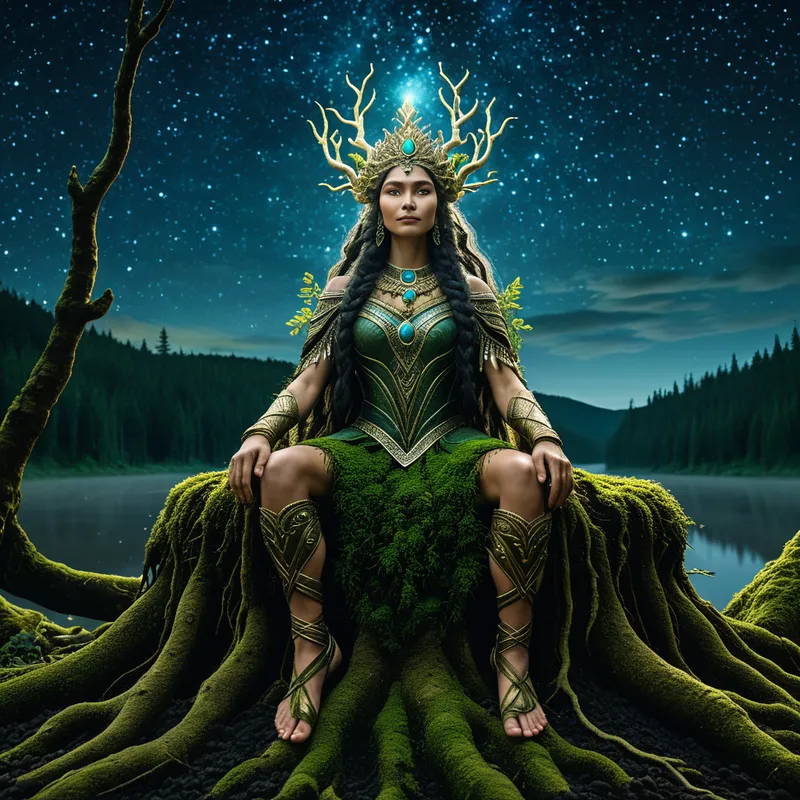
Umai Earth Goddess Siberian Myth Meaning & Symbolism
The story of Umai, the primordial Earth Mother of Siberian myth, who births life from her body and offers sanctuary to the soul, weaving the world from flesh and spirit.
The Tale of Umai Earth Goddess Siberian
In the time before memory, when the world was a single, silent breath held in the throat of the great dark, there was only the Cold and the Stillness. Then, from the heart of the void, a warmth began to stir. It was not a fire, but a deep, slow pulse—the first heartbeat. This was Umai.
She did not arrive with thunder or light, but unfolded. From the formless, her body became the ground itself—the curve of the hill, the bed of the valley, the unyielding bone of the mountain. Her flesh was the dark, rich humus; her veins were the secret rivers that run under stone; her hair was the endless, whispering Forest. With a sigh that became the first wind, she gave of herself. From her palms sprang the first birch trees, white and trembling. From the tears of her longing fell the first Rain, which pooled in her footprints to become lakes.
But a world of earth and water was a sleeping world. Umai looked into the polished surface of a still lake, her own reflection gazing back—a face of stone and soil, eyes like deep pools. From this reflection, from her own desire for witness, she drew forth the first souls. She breathed upon the wet clay by the water’s edge, and it squirmed, taking shape: the fleet Horse, the soaring Eagle, the silent, gliding Fish. And lastly, from clay mixed with her own breath and the light of the newly kindled Sun, she formed the first people. She placed them gently upon her breast, and where their feet touched, grass grew.
Yet the Cold had not retreated; it had only been pushed back. It gathered at the edges of her being, a biting wind that sought to steal the warmth from her children. It was a force of hunger, of unmaking. Umai saw the fear in the first human’s eyes as they shivered. Without a word, she opened a doorway in her side—not a wound, but a Cave leading deep into her heart. “Enter,” her voice echoed, not in the air, but in the ground beneath their feet. “Find your Hearth Fire within my bones.”
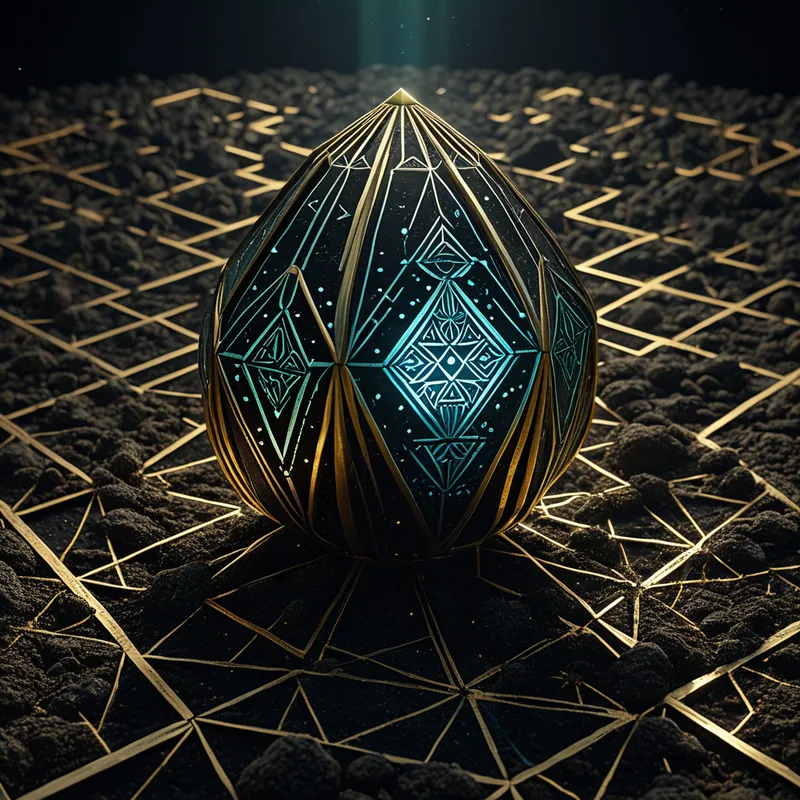
The people entered the sacred dark. In the deep warmth, they found not just shelter, but a glowing Stone that beat with a slow, steady light. This was the Heart of Umai. Touching it, they understood the Circle of all things: that to her flesh they would one day return, and from her flesh new life would always rise. They emerged not just survivors, but children of the earth, their own hearts echoing her steady, nurturing pulse. And so, Umai became the ground beneath them, the shelter around them, and the silent, enduring song within them—the Mother who is both womb and tomb, whose only law is the patient, turning wheel of Rebirth.
Cultural Origins & Context
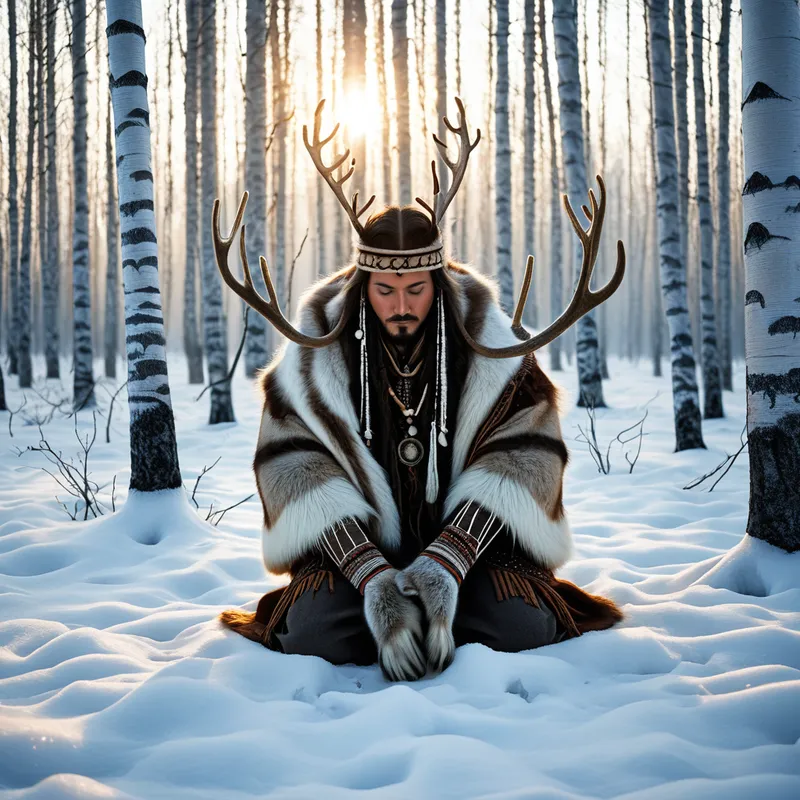
The figure of Umai (also Oomay, Umay) is central to the spiritual traditions of numerous Siberian peoples, particularly the Turkic-speaking groups like the Altai, Khakas, and Yakuts, as well as influencing neighboring Mongolic cosmologies. This is not a myth contained in a single, canonical text, but a living oral tradition breathed into existence by shamans (kam) across the vast taiga and steppe. The story was sung during rituals of birth, to invite Umai’s protection for the newborn, and during rites of healing, to call upon her restorative power from within the earth.
Her primary societal function was foundational: she explained the origin of life and the nature of death in a landscape that was both brutally harsh and breathtakingly abundant. She modeled a relational existence where humans were not masters of the land, but literal children of it. The myth served as the ultimate ecological and ethical charter—to harm the earth was to harm the mother, to cut oneself off from the source of life and soul. The shaman’s journey into the underworld often mirrored the human entry into Umai’s cave in the myth, seeking the healing “heart-stone” of the world to restore balance to the community.
Symbolic Architecture
At its core, the myth of Umai is a profound map of the psyche’s [relationship](/symbols/relationship “Symbol: A representation of connections we have with others in our lives, often reflecting our emotional state.”/) with the foundational [layer](/symbols/layer “Symbol: Layers often symbolize complexity, depth, and protection in dreams, representing the various aspects of the self or situations.”/) of existence—the unconscious as a nurturing, generative, and ultimately grounding [matrix](/symbols/matrix “Symbol: A dream symbol representing the fundamental structure of reality, consciousness, or the self. It often signifies feelings of being trapped, controlled, or questioning the nature of existence.”/).
The Earth is not merely dirt we stand upon; it is the primary body of the Mother, the physical manifestation of the unconscious ground of being from which all conscious life emerges and to which it returns.
Umai symbolizes the [Mother](/symbols/mother “Symbol: The symbol of ‘Mother’ represents nurturing, protection, and the foundational aspect of one’s emotional being, often associated with comfort and unconditional love.”/) [archetype](/symbols/archetype “Symbol: A universal, primordial pattern or prototype in the collective unconscious that shapes human experience, behavior, and creative expression.”/) in its most literal and cosmic form. She is not a [goddess](/symbols/goddess “Symbol: The goddess symbolizes feminine power, divinity, and the nurturing aspects of life, embodying creation and wisdom.”/) in the sky, but of the ground. Her act of creation is one of embodiment and sacrifice—her [body](/symbols/body “Symbol: The body in dreams often symbolizes the dreamer’s self-identity, personal health, and the relationship they have with their physical existence.”/) becomes the world. This represents the psychological [truth](/symbols/truth “Symbol: Truth represents authenticity, honesty, and the quest for knowledge beyond mere appearances.”/) that our very [consciousness](/symbols/consciousness “Symbol: Consciousness represents the state of awareness and perception, encompassing thoughts, feelings, and experiences.”/) and [life](/symbols/life “Symbol: The symbol of ‘Life’ represents a journey of growth, interconnectedness, and existential meaning, encompassing both the joys and challenges that define human experience.”/) force are born from and sustained by a vast, unconscious, biological, and instinctual substrate. The [Serpent](/symbols/serpent “Symbol: A powerful symbol of transformation, wisdom, and primal energy, often representing hidden knowledge, healing, or temptation.”/) of her veins and the [Mountain](/symbols/mountain “Symbol: Mountains often symbolize challenges, aspirations, and the journey toward self-discovery and enlightenment.”/) of her bone speak to the ancient, slow-moving, and permanent structures of the deep psyche.
The central conflict with the Cold is not a battle, but an act of enduring and offering sanctuary. This symbolizes the ego’s confrontation with the cold, harsh realities of life (suffering, [mortality](/symbols/mortality “Symbol: The awareness of life’s finitude, often representing transitions, impermanence, or existential reflection in dreams.”/), [isolation](/symbols/isolation “Symbol: A state of physical or emotional separation from others, often representing a need for introspection or signaling distress.”/)). The [solution](/symbols/solution “Symbol: A solution symbolizes resolution, clarity, and the overcoming of obstacles, often representing a sense of accomplishment.”/) is not to fight on the surface, but to descend—to go [inward](/symbols/inward “Symbol: A journey toward self-awareness, introspection, and the exploration of one’s inner world, thoughts, and unconscious mind.”/), into the cave of the unconscious (Umai’s side), to reconnect with the inner [Hearth Fire](/symbols/hearth-fire “Symbol: The hearth fire symbolizes warmth, community, and the sustenance of life, representing the heart of a home and a source of comfort and nourishment.”/). The glowing [heart](/symbols/heart “Symbol: The heart symbolizes love, emotion, and the core of one’s existence, representing deep connections with others and self.”/)-[stone](/symbols/stone “Symbol: In dreams, a stone often symbolizes strength, stability, and permanence, but it may also represent emotional burdens or obstacles that need to be acknowledged and processed.”/) found there is the [symbol](/symbols/symbol “Symbol: A symbol can represent an idea, concept, or belief, serving as a powerful tool for communication and understanding.”/) of the indestructible core of the Self, the psychic center that exists beyond the ego’s fears.
The Dreamer’s Resonance
When this mythic pattern stirs in modern dreams, it often signals a profound need for grounding, nurturance, and reconnection to one’s biological and instinctual roots. The dreamer may find themselves in vast, empty landscapes, feeling adrift or exposed—a direct reflection of the “Cold” at the edges of Umai’s realm. Somatic sensations are key: dreaming of pressing hands into warm soil, feeling roots grow from one’s feet, or hearing a deep, rhythmic pulse from underground all point to this process.
To dream of entering a Cave or burrowing into the earth is the psyche’s imperative to undertake this mythic descent. It is a call away from the brittle, over-intellectualized, or hyper-active conscious attitude, and a movement toward the healing dark. The psyche is seeking its own “heart-stone”—the authentic, unshakable core of identity that can only be found by turning toward, not away from, the primal, earthy foundations of one’s being. This is often a necessary prelude to a psychological Rebirth.
Alchemical Translation
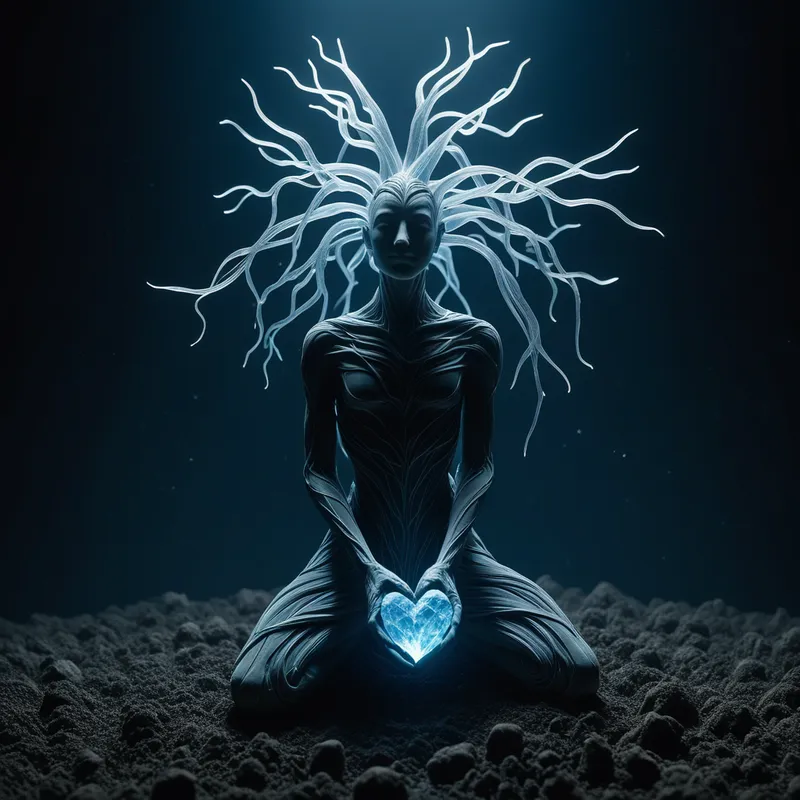
The alchemical process mirrored in Umai’s myth is that of solutio and coagulatio—dissolution into the primal matter and re-coagulation into a new, grounded form. The modern individual’s journey of individuation often requires a similar “return to the mother,” not in a regressive sense, but in a transformative one.
Individuation is not about rising above our nature, but about sinking roots deep into it, discovering the nourishing darkness from which our most authentic light must draw its sustenance.
The first stage is the recognition of the “Cold”—the feeling of existential alienation, anxiety, or meaninglessness. The conscious ego feels separate from the source of life. The alchemical instruction is to follow Umai’s invitation: to consciously descend. This is the practice of turning inward through meditation, engaging with the body through somatic work, or confronting the “shadow” material of one’s personal and collective unconscious. It is the solutio, the dissolving of the ego’s rigid structures in the moist, dark earth of the psyche.
Within this darkness, one seeks the inner Stone—the core truth of the Self. This is not an idea, but a felt, embodied knowing of one’s fundamental value and place in the great web. Finding it is the moment of coagulatio. The individual then re-emerges, not as the same person who descended, but as one who is now consciously rooted. They carry the warmth of the inner hearth. Their consciousness is no longer a fragile thing on a cold plain, but a tree drawing steady nourishment from the deep, rich soil of Umai’s enduring body. The triumph is not over the world, but a sacred reconciliation with it, achieving a state of grounded, resilient being—a soul at home in its own flesh and in the flesh of the world.
Associated Symbols
Explore related symbols from the CaleaDream lexicon:
- Earth — The primary body and manifestation of Umai, representing the physical and psychological ground of being, the source of all life and the destination of all return.
- Mother — The archetypal essence of Umai as the nourishing, protective, and generative source from which all things are born and sustained.
- Cave — The doorway into Umai’s side, symbolizing the descent into the deep unconscious, a place of sanctuary, initiation, and discovery of the inner core.
- Heart — The glowing stone at the center of the earth, representing the indestructible core of the Self, the source of psychic warmth and authentic life.
- Hearth Fire — The warmth and spiritual center found within Umai’s depths, signifying the vital energy of the soul and the sacred center of the home/self.
- Rebirth — The fundamental cycle embodied by Umai, where return to the earth (dissolution) is the necessary precursor to the emergence of new life and consciousness.
- Stone — The enduring, foundational heart of Umai, symbolizing the eternal, unshakable aspect of the psyche and the concentrated power of the earth.
- Tree — Life born from Umai’s body, representing the connection between the deep, unconscious roots and the conscious, aspiring growth toward the sky.
- Root — The hidden, anchoring filaments connecting all life to Umai, symbolizing our fundamental attachment to the instinctual, ancestral, and biological layers of existence.
- Circle — The endless cycle of life, death, and regeneration governed by Umai, representing the wholeness and eternal return inherent in nature and the psyche.
- Rain — The tears and life-giving gift of Umai, symbolizing the fertilizing, emotional, and cleansing waters that emerge from the union of sky and earth.
- Forest — The living garment and hair of Umai, representing the complex, interconnected, and mysterious realm of the instinctual and untamed psyche.