Uchiwa Myth Meaning & Symbolism
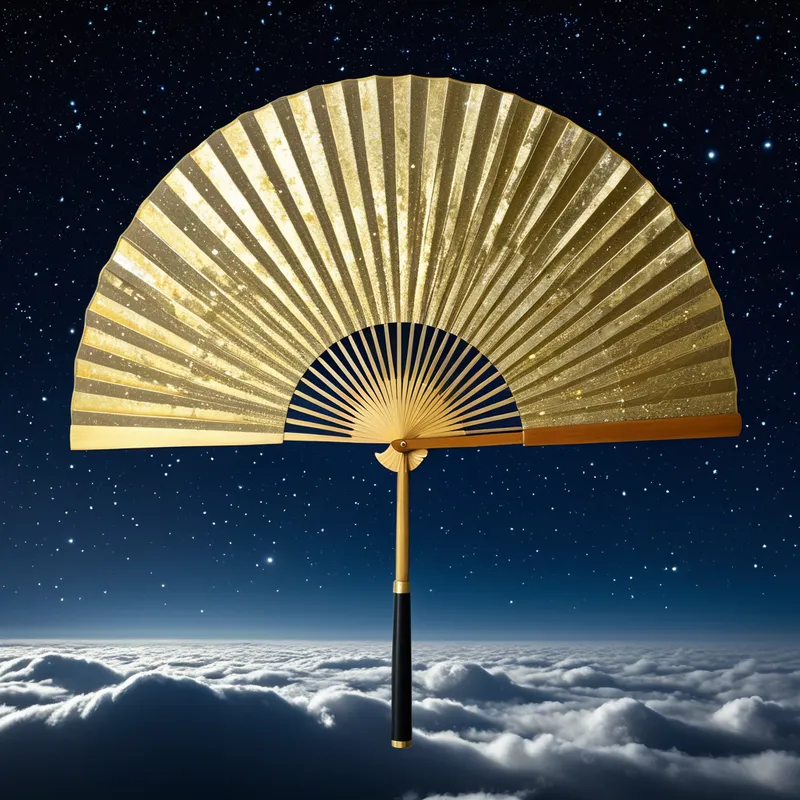
A myth of a divine fan, born from celestial breath, that brings order to chaos and teaches the sacred rhythm of creation and rest.
The Tale of Uchiwa
In the time before time, when [the world](/myths/the-world “Myth from Tarot culture.”/) was a formless, swirling broth of mist and potential, the kami looked upon the chaos. The heavens, Takamagahara, were a realm of pure light and song, but below, the earthly realm was a silent, stagnant sea of mist. No wind stirred. No leaf trembled. The very air was heavy with unborn possibility, waiting for the first breath.
Among the kami, one held a particular concern for the world below. Not a warrior, nor a ruler of storms, but a deity of subtlety and grace. Some say her name was Shinme, the Divine Woman of the Breath. She watched the stillness and felt a profound compassion for the latent life within [the mist](/myths/the-mist “Myth from Celtic culture.”/). It needed not a force to shatter it, but a caress to awaken it.
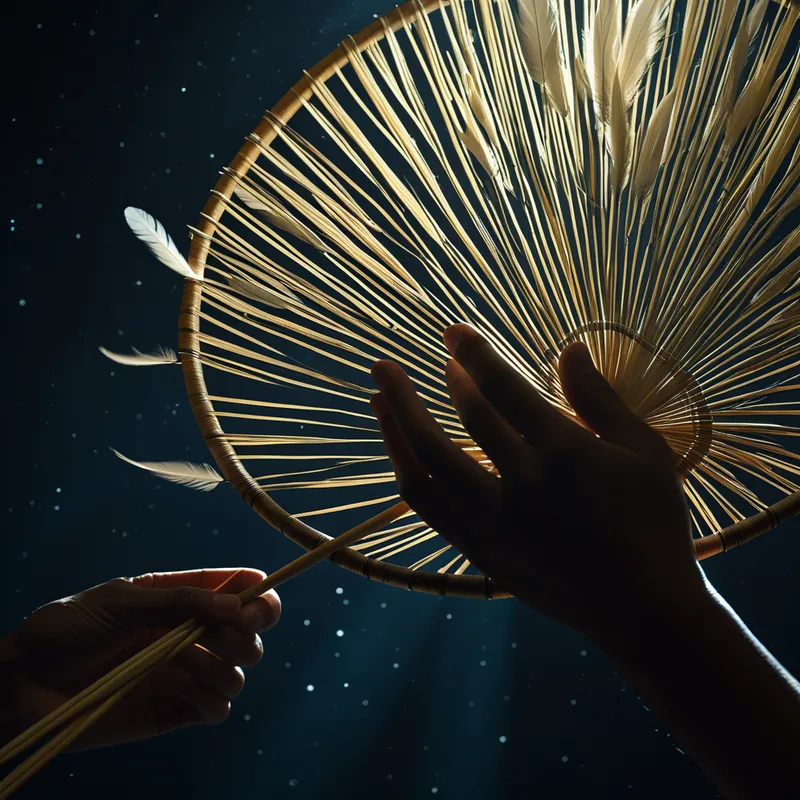
So, from the highest branch of the eternal Sakaki tree in Takamagahara, she plucked feathers of light. From the reeds growing at the shore of the Amanogawa, she gathered stems of perfect flexibility. But the most crucial ingredient was her own breath. She breathed upon the materials—not a violent gust, but the soft, sustained exhalation of intention, the kokyu that gives life to spirit. As she wove, she sang a song without words, a melody that was the very pattern of gentle motion.
Thus, Uchiwa was born. It was not a tool; it was an extension of her being, a sacred object imbued with the first principle of movement. She descended to the edge of the formless realm. Holding the Uchiwa aloft, she began to fan.
The first movement was infinitesimally slow. A single, graceful arc. From it, a sigh emanated—the first zephyr. The heavy mist trembled. She fanned again, a rhythm establishing itself: a gentle push, a patient pull. With each motion, the sigh became a breeze. The stagnant mist began to swirl, to separate. Lighter elements rose, drawn upward by the Uchiwa’s pull, beginning to form [the sky](/myths/the-sky “Myth from Persian culture.”/). Heavier elements settled, coalescing into the first contours of land. The breeze became a wind, carving valleys and urging the first waters to flow in rivulets.
But Shinme did not fan endlessly. She understood the sacred pause. She would fan seven times, then rest, observing the patterns her breath had wrought. In the rest, the elements settled into their new forms. [The wind](/myths/the-wind “Myth from Various culture.”/) itself, born of the fan, now took up the task, whispering through the newborn world. The Uchiwa had not commanded; it had initiated. It had taught the universe its first rhythm: the active breath of creation and the receptive silence of being. Its work complete, the divine Uchiwa was placed at the boundary of worlds, a silent guardian of the gentle, ordering principle it had introduced into the heart of chaos.
Cultural Origins & Context
The myth of Uchiwa finds its roots not in a single, codified text like the Kojiki, but in the oral traditions surrounding sacred objects and seasonal rituals. It is a mukashibanashi of the most profound kind, often told by shrine attendants and elders during the muggy days of early summer, when the air grows heavy and still.
The Uchiwa, as a physical object, is ancient and ubiquitous in Japan. Originally made of bamboo and paper, it was a practical tool for cooling, but also a ritual implement. In Shinto, fans were used by priests and shrine maidens (miko) in ceremonial dance ([Kagura](/myths/kagura “Myth from Shinto culture.”/)) to purify space and invite the presence of the kami. The fan’s movement was seen as a way to direct spiritual energy, to brush away impurity and stir the sacred breath (tama) of the world.
This myth served a societal function of encoding a deep ecological and spiritual ethic. It explained the origin of wind not as a violent act of a storm god, but as a gentle, intentional act of care. It framed the natural world’s order as the result of rhythmic, balanced intervention, not chaotic force. The story was a reminder that human creation—from crafting a tool to building a community—should mirror this divine example: purposeful action followed by mindful observation, respecting the natural rhythms one sets in motion.
Symbolic Architecture
At its core, the Uchiwa is a [symbol](/symbols/symbol “Symbol: A symbol can represent an idea, concept, or belief, serving as a powerful tool for communication and understanding.”/) of the mediating principle. It exists between the kami and the world, between [breath](/symbols/breath “Symbol: Breath symbolizes life, vitality, and the connection between the physical and spiritual realms.”/) and form, between [action](/symbols/action “Symbol: Action in dreams represents the drive for agency, motivation, and the ability to take control of situations in waking life.”/) and rest. It is not the [source](/symbols/source “Symbol: The origin point of something, often representing beginnings, nourishment, or the fundamental cause behind phenomena.”/) of power (the kami is), but the [instrument](/symbols/instrument “Symbol: An instrument symbolizes creativity, communication, and the means by which one expresses oneself or influences the world.”/) that translates that power into gentle, effective [motion](/symbols/motion “Symbol: Represents change, progress, or the flow of life energy. Often signifies transition, personal growth, or the passage of time.”/) within the manifest world.
The fan does not create the wind; it discovers the wind that was always latent in the stillness, and gives it a direction.
Psychologically, the Uchiwa represents the directed function of [consciousness](/symbols/consciousness “Symbol: Consciousness represents the state of awareness and perception, encompassing thoughts, feelings, and experiences.”/). The formless mist is the unconscious—fertile, potential-laden, but undifferentiated and stagnant. The kami, Shinme, is the archetypal [spirit](/symbols/spirit “Symbol: Spirit symbolizes the essence of life, vitality, and the spiritual journey of the individual.”/) of mindful [intention](/symbols/intention “Symbol: Intention represents the clarity of purpose and direction in one’s life and can symbolize motivation and commitment within a dream context.”/). The act of weaving the fan is the process of constructing a conscious tool—a skill, a philosophy, a focused mind. The fanning itself is the [application](/symbols/application “Symbol: An application symbolizes engagement, integration of knowledge, or the pursuit of goals, often representing self-improvement and personal development.”/) of that conscious tool to the raw [material](/symbols/material “Symbol: Material signifies the tangible aspects of life, often representing physical resources, desires, and the physical world’s influence on our existence.”/) of the [psyche](/myths/psyche “Myth from Greek culture.”/) and one’s [life](/symbols/life “Symbol: The symbol of ‘Life’ represents a journey of growth, interconnectedness, and existential meaning, encompassing both the joys and challenges that define human experience.”/). It is not about brutal control, but about initiating a gentle, rhythmic ordering. The [separation](/symbols/separation “Symbol: A spiritual or mythic division between realms, states of being, or consciousness, often marking a transition or loss of connection.”/) of sky and land symbolizes the [birth](/symbols/birth “Symbol: Birth symbolizes new beginnings, transformation, and the potential for growth and development.”/) of discrimination and [clarity](/symbols/clarity “Symbol: A state of mental transparency and sharp focus, often representing resolution of confusion or attainment of insight.”/) from [confusion](/symbols/confusion “Symbol: A state of mental uncertainty or disorientation, often reflecting internal conflict, lack of clarity, or overwhelming choices in waking life.”/).
The sacred pause—the rest after seven fans—is equally critical. It represents the necessity of unconscious [integration](/symbols/integration “Symbol: The process of unifying disparate parts of the self or experience into a cohesive whole, often representing psychological wholeness or resolution of internal conflict.”/). Constant, frantic doing only creates [chaos](/symbols/chaos “Symbol: In Arts & Music, chaos represents raw creative potential, uncontrolled expression, and the breakdown of order to forge new artistic forms.”/). True creation requires periods of receptivity, of allowing what has been set in motion to settle and find its own form. The myth encodes the balance between the [Logos](/myths/logos “Myth from Christian culture.”/) of action and the Eros of being.
The Dreamer’s Resonance
When the symbol of the Uchiwa appears in a modern dream, it often signals a psychic state where things feel stagnant, foggy, or emotionally “stuck.” The dreamer may be in a period of creative block, indecision, or emotional confusion where everything feels merged and unclear.
The somatic experience in such a dream might be one of heaviness, labored breathing, or moving through a thick haze. The appearance of the Uchiwa—whether it is being offered, found, or wielded—marks the psyche’s intuition that a gentle, rhythmic intervention is needed. It is not a call for a heroic, sweeping effort, but for a subtle, consistent application of conscious attention.
If the dreamer is fanning, it indicates the beginning of this inner process of clarification. What “mist” is being parted? What latent potential is being stirred? If the Uchiwa is broken or motionless, it may point to a feeling of being disconnected from one’s tools of consciousness or the rhythm of action and rest. The dream is presenting the archetypal tool for navigating a period of formlessness, urging the dreamer to find their own “sacred breath” to bring order to their inner chaos.
Alchemical Translation
The journey of the Uchiwa myth is a perfect map for the alchemical process of individuation, specifically the stage of [separatio](/myths/separatio “Myth from Alchemical culture.”/)—the separation of the subtle from the gross, the valuable from the worthless, consciousness from the unconscious.
The initial massa confusa is the undifferentiated state of the personality, where complexes, potentials, and shadows are all merged. [The alchemist](/myths/the-alchemist “Myth from Various culture.”/), like Shinme, must first construct their vas or vessel—their conscious attitude and disciplined focus (the weaving of the fan). This vessel must be imbued with the [spiritus](/myths/spiritus “Myth from Alchemical culture.”/), the life-breath of sincere intention.
The goal is not to eliminate the mist, but to discover the sky and land hidden within it. The chaos is not the enemy; it is the raw material of the Self.
The rhythmic fanning is the sustained work of analysis, reflection, and conscious living. Each gentle stroke is a moment of mindfulness, a question asked, a feeling acknowledged, a boundary set. This gradually differentiates the inner elements: spirit (sky) from matter (land), enduring values from passing whims, the voice of [the Self](/myths/the-self “Myth from Jungian culture.”/) from the noise of the [persona](/myths/persona “Myth from Greek culture.”/).
The critical alchemical secret embedded in the myth is the neglectum, the necessary rest. In alchemy, the substance must often be left to digest in its own time. In individuation, insights must be allowed to integrate. Constant analysis without integration leads to psychic inflation or exhaustion. The seven fans followed by rest model the sacred law that transformation occurs in the pauses between efforts. The modern individual learns to fan—to act with intention—and then to set the fan down, to trust that the winds they have awakened will continue the work in the depths of the soul, slowly, surely, bringing forth a world of inner order and authentic life.
Associated Symbols
Explore related symbols from the CaleaDream lexicon: