
Tunupa the Salt Pillar
An Incan myth where the god Tunupa is transformed into a salt pillar, symbolizing themes of punishment, natural order, and sacred geography.
The Tale of Tunupa the Salt Pillar
In the high, thin air of the Altiplano, where [the sky](/myths/the-sky “Myth from Persian culture.”/) presses close and [the earth](/myths/the-earth “Myth from Hindu culture.”/) stretches into a blinding white plain, the god Tunupa walked. He was a deity of profound order, a bringer of civilization, law, and [the sacred fire](/myths/the-sacred-fire “Myth from Native American culture.”/). His presence was like the steady, deep note of a [temple bell](/myths/temple-bell “Myth from Buddhist culture.”/), resonating through the nascent world. He carried with him the gifts of culture—knowledge of agriculture, the principles of social harmony, and the sacred rites that maintained the balance between the human realm and the huacas of the landscape.
Yet, [the world](/myths/the-world “Myth from Tarot culture.”/) was still wild, its energies raw and untamed. Tunupa’s journey was one of instruction, a pilgrimage to imprint divine order upon the chaotic beauty of creation. He traversed the land, and wherever he passed, rivers learned their courses, mountains settled into their solemn vigil, and people remembered the laws of reciprocity—ayni—with the earth.
But in his righteous purpose, Tunupa incurred a terrible wrath. The nature of this transgression varies in the telling—some whisper he challenged the authority of other, more volatile gods; others say his unwavering order itself became a provocation, a rigid line drawn against the necessary fluidity of life. The most poignant versions suggest his crime was one of sacred passion: a love for a mortal woman, or a defiance born from protecting the people from divine caprice. Whatever the cause, the celestial powers convened and their judgment was absolute.
The punishment was not annihilation, but a profound, petrifying transformation. As Tunupa stood upon the immense salt desert of Uyuni, the sky itself turned against him. A cataclysm of divine fire and storm descended. His body, once a vessel of moving grace and teaching, was seized by the elements. The fierce winds that scour the plateau encased him. The very [salt of the earth](/myths/salt-of-the-earth “Myth from Biblical culture.”/), the mineral essence of preserved tears and ancient seas, rose and adhered to his form. From the soles of his feet to [the crown](/myths/the-crown “Myth from Various culture.”/) of his head, he was enveloped, crystallized, made static.
Where a god once walked, there now stood a solitary pillar of salt and stone. Tunupa did not die; he was translated. His consciousness, his divine essence, was imprisoned within this new, mineral form. He became the huaca of the salt flats—an eternal, silent witness to the passage of clouds and the slow dance of stars, a monument to the cost of divine discord. The salt pillar stands still, while the world turns around it, a fixed point in a flowing universe, teaching through its stark, arrested presence.
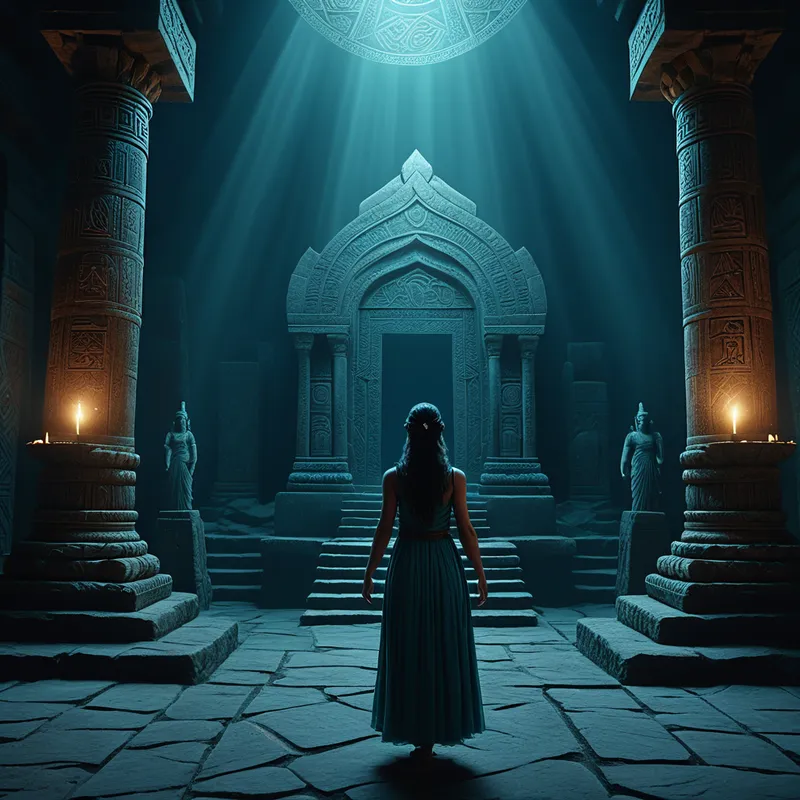
Cultural Origins & Context
The myth of Tunupa emerges from the heart of the Andean cosmological vision, a worldview where geography is theology. The story is intrinsically linked to the surreal landscape of the Salar de Uyuni in modern-day Bolivia, the world’s largest salt flat. To the Incas and the Aymara peoples who inhabited the region, this was not a barren wasteland but a sacred text written in salt and sky.
Tunupa himself is a complex figure, often syncretized with the god Illapa (Thunder) or seen as a culture hero akin to [Viracocha](/myths/viracocha “Myth from Incan culture.”/)’s messengers. He represents the civilizing principle, the one who establishes tawantinsuyu (order) against awqa ([chaos](/myths/chaos “Myth from Greek culture.”/)). His transformation into a landscape feature is not an anomaly in Andean thought, but its [cornerstone](/myths/cornerstone “Myth from Biblical culture.”/). Divinity does not reside on the earth; it is the earth. Mountains (apu), springs, and unusual rock formations are all venerated as embodied deities and ancestors.
The myth, therefore, serves as an etiological narrative, explaining the origin of a specific, awe-inspiring huaca. But more deeply, it codifies a fundamental principle: that the cosmic order is maintained through a balance of dynamic and static forces, of movement and stillness, and that violation of this balance—even by a god—results in a transformation that itself becomes part of the sacred order. Tunupa’s punishment is his apotheosis into the enduring landscape, a permanent part of the community’s sacred geography.
Symbolic Architecture
The myth constructs a profound [architecture](/symbols/architecture “Symbol: Architecture in dreams often signifies structure, stability, and the framing of personal identity or life’s journey.”/) of meaning from simple, potent elements. The [Salt](/symbols/salt “Symbol: Salt represents purification, preservation, and the essence of life. It is often tied to the balance of emotions and spiritual cleansing.”/) Pillar is the central [symbol](/symbols/symbol “Symbol: A symbol can represent an idea, concept, or belief, serving as a powerful tool for communication and understanding.”/): it is both tomb and [temple](/symbols/temple “Symbol: A temple often symbolizes spirituality, sanctuary, and a deep connection to the sacred aspects of life.”/), [prison](/symbols/prison “Symbol: Prison in dreams typically represents feelings of restriction, confinement, or a lack of freedom in one’s life or mind.”/) and [monument](/symbols/monument “Symbol: A structure built to commemorate a person, event, or idea, often representing legacy, memory, and cultural identity.”/). [Salt](/symbols/salt “Symbol: Salt represents purification, preservation, and the essence of life. It is often tied to the balance of emotions and spiritual cleansing.”/) preserves but also crystallizes; it halts decay but also halts growth. Tunupa is eternally preserved in a [moment](/symbols/moment “Symbol: The symbol of a ‘moment’ embodies the significance of transient experiences that encapsulate emotional depth or pivotal transformations in life.”/) of divine judgment, his teachings made permanent not through speech, but through silent, enduring form.
The pillar is the axis of a moral universe, a stark reminder that the cosmos enforces its laws even upon its lawmakers. In his stillness, Tunupa becomes the ultimate teacher of consequence.
The [Salt Flat](/symbols/salt-flat “Symbol: Salt flats symbolize the fundamental aspects of preservation, purity, and the stark beauty found in barren landscapes, often reflecting spiritual cleansing.”/) itself is the [canvas](/symbols/canvas “Symbol: A blank surface representing potential, creativity, and the foundation for expression or identity.”/) of this transformation—a vast, white [emptiness](/symbols/emptiness “Symbol: Emptiness signifies a profound sense of void or lack in one’s life, often related to existential fears, loss, or spiritual quest.”/) that reflects the sky. It represents the blank slate of potential, [the void](/myths/the-void “Myth from Buddhist culture.”/) from which form emerges and into which it can be reabsorbed. The act of turning a mobile god into a fixed feature on this plain speaks to the Inca understanding of pacha (time and [space](/symbols/space “Symbol: Dreaming of ‘Space’ often symbolizes the vastness of potential, personal freedom, or feelings of isolation and exploration in one’s life.”/)) as a unified, sacred entity. [History](/symbols/history “Symbol: History in dreams often represents the dreamer’s past experiences, lessons learned, or unresolved issues that continue to influence their present.”/) is written into the land.
The Transformation is not a diminishment but a change of state. Like [water](/symbols/water “Symbol: Water symbolizes the subconscious mind, emotions, and the flow of life, representing both cleansing and creation.”/) turning to ice or [vapor](/symbols/vapor “Symbol: Vapor represents the intangible, ephemeral nature of artistic expression and the fleeting quality of inspiration, often symbolizing transformation between states.”/), Tunupa’s essence is not destroyed but altered. He moves from an active, anthropomorphic deity to a passive, elemental one. This reflects a worldview where [consciousness](/symbols/consciousness “Symbol: Consciousness represents the state of awareness and perception, encompassing thoughts, feelings, and experiences.”/) and divinity are not exclusive to biological [life](/symbols/life “Symbol: The symbol of ‘Life’ represents a journey of growth, interconnectedness, and existential meaning, encompassing both the joys and challenges that define human experience.”/) but are inherent in all matter, especially that which is striking or anomalous.
The Dreamer’s Resonance
To the modern [psyche](/myths/psyche “Myth from Greek culture.”/), Tunupa’s fate echoes the universal human experience of being “frozen”—by trauma, by shame, by a single catastrophic mistake that seems to define one’s entire existence. He is the archetype of the Sage who, in his unwavering commitment to principle, becomes rigid and is ultimately immobilized by the very system he sought to order. Psychologically, he represents the fate of the conscious ego when it becomes too identified with its own structures, losing the fluid adaptability of the unconscious.
His pillar stands as a symbol of the complex that dominates a life: a core wound or a towering pride that structures everything around it, creating a personal landscape centered on a single, petrified event. The myth invites us to contemplate our own “salt pillars”—the fixed beliefs, the unprocessed griefs, the crystallized identities that hold us in place. Yet, in the Andean view, this pillar is still sacred. It suggests that even our most painful fixations, our frozen wounds, can be approached not just as pathologies to be dissolved, but as huacas—sacred sites of our personal geography that hold meaning and must be acknowledged, ritualized, and integrated into the whole self.

Alchemical Translation
The myth is a profound alchemical operation. Tunupa, the divine fire ([sulfur](/myths/sulfur “Myth from Alchemical culture.”/)) of spirit and law, is combined with the passive, receptive salt of the earth. The catalyst is the mercurial wind and storm of divine wrath—the volatile spirit that facilitates [the great work](/myths/the-great-work “Myth from Alchemical culture.”/). The result is the lapis, the philosopher’s stone, but in its most paradoxical form: a stone of teaching through absence, of wisdom through silence.
This is the alchemy of fixatio: the volatile is made fixed, the spiritual is made material. The goal is not liberation from matter, but the revelation of spirit within matter. Tunupa’s consciousness, imprisoned in salt, sanctifies the mineral world.
The process mirrors the inner work of confronting [the shadow](/myths/the-shadow “Myth from Jungian culture.”/). The god’s transgression—his hubris, his passion, his defiance—is [the prima materia](/myths/the-prima-materia “Myth from Alchemical culture.”/), the base lead of the personality. The divine punishment is the [nigredo](/myths/nigredo “Myth from Alchemical culture.”/), the blackening, the crushing humiliation and dissolution. His encasement in salt is the [albedo](/myths/albedo “Myth from Alchemical culture.”/), the whitening, where the complex is purified and isolated, seen clearly against the white desert of awareness. The enduring pillar, visited and venerated, is the beginning of the [rubedo](/myths/rubedo “Myth from Alchemical culture.”/)—not a “cure,” but the transformation of the wound into a sacred, meaning-generating center of the psyche.
Associated Symbols
Explore related symbols from the CaleaDream lexicon:
- Salt — The mineral of preservation and stasis, capable of halting decay but also freezing growth, embodying the dual nature of memory and fixation.
- Pillar — An axis of support and connection between earth and sky, representing structural integrity, but also potential rigidity and isolation when standing alone.
- Stone — The primal substance of endurance and reality, symbolizing the weight of existence, permanence, and the incarnation of spirit into solid form.
- Transformation — The fundamental process of alchemical change, where essence is maintained even as form is utterly altered, moving between states of being.
- Mountain — A sacred, immovable entity that serves as an ancestor and protector, representing ultimate stability, challenge, and the dwelling place of gods.
- God — The personification of a cosmic principle or force, whose struggles and punishments map the boundaries and laws of the perceived universe.
- Punishment — A divine or cosmic correction that often serves not merely as penalty, but as a mechanism for re-establishing balance and encoding moral law into the world.
- Nature — The ultimate context and active participant in the myth, where landscape is conscious and divine, and human stories are inseparable from geological ones.
- Dream — The realm where such transformative myths are born and continue to live, providing a symbolic language for the psyche’s own processes of fixation and release.
- Order — The principle Tunupa sought to impose, representing structure, law, and civilization, which in excess can conflict with the chaotic, fluid forces of life.
- Lightning — The sudden, catastrophic force of divine wrath or revelation that catalyzes irreversible change, splitting the old form to make way for the new.
- Earth — The receptive, grounding element that ultimately receives and embodies the transformed god, symbolizing the physical plane as the final repository of spiritual truth.