
Tsuru no Mai Myth Meaning & Symbolism
A celestial crane descends to dance for a poor woodcutter, weaving a robe of feathers that binds them in a pact of sacred sight and ultimate sacrifice.
The Tale of Tsuru no Mai
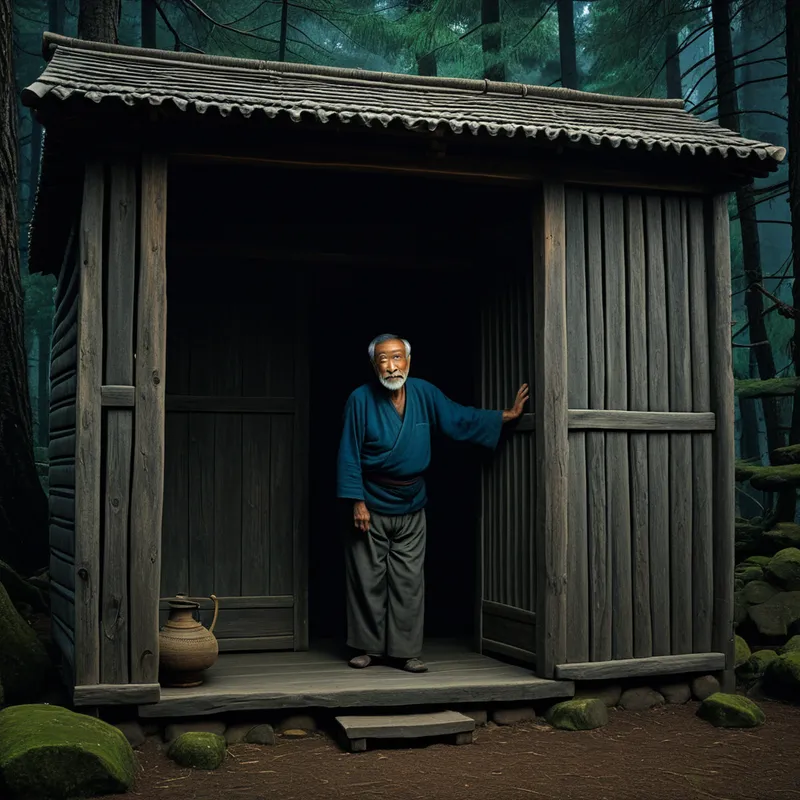
Listen, and let the cold mountain air fill your lungs. In a time when the world was thinner, when the veil between the human village and the spirit wilds was but a whisper of mist, there lived an old woodcutter. His name is lost to the pines, but his heart was known to be kind, worn smooth by solitude and hard work. One evening, as the winter sun bled behind the peaks and the world hushed under a blanket of deepening blue, he made his way home through the silent forest. His breath plumed in the air, and the only sound was the crunch of frost underfoot.
But as he neared his lonely hut at the forest’s edge, a new sound wove through the twilight. Not the call of an owl or the rustle of a fox. It was a sound like water over stones, like wind through high reeds—a soft, rhythmic rustling. Drawn by a curiosity deeper than fear, he crept to the edge of his clearing and hid behind the gnarled trunk of an ancient cedar.
There, in the silver wash of the rising moon, danced a being of impossible grace. It was a tsuru, a crane, but unlike any earthly bird. Its feathers were not merely white; they held the luminescence of fresh snow under starlight, each one edged with a hint of celestial silver. With a solemn, sacred precision, it began the Mai. Its long neck curved like a calligrapher’s brushstroke against the dark sky. Its wings swept wide, not to fly, but to trace great, arcing circles in the frozen air, stirring motes of ice-light into spirals. Its slender legs lifted and placed with a timeless, hypnotic rhythm, a silent music written in movement upon the earth.
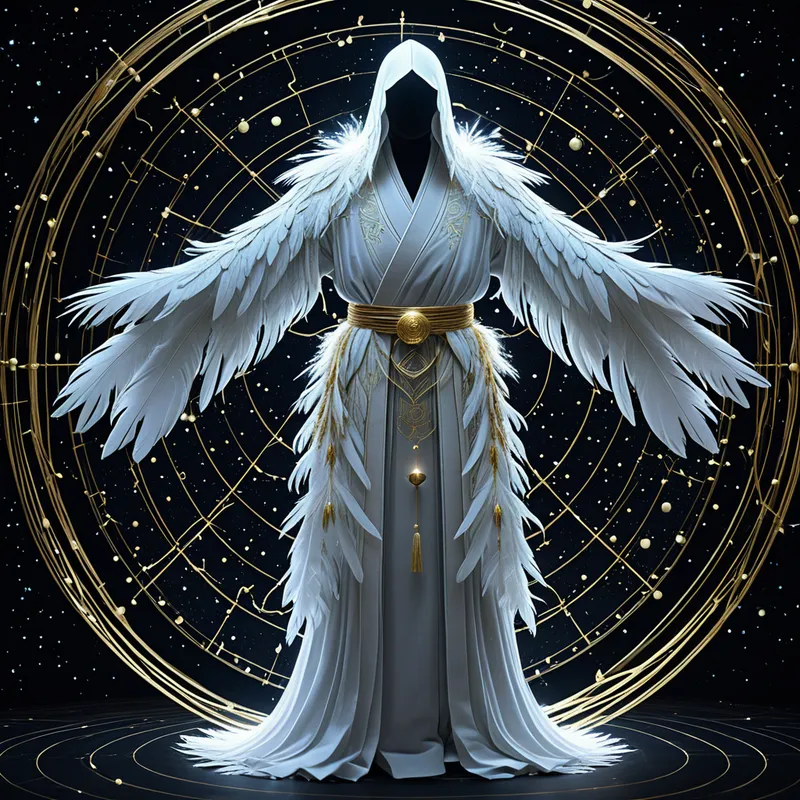
The woodcutter’s heart ceased its toil and simply beheld. He forgot the chill, his hunger, his very self. He was a vessel filled only with this transcendent sight. For what felt like an eternity and a single breath, the crane danced its story of wind, cloud, and starry migration. Then, as the dance reached its zenith, the crane paused. In a gesture of profound trust or profound weariness, it began to shed its glorious plumage. One by one, the luminous feathers drifted down, not scattering, but gathering, weaving themselves upon a low-hanging pine bough. They coalesced, shimmering, into a robe of such breathtaking beauty it made the moon seem dull—the Hagoromo.
The crane, now a stunningly beautiful woman clad in a simple white kimono, stepped forward and gently lifted the robe. She held it for a moment, a look of deep contemplation on her face, before laying it carefully over a rock. She walked to the woodcutter’s frozen pond and bent to gaze at her reflection, a stranger in a mortal world.
It was then that the woodcutter, his soul still singing from the dance, acted not from greed, but from a desperate, awe-struck desire to preserve this miracle. He slipped from his hiding place, darted forward, and seized the Hagoromo. The celestial woman turned, her eyes wide not with anger, but with a profound and tragic shock.
“Please,” she said, her voice the sound of distant wind chimes. “That robe is my wings, my home, my very nature. Without it, I cannot return to my place in the heavens. I am trapped here.” The woodcutter, clutching the impossibly light yet heavy fabric, saw the truth in her eyes. He had witnessed the divine, and in his human grasp, he now held it captive. A bargain was struck, born of his guilt and her necessity: he would return the Hagoromo, but only after she performed the Tsuru no Mai for him once more. She agreed, her expression a mask of resigned sorrow.
And so she danced again. But this dance was different. It was not an offering of beauty to the night, but a performance under duress, a sacred rite made transaction. The woodcutter watched, but the magic was now tinged with the salt of mortal tears. As the final movement ceased, he, true to his word, returned the robe. The woman—the crane—clasped it to her chest. As she donned it, her form shimmered, blurred, and she ascended, not with a flap of wings, but by dissolving into a spiral of light and feather, leaving the woodcutter alone forever in his clearing, haunted by a beauty he could never truly possess, and a freedom he had briefly, terribly, constrained.
Cultural Origins & Context
The tale of the Tsuru no Mai is a mukashibanashi, a story from the ancient past, with roots likely stretching back to the animistic foundations of Shinto. It exists in many regional variations, often attached to specific shrines or landscapes, suggesting it served as a yorishiro narrative. It was passed down orally for centuries by village elders and traveling storytellers before being recorded in medieval collections like the Shasekishū.
Its societal function was multifaceted. On one level, it was a cautionary tale about the boundaries between the human and spirit worlds (akeno and kakuriyo). It taught respect for the kami and the dangers of attempting to trap or commodify the divine. On another, it reflected the deep cultural reverence for the crane (tsuru), a symbol of longevity, fidelity, and good fortune. The crane’s transformation into a woman also connects to broader henge folklore, where animal spirits test or interact with humanity. The story served as a psychic container for the awe and terror of encountering something truly transcendent—a beauty so complete it reveals the poverty of possession.
Symbolic Architecture
At its core, the myth is a profound exploration of the sacred contract and its violation. The crane is not merely an animal but an emissary of the numinous, the Self in its transcendent aspect. Its dance is an unconscious content—a dream, a vision, a moment of sublime inspiration—spontaneously presenting itself to the ego (the woodcutter).
The dance is the psyche’s gift, offered in its own time and on its own terms. To demand an encore is to shackle the soul to the clock of the ego.
The Hagoromo is the symbol of autonomous spirit, the unique essence and freedom of this transcendent content. It is the means by which the divine moves between realms. The woodcutter’s theft represents the ego’s attempt to capture, own, and control a numinous experience—to turn a mystical encounter into a personal asset. He wants to have the beauty, not to be transformed by it.
The forced second dance is the critical tragedy. It is the archetypal pattern made neurosis. When the sacred is compelled to repeat itself to satisfy a mortal agenda, it loses its soul. The dance becomes a hollow performance, the connection becomes a contract, and the spontaneous symbol becomes a symptom. The crane’s eventual recovery of the robe and departure signifies that the autonomous psyche will ultimately reclaim its freedom, often leaving the ego in a state of profound, melancholic awakening—wiser, but eternally conscious of a paradise glimpsed and lost through one’s own hand.
The Dreamer’s Resonance
When this myth stirs in the modern dreamer, it often manifests as a pattern of entrapment and compelled performance. You may dream of a breathtakingly beautiful animal (a bird, a stag, a fox) that you somehow cage or photograph, only for it to sicken or its beauty to fade. You may dream of being forced to sing, dance, or create for a shadowy audience, your authentic expression feeling hollow and rehearsed.
Somatically, this can feel like a constriction in the chest or throat—the Hagoromo as a literal weight. Psychologically, you are likely in a process where some vital, creative, or spiritual part of you (the crane) has shown itself. But instead of honoring its autonomy, you have, perhaps out of fear of losing it or a desire for security, tried to institutionalize it. You’ve taken the inspired painting and turned it into a tedious commission. You’ve taken the moment of spiritual insight and tried to build a rigid dogma around it. The dream is the psyche’s rebellion, showing you the cost of this captivity: the life goes out of the very thing you sought to keep.

Alchemical Translation
The individuation process modeled here is not one of heroic conquest, but of reverent release and humbled witnessing. The crane is the Self. Its dance is the spontaneous, ordering activity of the Self as it seeks to manifest in the clearing of conscious life.
The woodcutter’s initial role is perfect: he is the humble, receptive ego, witnessing the Self’s activity without interference. This is the first stage of alchemical nigredo—the encounter with the divine in the dark forest of the unconscious. His fatal error is the move from witness to warden. This is the ego’s inflation, its hubris that believes it can manage the mystery.
The alchemical vessel is not a prison. It is a sacred space where transformation is allowed to occur, not commanded to perform.
The true transmutation begins in the aftermath of the crane’s departure. The woodcutter is left with the memory of the dance, the feeling of the Hagoromo, and the knowledge of his mistake. This is the precious ash left after the fire of the encounter—the albedo. He does not possess the crane, but he is irrevocably changed by it. His consciousness has been expanded to include the reality of a beauty that cannot be owned, a freedom that must be granted. He learns to be a caretaker of the clearing, not a captor of the visitor. In modern terms, we integrate the myth not by trying to recapture lost inspiration, but by creating the inner and outer conditions of humility, respect, and open space where the dance might choose to appear again—and by having the wisdom to let it leave when it must.
Associated Symbols
Explore related symbols from the CaleaDream lexicon: