
The Alchemy of Regret: When Dreams Hold the Path Not Taken
The Somatic Echo
It arrives not as a thought, but as a weather system within the body. A cold, hollow ache behind the sternum, as if a vital organ has been replaced with a cavity of still air. The shoulders carry a phantom weight, a gravitational pull toward a past that cannot be altered. There is a metallic taste on the tongue—the flavor of choices alloyed with consequence. This is the somatic signature of regret, a deep-time signal from the psyche that something within the personal history remains unassimilated, a ghost limb of a potential self that still pulses with a life it never got to live. Before the mind can conjure images of missed trains or unsaid words, the nervous system is already broadcasting the elegy.
The Dreamer's Log
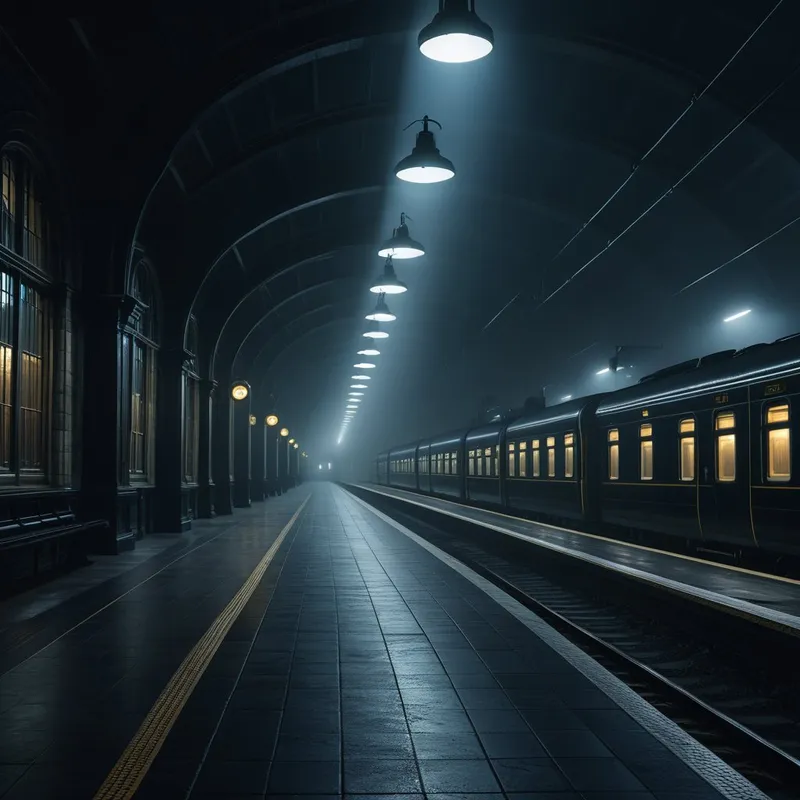
He stands on an empty platform in a train station carved from polished obsidian. The air smells of ozone and old newspapers. A single, silent train, its windows glowing with a warm, golden light, is already pulling away, accelerating into a tunnel of pure fog. He is not late; he was never meant to board. He simply watches it leave, knowing with absolute certainty that everything he ever wanted was on it, and his ticket is still in his hand, unused.
Alchemical Interpretation: The dream is not about a literal missed opportunity, but a confrontation with the archetype of the unlived life—the sovereign choice to remain in the known, safe stasis, while the vehicle of profound transformation departs without him.
The False Lead
Regret in dreams is not a verdict from a cosmic court, nor is it a sign of mere "bad luck" or poor character. To mistake it for simple guilt or shame is to misread the map. Guilt says, "I did something wrong." Shame says, "I am wrong." Regret, in its profound, dreaming form, whispers something more complex: "A version of me existed in a possible world, and I did not become them." It is the grief not for a sin, but for a self—a parallel identity that branched off at a decision point and now haunts the present, asking for recognition, not punishment.
Psychological Architecture
This haunting is the engine of Shadow work. The figure on the platform, the unsent letter, the door left unopened—these are not memories, but active, disowned parts of the psyche. In the language of internal family systems, they are exiles: bundles of potential, courage, desire, or vulnerability that were deemed too risky, too painful, or too disruptive to the survival system at the time. We made a choice for safety, for approval, for a manageable life, and in doing so, we sent a piece of our soul's potential into the inner exile of "what if."
Dreams of regret are the return of these exiles, not to torment, but to petition for reintegration. The individuation process here is a re-membering. It is the conscious, often painful, act of turning toward that hollow ache and listening. What part of me did I leave behind? What voice did I silence? What boldness did I trade for security? The work is to host this ghost, to let it tell its story of the life it could have lived, and in the telling, to reclaim its essential qualities—its passion, its honesty, its wildness—as nutrients for the self you are becoming now.
Mythic Resonance
We see this eternal drama in the Greek myth of Orpheus and Eurydice. Orpheus, granted the chance to lead his love back from the underworld, is given one condition: do not look back. His failure, that fatal glance over his shoulder, is not mere disobedience; it is the embodiment of paralyzing regret in the very moment of redemption. He looks back not out of doubt in Eurydice, but out of a catastrophic attachment to the trauma of loss itself. The myth tells us that the energy of regret, if turned upon the process of healing, can unravel the transformation at the threshold. Our modern "underworld" is the psyche's shadow, and our "Eurydice" is the exiled self we are trying to lead back into the light. The dream warns us not to look back with despair, but to walk forward with faith in the integration process itself.
Symbolic Nodes
- Empty Platforms/Departing Vehicles: The palpable absence of a critical life transition or path.
- Unsent Letters or Muted Phones: Frozen communication, truths that remain captive within.
- Locked Doors with Keys in Hand: The agency was present, but the will to use it was not.
- Mirrors Showing an Older or Different You: Confrontation with alternate timelines and selves.
- Watching a Scene from Behind Glass: The self as a passive observer of its own potential life.
- A Garden Overgrown or a House in Disrepair: Neglected aspects of the inner world or potential.
Archetypal Resonance
The energy of profound regret is most intimately aligned with The Shadow Ruler Archetype. In its healthy expression, the Ruler creates order, assumes responsibility, and steers the ship of self with sovereignty. Its shadow, however, is the Tyrant and the Control-Freak, obsessed with a perfect, faultless narrative. Dream-regret is the Tyrant's aftermath: a brutal audit of the kingdom of the self, highlighting every "failed" decision, every deviation from the "perfect plan." The somatic echo is the weight of the crown grown too heavy, the cold throne of self-judgment. Yet, within this harsh energy lies the alchemical potential: the Shadow Ruler's intense desire for a coherent, well-ordered self is the very fire that can, if turned from punishment to compassionate stewardship, forge a new sovereignty—one built not on the myth of perfect control, but on the integrated wisdom of every choice, every path, both taken and forsaken.
The Alchemical Process
The transmutation of regret is not an act of erasure, but of radical recombination. The base material is the leaden weight of the "mistake," the grief for the lost self. The heat required is the unbearable courage to fully feel that grief without narrative, to sit in the hollow ache without rushing to justify or condemn. This is the nigredo, the blackening.
The pressure is the conscious work of reframing: not "I regret that choice," but "What part of me was born from that choice? What strength was forged in its consequence? And what quality, now mourned as lost, can I reclaim in a new form in my present life?" This is the albedo, the whitening. The golden product—the citrinitas and rubedo—is sovereignty. It is the empowered understanding that you are not the victim of your past choices, but the author who gets to decide what those choices mean in the ongoing story of your life. The missed train's destination is integrated as a longing for movement, which can now fuel the next journey.
The Integration Protocol
Question 1: If the figure in my dream (the one watching the train leave, holding the unsent letter) could speak without shame or justification, what single sentence would it say about what it truly wanted?
Question 2: What is one small, concrete strength or insight I possess today that is a direct result of the very choice I sometimes regret?
Question 3: If I imagined that "missed path" as a character that split off from me, what gift did it take with it that my current self is now ready to welcome back?
Action 1 (Somatic Reclamation): When you feel the hollow ache of regret, place a hand over your sternum. Breathe into that space for three cycles. On the fourth inhale, imagine breathing in a soft, copper light. On the exhale, let the breath carry out the cold, static air. Do not seek to change the feeling, only to share your body's warmth with it.
Action 2 (Unsent Letter Ritual): Write the letter, say the speech, have the conversation you dream of regretting. Write it with full, unfiltered emotion. Then, do not send it. Instead, perform a simple ritual of release: read it aloud to a tree, burn it safely (witnessing the smoke as the transformation of matter), or seal it in an envelope and place it in a drawer, acknowledging its truth is now held, not trapped.
Action 3 (Creative Mapping): Draw two parallel, winding paths on a large sheet of paper. Label one "The Path Taken." Along it, note key milestones, both difficult and joyful. Label the other "The Ghost Path." Here, using symbols, colors, or abstract shapes, not words, intuitively express the energies of what you imagine lived there—not events, but feelings like "wild freedom," "quiet solitude," "creative chaos." Then, draw bridges or tributaries between the two paths. Where can the energy of the Ghost Path irrigate the landscape of your Path Taken now?
Final Validation
The dreams that visit you with the cold air of regret are among the most demanding and the most honorable. They testify that your soul is not content with a half-lived life, that it still holds a blueprint of your fullest potential. The weight you carry is the weight of your own significance. To feel this depth of sorrow for paths untrod is to confirm the immense value of the journey itself. Let this difficult feeling be the proof not of your failure, but of your capacity for a love so vast it grieves for even the versions of you that never were. From that love, you can begin the true work: not of rewriting history, but of gathering all your selves—the chosen, the unchosen, the mourned, and the nascent—into a sovereign, integrated whole. The platform is not empty. You are standing on it. The next journey is always waiting for the conductor to take the helm.