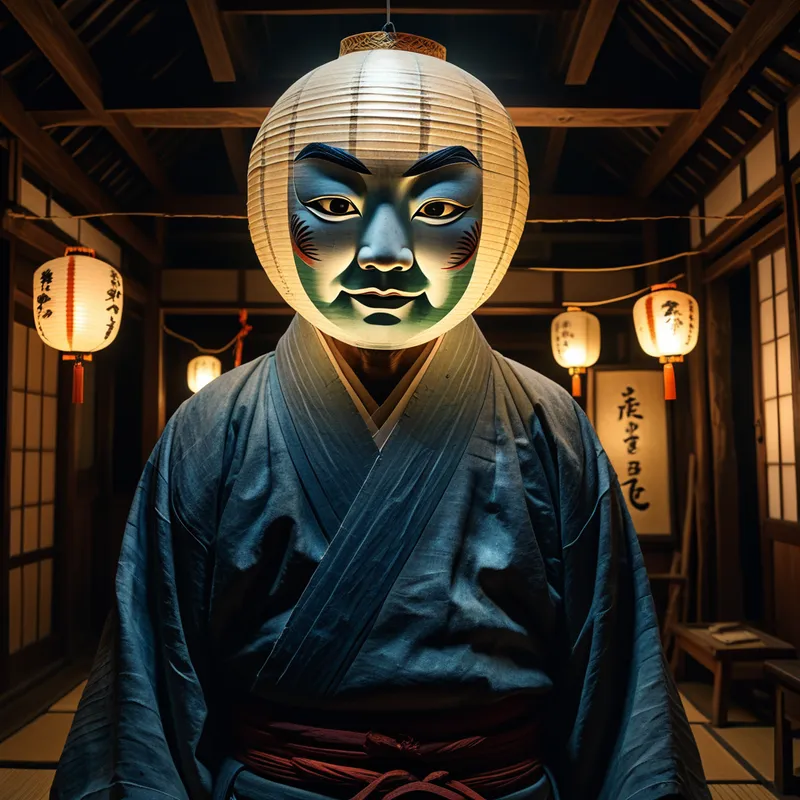
Tsukumogami Myth Meaning & Symbolism
In Japanese folklore, objects used for a century awaken with spirits, teaching that everything possesses a soul and demands respect.
The Tale of Tsukumogami
Listen, and hear the tale not of gods or demons, but of the quiet ones. The ones who dwell in the shadowed corner of the storeroom, who rest beneath the floorboards, who gather dust in the forgotten alcove. For a hundred years, they served. A paper lantern, its bamboo frame bent from holding light. A wooden geta sandal, its teeth worn smooth by ten thousand steps. A ceramic sake cup, its lip chipped from a joyful toast long silenced. A worn-out straw raincoat, its fibers remembering every storm.
For ninety-nine years and three hundred and sixty-four days, they are merely things. Then, on the night of the hundredth year, when the moon is a sliver and the world holds its breath, a change stirs in the silence. It is not a bang or a crash, but a sigh—a collective, ancient exhalation from the realm of objects. The lantern’s painted crane seems to shift its wings. The sandal’s thong, where a toe once rested, grows warm. In the cup’s glaze, a face, faint and sorrowful, swims to the surface.
They awaken. Not with the fury of betrayed gods, but with the profound melancholy of the abandoned. The biwa lute, its strings long silent, remembers the song it last played and weeps resin tears. The shoji screen, torn and patched, groans with the memory of every hand that slid it open and shut. They gather in the liminal hours before dawn, a parliament of the discarded. They do not seek vengeance, but recognition. A whispered conference in the attic, a rustling procession through the garden. They are the Tsukumogami, and their existence is a question posed to the silent house: "Did our service mean nothing?"
Cultural Origins & Context
The concept of Tsukumogami is deeply rooted in the animistic heart of Shinto, where kami (spirits) reside in natural phenomena, places, and, significantly, objects. This belief system, combined with Buddhist ideas of impermanence and the interconnectedness of all life, created fertile ground for stories where the boundary between person and thing is porous. The tales were codified in texts like the Tsukumogami-ki and flourished during the Muromachi period (14th-16th centuries), a time of social upheaval where the lifespan of objects—and people—could feel precarious.
These stories were not mere ghost tales for entertainment. They served a vital societal function: teaching mono no aware, the poignant awareness of the transience of things, and the ethic of mottainai, a sense of regret concerning waste. By imagining a spirit in a worn-out tool, the culture enforced respect for craftsmanship, gratitude for service, and mindful consumption. The storyteller, perhaps an elder or a traveling monk, used these narratives to instill a sacred responsibility toward the material world, reminding listeners that everything they used was a companion on life’s journey.
Symbolic Architecture
At its core, the Tsukumogami myth is a profound meditation on the soul of the inanimate and the psychology of relationship. The object is a vessel for human energy, intention, and memory. Every use imbues it with a fragment of the user’s life.
The object is the silent witness, the container of our daily rituals. To discard it carelessly is to discard a chapter of our own story, unread.
Symbolically, the Tsukumogami represents the psyche's repressed contents—not necessarily dark shadows, but neglected memories, abandoned skills, and unused potentials. The hundred-year slumber is the period of latency, where these aspects are stored away in the attic of the unconscious. Their awakening is not an attack, but a demand for integration. The chipped cup symbolizes imperfect but cherished service; the torn raincoat represents protection now outgrown. They are the "orphaned" parts of our personal history, asking not for dominance, but for acknowledgment and a dignified retirement.
The Dreamer's Resonance
When this myth pattern surfaces in modern dreams, it signals a process of re-membering. One might dream of a childhood home where familiar furniture has faint, watchful eyes, or of a box of old possessions that hum with a quiet energy. The somatic feeling is often one of poignant density—a heavy, melancholic warmth in the chest, a tightening in the throat.
Psychologically, this is the unconscious presenting its inventory of neglected attachments and unresolved histories. The dreaming culture.") mind, like the storeroom, is full of psychological "objects": old identities (the uniform from a first job), abandoned creative projects (the paintbrush with dried paint), or outmoded coping mechanisms (the locked diary). The Tsukumogami in the dream are these aspects personified. Their gathering is not a threat, but an invitation to review, to thank, and to consciously decide what to keep close and what to release with ceremony. The process is one of clearing psychic clutter not through violent purge, but through sacred acknowledgment.

Alchemical Translation
The alchemical journey modeled by the Tsukumogami is the transmutation of neglect into reverence, and waste into wisdom. For the modern individual hurtling through a disposable culture, the myth outlines a path of individuation through mindful re-engagement with one's own material and psychological past.
The first stage is the long incubation—the 100 years. This is our life, accumulating experiences, identities, and emotional residues, often without conscious processing. The "awakening on the hundredth year" is the psychological crisis or moment of introspection where this accumulated mass of the past suddenly makes its presence felt. It can feel melancholic, overwhelming, even haunting.
Individuation requires making peace with all that has served you, even that which is now worn out or outgrown. The spirit of the old must be honored before the new can be fully embodied.
The alchemical operation is consecration. One does not fight the spirits of old shoes or broken clocks. One listens. The modern translation is the practice of actively reviewing one's history—through journaling, therapy, or ritual—and consciously thanking past versions of oneself, old relationships, and former passions for their service. This is the nigredo, the blackening, where the weight of the past is fully felt. The albedo, the whitening, is the understanding and forgiveness that follows. The final rubedo, the reddening, is the integration of that gratitude into a present life lived with more intention and less waste, where one relates to both objects and inner states not as disposable commodities, but as temporary, sacred companions on the journey. The Tsukumogami, once acknowledged, do not haunt; they retire, leaving the psyche lighter, clearer, and more whole.
Associated Symbols
Explore related symbols from the CaleaDream lexicon: