Triumphal Procession Myth Meaning & Symbolism
A conquering general, hailed as a god, parades through Rome with his spoils and captives, shadowed by a slave whispering of mortality.
The Tale of Triumphal Procession
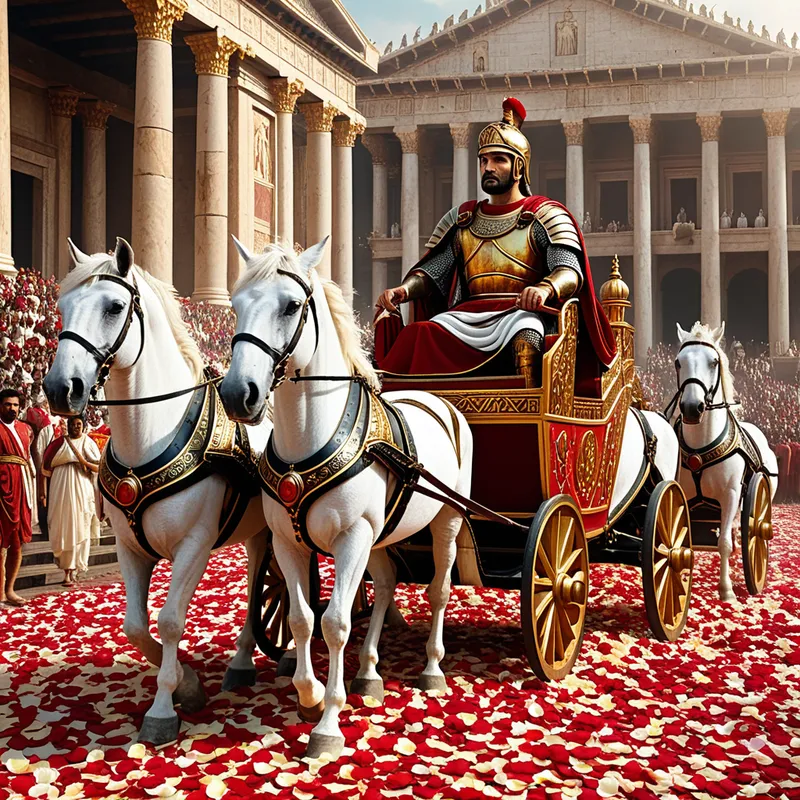
Hear now the roar that shakes the seven hills. The sun is a hammer on gold, and the air is thick with the scent of crushed roses and sweat. Beyond the pomerium, where the army must lay down its steel, a single man is being remade. He is not a man today. He is the living statue of Victory.
His skin is painted the color of blood and divinity, minium. Upon his brow rests the corona triumphalis, not gold, but living laurel. He stands in the quadriga, a chariot that seems to float, drawn by four horses whose coats shine like polished marble. In his hand, an ivory scepter tipped with an eagle. Behind him, a slave holds a heavy golden corona civica over his head—a crown of immense weight, a crown that whispers, not of glory, but of duty.
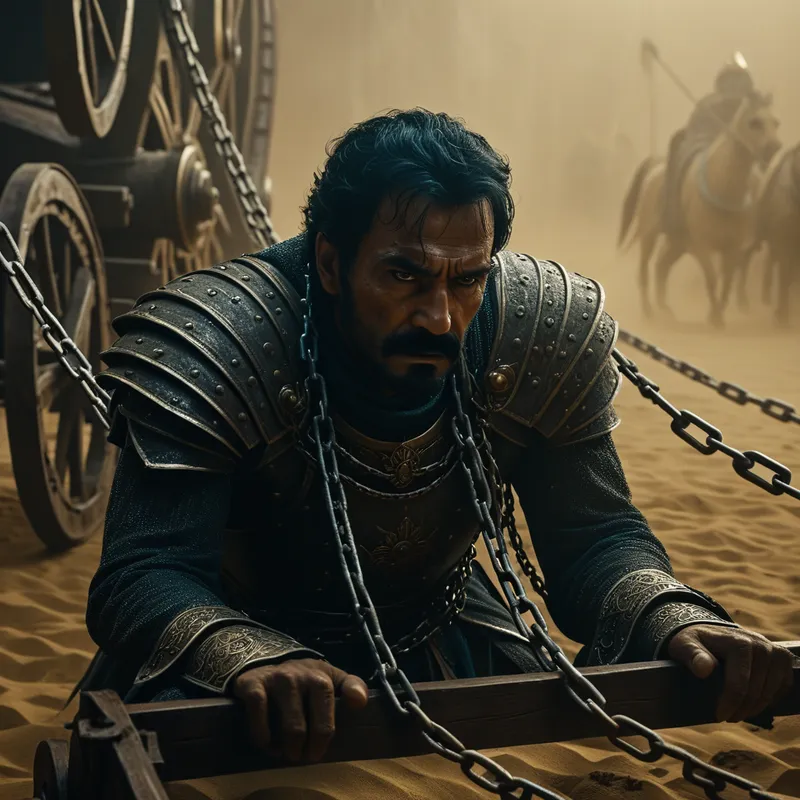
Before him flows [the river](/myths/the-river “Myth from Buddhist culture.”/) of his proof. The spoils: chests spilling silver, statues of foreign gods looking lost, paintings of shattered cities. Then, the living spoils. The captured kings and chieftains, their chains clinking a dull counter-rhythm to the blaring cornu. Their eyes are downcast, or blazing with a fire that has nowhere to go. They are the embodied shadow of his victory, the necessary proof that the chaos beyond the borders has been subdued and dragged into the light of Ius.
The crowd is a single, heaving beast. Their voices are a storm of “Io Triumphe!” Petals rain down like a perfumed snow. For this day, for this sacred procession along the Via Sacra, he is allowed to touch the divine. He is Jupiter Optimus Maximus on Earth. The Senate, the people, the very stones of the temples acknowledge it.
But listen. Beneath the roar, a whisper. The slave behind him, holding the golden crown, leans close to his ear, his breath a cold thread in the hot, celebratory air. He whispers the same phrase, over and over, a sacred incantation meant for one ear alone: “Respice post te. Hominem te esse memento. [Memento mori](/myths/memento-mori “Myth from Christian culture.”/).” Look behind you. Remember you are a man. Remember you must die.
[The chariot](/myths/the-chariot “Myth from Tarot culture.”/) rolls on, past the screaming faces, towards the stark white bulk of the Capitolium. There, at [the summit](/myths/the-summit “Myth from Taoist culture.”/), he will offer the laurels to Jupiter. The captive kings, their purpose served, will be led away to the darkness of the Tullianum. The man, his red paint already cracking, will walk back down the hill. The god is dead. Long live the man. The procession is complete.
Cultural Origins & Context
This was not merely a parade; it was the highest ritual of the Roman state, a carefully choreographed drama of power, piety, and politics. The [Triumph](/myths/triumph “Myth from Roman culture.”/) was granted by the Senate to a general who had achieved a significant foreign victory, killed at least 5,000 of the enemy, and expanded the territory of Rome. It was a privilege, not a right, and fierce political battles were fought over its awarding.
The ritual was a liminal journey. The general, the triumphator, began outside the sacred city boundary (pomerium), in his role as military commander (imperator). The procession physically and symbolically crossed that threshold, transforming him into a temporary, sacred king-like figure within the city. The entire event was a thanksgiving to Jupiter Optimus Maximus, the ultimate source of Rome’s victory and order. By displaying the captured wealth and leaders, it made tangible the abstract concept of Roman supremacy and the subduing of external chaos (barbaricum). The slave’s reminder of mortality was a crucial piece of religious theater—a public check on hubris, a symbolic purification that prevented the human victor from being consumed by the divine role he played.
Symbolic Architecture
At its core, the Triumphal Procession is a myth of [the ego](/myths/the-ego “Myth from Jungian culture.”/)‘s supreme [moment](/symbols/moment “Symbol: The symbol of a ‘moment’ embodies the significance of transient experiences that encapsulate emotional depth or pivotal transformations in life.”/) of conscious [achievement](/symbols/achievement “Symbol: Symbolizes success, mastery, or reaching a goal, often reflecting personal validation, social recognition, or overcoming challenges.”/), and the unavoidable [shadow](/symbols/shadow “Symbol: The ‘shadow’ embodies the unconscious, repressed aspects of the self and often represents fears or hidden emotions.”/) that accompanies it.
The triumphator represents the conscious [personality](/symbols/personality “Symbol: Personality in dreams often symbolizes the traits and characteristics of the dreamer, reflecting how they perceive themselves and how they believe they are perceived by others.”/) at its peak—the [Hero](/symbols/hero “Symbol: A hero embodies strength, courage, and the ability to overcome significant challenges.”/) who has conquered the outer world, achieved monumental success, and received full societal validation. He is order, [clarity](/symbols/clarity “Symbol: A state of mental transparency and sharp focus, often representing resolution of confusion or attainment of insight.”/), and willpower personified. The painted god-form is the [persona](/symbols/persona “Symbol: The social mask or outward identity one presents to the world, often concealing the true self.”/) at its most inflated, [the mask](/myths/the-mask “Myth from Various culture.”/) of ultimate capability.
The greatest victory is a tomb for the parts of the self that were deemed unworthy of the march.
The captives in chains are the essential counterpart. They symbolize all that was defeated, suppressed, or denied to achieve this victory: the “barbaric” emotions, the vulnerable parts of [the self](/myths/the-self “Myth from Jungian culture.”/), the instincts, the failures, the enemies within. They are the psychological shadow, made visible and paraded in humiliation. Yet, they are not destroyed; they are brought into the [city](/symbols/city “Symbol: A city often symbolizes community, social connection, and the complexities of modern life, reflecting the dreamer’s relationships and societal integration.”/), into the [realm](/symbols/realm “Symbol: The symbol of ‘Realm’ often signifies the boundaries of one’s consciousness, experiences, or emotional states, suggesting aspects of reality that are either explored or ignored.”/) of [consciousness](/symbols/consciousness “Symbol: Consciousness represents the state of awareness and perception, encompassing thoughts, feelings, and experiences.”/). Their [presence](/symbols/presence “Symbol: Presence in dreams often signifies awareness or acknowledgment of something significant in one’s life.”/) is proof that the battle happened.
The slave whispering “Memento Mori” is the voice of the transcendent function, the reconciling third. He bridges the inflated god (ego) and the chained captive (shadow) with the ultimate [truth](/symbols/truth “Symbol: Truth represents authenticity, honesty, and the quest for knowledge beyond mere appearances.”/) of [human](/symbols/human “Symbol: The symbol of a human represents individuality, complexity of emotions, and social relationships.”/) limitation. He is the embodied [awareness](/symbols/awareness “Symbol: Conscious perception of self, surroundings, or internal states. Often signifies awakening, insight, or heightened sensitivity.”/) that all temporal achievements are finite, that the [persona](/myths/persona “Myth from Greek culture.”/) is a temporary [costume](/symbols/costume “Symbol: A costume symbolizes the roles we play in life and the masks we wear, often reflecting personal desires or societal expectations.”/), and that true [integration](/symbols/integration “Symbol: The process of unifying disparate parts of the self or experience into a cohesive whole, often representing psychological wholeness or resolution of internal conflict.”/) requires acknowledging one’s mortal, flawed humanity.
The Dreamer’s Resonance
When this myth stirs in the modern [psyche](/myths/psyche “Myth from Greek culture.”/), it rarely appears as togas and chariots. It manifests as dreams of grand awards ceremonies where the dreamer is receiving a trophy, only to notice their own hands are stained or the audience’s faces are blank. It is the dream of a triumphant promotion at work, followed by a haunting sense of emptiness or the sudden appearance of a forgotten, impoverished friend from the past. It is the somatic feeling of applause ringing in the ears while a cold knot of anxiety tightens in the stomach.
These dreams signal a critical moment of psychological rebalancing. The conscious ego has achieved a hard-won goal—a career milestone, creative completion, social recognition—and is basking in its triumph. The unconscious, however, is presenting the bill. The dream is the “slave’s whisper,” reminding the dreamer of what was sacrificed, neglected, or arrogantly dismissed on the path to that success. The captive in the dream is often a symbol of a repressed talent, a neglected relationship, a denied vulnerability, or an old wound that was buried rather than healed. The procession is not a celebration, but a forced inventory.

Alchemical Translation
The alchemical journey mirrored in the Triumph is the opus contra naturam—the work against nature, which here means the work against the ego’s natural desire to identify solely with its victories.
[The first stage](/myths/the-first-stage “Myth from Alchemical culture.”/) is the victoria (victory), the conscious effort and success in the outer world (the campaign). This is the [nigredo](/myths/nigredo “Myth from Alchemical culture.”/) in a sense, the battle in the dark, chaotic field of endeavor. The triumphant return is the albedo, the whitening, where the achieved goal is purified, celebrated, and raised to a brilliant, seemingly perfect state (the god-like triumphator).
To integrate the triumph, one must first kneel in the temple of the greater Self and offer up the laurels of the smaller self.
The crucial, transformative stage is the [rubedo](/myths/rubedo “Myth from Alchemical culture.”/), the reddening, which is not the red paint of divinity, but the blood-red awareness of mortality and integration. This is enacted by the ritual’s end. The triumphator must offer his laurels to Jupiter—symbolically surrendering his personal achievement to a transpersonal principle, acknowledging a power greater than his own will. He must then descend from the Capitol, leaving the divine role behind. Finally, he must, psychologically, turn and face his captives. This is the individuation imperative: to not leave the defeated aspects of the self to rot in the psychic dungeon, but to truly see them, to understand their necessity, and to integrate their energy.
The true “triumph” is not the parade, but the quiet walk home afterwards, when the man, stripped of his paint, carries within him both the memory of the cheers and the echo of the chains, having touched divinity but chosen humanity. The procession ends when the hero becomes whole.
Associated Symbols
Explore related symbols from the CaleaDream lexicon: