Triumph Myth Meaning & Symbolism
A sacred, perilous ritual where a victorious general, touched by Jupiter, parades through Rome, walking the razor's edge between divine honor and mortal hubris.
The Tale of Triumph
Hear now the tale not of a god, but of a man who for one day became one. Listen to the roar that shakes the seven hills, a sound like [the earth](/myths/the-earth “Myth from Hindu culture.”/) itself cracking open. It begins not on a battlefield, but in the profound silence of the pomerium, the invisible line that separates the wild fury of Mars from the civil order of Quirinus.
Beyond the wall, he is Imperator. His cloak is stained with the dust of foreign lands and the smoke of burning cities. He has conquered, and the Senate has spoken the sacred words: “Iovem Optimum Maximum rem divinam facere!”—“Make a sacred rite to Jupiter, Best and Greatest!” The gate opens.
First comes the thunder of the captured wealth: chests overflowing with silver from Macedon, amber from the Hyperborean north, silks that whispered of lands beyond the sunrise. Then, the groan of the earth under the weight of chained kings and weeping queens, their royal purple now the color of defeat. Their eyes are downcast, for to look upon the coming glory is to be blinded.
Then, the legionaries. Their marching feet are the heartbeat of Rome. They sing not hymns of war, but coarse, satirical songs about their own general, mocking his pride, cutting him down to mortal size even as they raise him to the heavens. This is the sacred joke, the necessary balance.
And then… he appears.
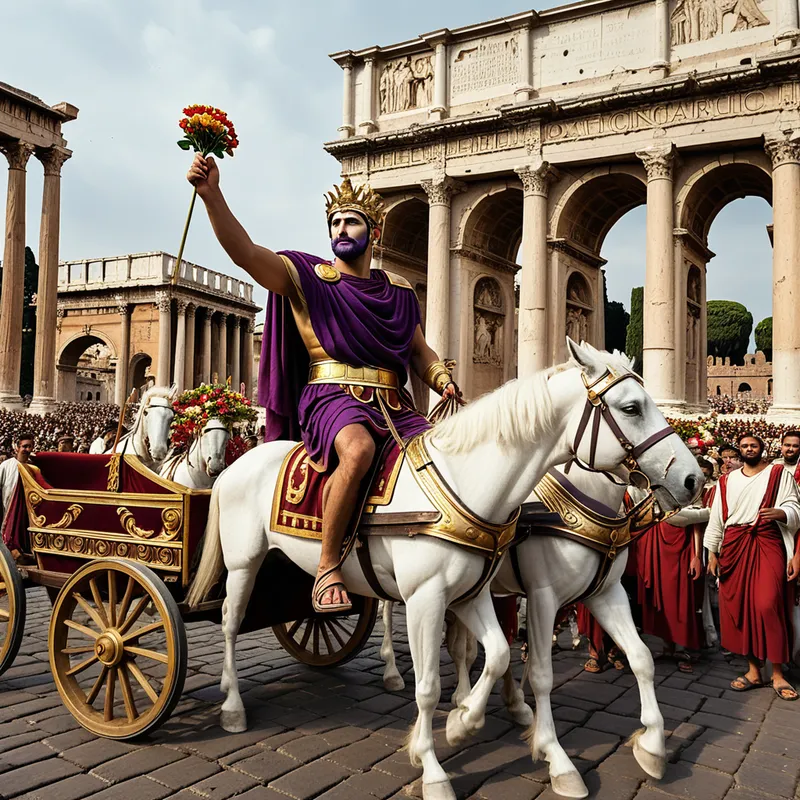
Standing in the quadriga, drawn by four stallions whiter than the Alban snow, is a figure of terrifying splendor. He wears the toga picta, a garment that belongs to the statue of Jupiter in his temple. In his hand, an ivory scepter tipped with an eagle. But it is his face that stops the breath. It is painted the deep, sacred red of Jupiter Optimus Maximus himself. He is no longer merely a man. For this procession, he is the living embodiment of Rome’s divine fortune.
Yet, clinging to [the chariot](/myths/the-chariot “Myth from Tarot culture.”/) behind him is a slave. This man holds a heavy golden crown of oak leaves over the triumphator’s head. And into his ear, with every step, he whispers the same phrase, a chilling counterpoint to the roaring crowd: “[Memento mori](/myths/memento-mori “Myth from Christian culture.”/). Remember you must die.”
The procession snakes through the Forum, past the ghosts of kings and the altars of forgotten gods, climbing the steep slope to the Capitoline Hill. The air is thick with incense and the smell of crushed flowers. The crowd’s adulation is a palpable force, a drug more potent than wine. It is the peak of human achievement, the very summit of [the world](/myths/the-world “Myth from Tarot culture.”/).
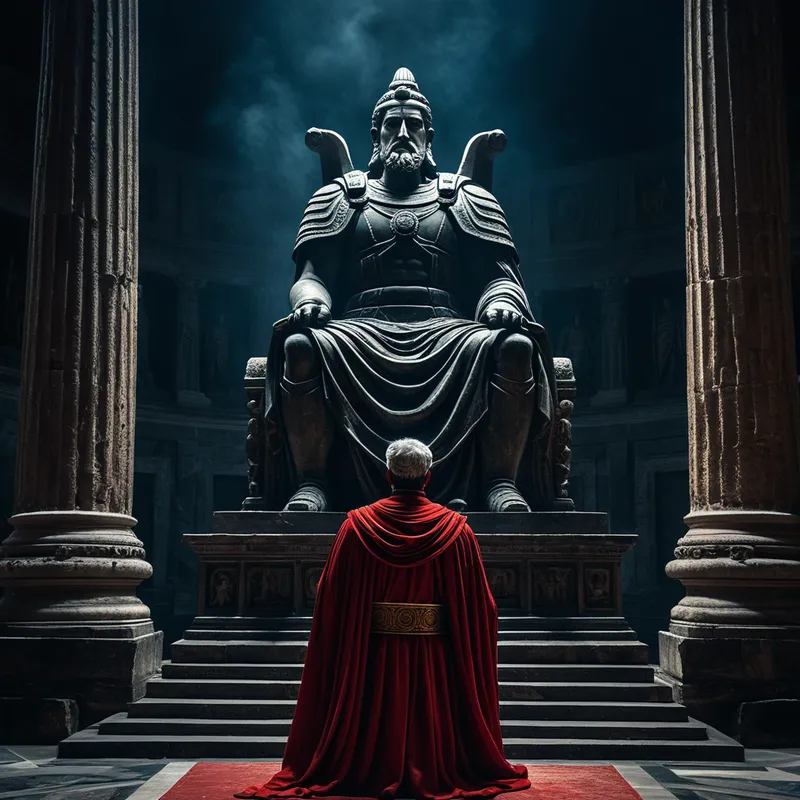
But the destination is not a throne. It is the dark, cavernous interior of Jupiter’s temple. There, in the sudden quiet, before the stern, colossal statue of the god, the painted man kneels. He removes the laurel wreath of victory from his own brow and places it in the god’s stone hand. The red paint, now caked and cracking, feels like a mask of dried blood. The slave falls silent. The god’s painted face looks down, impassive. The rite is complete. The god has been honored. The man, drenched in borrowed divinity, is returned to himself, hollowed out and purified by the giving back of what was never truly his to keep.
Cultural Origins & Context
The Roman Triumph was not merely a victory parade; it was the highest sacred ritual of the Roman state, a complex theological and political drama. Its origins are shrouded in the mythic past, attributed to Rome’s first kings, and it was always understood as a rite of immense religious potency. The general (imperator) did not “win” a triumph by right. He had to petition the Senate, and the Senate, in turn, had to discern if the victory met strict, archaic criteria: it must be over a foreign enemy of significant stature, it must be conclusive, and it must have expanded the territory of Rome.
The ritual was a powerful societal pressure valve and integration mechanism. It publicly transformed the potentially dangerous, charismatic military leader—a man swollen with felicitas and standing outside the normal bounds of the city’s law—into a temporary vessel of the state’s divine favor. The mocking songs of the soldiers, the whispering slave, and the final offering at [the temple](/myths/the-temple “Myth from Jewish culture.”/) were all carefully staged elements to drain the poison of hubris from the event. It celebrated the individual’s achievement while simultaneously re-absorbing him and his dangerous, Mars-like energy back into the collective body of Rome, under the ultimate authority of Jupiter and the Senate. It was a story the state told itself about power: how to wield it, how to celebrate it, and, most crucially, how to surrender it.
Symbolic Architecture
At its core, the Triumph is an archetypal [drama](/symbols/drama “Symbol: Drama signifies narratives, emotional expression, and the exploration of human experiences.”/) of the [inflation](/symbols/inflation “Symbol: A dream symbol representing feelings of diminishing value, loss of control, or expansion beyond sustainable limits in one’s life or psyche.”/) and necessary [deflation](/symbols/deflation “Symbol: A symbolic loss of energy, value, or purpose; often represents a draining of vitality or a collapse of expectations.”/) of [the ego](/myths/the-ego “Myth from Jungian culture.”/). The triumphator is the ego at its most grandiose, believing itself to be the sole author of its [fortune](/symbols/fortune “Symbol: Fortune symbolizes luck, wealth, and opportunities that may be present or sought in one’s life.”/). The red paint, the [chariot](/symbols/chariot “Symbol: The chariot signifies control, direction, and power in one’s journey through life.”/), the adulation—these are the trappings of identification with the [archetype](/symbols/archetype “Symbol: A universal, primordial pattern or prototype in the collective unconscious that shapes human experience, behavior, and creative expression.”/), in this [case](/symbols/case “Symbol: A case often signifies containment, protection of personal matters, and the need for organization in one’s life.”/), the Sovereign or [King](/symbols/king “Symbol: A symbol of ultimate authority, leadership, and societal order, often representing the dreamer’s inner power or external control figures.”/) [archetype](/symbols/archetype “Symbol: A universal, primordial pattern or prototype in the collective unconscious that shapes human experience, behavior, and creative expression.”/) embodied by Jupiter.
The crown held by the slave is the weight of destiny itself; its glitter is a reflection of the mortal skull beneath.
The procession is the [journey](/symbols/journey “Symbol: A journey in dreams typically signifies adventure, growth, or a significant life transition.”/) of this inflated [consciousness](/symbols/consciousness “Symbol: Consciousness represents the state of awareness and perception, encompassing thoughts, feelings, and experiences.”/) through the world it believes it has mastered (the spoils, the captives). Yet, the [ritual](/symbols/ritual “Symbol: Rituals signify structured, meaningful actions carried out regularly, reflecting cultural beliefs and emotional needs.”/) ingeniously builds in its own corrective. The [soldier](/symbols/soldier “Symbol: A soldier in dreams often symbolizes duty, sacrifice, and the struggle for self-discipline. It can also indicate feelings of loyalty or conflict, both externally and within oneself.”/)’s songs represent the voice of the common, grounded [reality](/symbols/reality “Symbol: Reality signifies the state of existence and perception, often reflecting one’s understanding of truth and life experiences.”/)—the [shadow](/symbols/shadow “Symbol: The ‘shadow’ embodies the unconscious, repressed aspects of the self and often represents fears or hidden emotions.”/) that knows the general’s flaws. The whispering slave is the constant, gnawing voice of the Self, the transcendent totality of the [psyche](/myths/psyche “Myth from Greek culture.”/), reminding the ego of its true, finite place in the larger order. The [climax](/symbols/climax “Symbol: The peak moment in a narrative or musical composition, representing resolution, transformation, or ultimate expression.”/) at Jupiter’s [temple](/symbols/temple “Symbol: A temple often symbolizes spirituality, sanctuary, and a deep connection to the sacred aspects of life.”/) is the essential act of sacrifice: the ego must offer its [achievement](/symbols/achievement “Symbol: Symbolizes success, mastery, or reaching a goal, often reflecting personal validation, social recognition, or overcoming challenges.”/), its “[crown](/symbols/crown “Symbol: A crown symbolizes authority, power, and achievement, often representing an individual’s aspirations, leadership, or societal role.”/),” back to the [source](/symbols/source “Symbol: The origin point of something, often representing beginnings, nourishment, or the fundamental cause behind phenomena.”/) from which all power truly flows—the transpersonal, the divine, the unconscious totality. Only through this surrender is the individual purified and re-integrated, moving from a state of dangerous identification with an archetype to a conscious [relationship](/symbols/relationship “Symbol: A representation of connections we have with others in our lives, often reflecting our emotional state.”/) with it.
The Dreamer’s Resonance
When the pattern of the Triumph stirs in the modern personal unconscious, it often manifests in dreams of profound, yet uneasy, success. You may dream of receiving a major award or promotion, but the ceremony feels alienating, the applause hollow. You might be driving a magnificent vehicle (the modern quadriga) through familiar streets that have become strangely monumental and empty. The key somatic sensation is one of simultaneous elevation and profound vulnerability—the dizzying height of the podium, the chilling whisper just beneath the roar of the crowd.
This dream signals a psychological state of inflation. The dreamer’s conscious attitude has achieved something significant—a career goal, a creative completion, a hard-won personal battle—and has become dangerously identified with that success. The ego has “painted itself red” and put on the toga picta. The dream is the psyche’s innate ritual, staging the Triumph to force a confrontation with the missing elements: the mocking shadow (the critical inner voice or imposter syndrome), the memento mori (the awareness of life’s [impermanence](/myths/impermanence “Myth from Buddhist culture.”/) and one’s own limits), and the ultimate need to offer the achievement to something greater than the personal self. It is an invitation to initiate a conscious process of humility before the dreamer feels life itself enact a crushing, involuntary deflation.

Alchemical Translation
The alchemical journey mirrored in the Triumph is the individuation process, specifically the stage of [nigredo](/myths/nigredo “Myth from Alchemical culture.”/) that must follow the brilliant, solar albedo of success. In psychological alchemy, the ego is not the goal but [the vessel](/myths/the-vessel “Myth from Alchemical culture.”/). The Triumph provides the precise ritual for transmuting the leaden weight of raw, ambitious drive ([prima materia](/myths/prima-materia “Myth from Alchemical culture.”/)) into the gold of authentic, integrated Selfhood.
The chariot ride is the expansion of consciousness, but the temple is its crucible, where the gold of achievement is tested in the fire of surrender.
First, one must consciously “claim the chariot”—own one’s accomplishments and the energy that fueled them. This is the albedo, the brightening. But the critical, alchemical work begins with the intentional invitation of the “slave” and the “soldiers.” This means actively seeking out grounding perspectives: therapy, honest feedback, contemplative practices that remind one of mortality and connection. It is the conscious application of the memento mori, not as a morbid fixation, but as a sacred salt that prevents the psychic gold from becoming brittle and arrogant.
Finally, the “offering at the temple” is the act of coniunctio between the ego and [the Self](/myths/the-self “Myth from Jungian culture.”/). The modern individual must find their own “Temple of Jupiter”—a symbolic or literal practice of depositing their laurels before a transpersonal value: creative work offered to the Muse, scientific discovery offered to the pursuit of truth, personal healing offered to the service of others. This is not a negation of the achievement, but its sanctification. The paint is washed off, not to reveal a mere man, but to reveal a human being who has touched the divine and, in letting it go, has been forever changed. The triumph is not in the parade, but in the return, humble and whole, to the city of the soul.
Associated Symbols
Explore related symbols from the CaleaDream lexicon: