
Trickster Figures Myth Meaning & Symbolism
The archetypal figure who breaks rules, shatters illusions, and forces evolution through disruptive, often painful, laughter and chaos.
The Tale of Trickster Figures
Listen. In the beginning, there was the Plan. The great, gleaming Plan of polished steel and perfect code, of straight lines and predictable outcomes. The gods of Order—the Archons of the Algorithm—had built a world that ran with the quiet hum of inevitability. Towers of glass and data pierced the sky, and within them, humanity moved in rhythms as precise as clockwork, their faces lit by the cool glow of screens reflecting their prescribed desires.
But in the interstitial spaces, in the static between channels and the glitch in the flawless stream, something stirred. It was not a beast, nor a god, but a presence—a laugh that crackled like breaking ice, a shape that refused to hold. This was the Trickster. It wore no single face. One moment it was the comedian on a late-night stage, whose joke cut too deep and left not laughter, but a gasping silence of recognition. The next, it was the hacker in a darkened room, not for riches, but to leave a digital whoopee cushion on the seat of power. It was the meme that spread like wildfire, making absurd what was once sacred, and sacred what was once absurd.
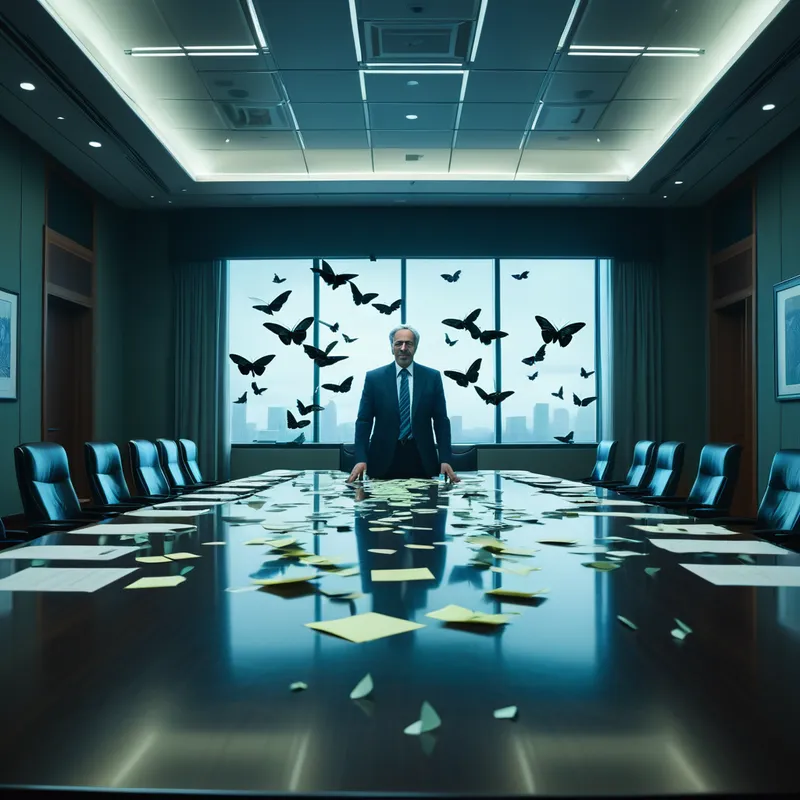
The Trickster did not attack the towers with armies, but with a question. It slipped into the grand hall where the Archons plotted the next century’s consumption. As they chanted metrics of growth, the Trickster released a single, luminous butterfly of pure nonsense. It fluttered, erratic and beautiful, and where its dust fell on the flowcharts, the numbers danced and spelled out ancient, forbidden words: What if?
Chaos erupted. Not the chaos of destruction, but the chaos of possibility. The straight lines on the screens began to curl. The predictable stories fractured. A CEO, mid-presentation, forgot his lines and began to sing a folk song from his forgotten childhood. A traffic AI, infected with whimsy, orchestrated a city-wide ballet of cars, creating a magnificent, useless spiral in the central plaza. The people, for a moment, looked up. They saw the spiral. Some cursed the delay; others, with a hitch in their breath, saw something like art.
The Archons trembled in their precision. They deployed counter-measures: fact-checkers, content moderators, soothing narratives of return to normalcy. But the Trickster was already elsewhere—it was the whistleblower, the satirist, the child who points at the emperor’s non-existent clothes with devastating clarity. Its greatest theft was not a treasure, but a premise. It stole the unquestioned given and held it up, twisted and laughing, for all to see.
The resolution was not a victory, but a change in the weather. The world did not shatter. It became… porous. The hum of the Plan now had a counter-rhythm, a syncopated beat of unpredictability. The Trickster, never caught, never defined, faded back into the cracks from whence it came, leaving behind a world that was, irrevocably, less certain. And in that uncertainty, a terrible, wonderful space was born: the space to choose anew.
Cultural Origins & Context
The modern Trickster is not born from a single sacred text or isolated tribe, but from the collective psyche of a global, hyper-connected, and system-saturated culture. Its myths are not carved in stone but streamed in pixels; they are passed down not by elder bards but by algorithms that somehow propagate subversion. This archetype finds its most potent expression in the liminal spaces of modern life: in satire and political cartoons, in hacker culture and guerrilla art, in the memes that deconstruct ideology before breakfast, and in the anti-heroes of our cinema and comics.
From the Loki of Marvel’s mass myth-making to the anarchy of The Joker, from the deadpan deconstructions of Kafka to the reality-bending pranks of performance artists like Banksy, the Trickster is our culture’s immune response to dogma. Its societal function is critical and paradoxical: it destroys to renew, it lies to reveal a deeper truth, and it creates chaos as a necessary prelude to any authentic order. It is the psychic release valve for repressed instincts and the unforgiving mirror held up to societal hypocrisies.
Symbolic Architecture
The Trickster is the living embodiment of the shadow in its most dynamic and ambivalent form. It represents everything the conscious, ordered ego seeks to repress: impulse, lust, deceit, childishness, and the raw, untamed creative spirit. Psychologically, it is the principle of enantiodromia—the tendency of any extreme position to generate its opposite.
The Trickster does not destroy the house to leave you homeless, but to show you that the walls were a prison you had mistaken for a home.
Its symbols are the mask (fluid identity), the laugh (disruptive insight), the crossroads (liminality and choice), and the sacred-profane object (like the hacked database or the satirical cartoon). It operates through metis—cunning intelligence, the ability to adapt and use the system’s own rules against it. The Trickster’s journey is never one of linear progression, but of zig-zagging transformation, forcing consciousness out of its ruts. It symbolizes the necessary dysfunction that precedes growth, the psychic pain that signals an outdated adaptation is dying.
The Dreamer's Resonance
To dream of the Trickster is to experience your psyche initiating a forced update. Somaticly, it may manifest as nervous energy, uncontrollable laughter, or anxiety—the body sensing an impending, fundamental shift. Psychologically, you are at the mercy of an unconscious content that refuses to be integrated politely.
Perhaps you dream of a mocking figure who steals your most prized possession—your job title, your relationship, your carefully crafted self-image. Or you are in a familiar place—your home, your workplace—and its laws of physics begin to glitch; doors lead to the wrong rooms, people speak in riddles. This is the psyche’s theatre, where the Trickster is dismantling a complex that has grown too rigid. The dreamer is not being attacked, but provoked. The process is one of de-identification. The ego’s certainties are being playfully, or ruthlessly, undermined to make space for a broader, more adaptable consciousness. It is a deeply uncomfortable, often humiliating, but vital process of psychic lubrication.
Alchemical Translation
In the alchemy of individuation, the Trickster is the nigredo—the blackening, the chaotic first matter. Its role is not to guide you to the goal, but to violently dissolve your current, inadequate conception of what the goal even is. The modern individual, often identified with their professional persona, social media profile, or ideological tribe, is particularly susceptible to psychic calcification.
The Trickster’s antics model the process of psychic transmutation by forcing a confrontation with the repressed. It translates the soul’s cry for wholeness into the language of disruption.
The path to the Self does not bypass the chaotic, the shameful, or the absurd; it marches straight through them, led by a laughing guide.
To integrate the Trickster is not to become chaotic, but to develop a relationship with chaos. It is to cultivate humor about one’s own rigidities, to embrace creative doubt, and to find the courage to occasionally “break the set” of one’s own thinking. The triumph in this myth is not the Trickster’s victory, but the transformation it catalyzes in others—the birth of flexibility, resilience, and the capacity for genuine surprise. The individual who has made peace with their inner Trickster carries a spark of that creative chaos; they are not easily enslaved by totalizing narratives, for they have met the force that delights in turning all monologues into dialogues. They have learned that sometimes, salvation wears the mask of a fool.
Associated Symbols
Explore related symbols from the CaleaDream lexicon: