Tír na nÓg Myth Meaning & Symbolism
A warrior's journey to a timeless paradise reveals the tragic cost of forgetting one's mortal soul and the irrevocable nature of lived experience.
The Tale of Tír na nÓg
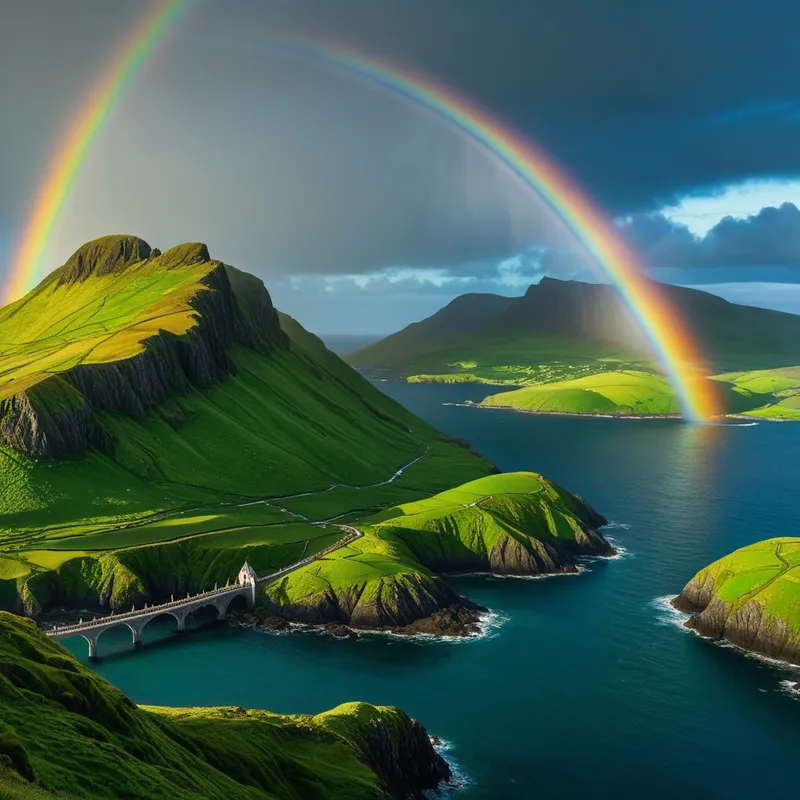
Hear now the tale that is sung when the west wind carries the scent of apple blossom and [the sea](/myths/the-sea “Myth from Greek culture.”/) whispers of lands beyond the sun’s setting. It begins not in our world of rust and rain, but in the shimmering realm of the Tuatha Dé Danann, who retreated from the clamor of mortal kings into [the hollow hills](/myths/the-hollow-hills “Myth from Celtic culture.”/) and the islands beyond the ninth wave.
On such an island, the fairest of them all, lived Niamh Chinn Óir, Niamh of the Golden Hair. Daughter of [Manannán mac Lir](/myths/manannn-mac-lir “Myth from Celtic culture.”/), god of the sea, she rode the waves on a steed as white as sea-foam, with a mane that flowed like liquid silver. Her heart grew weary of the unchanging perfection of Tír na nÓg. She longed for a love forged in the fire of mortality, for a hero whose deeds were sung in [the world](/myths/the-world “Myth from Tarot culture.”/) of struggle and time.
So she crossed the grey-green sea to the shores of Ireland, where the Fianna hunted. And there she found him: [Oisín](/myths/oisn “Myth from Celtic culture.”/), son of Fionn, whose strength was matched only by the sweetness of his poetry. When she spoke, her voice was the sound of a thousand distant bells. “[Oisín](/myths/oisn “Myth from Celtic culture.”/),” she said, “come with me to Tír na nÓg, where the trees bear fruit year-round, where honey-wine flows in rivers, where sorrow and age are unknown, and where you shall have my love for all eternity.”
What mortal could refuse? Oisín mounted the white steed behind her, and they galloped across the waves, leaving the rocky shores of Ireland to become a faint, grey line. They passed through a veil of mist and light, and entered [the Land of Youth](/myths/the-land-of-youth “Myth from Celtic culture.”/).
And so it was. For three hundred years—or was it three days?—Oisín lived in bliss. He feasted, he hunted strange and gentle beasts, he composed poems for Niamh, and he felt not a single ache in his bones, not a single shadow on his heart. Time, in that place, was not a river but a still, deep pool. Yet, deep in the well of his soul, a tiny stone of longing settled. He began to dream of the rough camaraderie of the Fianna, of his father’s weathered face, of the smell of Irish earth after rain. A homesickness, not for a place, but for his own story, began to grow.
He asked Niamh if he might return, just for a day, to see his kin. Her eyes, usually bright as stars, clouded with a sorrow older than the world. “If you must,” she whispered, “but you must not set foot upon the soil of Ireland. Stay upon the back of my white steed, for if your mortal feet touch that ground, the centuries you have evaded will claim you in an instant.”
Oisín promised. The white horse carried him back across the sea. But the Ireland he found was not his Ireland. The forts were smaller, stranger. The people seemed like children. He asked for news of the Fianna, and was met with blank stares, then tales of legendary giants who had died centuries past. His heart turned to cold iron in his chest.
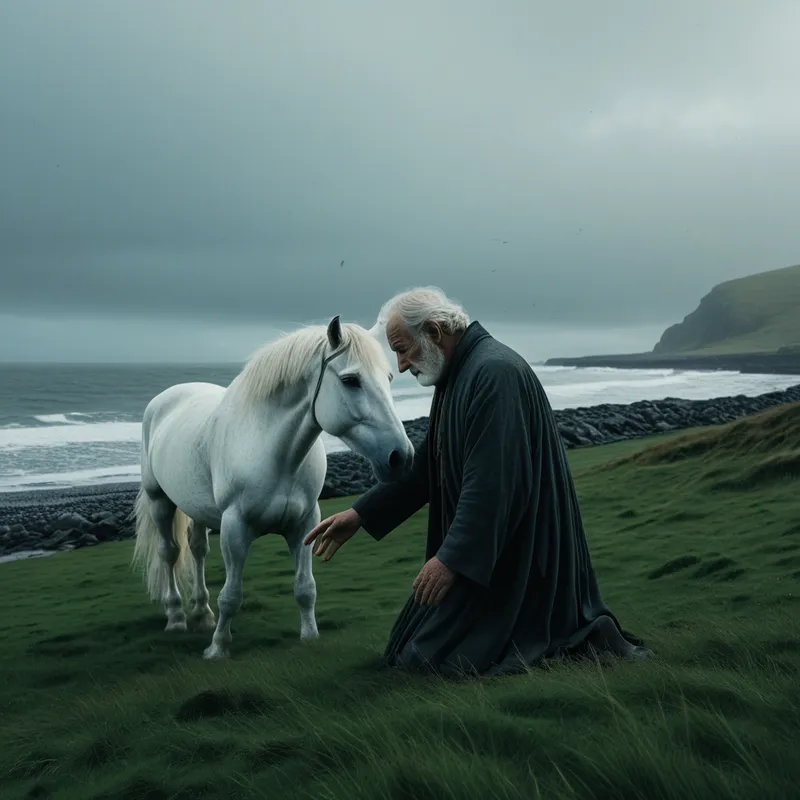
Then, he saw a group of men struggling to move a great stone. Moved by the old warrior’s instinct to help, he leaned from his saddle to heave it aside. As he strained, the girth of the saddle broke. Oisín, son of Fionn, tumbled from the white horse and fell onto the green grass of Ireland.
The centuries descended. In the blink of an eye, the young, radiant warrior was gone. In his place lay an ancient man, blind and withered, his body bowed under the weight of three hundred years. The white horse gave a final, mournful cry and vanished into [the mist](/myths/the-mist “Myth from Celtic culture.”/). Oisín was left alone, a living ghost in a land that remembered him only as a name in a song.
Cultural Origins & Context
The story of Oisín and Tír na nÓg is a late, poignant flowering of the wider Immrama and Echtrae traditions. These narratives of voyages to wondrous islands served as a complex cultural repository. They were preserved and shaped by the filid, the poet-historians of medieval Ireland, who acted as the bridge between the pre-Christian pagan past and the new Christian world.
Its societal function was multifaceted. On one level, it was pure entertainment, a tale of high adventure and tragic romance. On another, it was a metaphysical map. The Celtic [otherworld](/myths/otherworld “Myth from Celtic culture.”/) was not a linear heaven or hell, but a parallel dimension of eternal feasting, youth, and artistry, often accessed through liminal spaces: burial mounds ([sídhe](/myths/sdhe “Myth from Celtic / Irish culture.”/)), mist, or the western sea. Tír na nÓg represents the ultimate expression of this realm. The myth also served as an etiological story, explaining the passing of the heroic age of the Fianna and the arrival of a new, diminished time. Oisín, as the last bard of that age, becomes [the vessel](/myths/the-vessel “Myth from Alchemical culture.”/) through which its memory is transmitted, even as he personally pays the ultimate price for its loss.
Symbolic Architecture
At its core, Tír na nÓg is not a geographical [location](/symbols/location “Symbol: The symbol of ‘Location’ signifies a sense of place, context, and the environment in which experiences unfold.”/), but a state of [consciousness](/symbols/consciousness “Symbol: Consciousness represents the state of awareness and perception, encompassing thoughts, feelings, and experiences.”/). It symbolizes the unconscious itself—timeless, perfect, and devoid of conflict. It is the [womb](/symbols/womb “Symbol: A symbol of origin, potential, and profound transformation, representing the beginning of life’s journey and the unconscious source of creation.”/), the primal [paradise](/symbols/paradise “Symbol: A perfect, blissful place or state of being, often representing ultimate fulfillment, harmony, and transcendence beyond ordinary reality.”/), the state of pre-individuated [bliss](/symbols/bliss “Symbol: A state of profound happiness and spiritual contentment, often representing fulfillment of desires or alignment with one’s true self.”/) where [the ego](/myths/the-ego “Myth from Jungian culture.”/) has not yet formed and therefore cannot know suffering or lack.
The Land of Youth is the soul’s memory of wholeness, a siren call to return to a state before the painful, necessary fracture of self-awareness.
Oisín represents the conscious ego, the heroic [identity](/symbols/identity “Symbol: Identity represents the sense of self, encompassing personal beliefs, cultural background, and social roles.”/) forged in the world of [action](/symbols/action “Symbol: Action in dreams represents the drive for agency, motivation, and the ability to take control of situations in waking life.”/), time, and [lineage](/symbols/lineage “Symbol: Represents ancestral heritage, family connections, and the transmission of traits, values, and responsibilities across generations.”/) (the Fianna). His [journey](/symbols/journey “Symbol: A journey in dreams typically signifies adventure, growth, or a significant life transition.”/) to Tír na nÓg is the ego’s seduction by the unconscious. Niamh is the [anima](/symbols/anima “Symbol: The feminine archetype within the male unconscious, representing soul, creativity, and connection to the inner world.”/), the [soul](/symbols/soul “Symbol: The soul represents the essence of a person, encompassing their spirit, identity, and connection to the universe.”/)-[image](/symbols/image “Symbol: An image represents perception, memories, and the visual narratives we create in our minds.”/), who beckons him away from his differentiated [life](/symbols/life “Symbol: The symbol of ‘Life’ represents a journey of growth, interconnectedness, and existential meaning, encompassing both the joys and challenges that define human experience.”/) into undifferentiated unity. For a time, this is blissful; it is the poet’s inspiration, the [lover](/symbols/lover “Symbol: A lover in dreams often represents intimacy, connection, and the emotional aspects of relationships.”/)’s union, the mystic’s [ecstasy](/symbols/ecstasy “Symbol: A state of overwhelming joy, rapture, or intense emotional/spiritual transcendence, often involving a loss of self-awareness.”/). But the ego cannot live forever in the unconscious without dissolving. The homesickness Oisín feels is the [psyche](/myths/psyche “Myth from Greek culture.”/)’s imperative toward individuation—the need to return to the world of time, [responsibility](/symbols/responsibility “Symbol: Responsibility in dreams often signifies the weight of duties and the expectations placed upon the dreamer.”/), and [story](/symbols/story “Symbol: The symbol of ‘Story’ represents the narrative woven through our lives, embodying experiences, lessons, and emotions that shape our identities.”/) to complete [the self](/myths/the-self “Myth from Jungian culture.”/).
The white horse is [the psychopomp](/myths/the-psychopomp “Myth from Various culture.”/), the [vehicle](/symbols/vehicle “Symbol: Vehicles in dreams often symbolize the direction in life and the control one has over their journey, reflecting personal agency and decision-making.”/) that can travel between worlds, but it is also the fragile thread of consciousness that connects the ego to its [source](/symbols/source “Symbol: The origin point of something, often representing beginnings, nourishment, or the fundamental cause behind phenomena.”/). The breaking of the [saddle](/symbols/saddle “Symbol: A saddle represents the concept of guidance and support in one’s journey, often associated with control and desire for freedom.”/) is the catastrophic [moment](/symbols/moment “Symbol: The symbol of a ‘moment’ embodies the significance of transient experiences that encapsulate emotional depth or pivotal transformations in life.”/) of re-entry. The [stone](/symbols/stone “Symbol: In dreams, a stone often symbolizes strength, stability, and permanence, but it may also represent emotional burdens or obstacles that need to be acknowledged and processed.”/) is not merely a physical object; it is the [weight](/symbols/weight “Symbol: Weight symbolizes burdens, responsibilities, and emotional loads one carries in life.”/) of [reality](/symbols/reality “Symbol: Reality signifies the state of existence and perception, often reflecting one’s understanding of truth and life experiences.”/), the concrete [truth](/symbols/truth “Symbol: Truth represents authenticity, honesty, and the quest for knowledge beyond mere appearances.”/) of [mortality](/symbols/mortality “Symbol: The awareness of life’s finitude, often representing transitions, impermanence, or existential reflection in dreams.”/) that the returning [dreamer](/symbols/dreamer “Symbol: The dreamer represents the self, the conscious mind engaging with subconscious thoughts and feelings during dreaming.”/) must bear. Oisín’s transformation is the shocking, instantaneous [integration](/symbols/integration “Symbol: The process of unifying disparate parts of the self or experience into a cohesive whole, often representing psychological wholeness or resolution of internal conflict.”/) of all the time he had denied—a visual [metaphor](/symbols/metaphor “Symbol: A figure of speech where one thing represents another, often revealing hidden connections and deeper truths through symbolic comparison.”/) for the unavoidable consequences of lived experience.
The Dreamer’s Resonance
When this myth pattern stirs in the modern dreamer, it often manifests as dreams of idyllic, timeless places—a perfect house, a serene garden, a reunion with a lost love—from which the dreamer is abruptly or tragically ejected. The somatic experience is one of profound disorientation upon waking, a literal heaviness in the limbs, as if the body has aged decades in the night.
Psychologically, this signals a crucial phase of “returning to earth.” The dreamer may be emerging from a prolonged period of escapism, a spiritual bypass, a manic creative high, or a relationship that provided blissful fusion at the cost of the self. The dream is the psyche’s corrective, enforcing a confrontation with chronological time and earthly limits. The figure of Oisín in the dream may appear as the dreamer themselves, suddenly old and frail in a familiar setting, or as a guide who offers a beautiful fruit that turns to dust upon touching it. The process is one of grounding, however painful. It is the end of inflation and the beginning of a humbler, more authentic engagement with a flawed, mortal life.
Alchemical Translation
The alchemical opus is framed as [solve et coagula](/myths/solve-et-coagula “Myth from Alchemical culture.”/): dissolve and coagulate. Oisín’s journey is a perfect model of this psychic transmutation. The solve phase is his departure with Niamh—the dissolution of his heroic ego into the golden waters of the anima and the unconscious. He becomes one with [the prima materia](/myths/the-prima-materia “Myth from Alchemical culture.”/), the timeless, undifferentiated substance of the soul.
The tragedy is not the leaving, but the forgetting. The true work begins only with the remembering, with the insistent call back to the shore of the self.
The coagula is the return and the petrification. This is not a failure, but the necessary next stage. The enlightened sage cannot return to the marketplace; the transformed consciousness cannot pretend it has not been transformed. Oisín’s aged body is the [lapis philosophorum](/myths/lapis-philosophorum “Myth from Alchemical culture.”/), the Philosopher’s Stone, but not in its expected glorious form. It is the stone of wisdom forged in loss. His blindness is not merely physical; it is the inward sight of one who has seen the other world and can no longer see this one in the same way.
For the modern individual, the myth warns against seeking a permanent state of blissful, conflict-free “enlightenment” or perfect happiness. That is Tír na nÓg, a state of psychic death-in-life. The alchemical goal is not to stay in the bath of dissolution, but to return, irrevocably changed, and bear the weight of that change in the world of time. Our “white horse”—our meditation practice, our therapy, our art—can carry us to the edge of understanding, but we must ultimately dismount and stand on our own feet, accepting the crushing, beautiful weight of our own lived years. In that acceptance, in the full embrace of our mortal story with all its grief and joy, lies the real, hard-won eternity.
Associated Symbols
Explore related symbols from the CaleaDream lexicon:
- Sunlit Meadow
- Abandoned Swing
- Gaming Console
- Village Green
- Abandoned Theme Park
- Open Field
- Fairy Tale Castle
- Buttercup Meadow
- Lighthouse
- Snow Globe Village
- Secret Level
- Ball Pit
- Lighthouse by the Sea
- Fairytale Castle
- Otherworldly Settings
- Cardboard Box Labyrinth
- Old-Fashioned Jacks
- Seaside Villa
- Nordic Lodge
- Celtic Roundhouse
- Round House
- Sustainable Village
- Mansion with Turrets
- Quaint Village Square
- Seaside View Room
- Sandy Beach Room
- Mystical Portal Room
- Imaginary Realm
- Abandoned Cabin
- Hazy Horizon
- Highland Pastures
- Nostalgic Playground
- Promenade
- Crumbling Fortress
- Ephemeral Ghost Town
- Breezy Meadow
- Abandoned Playground
- Circular Portal
- Beach House
- Abandoned Roller Coaster