Totem Pole Myth Meaning & Symbolism
A myth where a carver's vision reveals the stacked souls of his lineage, forging a living pillar of memory that binds the human, natural, and spirit worlds.
The Tale of the Totem Pole
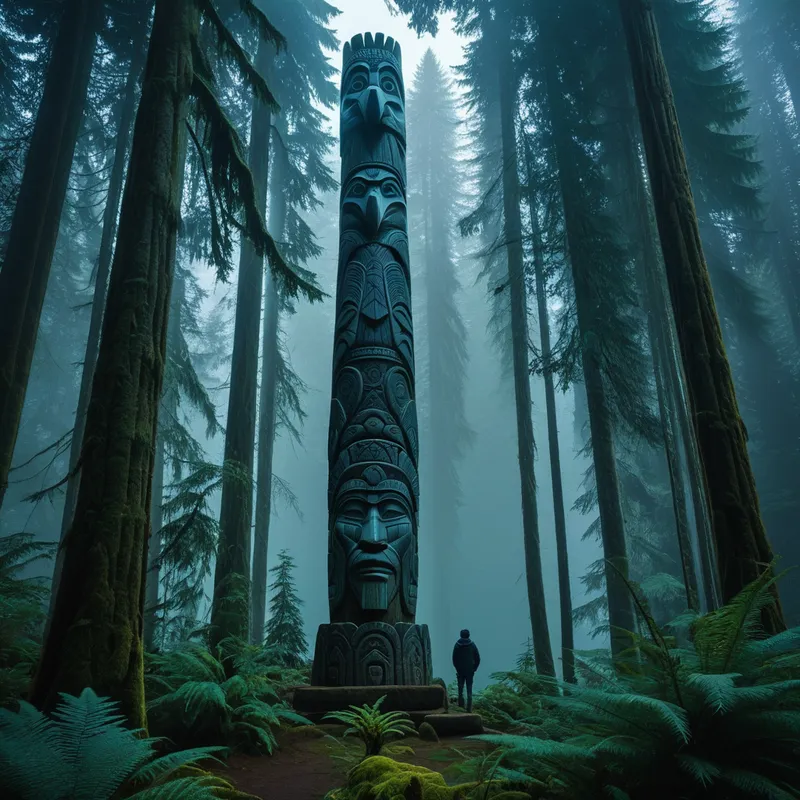
Listen. [The wind](/myths/the-wind “Myth from Various culture.”/) does not just move through the cedars; it remembers. It carries the breath of the first people, the rustle of the first salmon run, the whisper of the first story told when [the world](/myths/the-world “Myth from Tarot culture.”/) was soft and new. In a time when the boundary between the human village and the spirit forest was as thin as a [spider](/myths/spider “Myth from Native American culture.”/)’s silk, there lived a carver named Kalanu.
Kalanu’s hands knew the heart-grain of the cedar, but his own heart was heavy with a silent question. His people told stories, yes. They painted their histories on house fronts and danced them in the firelight. But stories, like smoke, faded. Memories, like footprints on a beach, were washed away by the relentless tide of time. He felt the weight of all that might be forgotten—the name of the great-grandmother who bargained with [Raven](/myths/raven “Myth from Haida culture.”/) for fire, the courage of the uncle who wore the Bear cloak in battle, the cunning of the cousin who learned the language of the Wolf.
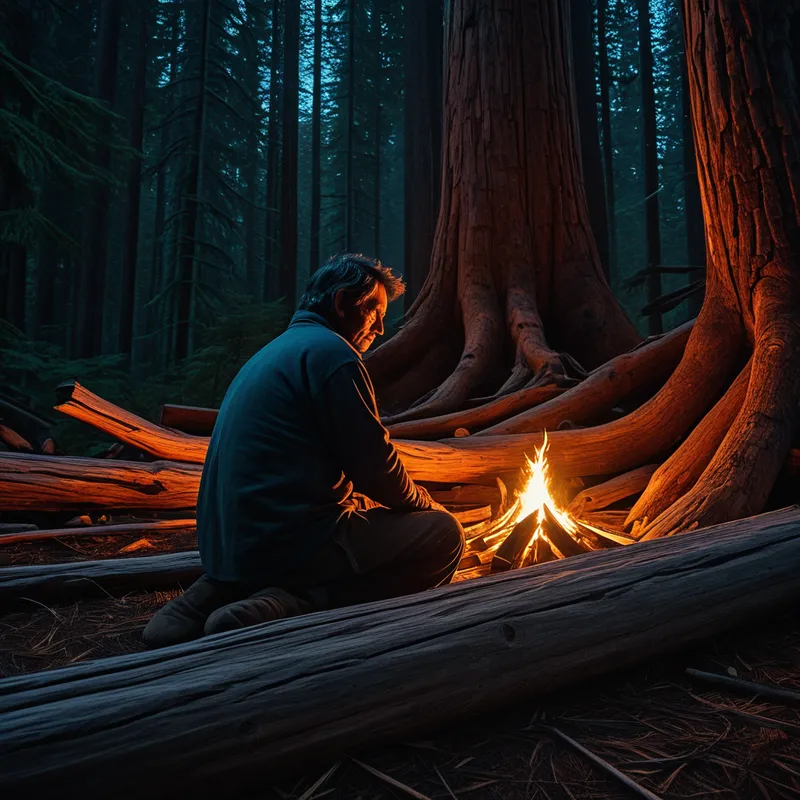
One night, under a moon so full it seemed a hole in [the sky](/myths/the-sky “Myth from Persian culture.”/), Kalanu went into the deepest part of the ancient forest. He did not take his tools. He took only his hunger to remember. He pressed his forehead against the vast, fragrant flank of a grandfather cedar, a tree that had witnessed the turning of centuries. He whispered his question into the bark: “How do we hold what time steals?”
He slept there, at the tree’s roots. And he dreamed.
In the dream, he did not see the tree as a tree. He saw it as a column of time. At its base, in the dark, rich soil, swam the silver forms of the Salmon People, the foundation of life. Above them, solid and unshakable, stood the Bear, guardian of [the earth](/myths/the-earth “Myth from Hindu culture.”/)’s secrets. Upon the Bear’s shoulders perched the Wolf, its head thrown back in a silent howl that was a song of family and the hunt. Higher still, gazing out with eyes that held both mischief and cosmic knowledge, was Raven, the [shape-shifter](/myths/shape-shifter “Myth from Native American culture.”/), the one who stole the light. And at the very top, where the tree met the stars, was a human face—but it was not one face. It was all faces: his father’s stern brow, his grandmother’s laughing eyes, his own son’s curious gaze, all woven into one being looking toward the future.
The vision was not a silent picture. It was a chorus. He heard the splash of the salmon, the deep rumble of the bear, the harmonic howl of the wolf-pack, the clever kraa of the raven, and the soft, overlapping stories of the human voices. They were not separate. They were stacked, one upon the other, a sacred ladder of being.
Kalanu awoke with the dawn light spearing through the canopy. He knew what he must do. He returned to his village, gathered his sharpest adzes and chisels, and asked for the great tree. With reverence, the tree was felled. And Kalanu began to carve. But he was not carving wood; he was revealing the dream. He was peeling back the cedar’s skin to show the living memory sleeping within.
Chip by chip, curl by red curl, the figures emerged. He did not invent their forms; he remembered them from the dream. He carved the foundational salmon, the mighty bear, the vigilant wolf, the watchful raven, and the composite human face at the pinnacle. When he placed the final, painted abalone eye into the raven, a shudder passed through the pole. It was no longer just carved cedar. It was a axis mundi. It stood in the center of the village, and the people knew, without being told, that it held them. It was their story, their law, their lineage, and their link to the unseen world—all standing together, facing the world, forever.
Cultural Origins & Context
The story of the totem pole’s mythic origin, while varying in details among the many distinct nations of the Pacific Northwest—from the Tlingit and Haida to the Coast Salish—speaks to a unified cultural logic. It is not merely a tale of artistic invention but a narrative encoding the function of these monumental sculptures.
Totem poles (k’iit’aa or similar terms) were not idols of worship, as misunderstood by early outsiders. They were heraldic documents, carved in the dense, straight-grained red and yellow cedar that is itself considered a sacred, living being. They recorded clan lineages, commemorated historic events, asserted rights and privileges, or served as mortuary vessels. The myth of the visionary carver like Kalanu explains the why: these poles are born from a confluence of ancestral mandate, supernatural vision, and masterful skill. The right to display certain crests—Raven, Eagle, Bear, Killer Whale—was earned through story, encounter, or inheritance. The pole made these invisible relationships visible and permanent, a contract between the people, their ancestors, and the natural world, told in a language of symbols that every community member could read.
Symbolic Architecture
Psychologically, the [totem pole](/symbols/totem-pole “Symbol: A totem pole serves as a ceremonial monument that symbolizes the lineage, culture, and history of a tribe, often depicting animals and other figures with spiritual significance.”/) is a staggering map of the stratified [psyche](/myths/psyche “Myth from Greek culture.”/) and the collective [soul](/symbols/soul “Symbol: The soul represents the essence of a person, encompassing their spirit, identity, and connection to the universe.”/).
The totem pole is the spine of a people, each vertebra a generation, each crest a memory turned to bone.
At its most fundamental, it represents order emerging from [chaos](/symbols/chaos “Symbol: In Arts & Music, chaos represents raw creative potential, uncontrolled expression, and the breakdown of order to forge new artistic forms.”/). The vertical stack imposes a cosmology onto the formless flow of time and experience. The base creatures (often aquatic or [earth](/symbols/earth “Symbol: The symbol of Earth often represents grounding, stability, and the physical realm, embodying a connection to nature and the innate support it provides.”/)-bound) symbolize the foundational, instinctual, and often unconscious layers of the psyche—the primal drives and ancestral memories that support everything else. As the eye travels upward, the figures represent ascending levels of complexity: social bonds ([Wolf](/symbols/wolf “Symbol: Wolves in dreams symbolize instinct, intelligence, freedom, and a deep connection to the wilderness and primal instincts.”/)), transformative cunning and [consciousness](/symbols/consciousness “Symbol: Consciousness represents the state of awareness and perception, encompassing thoughts, feelings, and experiences.”/) ([Raven](/symbols/raven “Symbol: The raven is often seen as a messenger of the divine and a symbol of transformation, wisdom, and the mysteries of life and death.”/)), and finally, integrated [human](/symbols/human “Symbol: The symbol of a human represents individuality, complexity of emotions, and social relationships.”/) [identity](/symbols/identity “Symbol: Identity represents the sense of self, encompassing personal beliefs, cultural background, and social roles.”/) at the apex. This is not a [hierarchy](/symbols/hierarchy “Symbol: A structured system of ranking or authority, often representing social order, power dynamics, and one’s position within groups or institutions.”/) of value but a hierarchy of [emergence](/symbols/emergence “Symbol: A process of coming into being, rising from obscurity, or breaking through a barrier, often representing birth, transformation, or revelation.”/). You cannot have the wise [human](/symbols/human “Symbol: The symbol of a human represents individuality, complexity of emotions, and social relationships.”/) at the top without the sustaining salmon at the bottom.
Each figure is an [archetype](/symbols/archetype “Symbol: A universal, primordial pattern or prototype in the collective unconscious that shapes human experience, behavior, and creative expression.”/), a [cluster](/symbols/cluster “Symbol: A dense grouping of similar elements, representing complexity, patterns, or interconnectedness within a larger system.”/) of living meanings. The Bear is not just an animal; it is the [archetype](/symbols/archetype “Symbol: A universal, primordial pattern or prototype in the collective unconscious that shapes human experience, behavior, and creative expression.”/) of ferocious protection, healing, and introspective solitude. Raven is the [trickster](/symbols/trickster “Symbol: A boundary-crossing archetype representing chaos, transformation, and the subversion of norms through cunning and humor.”/)-guide, the [shadow](/symbols/shadow “Symbol: The ‘shadow’ embodies the unconscious, repressed aspects of the self and often represents fears or hidden emotions.”/) and the light-bringer, the necessary chaos that forces evolution. The [pole](/symbols/pole “Symbol: A pole in dreams often symbolizes stability, support, or a point of reference in life.”/), in its totality, asserts that identity is composite and communal. An individual is not a solitary self, but a living [column](/symbols/column “Symbol: A vertical architectural support representing strength, stability, and connection between earth and sky. It symbolizes structure, tradition, and spiritual ascent.”/) comprised of all these inherited and earned psychic forces.
The Dreamer’s Resonance
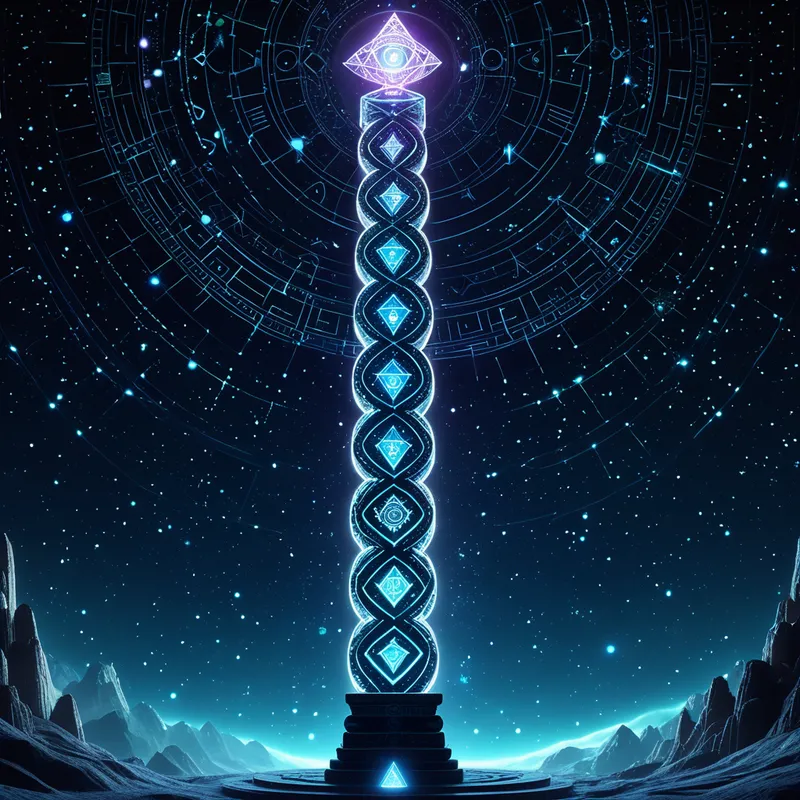
When the image of a totem pole arises in a modern dream, it often signals a profound process of psychic structuring and ancestral reckoning. The dreamer may be feeling fragmented, pulled in different directions by competing identities—professional, familial, personal. The totem pole emerges as a symbol of necessary integration.
Somatically, this can feel like a pressure in the spine, a need to “stand up straight” in one’s own truth. Psychologically, it is the unconscious working to stack the disparate parts of [the self](/myths/the-self “Myth from Jungian culture.”/) into a coherent, vertical order. Dreaming of carving a pole suggests active engagement in this process of self-definition. Dreaming of a crumbling or fallen pole may indicate a collapse of personal history, values, or support systems. The specific animals that appear are crucial messengers, pointing to which archetypal energies—nurturing, aggressive, cunning, loyal—are demanding recognition and placement within the dreamer’s internal hierarchy.
Alchemical Translation
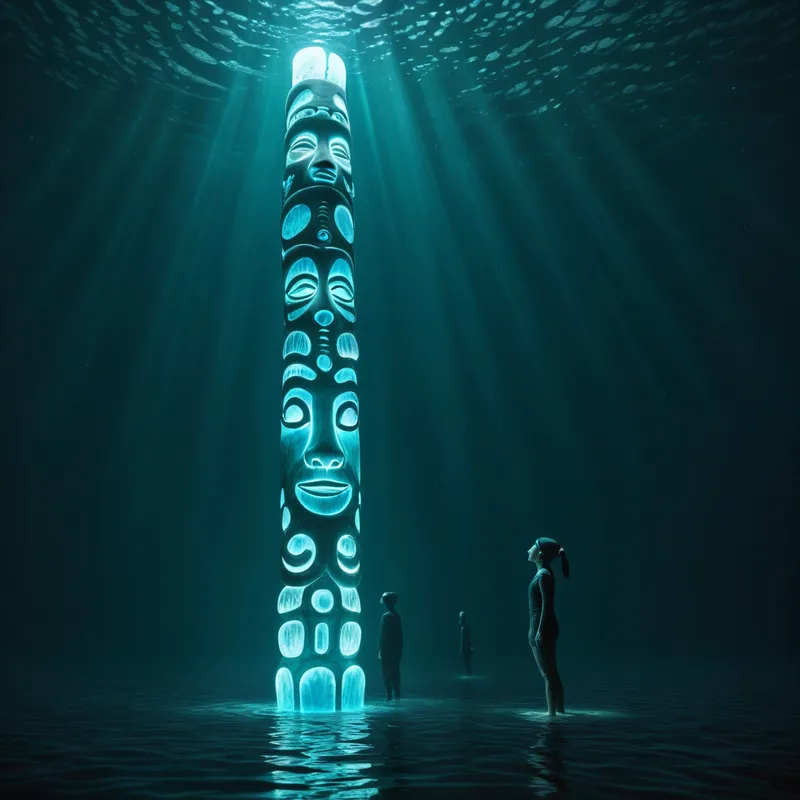
The myth models the alchemical process of individuation—the Jungian journey toward wholeness. The carver, Kalanu, begins in a state of [nigredo](/myths/nigredo “Myth from Alchemical culture.”/), the blackening: the melancholic confusion of unintegrated memories and a fragile identity. His quest into the forest is the [separatio](/myths/separatio “Myth from Alchemical culture.”/), withdrawing from the collective to confront the raw material of the Self (the primordial cedar).
The visionary dream is the coniunctio, [the sacred marriage](/myths/the-sacred-marriage “Myth from Various culture.”/). Here, the disparate elements—instinct (salmon), strength (bear), community (wolf), intellect (raven), and consciousness (human)—are seen in their essential, interconnected relationship. They are united in the symbolic vessel of the tree.
The act of carving is the coagulatio: making spirit into matter, giving fixed, enduring form to the fluid vision. It is the embodiment of insight.
Finally, raising the pole is the [rubedo](/myths/rubedo “Myth from Alchemical culture.”/), the reddening or culmination. The integrated Self is erected in the center of one’s personal “village”—one’s life. It becomes a permanent [reference](/myths/reference “Myth from Global/Universal culture.”/) point, a testament to one’s lineage (both genetic and psychic), and a guidepost for future action. It does not erase complexity; it organizes it into a living monument. The modern individual’s alchemical work is identical: to consciously gather the fragmented crests of their being—their inherited traumas and gifts, their personal triumphs and shadows, their animal instincts and spiritual aspirations—and carve them, with painful honesty and artistic care, into a singular, standing testament of who they are. The finished pole does not speak of a finished person, but of one who has learned how to hold all their stories at once, facing the world with the full weight of their becoming.
Associated Symbols
Explore related symbols from the CaleaDream lexicon: