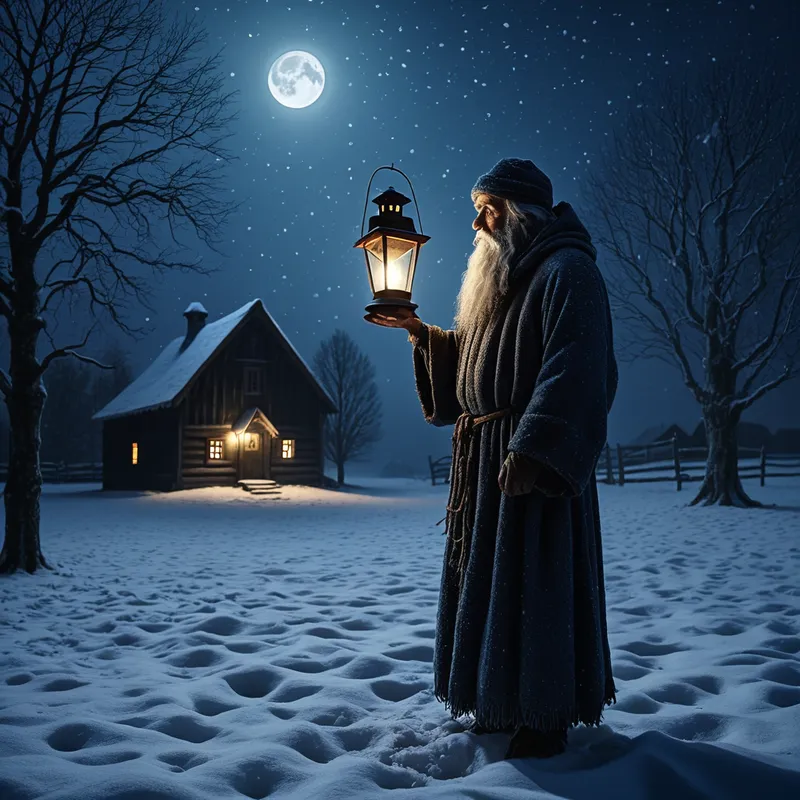
Tomten Myth Meaning & Symbolism
The silent, ancient guardian of the farmstead, a spirit of place who remembers the old ways and demands respect through quiet, steadfast presence.
The Tale of Tomten
Listen, and hear the whisper beneath the snow. In the deep of the Nordic winter, when the sun is a memory and the world is held in the breath of ice, the true master of the land awakens. Not in the farmhouse where the fire crackles, nor in the barn where the beasts sigh in their sleep. The master is older than the hearthstone, older than the first furrow cut in the earth. He is the Tomten.
See him now, as the last ember in the hearth dies to a red eye. From the shadowed corner of the hayloft, or from the space between the granary stones, a small, aged figure stirs. He is the color of lichen-covered rock, of grey wool and old, polished silver. His beard is like hoarfrost, his eyes hold the patient gleam of a centuries-old star. He wears simple homespun, and on his feet are no boots, for he is of the land, and the cold does not bite him.
He moves without sound, a drift of awareness through the sleeping world. His gnarled hands, gentle as roots, check the latch on the stable door, ensuring the north wind cannot creep in to disturb the cows. He runs a palm along the beam of the barn, feeling the strength of the timber, listening to the memories stored within its rings. He visits the sheep, his presence a calm that settles their dreams. He is the silent pulse of the place itself, the guardian of the threshold between the human order and the wild, ancient soul of the earth.
His work is not of grand magic, but of meticulous care. He remembers the name of every field, the summer each calf was born, the year the great oak lost its limb. He is the memory of the farm, its living conscience. But his guardianship has a condition, a sacred pact written not on parchment but in the rhythm of respect. He expects to be acknowledged. Not with loud praise, but with the quiet offering—a bowl of the finest porridge, left on the step, with a generous pat of butter melting in its center. This is his due, the token of the bond.
Forget this offering, treat the land with greed or disrespect, and the Tomten’s nature shifts. His silent care turns to silent mischief. The milk sours overnight. Tools vanish only to be found in foolish places. A subtle, chilling draft will find its way into the warmest room. He does not rage; he reminds. He is the consequence of broken reciprocity, the embodiment of the land’s subtle, corrective will. But tend the offering, honor the old ways, and his blessing is profound—a certainty of protection, a feeling that the very soil beneath your feet is held in wise, ancient hands. He is the unseen shepherd, and the farmstead is his flock.

Cultural Origins & Context
The Tomten is not a god of grand mythologies, but a spirit of the everyday, born from the intimate relationship between the Nordic farmer and a formidable, animistic world. His roots lie deep in the pre-Christian belief of the landvættir, the spirits that inhabited every rock, spring, and grove. As agriculture took hold, this belief localized. The spirit of the land became the spirit of the place—the specific plot of earth a family had carved a life from.
This myth was not recited in grand halls but whispered in farmhouse kitchens, passed from grandparent to child at the edge of sleep. It was a functional folklore, a story with a direct purpose: to encode ecological and social ethics. The Tomten myth taught stewardship. It framed the farm not as property to be exploited, but as a living entity with which one was in partnership. The offering of porridge was a ritual of gratitude, a tangible acknowledgment that human survival was intertwined with the goodwill of the non-human world.
Furthermore, the Tomten served as a psychological anchor. In the isolating vastness of the Nordic winter, the idea that the homestead itself had a conscious, protective presence combatted loneliness and existential fear. He was the personification of ancestral continuity—the idea that the work and care of past generations lingered, watching over the present. He was both a comfort and a moral compass, a silent witness to all that transpired under his watch.
Symbolic Architecture
Psychologically, the Tomten is a profound symbol of the Shadow in its neutral, even benevolent form. He dwells in the overlooked corners, the attics and barns of our own psyche—the repository of ancestral memory, instinctual wisdom, and the deep, automatic processes that sustain life. He is not the heroic ego, but the quiet, background intelligence of the body and the unconscious that keeps the “homestead” of the self running.
The Tomten represents the psyche’s innate, self-regulating wisdom—the part of us that remembers how to heal, how to maintain balance, and how to demand respect for our own deepest needs.
His dual nature—benevolent guardian and mischievous trickster—symbolizes the psyche’s feedback system. Respect the unconscious (offer the porridge of attention, ritual, and respect), and it supports us with intuition, resilience, and a sense of grounded belonging. Neglect or violate it (through conscious greed, repression, or living out of alignment with our true nature), and it responds not with volcanic eruption, but with subtle symptoms: a souring of mood, a loss of vital energy, a sense of things being perpetually “misplaced” in our lives. The Tomten’s mischief is the psyche’s gentle, initial correction.
He is also the archetype of the Genius Loci, the spirit of place. He symbolizes our profound connection to a specific environment—how a landscape, a home, or a community can become a part of our soul’s architecture. To be disconnected from one’s “Tomten” is to suffer a deep, nameless homesickness, even when at home.

The Dreamer’s Resonance
When the pattern of the Tomten stirs in modern dreams, it often signals a process of reconnection with the foundational, often neglected, layers of the self. Dreaming of a small, ancient figure in the basement of a childhood home, or a presence silently tending to plants in a forgotten room, points to an awakening of the inner caregiver and steward.
Somatically, this can feel like a grounding—a sudden, deep breath, a feeling of solidity in the feet, a release of chronic, low-grade anxiety. Psychologically, it is the beginning of tending to one’s own “homestead.” The dream may highlight what has been neglected: the “porridge” of self-care, the respect for one’s own boundaries and rhythms, the acknowledgment of ancestral patterns or inherited gifts. The mischievous Tomten appears in dreams as frustrating, repetitive minor problems—keys that vanish, appliances that fail—symbolizing the psyche’s insistence that we address these foundational imbalances before pursuing grander ambitions. The dream is an invitation to listen to the quiet, ancient intelligence within that knows how to maintain the soul’s equilibrium.

Alchemical Translation
The alchemical process modeled by the Tomten myth is not the dramatic Magnum Opus of slaying dragons, but the vital, ongoing work of Cura, or care. It is the transmutation of the mundane into the sacred through the application of consistent, respectful attention.
The individual’s “farmstead” is the totality of their life: body, psyche, relationships, and work. The “porridge” is the daily, often humble, rituals of maintenance—meditation, journaling, nourishing food, honest conversation, creative practice. These are not glamorous, but they are the offerings that honor the inner Tomten, the self-regulating spirit of the psyche.
Individuation, in the Tomten’s key, is the slow, patient integration of the silent guardian—making a conscious ally of the ancestral, instinctual, and deeply grounded parts of ourselves we have ignored.
The triumph is not a heroic conquest, but the achievement of a steadfast, resilient inner ecology. It is the state where one feels an unshakable sense of belonging—to oneself, to one’s history, and to one’s place in the world. The conflict is the modern disease of disconnection: from the body, from nature, from silence. The resolution is the re-establishment of the pact. When we consistently tend our inner homestead with respect, the Tomten within bestows his blessing: a life that feels protected from within, inherently meaningful, and woven into a story larger than the individual ego. We become, ourselves, the wise stewards of our own souls.
Associated Symbols
Explore related symbols from the CaleaDream lexicon: