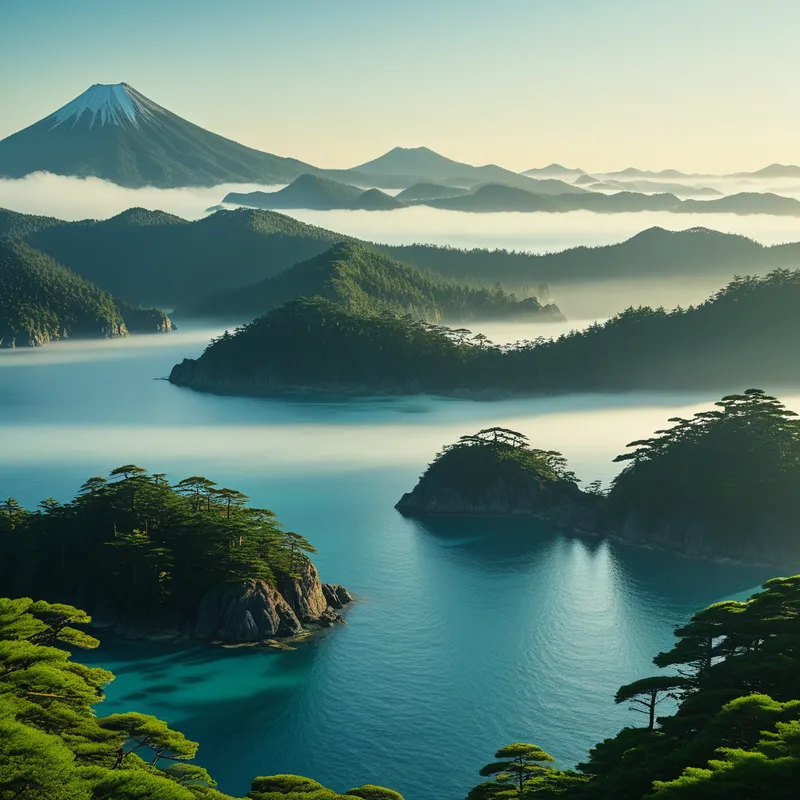
Tokoyo the Eternal Land Myth Meaning & Symbolism
A Shinto myth of a timeless, pure land beyond the horizon, sought by heroes and emperors as the realm of eternal life and divine ancestors.
The Tale of Tokoyo the Eternal Land
Listen, and let your spirit travel beyond the known shores, beyond the crashing waves of the mundane world. There, where the sun is born anew each day from the womb of the ocean, lies a realm untouched by time. The ancient ones called it Tokoyo.
It is said that in the age when gods walked closer to the earth, a great emperor, his heart heavy with the weight of mortality, heard whispers on the wind. The whispers spoke of a land where the kami of old had retreated, a land where the springs granted not just life, but everlasting youth. His soul, once content with ruling the earthly plains, now burned with a singular, aching desire: to find Tokoyo.
He summoned his most courageous sailors and commanded the construction of ships from the heartwood of sacred cypress. They set sail as the morning star faded, their prows cutting through the mist that veils the world’s edge. For days and nights, they sailed east, towards the source of the sun. The sea changed from familiar green to a deep, mysterious indigo. The air grew still and fragrant with the scent of unknown blossoms carried from beyond sight.
Then came the trial. A great serpent of the deep, wani, rose from the abyss, its scales like polished night, its eyes like cold moons. It coiled around the emperor’s ship, the timbers groaning. But the emperor, his will forged by divine lineage, stood firm. He offered prayers to the Amaterasu and to the kami of the sea. He cast into the waters a mirror, a symbol of his own soul, polished and true. The serpent, seeing its own reflection—not as a monster, but as a divine creature of the depths—released its hold and sank back into the mystery from whence it came.
The storm cleared. Before them, as if a curtain had been drawn aside, lay the shores of Tokoyo. No beach of sand met them, but gentle slopes covered in soft, eternal moss. Trees bore fruit and blossom simultaneously. Crystal streams sang over smooth stones. The light itself was different—golden and soft, emanating from everything. Here, the ancestors dwelled in peace, their forms luminous and gentle. They welcomed the emperor not as a ruler, but as a long-awaited child returning home. He drank from a spring whose water tasted of clarity itself, and in that moment, the relentless march of time within him ceased. He had not escaped death; he had arrived where the concept held no dominion.

Cultural Origins & Context
The myth of Tokoyo exists in the liminal spaces of Shinto tradition, more as a powerful concept than a single, codified tale. It is found in early chronicles like the Kojiki and Nihon Shoki, often referenced alongside other mythical realms like Yomi and Takamagahara. Unlike the dark Yomi, Tokoyo represents a positive, horizontal transcendence—a journey across, not down.
It was a myth carried not just by priests, but by fishermen, farmers, and travelers. They saw Tokoyo in the impossible glow on the far horizon at dawn, in the longing for a bountiful catch from the deep, unknown waters. It functioned as a cosmological anchor, a promise that purity, peace, and the essence of the ancestral kami were not lost, but merely waiting beyond the visible world. It validated the human yearning for something more than the cyclical decay and renewal of the natural world, offering a vision of eternity that was not static, but vibrantly alive.
Symbolic Architecture
Tokoyo is not a geographical [location](/symbols/location “Symbol: The symbol of ‘Location’ signifies a sense of place, context, and the environment in which experiences unfold.”/), but a state of being. It symbolizes the [soul](/symbols/soul “Symbol: The soul represents the essence of a person, encompassing their spirit, identity, and connection to the universe.”/)’s [origin](/symbols/origin “Symbol: The starting point of a journey, often representing one’s roots, source, or initial state before transformation.”/) and [destination](/symbols/destination “Symbol: Signifies goals, aspirations, and the journey one is on in life.”/)—a place of pre- and post-personal wholeness. The perilous sea voyage represents the conscious ego’s [journey](/symbols/journey “Symbol: A journey in dreams typically signifies adventure, growth, or a significant life transition.”/) away from collective, societal [identity](/symbols/identity “Symbol: Identity represents the sense of self, encompassing personal beliefs, cultural background, and social roles.”/) (the emperor’s [realm](/symbols/realm “Symbol: The symbol of ‘Realm’ often signifies the boundaries of one’s consciousness, experiences, or emotional states, suggesting aspects of reality that are either explored or ignored.”/)) into the vast, unstructured psyche (the [ocean](/symbols/ocean “Symbol: The ocean symbolizes the vastness of the unconscious mind, representing deeper emotions, intuition, and the mysteries of life.”/)).
The serpent one meets at the boundary is not an enemy to slay, but the guardian of the threshold, the embodiment of the primal, chaotic forces that must be recognized and integrated, not conquered.
The shintai mirror cast into the sea is pivotal. It represents the act of self-[reflection](/symbols/reflection “Symbol: Reflection signifies self-examination, awareness, and the search for truth within oneself.”/) at the [moment](/symbols/moment “Symbol: The symbol of a ‘moment’ embodies the significance of transient experiences that encapsulate emotional depth or pivotal transformations in life.”/) of greatest peril. To see the “[monster](/symbols/monster “Symbol: Monsters in dreams often symbolize fears, anxieties, or challenges that feel overwhelming.”/)” truly is to see its divine [nature](/symbols/nature “Symbol: Nature symbolizes growth, connectivity, and the primal forces of existence.”/), and thus to see one’s own [shadow](/symbols/shadow “Symbol: The ‘shadow’ embodies the unconscious, repressed aspects of the self and often represents fears or hidden emotions.”/) not as evil, but as a necessary, powerful [aspect](/symbols/aspect “Symbol: A distinct feature, quality, or perspective of something, often representing a partial view of a larger whole.”/) of the self. This [integration](/symbols/integration “Symbol: The process of unifying disparate parts of the self or experience into a cohesive whole, often representing psychological wholeness or resolution of internal conflict.”/) is the key that allows [passage](/symbols/passage “Symbol: A passage symbolizes transition, movement from one phase of life to another, or a journey towards personal growth.”/) from the realm of struggle to the realm of [peace](/symbols/peace “Symbol: Peace represents a state of tranquility and harmony, both internally and externally, often reflecting a desire for resolution and serenity in one’s life.”/).
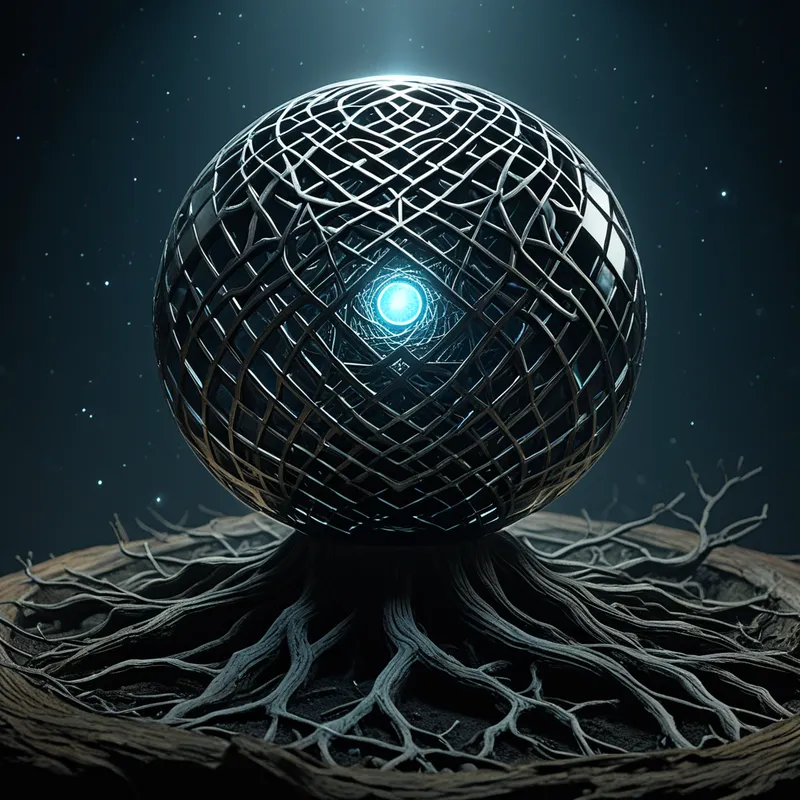
The Dreamer’s Resonance
When this myth stirs in modern dreams, it often manifests as dreams of inexplicable longing for a specific, unnamable place—a familiar yet impossibly distant landscape, often across a body of water. One may dream of finding a hidden, pristine cove, an untouched forest, or a serene, empty city. The somatic feeling is one of profound relief, deep peace, and a release of chronic tension.
Psychologically, this indicates a process of the psyche seeking its own individuation. The dreamer is, often unconsciously, navigating a passage from a life phase defined by effort, conflict, and adaptation (the emperor’s rule, the stormy sea) toward a potential state of inner alignment. The dream-Tokoyo is a symbolic preview of the Self, a vision of what it feels like when the warring parts of one’s personality are reconciled. The journey there in the dream—whether thwarted or successful—maps the dreamer’s current relationship with their own depths.

Alchemical Translation
The alchemy of Tokoyo is the transmutation of seeking into being. The emperor begins with a desire for immortality—an external object to be obtained. Through the ordeal at sea, this desire is refined into a state of timelessness, achieved through the mirror-work of shadow integration.
The eternal land is not found by building a faster ship, but by polishing the mirror of consciousness until it reflects the depths without distortion.
For the modern individual, this myth models the journey from goal-oriented striving to essence-oriented being. We are all emperors of our personal realms, burdened by the mortality of our identities, our achievements, and our failures. The call to Tokoyo is the call to embark on the inner voyage, to face the serpentine complexities of our unconscious (our rage, grief, shame) not with weapons, but with the reflective tool of honest self-examination. The promised land is not a reward for endurance, but the experiential reality that emerges when we cease fighting our own nature and instead recognize its inherent, chaotic divinity. The “eternal life” offered is the experience of the present moment freed from the tyranny of time-bound anxiety—the nunc stans, the everlasting now, which is the true territory of the soul.
Associated Symbols
Explore related symbols from the CaleaDream lexicon:
- Ocean — The vast, unconscious psyche that must be traversed to move from the known world of the ego to the unknown realm of the integrated Self.
- Journey — The core narrative and psychological process of leaving familiar identity behind to seek a state of wholeness and timeless being.
- Mirror — The tool of self-reflection and shadow integration, crucial for passing the guardians of the threshold and seeing the divine within the monstrous.
- Land — The achieved state of being, the grounded, stable reality of the Self that is discovered after the perilous journey across the formless waters.
- Island — The isolated, pristine state of the Self, a contained realm of completeness that exists separate from the fragmented mainland of ordinary consciousness.
- Serpent — The primal, chthonic guardian of the deep, representing the untamed forces of the unconscious that must be faced and recognized as part of the whole.
- Eternal — The core quality of Tokoyo and the goal of the seeker, representing a state beyond temporal decay, a psychological experience of timeless essence.
- Spirit — The ancestral kami and the luminous essence of the inhabitants of Tokoyo, representing the transpersonal, guiding aspects of the psyche that dwell in wholeness.
- Light — The unique, golden, emanating illumination of Tokoyo, symbolizing consciousness that is no longer projected but inherent, the inner light of the Self.
- Dream — The mode through which the modern psyche accesses the longing for and the vision of this eternal land, a symbolic navigation of the inner sea.