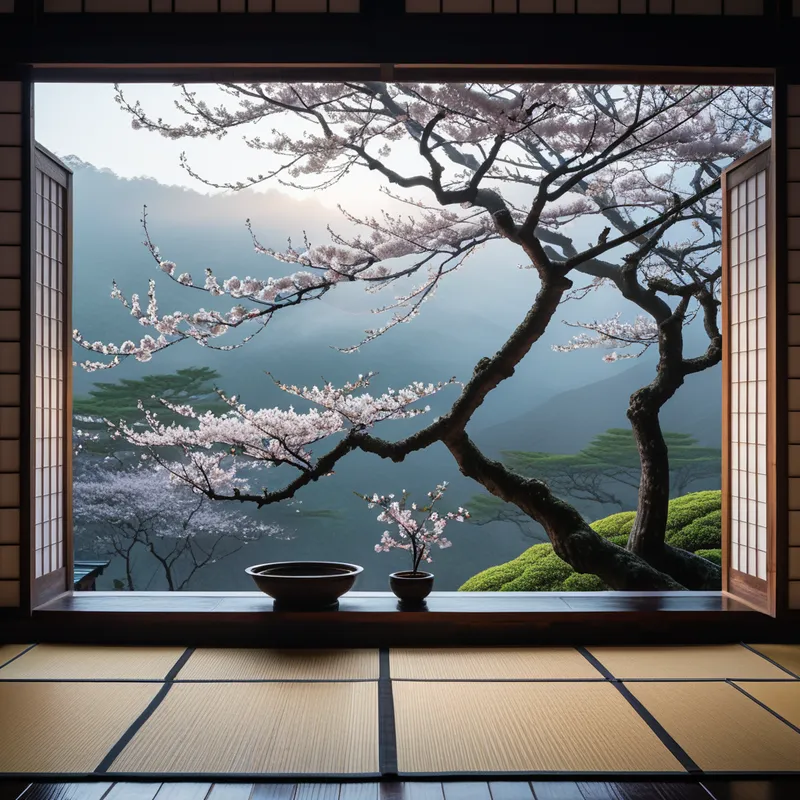
Tokonoma Myth Meaning & Symbolism
The myth of the sacred alcove where emptiness becomes a vessel for presence, hosting the seasonal soul of the world in a silent, reverent dialogue.
The Tale of Tokonoma
Listen. There is a story not of a person, but of a space. A story of a silence that speaks.
In the heart of the home, where the woven tatami breathes the scent of earth and straw, a different kind of wall was born. It was not a barrier, but an invitation. The builders did not construct it; they listened for it. They felt the house’s desire for a place to kneel, to bow its architectural head. And so, they recessed a portion of the wall, raised its floor a sliver above the living plane, and framed it with pillars of unadorned wood that spoke of the forest’s spine.
This space was named Tokonoma. And it was born empty.
But an emptiness that waits is a powerful thing. It began to call. First came the kakemono. A master of ink would spend a lifetime capturing not a mountain, but the spirit of a mountain in a single, decisive stroke. This scroll would be unrolled and hung in the alcove, not as a picture on a wall, but as a window into another state of being—a cliff face at twilight, a line of ancient poetry that cut to the bone of existence.
The emptiness was no longer empty. It held a vista. Then, beneath this window-world, a second soul would arrive. Perhaps a stone. Not just any stone, but one found on a windswept beach, its shape worn by millennia of tides, holding the memory of the sea’s patience. Or a branch of plum blossom, bravely blooming while snow still clung to the earth, placed in a vessel of clay so rough and vital it seemed barely separated from the ground.
And sometimes, a third presence: an incense burner, a simple bowl, a lacquer box. But never more. The space would breathe with this triad—the vertical aspiration of the scroll, the grounded, enduring spirit of the object, and the fleeting, seasonal life of the flower.
The conflict was the world outside—the noise, the clutter, the endless becoming. The Tokonoma was the resolution: a deliberate, sacred pause. The rising action was the careful selection, the ritual cleansing of hands and heart, the mindful placement. The climax was the moment of stepping back, of seeing the conversation now held in the alcove: the mountain speaking to the stone, the poetry humming to the blossom, the void between them vibrating with unspoken meaning.
Here, the family would gather. Guests would be received. They would kneel before it, not in worship of the objects, but in recognition of the relationship it framed—a relationship between the human soul and the soul of the world, held in a silent, perfect balance. The story had no end, for with the turning of the season, the blossom would fade, the scroll would be rolled away, and the emptiness would return, waiting once more to be filled with the next necessary truth.
Cultural Origins & Context
The Tokonoma did not emerge from a single mythic tale but evolved from a deep cultural and spiritual synthesis. Its origins are traced to the Shinto reverence for natural spirits (kami) believed to inhabit rocks, trees, and waterfalls, and the influence of Zen Buddhism, which entered Japan from China. Zen brought with it the aesthetics of Chán monastic life, where a simple altar might hold just a flower or an incense burner before a statue of the Buddha.
By the Muromachi period, this fusion crystallized in the <abbr title=“The Japanese “Way of Tea,” a ritualized preparation and consumption of matcha”>chanoyu (tea ceremony). The tea room itself became a sanctum, and the Tokonoma its spiritual focal point. It was the seat of the shōkyaku, where the season’s first scroll would be displayed, setting the thematic and contemplative tone for the gathering. The practice was passed down not through epic poems, but through lived ritual, taught by tea masters, bunjin, and heads of households. Its societal function was pedagogical and psychological: to cultivate mono no aware, wabi, and sabi—to train the eye and the heart to find profundity in asymmetry, impermanence, and humble materials.
Symbolic Architecture
Psychologically, the Tokonoma is not a thing, but a function of the psyche. It represents the sacred inner chamber where the conscious ego (the host) consciously arranges a dialogue with contents from the greater Self (the seasonal, the eternal, the archetypal).
The Tokonoma is the architecture of attention. It says: “Here, and only here, for now, we will attend to this.”
The raised floor symbolizes a threshold, a liminal space between the mundane and the numinous. The emptiness (kū) is its primary symbol—not a barren void, but a fertile, receptive potential, the wu wei of space. The scroll represents the vertical axis of spirit, ideas, and cultural memory—the Logos. The seasonal object (ikebana, stone) represents the horizontal axis of nature, the body, the earthly and transient—the Eros. Their arrangement is a mandala of wholeness, a temporary resolution of these eternal opposites within the container of the soul’s own home.
The Dreamer’s Resonance
To dream of a Tokonoma is to encounter the psyche’s own need for a sanctified frame. One might dream of an alcove in a childhood home, now noticed for the first time, or a blank space on a chaotic wall that demands to be recognized.
The somatic process is one of centering. There is often a feeling of relief in the dream, a slowing of breath. The psychological process is one of selection and honoring. The dreamer is in a state where unconscious contents—a powerful memory, a burgeoning talent, a neglected grief—are seeking conscious acknowledgment. The empty alcove is the invitation to stop, to turn inward, and to consciously “place” that content in a position of respect, to give it a dedicated psychic space where it can be seen in relationship to the larger themes of one’s life (the scroll) and one’s grounded reality (the stone). It is the dream-ego preparing for a moment of integration, often preceding a life transition where one must discern what is essential from the clutter of the everyday.
Alchemical Translation
The alchemical process modeled by the Tokonoma is the opus of individuation through conscious curation. The modern soul lives in a state of psychic sprawl, a clutter of identities, impulses, and digital fragments. The myth teaches that wholeness is not achieved by adding more, but by creating a disciplined vessel for meaning.
The first act of creation is not to make, but to make space. The first act of the Self is to command a holy silence.
The “nigredo” is the cluttered, undifferentiated state of the psyche. The “albedo” is the cleansing, the creation of the empty alcove—a practice of meditation, journaling, or therapy that clears a dedicated inner space. The “rubedo” is the mindful selection and placement: What is the central, guiding principle (the scroll) for this season of my life? What is the grounding, enduring truth (the stone) I must rely upon? What is the beautiful, fleeting emotion or experience (the blossom) that needs to be honored in its briefness?
The transmutation is in the relationship between these elements, witnessed by the conscious self. The ego does not become the scroll, the stone, or the blossom; it becomes the host of their conversation. It holds the tension of their differences, and in that holding, a third, transcendent thing arises: a moment of meaning, of satori in miniature. The cycle completes as the season changes; the arrangement is dissolved back into emptiness, teaching the final alchemical truth of non-attachment. The Self is not the collection of its contents, but the eternal, receptive space that can host them, one sacred combination at a time.
Associated Symbols
Explore related symbols from the CaleaDream lexicon: