Tángláng Quán Myth Meaning & Symbolism
A humble mantis, through observation and courage, masters a martial art to challenge a divine master, embodying the power of the small and the overlooked.
The Tale of Tángláng Quán
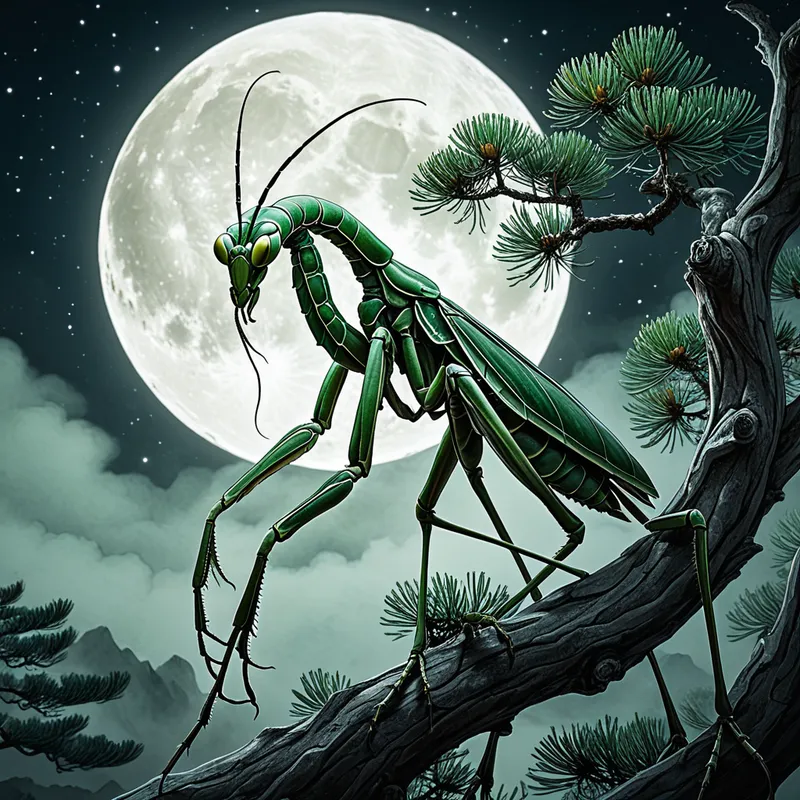
Listen, and hear the whisper of the grass. In the deep green heart of the Middle Kingdom, where mist clings to ancient pines and bamboo groves sigh with the wind, there lived a man named Wáng Láng. He was a seeker, a soul aflame with the desire to master the way of the fist, to understand the dance of energy that moves between heaven and earth. Yet, for all his training, a shadow of defeat clung to him. He had journeyed to the sacred Song Mountains, to the temple of Shàolín, and there he had faced a master whose skill was like the flowing river—impossible to grasp, impossible to oppose. He was bested, utterly and completely.
His spirit bruised but unbroken, Wáng Láng retreated into the embrace of the wild forest. He sat beneath a great, twisting pine, his mind a tempest of frustration. How could he bridge the chasm between his effort and that sublime mastery? It was then that the small gods of the earth began their sermon. A rustle in the leaves. A flash of emerald and bronze. Before him, on a sun-dappled branch, a praying mantis engaged in its own silent battle. It was not fighting another insect, but a cicada, larger, louder, full of summer’s boastful song.
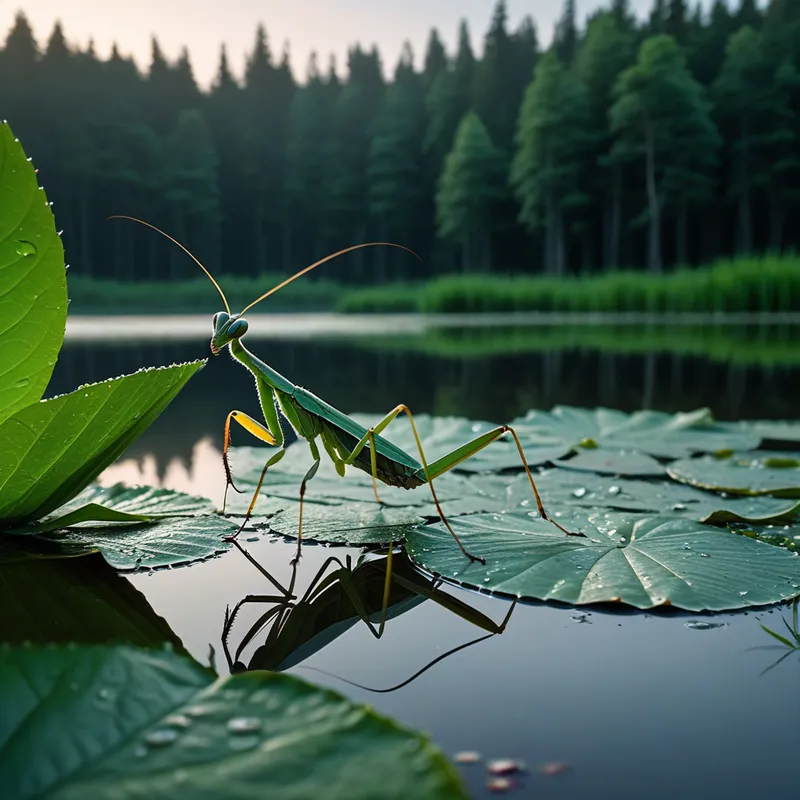
Wáng Láng watched, and his worldly concerns fell away. He saw not an insect, but a principle made flesh. The mantis did not meet force with force. It stood its ground, a statue of patient intent. Its spiked forearms, like twin hooks of jade, were held in a posture of profound readiness—not aggression, but absolute presence. When the cicada moved, the mantis was already there. Its strike was not a blind lunge, but a calculated interception, a capture of the opponent’s very momentum. It flowed around the attack, using the larger creature’s strength as a lever for its own victory.
For days and nights, Wáng Láng became a disciple of the small. He observed the mantis in duel after duel. He noted how it alternated between utter stillness and explosive, direct attacks. He saw how it used its elongated body to create angles, how its head turned to track with uncanny precision. He mimicked its postures, feeling the strange, angular geometry in his own limbs. He began to understand: here was a martial art written in the language of life and death, a Yīn-Yáng dance of hard and soft, waiting and seizing.
He distilled these observations into a new system—the Tángláng Quán. It was a style of hooks and grabs, of swift, penetrating strikes aimed at vital points, of using an opponent’s energy against them with the efficiency of a predator. When he returned to the temple and faced the master once more, he did not fight as a man. He fought as the embodiment of the mantis principle. His movements were unpredictable, attaching and sticking to the master’s flow, interrupting it with sharp, precise corrections. The master, for the first time, was challenged not by greater force, but by a completely different logic—the relentless, adaptive logic of the natural world. The humble had schooled the sublime.
Cultural Origins & Context
The myth of Tángláng Quán’s origin is inextricably linked to the living tradition of Chinese martial arts, or Wǔshù. Unlike cosmic creation myths, this is a human-centric, foundational legend belonging to a specific school. It is a chuánshuō (legend) passed down orally from master to disciple within the lineage of Mantis Fist practitioners. Its primary function is etiological—it explains the “why” and “how” of a particular martial arts system, rooting its authority not in arbitrary human invention, but in the observed wisdom of nature itself.
This reflects a core tenet of traditional Chinese thought: the unity of humanity and the natural world (Tiānrén Héyī). The ideal warrior-sage does not conquer nature but learns from it. By observing the mantis, Wáng Láng participates in a grand, ancient tradition of biomimicry, where the strategies of animals—the tiger’s power, the crane’s grace, the monkey’s agility—are internalized as spiritual and physical disciplines. The myth served to validate the style’s techniques, inspire students with the virtue of humble observation, and connect the practice to a deeper, animistic worldview where wisdom resides in every leaf and creature.
Symbolic Architecture
At its heart, Tángláng Quán is a myth about the intelligence of adaptation and the power of the peripheral. The mantis is not the king of beasts; it is an often-overlooked insect. Its victory is a testament to the potency of specialized skill over generalized strength.
The greatest power is not in being the largest force in the field, but in becoming the most precise instrument for the moment at hand.
Psychologically, the mantis represents the focused consciousness. Its ability to remain perfectly still symbolizes the cultivated mind in meditation, observing the flow of thoughts (the cicada’s noise) without being swept away. Its sudden, decisive strike represents the moment of insight or action that emerges from that deep stillness. The myth champions the underdog archetype, but with a crucial nuance: the underdog wins not by becoming a giant, but by perfecting its inherent, unique qualities. Wáng Láng’s initial defeat represents the ego’s futile struggle against a superior complex. His retreat is a necessary descent—a movement away from collective standards (temple mastery) into a personal, instinctual space (the forest). His creation is an act of psychic synthesis, building a new structure of the self from the raw materials of observed reality.
The Dreamer’s Resonance
To dream of the praying mantis or of learning Tángláng Quán often signals a profound process of reorientation in the dreamer’s psyche. Somatically, one might feel a new awareness of angles, leverage, and precision in their body, even if awake—a sense of wanting to move or act with more efficiency and less wasted effort.
Psychologically, this dream pattern emerges when the conscious mind (Wáng Láng) has been “defeated” by a life situation too complex or powerful to overcome directly. The dream presents the solution not through increased force, but through a call to observation and adaptation. It suggests the need to step back from the head-on conflict and study the “pattern” of the problem. Who or what is the “cicada” in your life—the loud, draining, or repetitive challenge? The mantis asks you to find its rhythm, its blind spot, and to develop a specialized, almost surgical response. This dream is an invitation to embrace your own unique, perhaps overlooked, strengths and to wield them with patience and devastating accuracy.
Alchemical Translation
The journey of Wáng Láng is a perfect map for the alchemical process of individuation. The initial state is one of identified striving—he seeks mastery according to an established, collective standard (the Shaolin master). His defeat is the nigredo, the blackening, the necessary humiliation of the ego that cracks open the possibility for new growth.
His retreat to the forest is the beginning of the albedo, the whitening. He turns inward and downward, into the unconscious (the natural world). Here, he does not find a spirit animal of raw power, but one of intricate intelligence. The mantis is a content of the unconscious—an instinctual pattern of behavior—that he must consciously assimilate. This is the core of the work: the patient, meticulous observation and integration of an autonomous psychic complex.
Individuation is not about adding more of what you think you should be, but about consciously reclaiming the precise, innate patterns you have always carried.
Creating Tángláng Quán is the rubedo, the reddening. It is the creation of a new, functional synthesis between the conscious ego and the integrated unconscious content. He returns to the world not as a defeated man, but as a transformed one, bearing a new “philosophy” of being. He challenges the old authority (the parental or societal complex) not to destroy it, but to establish a new dialogue from a position of authentic, self-created power. The myth, therefore, teaches that true self-mastery comes not from conquering the outer world with a borrowed style, but from having the humility to learn the unique, potent style written in the scripture of your own deepest nature.
Associated Symbols
Explore related symbols from the CaleaDream lexicon: