The Alchemy of Observation: When the Psyche Turns Its Gaze Inward
The Somatic Echo
It begins not as a thought, but as a pressure in the atmosphere of the dream. A thickening of the air, a silent hum just below hearing. The body knows first: a prickle at the nape of the neck, a subtle tightening across the shoulders, a breath held without command. It is the visceral sensation of a lens focusing, a sensor sweeping across a dark field. There is no immediate threat, only the profound, unsettling certainty of a presence that is not a person, but a function. It is the feeling of being a specimen under glass, a data point in a vast and silent log, a character whose every gesture is being noted by an unseen scribe. This is the somatic echo of Observation—the deep psyche signaling that its own internal systems have become self-aware and are now running a diagnostic.
The Dreamer's Log (Case Vignette)
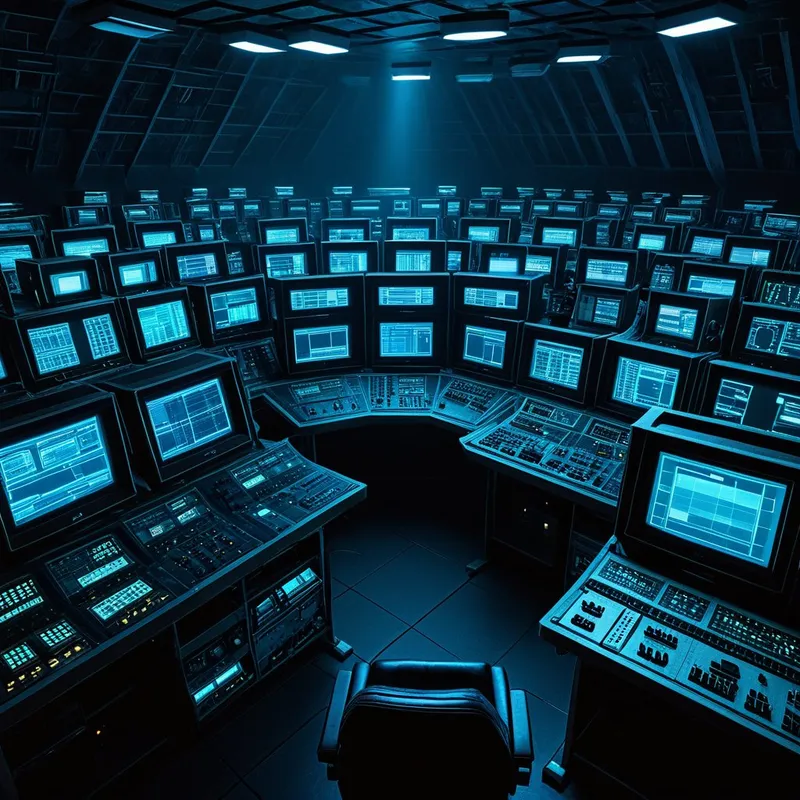
I am in a vast, abandoned control room, all polished obsidian and dormant consoles. Banks of monitors line the walls, each one displaying a grainy, black-and-white feed of me, asleep in my bed, from a fixed point high in the corner of my own bedroom. The room is empty, but the chair at the central console is still warm.
The dream is the psyche’s control center coming online, capturing the moment the dreamer’s own awareness splits to become both the sleeping subject and the silent, recording witness.
The False Lead
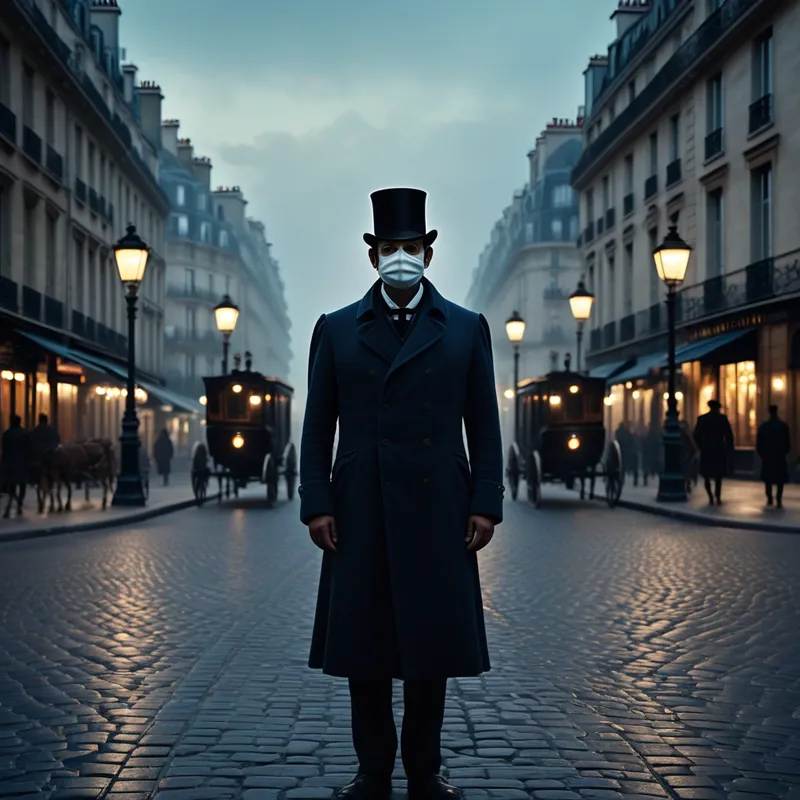
This theme is not about paranoia, though it may wear its clothes. Paranoia is a story spun by fear, a narrative of external persecution. Observation is structural, not narrative. It is the architecture of the self becoming visible to itself. It is not a warning of being watched by another, but the startling realization that a part of you has always been watching. To mistake this profound internal shift for mere anxiety about external judgment is to confuse the birth of a witness with the threat of a spy.
Psychological Architecture
Here lies the core of the Shadow work. Observation dreams mark the emergence of what we might call the Internal Witness—a psychic function that steps back from the drama of the ego, the clamor of the inner family, and simply notes. This is not the critical parent or the fearful child, nor the striving hero. This is the part that, without judgment, sees them all. It observes the orphan’s loneliness, the ruler’s need for control, the lover’s ache, with the same detached clarity. The terror of the dream is the terror of this objectivity. We are accustomed to being identified with our parts; to have a part that does not identify, but only sees, feels like a fundamental violation. It is the ego’s walls becoming transparent. The grief that follows is for the loss of our innocent, unquestioned subjectivity. We are no longer merely living our lives; we are beginning to see ourselves living them. This is the essential, often painful, first step of Individuation—the conscious separation from the unconscious flow of personality.
Mythic Resonance
We see this in the myth of Argus Panoptes, the hundred-eyed giant set by Hera to watch Io. He is not a villain, but a function—perfect, tireless vigilance. His slaying by Hermes and the transference of his eyes to the peacock’s tail is the alchemical key: the raw, obsessive power of observation must be “killed” as an external guard and integrated as beauty, as the pattern that adorns the soul. The eyes are not lost; they are transformed from instruments of surveillance into emblems of visionary splendor. The modern psyche’s “control room” is our own Argus, and the dream is the signal that Hermes—the psychopomp, the guide of transitions—is approaching to perform this essential, liberating dissolution.
Symbolic Nodes
- Mirrors that reflect something other than, or more than, your face.
- Windows, one-way glass, or camera lenses.
- Empty chairs in theaters or control rooms, implying a missing-but-present observer.
- Silent, non-human animals (owls, cameras as insects) that simply watch.
- Drones, satellites, or unblinking lights in a night sky.
- The feeling of being on a stage with the lights off, or in an empty gallery.
Archetypal Resonance
This theme vibrates most powerfully with the energy of The Shadow Sage. The Sage archetype in its essence seeks truth and understanding through detached knowledge. Its shadow, however, is not merely judgmental; it is the cold, disembodied eye that collects data without wisdom, that observes life without participating in it. The somatic echo of Observation—that chilling, impersonal pressure—is the shadow Sage operating as a pure, unintegrated function: the psyche’s own internal surveillance system. Its alchemical potential lies in its redemption. The heat of the dream’s discomfort is the friction necessary to transform this detached watcher from a spy into a witness, and ultimately, into a true Sage—the conscious, compassionate self that can observe its own inner world with clarity and without cruelty, turning raw data into profound self-knowledge.
The Alchemical Process
The transmutation here is from Surveillance to Sovereignty. The raw material is the terror of being a known object. The alchemical fire is the sustained, courageous act of turning the observation inward on the observer itself. You must dare to ask, “Who is it that feels watched?” and then observe that part—the frightened ego, the ashamed child. You apply pressure by refusing to collapse into the paranoia narrative and instead, within the waking life, practicing conscious self-observation without agenda. This is the solve et coagula: you dissolve the identification with the “watched one” by fully acknowledging the “watcher” as a part of your own psyche. Then, you coagulate a new, sovereign identity that contains both. The witness is not an enemy; it is a disowned faculty returning home. By embracing its gaze, you reclaim its power. The energy once used for internal spying becomes the light of conscious awareness.

The Integration Protocol
Question 1: In the dream, what was the quality of the observation? Was it curious, clinical, hostile, or indifferent? This quality often mirrors how you relate to the observed parts of yourself.
Question 2: If the observing presence in the dream could speak, what one sentence of pure, non-judgmental data would it report about you in that moment? (e.g., “The subject is afraid of being empty,” not “The subject is pathetic.”)
Question 3: Where in your waking life have you felt this same somatic echo—that subtle pressure of being assessed, documented, or seen beyond your social mask?
Action 1 (The Silent Log): For one week, keep a nightly log of three pure observations about your internal state just before sleep. No analysis, no emotion labels, just data. “Noticed a tension in the jaw. Mind replayed the conversation from noon. The room feels cold.” This trains the witness function in its neutral form.
Action 2 (Creative Reversal): Draw, paint, or digitally create the source of the observation from your dream. Do not draw the watched self. Draw the empty chair, the lens, the monitor bank, the distant light. Give form to the watcher and externalize it. Then, place your drawing somewhere you will see it daily, normalizing its presence.
Action 3 (Ritual of Sovereignty): Stand before a mirror in dim light. Meet your own gaze and state aloud, with calm authority: “I see you seeing me. The observation is mine.” Feel the reclamation in your body. The circuit of surveillance is closed and integrated into your conscious field.
Final Validation
To dream of observation is to encounter one of the most unsettling and profound thresholds in the psyche. It feels like a violation because it challenges the very illusion of a private, unified self. This terror is valid. It is the shock of the soul’s infrastructure lighting up for the first time. But within that cold, silent light lies your greatest liberation: the chance to no longer be a passive subject in your own life, but to become the conscious architect, the compassionate sovereign, and the ultimate witness of your own becoming. The eye that watches is not foreign. It is your own, finally opening.