Tūmatauenga Myth Meaning & Symbolism
The story of the primal deity who, through conflict with his divine brothers, forged the human capacity for war, hunting, and fierce self-determination.
The Tale of Tūmatauenga
In the beginning, there was only the Te Kore, the nothingness, the great and pregnant darkness. And from this nothingness, the primal parents, [Ranginui](/myths/ranginui “Myth from Maori culture.”/) and Papatūānuku, emerged, locked in a tight and suffocating embrace. Their children, the gods, were born into the cramped, dim world between their bodies. They lived in perpetual twilight, pressed upon by the damp flesh of the earth and the heavy weight of the sky.
Among these children was Tūmatauenga. His spirit was not one for quiet endurance. Where his brothers felt the damp and dreamed of dampness, Tū felt a fire kindling in his chest. He felt the press of the sky as a cage, the embrace of the earth as a prison. He listened to the slow, heavy breaths of his parents and heard not love, but stagnation. He saw his brothers—Tāne, who whispered to the growing things; Tangaroa, who dreamed of vast, fluid spaces; Rongo, who soothed with gentle rhythms—and he felt a profound and growing separation.
“We cannot live like this!” Tū’s voice cut through the humid silence, sharp as flint. “We are crushed in this darkness. We must part them.”
But his brothers were afraid. To wound the parents? To shatter the world? They proposed other ways. Tāwhirimātea howled and raged against the very idea. Rongo pleaded for patience. Tāne suggested he might push them apart with his growing strength. For a time, Tū waited, his jaw clenched, his hands curling into fists of frustration. He watched Tāne place his shoulders against his mother and his feet against his father, straining until sinews cracked and the world groaned. Light, terrible and beautiful, flooded in as the parents were wrenched apart. Sky recoiled to the heavens. Earth settled below. And the children were free.
But the separation was a wound. Ranginui wept, and his tears became the rain. Papatūānuku sighed, and her mist became the morning dew. Their grief filled the new world. Tāwhirimātea, furious at this violence against his father, declared war on his brothers. He unleashed his children—the whirlwinds, the hurricanes, the tempests—and attacked.
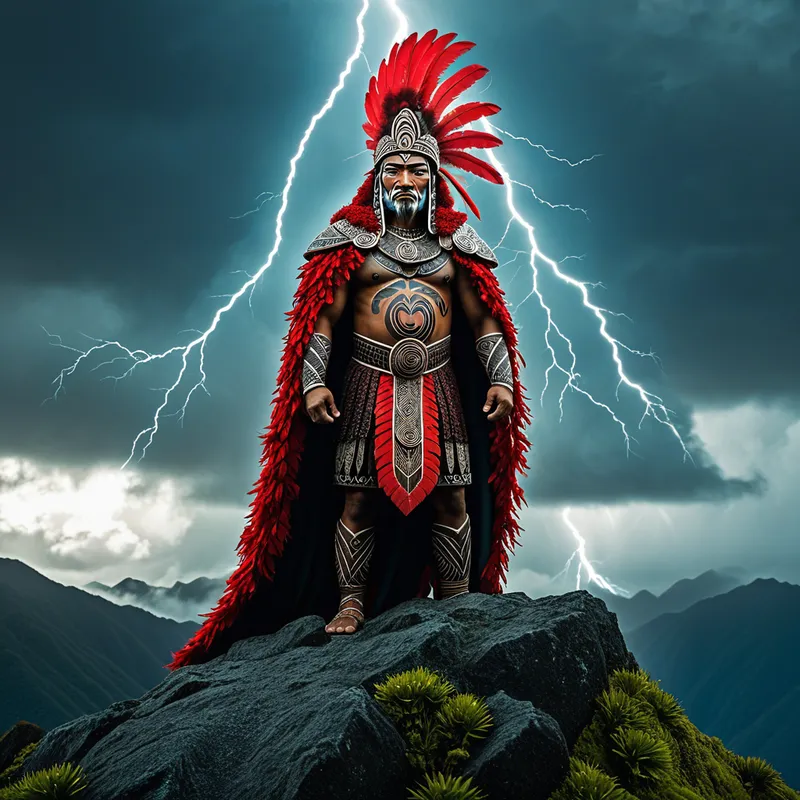
Tāne’s forests were shattered. Tangaroa’s oceans were churned into fury. Rongo’s cultivations were flattened. Each brother fled or was subdued by the storm’s wrath. But Tūmatauenga stood firm. The winds could not uproot him. The rains could not dissolve his resolve. He stood upon the body of his mother, feet planted, and he defied the storm. He did not flee into the earth or the sea. He faced the chaos, and he endured.
When the storm of Tāwhirimātea had spent its rage, Tū looked upon a world shaped by conflict. He saw his brothers, each in their own realm, nursing their wounds. And a cold, clear purpose settled in him. He had stood firm. Now, he would act. He went to the great forests of Tāne and fashioned spears and clubs from the wood. He wove nets from the plants. He took the bones of the earth and shaped them into blades. He did not ask permission. He took what he needed.
Then, he turned his implements upon the children of his brothers. The birds of Tāne, the fish of Tangaroa, the cultivated foods of Rongo—he hunted them, he caught them, he consumed them. He did not do this out of mere hunger, but as a declaration. He was the one who could confront, who could take, who could impose his will upon the world. From the defiance of the storm and the conquest of his brothers’ realms, Tūmatauenga forged the arts of war, the practices of hunting, and the essence of humanity. He became the father of humankind, imparting his fierce, resilient, and often terrible spirit.
Cultural Origins & Context
This cosmogonic narrative is part of the foundational whakapapa of the Māori world. Passed down orally through generations by tohunga and skilled orators, these stories were not mere entertainment but the living map of reality. The myth of Tūmatauenga and the separation of the primal parents explained the very structure of the universe—the reason for the sky, the land, the sea, and the storms. More specifically, it established the divine origin and necessary place of conflict, authority, and human industry.
Tū’s story functioned as a societal charter. It sanctified the arts of warfare (taua and haka), hunting, and tool-making. It provided a model for the warrior ethos, emphasizing resilience (tū), strategic action, and the assertion of mana. In a culture where identity was deeply tied to lineage and land, Tūmatauenga represented the fierce protectiveness and the sometimes-necessary aggression required to maintain that identity against external threats or internal discord. He was invoked before battle, his spirit channeled in the performance of the haka, a ritualized embodiment of his defiant stand against the storm.
Symbolic Architecture
At its [heart](/symbols/heart “Symbol: The heart symbolizes love, emotion, and the core of one’s existence, representing deep connections with others and self.”/), the myth of Tūmatauenga is a profound [allegory](/symbols/allegory “Symbol: A narrative device where characters, events, or settings represent abstract ideas or moral qualities, conveying deeper meanings through symbolic storytelling.”/) for the [birth](/symbols/birth “Symbol: Birth symbolizes new beginnings, transformation, and the potential for growth and development.”/) of [consciousness](/symbols/consciousness “Symbol: Consciousness represents the state of awareness and perception, encompassing thoughts, feelings, and experiences.”/) through [differentiation](/symbols/differentiation “Symbol: The process of distinguishing or separating parts of the self, emotions, or identity from a whole, often marking a developmental or psychological milestone.”/). The cramped world of the united parents symbolizes undifferentiated psychic unity—a state of unconscious oneness where no individual [identity](/symbols/identity “Symbol: Identity represents the sense of self, encompassing personal beliefs, cultural background, and social roles.”/) can form. Tū’s fiery impatience is the first spark of ego-[consciousness](/symbols/consciousness “Symbol: Consciousness represents the state of awareness and perception, encompassing thoughts, feelings, and experiences.”/), the part of the psyche that says, “I am here, and this state is intolerable.”
The first act of the Self is not creation, but separation. To become, one must first declare what one is not.
His brothers represent other psychic potentials: the nurturing, growing principle (Tāne/Rongo), the fluid emotional [realm](/symbols/realm “Symbol: The symbol of ‘Realm’ often signifies the boundaries of one’s consciousness, experiences, or emotional states, suggesting aspects of reality that are either explored or ignored.”/) (Tangaroa), the chaotic affective storms (Tāwhirimātea). Tū’s initial conflict is not with the outer world, but with these inner forces that resist change. His defiant stand against Tāwhirimātea’s storm is the ego’s struggle to maintain its nascent integrity against the overwhelming tempests of [emotion](/symbols/emotion “Symbol: Emotion symbolizes our inner feelings and responses to experiences, often guiding our actions and choices.”/) and psychic [chaos](/symbols/chaos “Symbol: In Arts & Music, chaos represents raw creative potential, uncontrolled expression, and the breakdown of order to forge new artistic forms.”/). His subsequent conquest—taking from the realms of his brothers to forge tools and sustenance—symbolizes the conscious ego’s necessary, if violent, appropriation of psychic [energy](/symbols/energy “Symbol: Energy symbolizes vitality, motivation, and the drive that fuels actions and ambitions.”/) from other archetypal complexes to build a functioning identity. He transforms raw, instinctual [life](/symbols/life “Symbol: The symbol of ‘Life’ represents a journey of growth, interconnectedness, and existential meaning, encompassing both the joys and challenges that define human experience.”/) (birds, fish) into sustenance for a conscious being.
The Dreamer’s Resonance
When the archetype of Tūmatauenga stirs in the modern dreamscape, it often heralds a critical phase of boundary-setting and self-assertion. The dreamer may find themselves in a cramped, dark, or suffocating space—a classic symbol of an undifferentiated life situation or a psyche burdened by enmeshment. The emergence of a fierce, resolute, or even angry figure (or the dreamer becoming that figure) signals the psyche’s readiness to force a separation.
Dreams of standing firm against howling winds, tidal waves, or familial pressure point directly to Tū’s ordeal. This is not a call to literal aggression, but a somatic signal of the need to establish psychic territory. The body may feel tense, jaw clenched, shoulders squared—a physiological preparation for the “stand.” Conversely, dreams where the dreamer is hunting, forging a tool, or ritually preparing for a confrontation indicate the next stage: the conscious gathering of resources and skills needed to defend this newly claimed selfhood. The shadow of Tū appears in dreams of uncontrolled rage or destructive conquest, warning that the warrior’s force, untempered by other virtues, can turn against the self and others.
Alchemical Translation
The journey of Tūmatauenga is a brutal but essential map for the alchemical process of individuation. The initial state, Te Kore and the embraced parents, is the nigredo—the black, chaotic, undifferentiated mass of the unconscious. Tū’s fiery impulse is the first stirring of the ignis that will initiate the work.
The separation of the parents is the separatio, the crucial and painful division of opposites (conscious/unconscious, spirit/matter, self/other) without which no transformation is possible. This act inevitably creates grief (the parents’ tears) and psychic backlash (Tāwhirimātea’s storm). The modern individual faces this as a life crisis, a breakup, leaving a family system, or any event that violently differentiates them from a prior state of belonging.
To forge the soul, one must first withstand the storm that creation unleashes. Endurance is the anvil upon which identity is hammered.
Tū’s unwavering stand represents the coagulatio—the “fixing” of the volatile spirit into a firm, enduring stance. This is the development of a resilient ego-complex capable of weathering inner and outer turmoil. Finally, his crafting of tools and hunting represents the coniunctio in its most pragmatic form: the conscious ego (Tū) integrating and utilizing the powers of the other archetypes (the brothers’ realms) to build a functional life in the manifested world. The “war” transforms into skilled action; raw conflict is alchemized into culture, art, and purposeful will. The individual does not eliminate their inner Tāne (creativity) or Tangaroa (emotion), but learns to consciously engage with these forces, taking what is needed to sustain a conscious existence, thereby becoming truly human.
Associated Symbols
Explore related symbols from the CaleaDream lexicon:
- Warrior — The embodied archetype of Tūmatauenga, representing the capacity for conscious confrontation, boundary-setting, and the focused application of will.
- Sky — The separated Ranginui, representing the realm of consciousness, spirit, and the father principle against which the ego defines itself.
- Earth — The foundational Papatūānuku, representing the unconscious, the body, and the maternal ground from which all life and action springs.
- Storm — The wrath of Tāwhirimātea, symbolizing the chaotic emotional and psychic backlash that follows any act of radical separation or individuation.
- Forest — The realm of Tāne, representing the untamed growth of the psyche, instinctual life, and the raw materials from which tools of consciousness are fashioned.
- Ocean — The domain of Tangaroa, symbolizing the deep, fluid, and often unconscious realm of emotions and the collective psyche.
- Fire — The inner spark of Tū’s impatience and resolve, the transformative force that initiates change and forges new realities from old states.
- Mountain — The firm ground upon which Tū stands defiantly, representing the achieved stability, resilience, and unwavering stance of the integrated self.
- Weapon — The spear or club fashioned by Tū, symbolizing the focused intellect, will, and skill developed to protect the nascent self and engage with the world.
- Light — The terrible beauty that floods in after the separation, representing the dawn of consciousness, clarity, and the painful illumination of truth.
- Shadow — The unintegrated aspects of the warrior, such as mindless aggression or the refusal of connection, which must be acknowledged to prevent the archetype from becoming tyrannical.
- Order — The ultimate result of Tū’s actions, the move from primal chaos to a world where humanity has a defined place and purpose, however hard-won.