Titans vs. Olympians Myth Meaning & Symbolism
The primordial war where the younger Olympian gods overthrow their Titanic forebears, forging a new world order from the bones of the old.
The Tale of Titans vs. Olympians
Before history, before memory, there was only the yawning, formless dark. From this abyss, Gaia and Ouranos arose, and from their union came the first gods: the Titans. They were the bones of the world itself—Oceanus was the encircling river, Mnemosyne was the bedrock of thought, Kronos was the relentless, devouring turn of the seasons. They were vast, elemental, and complete in their ancient, static reign.
But Ouranos, fearing their power, imprisoned his children in the bowels of the Earth. Gaia, in agony and rage, forged a adamantine sickle and gave it to her youngest and boldest, Kronos. In a terrible, defining act, Kronos ambushed his father and cast him down, severing the Sky from the Earth forever. The blood that fell upon the land gave birth to the Furies and the Giants; the seed that fell upon the sea foam gave birth to Aphrodite. A new age, brutal and raw, began under Kronos’s rule.
Yet a prophecy echoed in the halls of time: that Kronos too would be overthrown by his own child. In terror, he swallowed each babe his sister-wife Rhea bore: Hestia, Demeter, Hera, Hades, Poseidon. Their essence simmered within him, undigested, a rebellion waiting to be born. When Zeus was next delivered, Rhea wrapped a stone in swaddling clothes and gave it to Kronos, who swallowed it without a glance. The infant god was spirited away to a hidden Cretan cave, where his cries were drowned by the clashing shields of the Kouretes.
Zeus grew strong, fed on the milk of the goat Amaltheia. When the time was ripe, he returned. He gave Kronos a potion that churned the Titan’s stomach, forcing him to disgorge the stone and his five elder siblings, now fully grown and blazing with divine power. The stone was placed at Delphi, the navel of the world. The alliance was forged: the Olympians.
War erupted, shaking the cosmos to its foundations. For ten years, the Titans, led by the mighty Helios and Selene, battled the new gods from their stronghold on Mount Othrys. The Olympians held Mount Olympus. The conflict was a stalemate of primal fire against nascent lightning, of mountain-crushing strength against cunning strategy.
The tide turned when Zeus, advised by Gaia, released her other, monstrous children, long imprisoned by Ouranos: the one-eyed Cyclopes and the hundred-handed Hecatoncheires. The Cyclopes forged the divine weapons: Zeus’s thunderbolt, Poseidon’s trident, Hades’s helm of darkness. The Hecatoncheires, with three hundred hands each, became the ultimate artillery, raining three hundred mountains down upon the Titans at once.
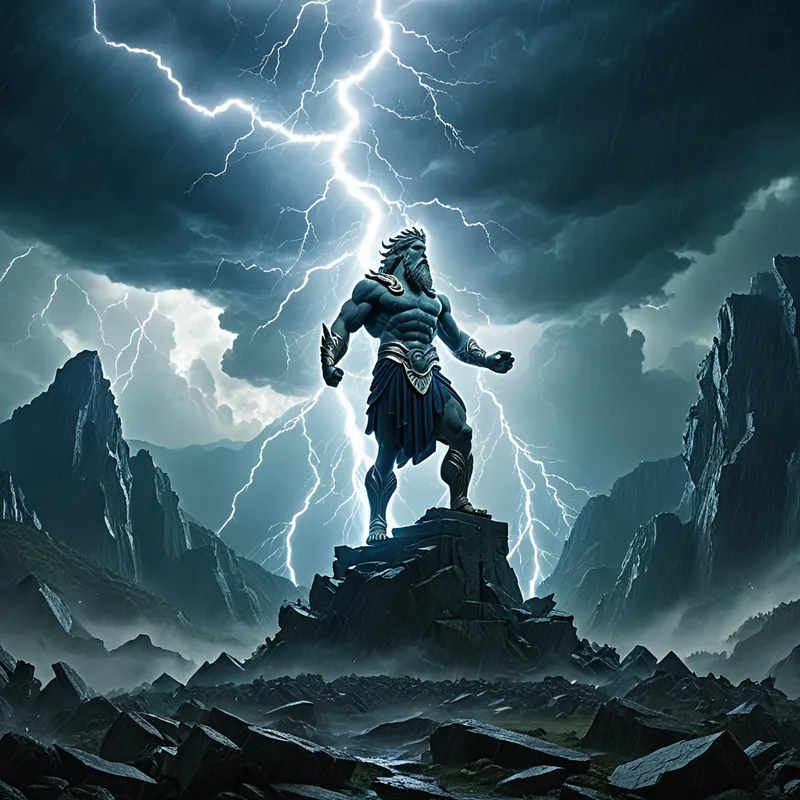
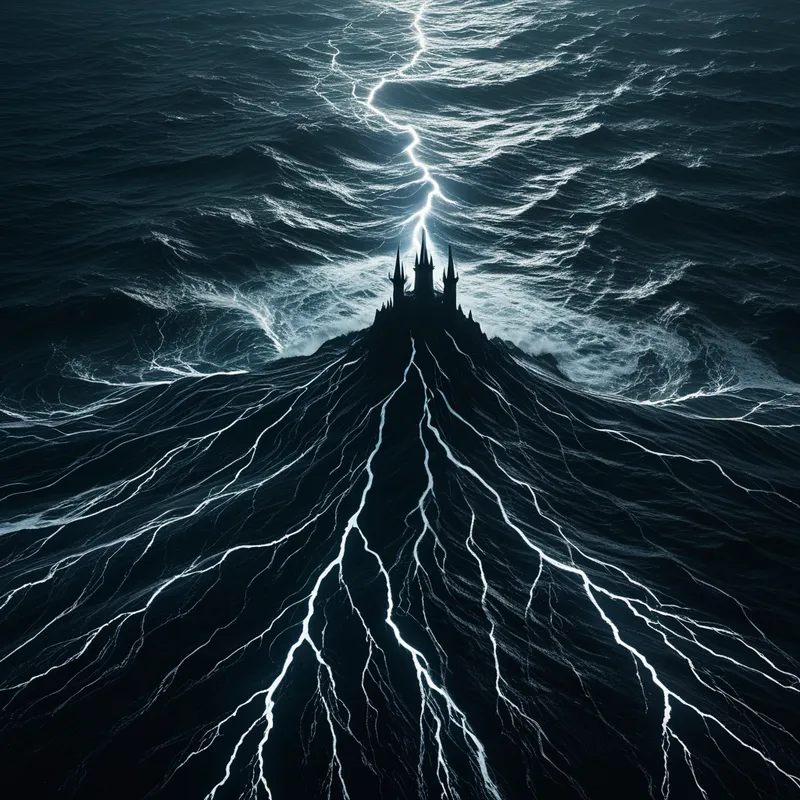
The final cataclysm was terrifying to behold. The Hecatoncheires seized the Titans. Zeus unleashed his thunderbolts with a fury that split the sky. Poseidon stirred the oceans into tsunamis. The earth cracked and burned. The Titans were overthrown, bound in chains of unbreakable adamantine, and cast down into the deepest, darkest pit of the underworld: Tartarus. The Hecatoncheires were set as their eternal, vigilant wardens. The reign of the Olympians was secured. Order was carved from chaos, light from darkness, a new law from the bones of the old.
Cultural Origins & Context
This foundational myth, known as the Theogony, was systematized by the poet Hesiod in the 8th century BCE. It was not mere entertainment, but a sacred narrative that served as the operating system for Greek cosmology and identity. Performed at religious festivals and aristocratic symposia, it answered the profound questions of origin: Where do we come from? How did the world we know come to be? Why is there order, and why is it perpetually threatened by disorder?
The story functioned as a divine charter, legitimizing the Olympian pantheon worshipped in city-states like Athens and Sparta. It explained the current world order (the cosmos) as the hard-won victory over a prior, more brutal, and impersonal state (the chaos of the Titanic reign). It also reflected very human political anxieties about succession, tyranny, and the violent, often patricidal, transfer of power from one generation to the next—a theme all too real in the ancient world.
Symbolic Architecture
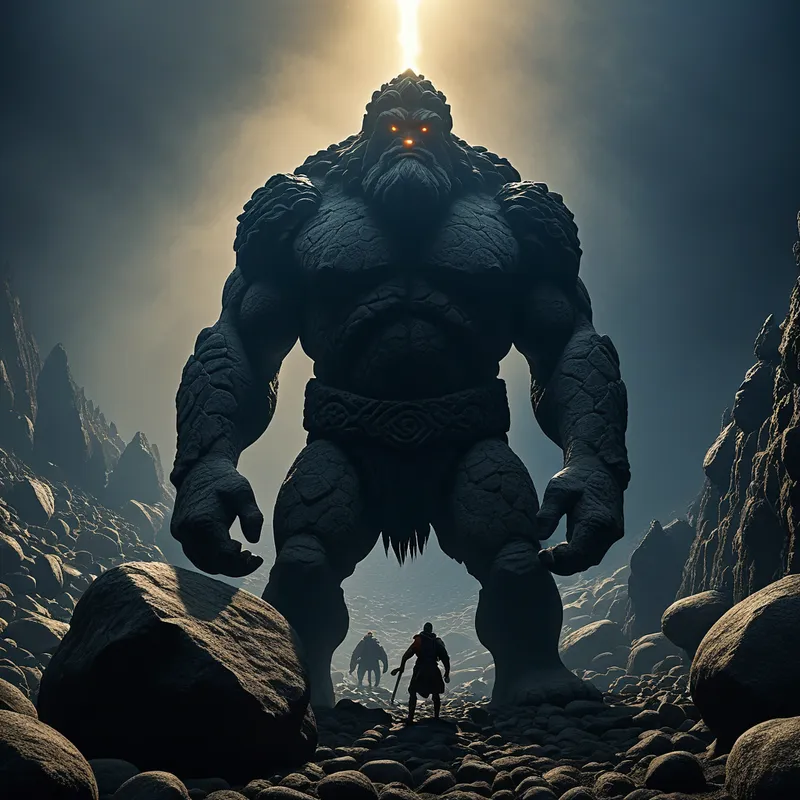
At its core, the Titanomachy is the psyche’s foundational drama. The Titans represent the primordial, unconscious, and instinctual forces within us. They are the raw, undifferentiated material of being: our deepest drives, our ancestral baggage, our chthonic passions, and the sheer, overwhelming weight of “what has always been.” They are the psychic bedrock, necessary but often oppressive, resistant to change and differentiation.
The Titans are not evil; they are the pre-conscious ground of being from which consciousness must painfully differentiate itself.
The Olympians symbolize the emergent forces of consciousness, order, and individuation. Zeus’s lightning is the brilliant, clarifying flash of insight that cuts through confusion. Hera represents the structuring principle of relationship and covenant. Athena embodies strategic wisdom born from the head of the father-god. Their victory is not the eradication of the Titanic realm, but its subjugation and integration into a new hierarchy. Tartarus is not destroyed; it becomes the necessary foundation, the repressed but essential basement of the psychic house.
The act of Kronos swallowing his children is a profound image of psychic stagnation, where potential is consumed by the dominant complex (the ruling “father”) and prevented from developing. Zeus’s liberation of his siblings is the ego’s first courageous act of reclaiming disowned parts of the self.
The Dreamer's Resonance
When this mythic pattern stirs in modern dreams, it signals a profound internal upheaval. The dreamer may be experiencing a “Titanic” state: feeling crushed by ancestral patterns, overwhelmed by raw emotion (earthquakes, floods), or ruled by an archaic, devouring inner authority (a consuming monster, a sinking feeling).
Dreams of immense, slow-moving giants, crumbling foundations, or being trapped in deep, earthy places point to this. Conversely, dreams of spectacular storms, liberating weapons (a key, a sword of light), or forming a council with powerful allies mirror the Olympian uprising. The somatic experience is often one of immense pressure giving way to a cathartic, if terrifying, release—a feeling of the very ground of one’s identity breaking apart to make way for a new, more conscious structure.
Alchemical Translation
The alchemical journey of individuation is precisely this Titanomachy internalized. The prima materia—the leaden, chaotic starting point of the work—is the Titanic self: identified with family systems, collective norms, and unconscious instincts.
The goal is not to defeat one’s origins, but to perform the sacred rebellion that transforms their rule into foundation.
The “Zeus principle” is the ego’s capacity to say “no” to the devouring status quo (Kronos), to risk exile for the sake of potential. The potion given to Kronos is the bitter but necessary therapy or insight that forces us to “disgorge” swallowed talents, emotions, and potentials we had internalized and imprisoned.
Freeing the “divine siblings” (Hades, Poseidon, Hera) is integrating the other major complexes of the psyche: the shadow (Hades, ruler of the unseen), the fluid realm of emotion and the unconscious (Poseidon), and the anima/animus (Hera). The alliance forged is the birth of a coherent, self-governing psyche.
Finally, the binding of the Titans in Tartarus represents the crucial act of containment. The primal forces are not annihilated; their raw power is put in service to the new order. Our deepest instincts and ancestral shadows become the secured foundation upon which our conscious, differentiated life is built. We do not live in Tartarus, but we acknowledge it as the necessary depth that gives our Olympus its height. The war is never truly over, for the Giants—the spawn of the spilled blood of the old order—will always threaten to rise again, ensuring that our hard-won consciousness must remain vigilant, engaged, and forever in the process of becoming.
Associated Symbols
Explore related symbols from the CaleaDream lexicon: