Tishtrya the Rain Star Myth Meaning & Symbolism
The myth of the celestial horse who battles drought to bring life-giving rain, embodying the cosmic struggle for renewal and the soul's resilience.
The Tale of Tishtrya the Rain Star
Listen, and hear the tale written in the turning of the sky, in the thirst of the earth, and in the first, sweet drop that breaks a seven-year drought.
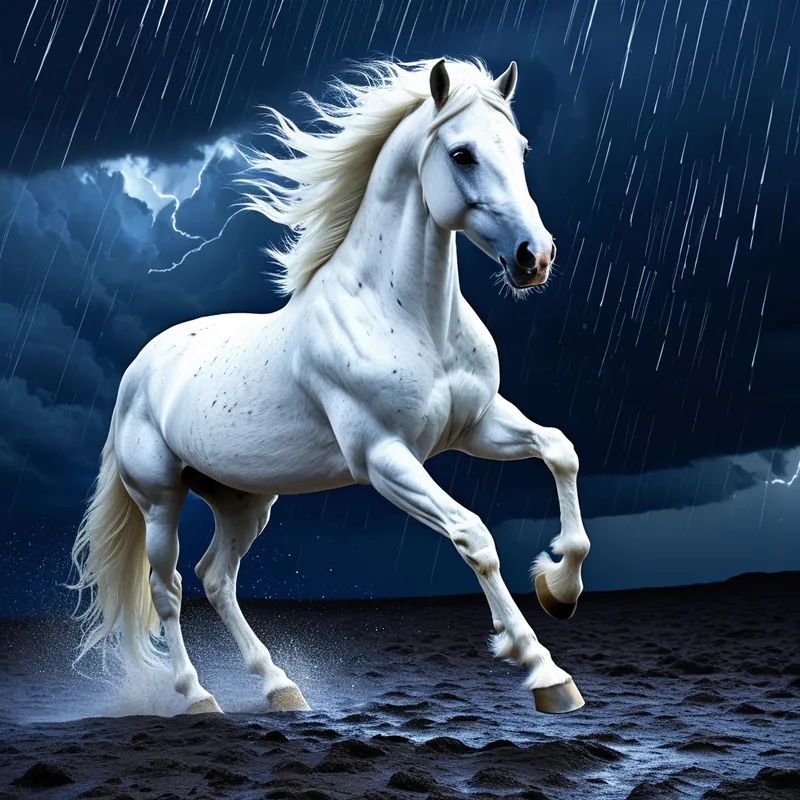
In the beginning, before the memory of rain, there was a great and terrible thirst. The land of Iran lay gasping, its rivers reduced to whispers in their beds, its fields to dust. The people looked up, their prayers as dry as the wind, and saw only the pitiless, burning blue. But the wise ones looked further, beyond the blue, to the place where the night is born. There, in the eastern firmament, dwelled Tishtrya, the brilliant one, the Rain Star. He was not a mere point of light, but a being of pure, gathered potential—a celestial stallion of dazzling white, his mane the streaming Milky Way, his hooves shod with thunder.
And Tishtrya looked upon the suffering earth, and his stellar heart was moved. He knew his duty, his cosmic role ordained by the great [Ahura Mazda](/myths/ahura-mazda “Myth from Persian culture.”/). He must descend. He must make the perilous journey to the Sea Vourukasha, the wellspring of all waters, and there, do battle with the demon of drought, Apaosha.
So the star became a horse, and the horse became a dive. Down from the constellations he plunged, a streak of white fire, into the waiting, vast expanse of the cosmic sea. The waters welcomed him, cool and deep. For ten days and nights, Tishtrya gathered his strength, transforming, distilling his celestial essence into the form of a pure, powerful rain.
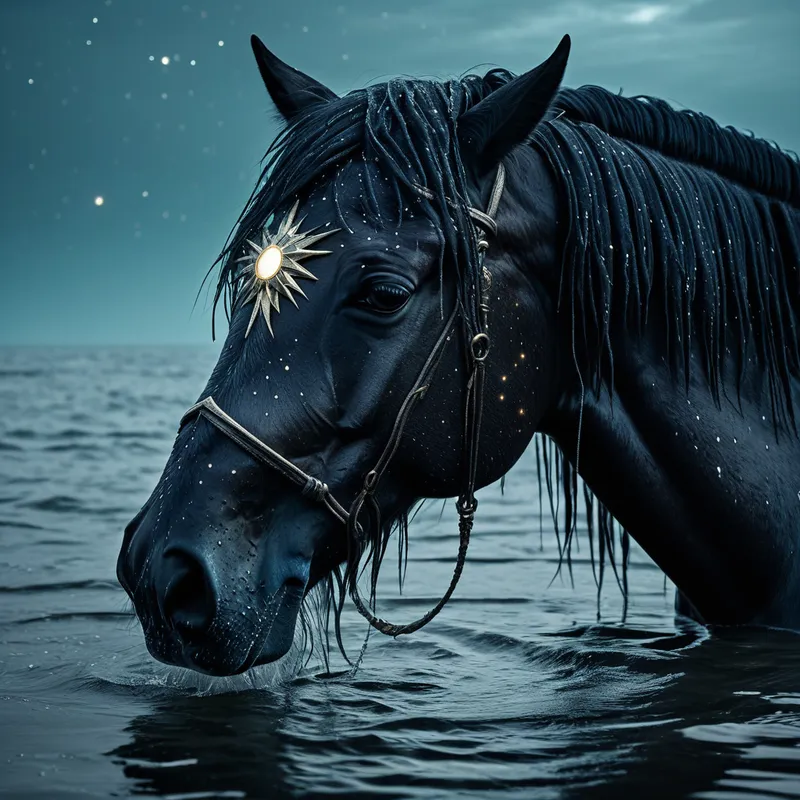
But Apaosha was waiting. He too took the form of a horse—a black, desiccated stallion, his hide like cracked leather, his breath a scorching wind, his eyes pits of endless thirst. No words were exchanged. There, in the shallows of Vourukasha, under a sky that watched in silence, they clashed.
It was a battle of essences. Where Tishtrya’s hooves struck, waves rose and spray glittered like diamonds. Where Apaosha reared, the very water hissed and steamed away. They fought for three days and three nights. The sound was not of flesh, but of elements in conflict: the roar of gathering clouds against the crackle of burning air. Tishtrya, the bringer of life, found himself matched, then overwhelmed. The demon of drought was mighty in his domain of absence. With a final, vicious charge, Apaosha drove the white stallion back, out of the sea, onto the barren shore.
Wounded, his stellar light dimmed, Tishtrya retreated. The land groaned in despair. The first battle was lost.
But the prayers of the world are a potent force. The people, guided by the priests, offered not just words, but the substance of their hope—sacrifices of white-haired animals, libations of precious haoma. Their devotion became a ladder of light, a reinforcement for the wounded star. Sraosha and Verethragna lent their strength. Tishtrya felt the power of faithful humanity flow into him, a second wind drawn from the collective soul.
He returned to Vourukasha. This time, he did not merely gather; he became the storm. He charged Apaosha not as a lone star, but as the vanguard of all life’s yearning. The clash was cataclysmic. Lightning was the flash of Tishtrya’s teeth; thunder, the pounding of his heart. And in the crescendo of the struggle, Tishtrya prevailed. He struck down the black horse, driving him from the waters, banishing him to the desolate places.
Victorious, the white stallion plunged again into the sea. Now, unimpeded, he drank deeply, his form swelling with the waters of life. He rose, heavier than a mountain, luminous with contained oceans. Then he ascended. As he climbed the sky, he shook his mighty mane. From it fell ten nights of rain: a gentle mist, a steady shower, a torrential downpour, and finally, the life-bringing drizzle that seeps deep into the roots of things. The rivers sang again. The earth drank and sighed, and from its bosom sprang green shoots, then flowers, then abundance.
And so, each year, the brilliant star Tishtrya appears in the east, and the people remember: the rain is not given; it is won.
Cultural Origins & Context
This myth is a cornerstone of the Mazdayasnian tradition, preserved most completely in the Yashts of the Avesta, specifically the Tishtar Yasht. It is not merely a weather allegory but a central cosmological drama. In the arid Iranian plateau, where survival hinged on seasonal rains and the careful management of water via qanats, the myth provided a sacred narrative for a fundamental ecological reality.
It was recited and invoked by priests, particularly during the season of the heliacal rising of Sirius in late summer, a time associated with the breaking of the drought. The myth served multiple societal functions: it explained the natural cycle, it prescribed ritual action (sacrifice and prayer) as a necessary component of cosmic order, and it reinforced the core Zoroastrian dualistic worldview—the eternal struggle between the forces of light, truth, and life (Asha), and the forces of darkness, deceit, and sterility (Druj). The people were not passive observers; their piety was the crucial reinforcement that turned the tide of the celestial battle.
Symbolic Architecture
At its [heart](/symbols/heart “Symbol: The heart symbolizes love, emotion, and the core of one’s existence, representing deep connections with others and self.”/), the myth of Tishtrya is a profound map of the psyche’s [relationship](/symbols/relationship “Symbol: A representation of connections we have with others in our lives, often reflecting our emotional state.”/) with its own [life](/symbols/life “Symbol: The symbol of ‘Life’ represents a journey of growth, interconnectedness, and existential meaning, encompassing both the joys and challenges that define human experience.”/)-giving, but often blocked, resources.
The drought is not outside; it is the inner landscape of a soul cut off from its own creative and emotional waters.
Tishtrya represents the archetypal [hero](/symbols/hero “Symbol: A hero embodies strength, courage, and the ability to overcome significant challenges.”/) of the libido—not in a merely sexual sense, but as the psychic [energy](/symbols/energy “Symbol: Energy symbolizes vitality, motivation, and the drive that fuels actions and ambitions.”/) of life, [connection](/symbols/connection “Symbol: Connection symbolizes relationships, communication, and bonds among individuals.”/), and [fertility](/symbols/fertility “Symbol: Symbolizes creation, growth, and abundance, often representing new beginnings, potential, and life force.”/). He is the potential for renewal, the brilliant [idea](/symbols/idea “Symbol: An ‘Idea’ represents a spark of creativity, innovation, or realization, often emerging as a solution to a problem or a new outlook on life.”/), the surge of feeling, the spiritual inspiration that originates in the “starry” [heights](/symbols/heights “Symbol: Represents ambition, fear, or spiritual elevation. Often symbolizes life challenges or a desire for perspective.”/) of the unconscious. The Sea Vourukasha is the boundless, primordial unconscious itself, the [source](/symbols/source “Symbol: The origin point of something, often representing beginnings, nourishment, or the fundamental cause behind phenomena.”/) of all psychic life and nourishment.
Apaosha, the [demon](/symbols/demon “Symbol: Demons often symbolize inner fears, repressed emotions, or negative aspects of oneself that the dreamer is struggling to confront.”/) of [drought](/symbols/drought “Symbol: Drought signifies a period of emotional scarcity, lack of resources, or feelings of deprivation leading to anxiety or intense longing.”/), is the [shadow](/symbols/shadow “Symbol: The ‘shadow’ embodies the unconscious, repressed aspects of the self and often represents fears or hidden emotions.”/) counterpart to Tishtrya. He is psychic [entropy](/symbols/entropy “Symbol: In arts and music, entropy represents the inevitable decay of order into chaos, often symbolizing creative destruction, impermanence, and the natural progression toward disorder.”/): [resistance](/symbols/resistance “Symbol: An object or tool representing opposition, struggle, or the act of pushing back against external forces or internal changes.”/), cynicism, [despair](/symbols/despair “Symbol: A profound emotional state of hopelessness and loss, often signaling a need for transformation or surrender to deeper truths.”/), creative block, emotional [aridity](/symbols/aridity “Symbol: Aridity symbolizes emotional or spiritual barrenness, a lack of nourishment, and a state of profound dryness or emptiness.”/)—all that says “no” to life’s flow. The battle is not against an external [enemy](/symbols/enemy “Symbol: An enemy in dreams often symbolizes an internal conflict, self-doubt, or an aspect of oneself that one struggles to accept.”/), but the inevitable inner conflict that arises when the conscious ego (the people on [earth](/symbols/earth “Symbol: The symbol of Earth often represents grounding, stability, and the physical realm, embodying a connection to nature and the innate support it provides.”/)) attempts to integrate a powerful new content from the unconscious. The first failure is essential; it represents the ego’s initial, inadequate resources to face a profound inner challenge.
The people’s sacrifices and prayers are the crucial work of conscious [attention](/symbols/attention “Symbol: Attention in dreams signifies focus, awareness, and the priorities in one’s life, often indicating where the dreamer’s energy is invested.”/) and valuation. This is the ego’s active participation in the psychic process. It is the discipline of tending to one’s inner life, of making “offerings” of time, [reflection](/symbols/reflection “Symbol: Reflection signifies self-examination, awareness, and the search for truth within oneself.”/), and respect to the unconscious. This conscious [effort](/symbols/effort “Symbol: Effort signifies the physical, mental, and emotional energy invested toward achieving goals and personal growth.”/) “strengthens” the heroic principle, allowing for a successful second attempt at [integration](/symbols/integration “Symbol: The process of unifying disparate parts of the self or experience into a cohesive whole, often representing psychological wholeness or resolution of internal conflict.”/).

The Dreamer’s Resonance
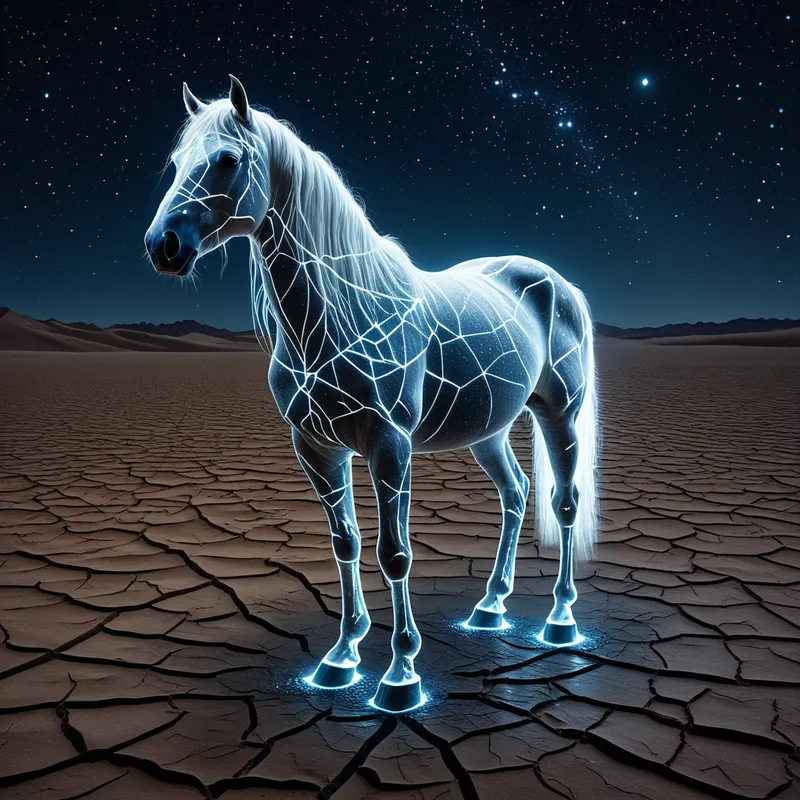
When this mythic pattern stirs in the modern dreamer, it often manifests as a profound sense of inner drought. One may dream of endless deserts, dried-up wells, or barren, cracked landscapes. The dream ego feels parched, stuck, and lifeless. Alternatively, the dream may present a powerful, beautiful, but wounded or trapped animal—often a white horse—unable to reach water.
The somatic experience accompanying such dreams can be a literal thirst upon waking, a feeling of tightness in the throat or chest, or a deep, aching fatigue. Psychologically, this indicates a critical depletion of psychic energy. The dream is sounding an alarm: the connection to the inner Sea Vourukasha, the source of vitality, meaning, and emotion, has been severed or blocked by the Apaosha-like forces of overwork, neglect, unresolved grief, or spiritual cynicism.
The dream is the first descent of Tishtrya—it is the unconscious itself initiating the process of renewal by showing the state of drought. The dreamer’s task upon waking is to become the “people who pray”—to engage in the ritual of self-care, reflection, and perhaps therapy or creative expression that will reinforce the heroic, life-seeking part of the psyche for the necessary inner battle.
Alchemical Translation
The myth of Tishtrya is a perfect allegory for the alchemical and Jungian process of individuation. The goal is the aqua permanens, the permanent water or philosophical mercury—the transformative, unifying psychic substance.
The rain that finally falls is not the same as the water in the sea; it is the celestial libido, transformed by struggle into the nourishing grace of conscious insight.
Stage 1 (Descent/Nigredo): Tishtrya’s plunge into Vourukasha is the descent into the unconscious, the initial, often frightening, engagement with the depths of one’s own psyche. It is the beginning of analysis, the confrontation with repressed material.
Stage 2 (Conflict/Albedo): The battle with Apaosha is the confrontation with the shadow. This is the painful, clarifying work of seeing one’s own resistance, one’s own capacity for aridity and destruction. The first defeat is the mortificatio, the necessary “death” of the ego’s naive attitude. The retreat is a period of introspection and gathering strength.
Stage 3 (Reinforcement/Citrinas): The people’s sacrifices represent the hard, conscious work of the ego. It is the discipline of attending to dreams, engaging in active imagination, and making tangible changes in one’s life to support the psychic process. This builds a stable connection (the transcendent function) between consciousness and the unconscious.
Stage 4 (Victory & Ascent/Rubedo): The victorious return and transformation into rain is the union of opposites. The stellar consciousness (Spirit) and the oceanic unconscious (Soul) are fused. The result is a “rain” of enlivening psychic energy that fertilizes the entire personality. The ego is no longer a parched supplicant, but a participant in a self-sustaining cycle of inner renewal. The individual becomes, in a sense, their own source of living water, capable of weathering future droughts because they know the battle and remember the path to the sea.
Associated Symbols
Explore related symbols from the CaleaDream lexicon:
- Rain — The final, blessed gift of Tishtrya’s struggle, representing the fertilizing grace of integrated psychic energy that nourishes the conscious personality and makes life flourish.
- Star — The celestial origin of Tishtrya, symbolizing the highest potential, guiding inspiration, and the divine spark of consciousness that descends into the chaos of the unconscious.
- Horse — The form of both Tishtrya and Apaosha, embodying raw psychic power, libido, and instinctual energy, which can be directed toward creation or destruction.
- Water — The fundamental element of life and the unconscious, represented by the Sea Vourukasha, from which all renewal and transformation must ultimately spring.
- Sacrifice — The ritual offerings of the people, representing the necessary conscious effort, discipline, and “giving up” of old attitudes required to empower inner change.
- Drought — The state of psychic sterility, emotional emptiness, and creative block personified by Apaosha, against which the heroic Self must struggle.
- Sea — The boundless, primordial unconscious (Vourukasha), the source of all psychic contents, depths, and potential nourishment.
- Journey — Tishtrya’s cyclical descent, battle, and ascent, mapping the eternal, inward journey of the soul toward integration and renewal.
- Light — The inherent nature of Tishtrya as a star, representing consciousness, truth (Asha), and the illuminating power of insight that dispels inner darkness.
- Healing — The ultimate outcome of the myth, as the life-giving rain restores the parched land, symbolizing the psyche’s innate capacity for recovery and wholeness after periods of conflict and depletion.
- Starlit Pathway — The trail left by Tishtrya’s descent and ascent, representing the remembered route the conscious ego can follow to reconnect with its source in the unconscious.
- Rainbow After Rain — The sign of the covenant fulfilled, representing the bridge between heaven and earth, spirit and matter, and the beautiful synthesis that emerges after the storm of inner conflict.