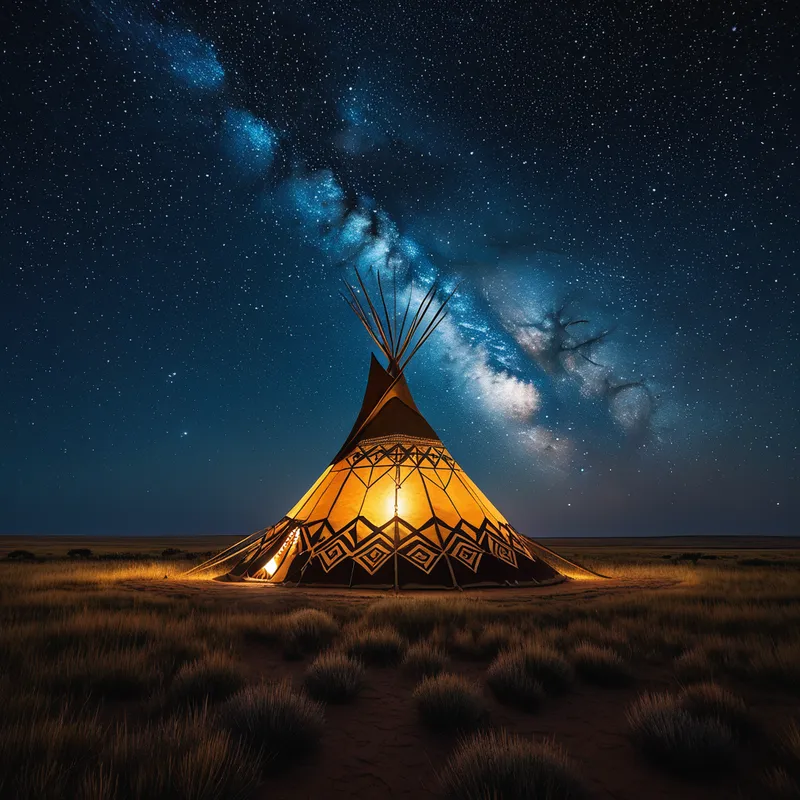
Tipi Myth Meaning & Symbolism
The myth of the sacred dwelling, a story of cosmic order, human humility, and the creation of a living space that connects heaven, earth, and the human heart.
The Tale of Tipi
In the time before memory, when the People walked the great, whispering grasses, they had no true home. The wind was a constant companion, sometimes a song, often a knife. The rain found them, and the sun beat upon their backs. They slept beneath the hide of the buffalo, grateful for its warmth, yet their spirits were exposed to the vast, open eye of the sky. They were children of the earth, but they had no womb to return to, no sacred circle to contain their dreams.
The Creator, Wakan Tanka, saw this. He saw the People huddled, their fires struggling against the endless prairie night. He did not send a thunderbolt or a mighty beast. Instead, he sent a whisper into the heart of a wise woman as she slept. In her dream, she saw a shape against the sun: a cone, graceful and strong, with its head held high to speak to the stars and its skirts spread wide to embrace the earth.
She awoke with the vision burning behind her eyes. She went to the elders and spoke of the sacred shape. At first, they were silent, for the idea was strange. But then the oldest among them, a man who had seen countless seasons turn, looked to the lodgepole pine standing sentinel on the hill. “Three legs hold up the cooking pot,” he murmured. “Perhaps three legs can hold up the sky for us.”
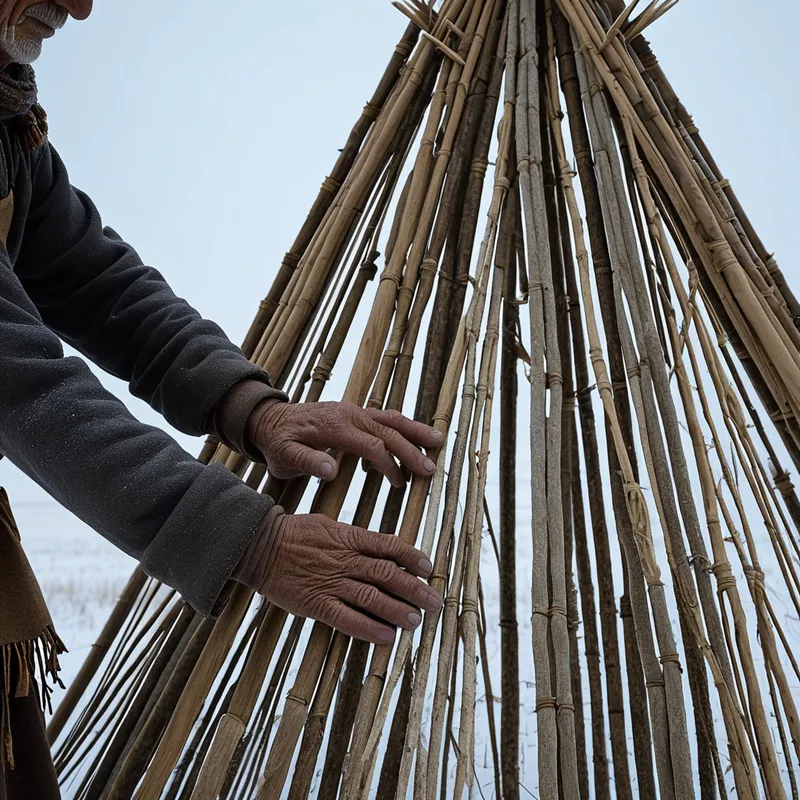
Together, the woman and the elders went to the pines. They selected three straight, strong poles and bound them at the top with sinew from the buffalo. As they lifted them, setting the tied end toward the north wind, a miracle occurred. The poles did not simply stand; they sang with tension, creating a tripod that was alive with potential. This was the first breath of the structure.
Guided by the dream, they added more poles, leaning them into the cradle of the first three, until a circle of timber was created. Then, they dressed it. They took the hides of the buffalo—not as a burden, but as a gift—and sewed them into a great skin. As they wrapped this hide around the pole skeleton, the final magic was revealed. They left two flaps at the top, ears to listen to the wind’s wisdom. They left a door facing the east, to greet the newborn sun each morning.
That night, the first fire was built in the center of the first tipi. The smoke rose, coiling up through the open ears, carrying prayers to the heavens. The flames painted stories on the inner walls. The wind outside moaned, but inside, there was a profound silence, a warmth that was more than heat. It was the warmth of belonging. The People sat in a circle, and for the first time, they were not just on the land; they were in a sacred space of the land, a living temple born from a dream, built with gratitude, and breathing with the cosmos.
Cultural Origins & Context
The story of the tipi’s origin is not a single, frozen myth but a living tradition woven through many Plains nations, including the Lakota, Blackfoot, Cheyenne, and Crow. It is a teaching story, passed down not in grand epics but in the practical, sacred act of construction itself. The knowledge belonged to the women, who were the tipi’s owners, makers, and primary spiritual caretakers. A grandmother teaching her granddaughter how to set the poles, how to align the door, how to paint the symbols of their family’s spiritual history on the outer cover—this was the transmission of the myth.
Its societal function was profound and multifaceted. The tipi was a physical embodiment of cosmological order. Its circular floor represented the sacred hoop of life, the cycle of the seasons, and the unity of the community. The central fire was the world axis, the connection between the earthly and the divine. The act of raising a tipi was a ritual re-enactment of creation, transforming a chaotic collection of poles and hides into an ordered, sanctified universe. It taught geometry, ecology, spirituality, and social structure in one integrated practice, ensuring that the concept of “home” was never separate from the concept of “the sacred.”
Symbolic Architecture
The tipi is a perfect symbolic architecture for the human psyche. It is a model of a conscious, integrated self, built in relationship with the greater forces of existence.
The three foundation poles are the first sacred thought: without a stable trinity of principles, no spiritual or psychological structure can stand.
These poles are often said to represent respect, obedience, and humility—or sometimes the past, present, and future. They create the stable tripod upon which all else depends. The subsequent poles, leaning into this foundation, are the myriad experiences, relationships, and talents of a life, all finding their support and direction from a core alignment.
The hide covering represents the persona—the protective skin between the inner self and the outer world. It is tough and practical, yet it can be painted with the unique symbols of one’s soul-story. The door, facing east, is the attitude of consciousness, forever oriented toward renewal, illumination, and the dawn of new understanding. Most crucially, the smoke flaps at the top signify the essential need for an outlet. The fire of passion, emotion, and spiritual yearning must have a channel to the transcendent; without it, the inner space becomes choked and unlivable.

The Dreamer’s Resonance
When the image of a tipi arises in the modern dreamscape, it is often a somatic call from the psyche for sanctuary, order, and sacred containment. The dreamer may be feeling spiritually exposed, buffeted by the “winds” of life’s chaos, anxiety, or meaningless routine. To dream of building a tipi is to engage in an act of profound self-care at the archetypal level. The body-mind is ritually constructing a psychic dwelling place.
Conversely, to dream of a tipi that is collapsing, on fire, or missing its cover speaks to a crisis of inner structure. The foundational principles (the three poles) may be compromised. The connection between inner experience and outer expression (the smoke flaps) may be blocked, leading to a buildup of psychic “smoke”—depression, confusion, or unprocessed emotion. The dream is presenting the blueprint of the soul’s current dwelling, urging inspection and repair. It asks: Where is your east? What prayers is your fire producing? Is your structure sound?
Alchemical Translation
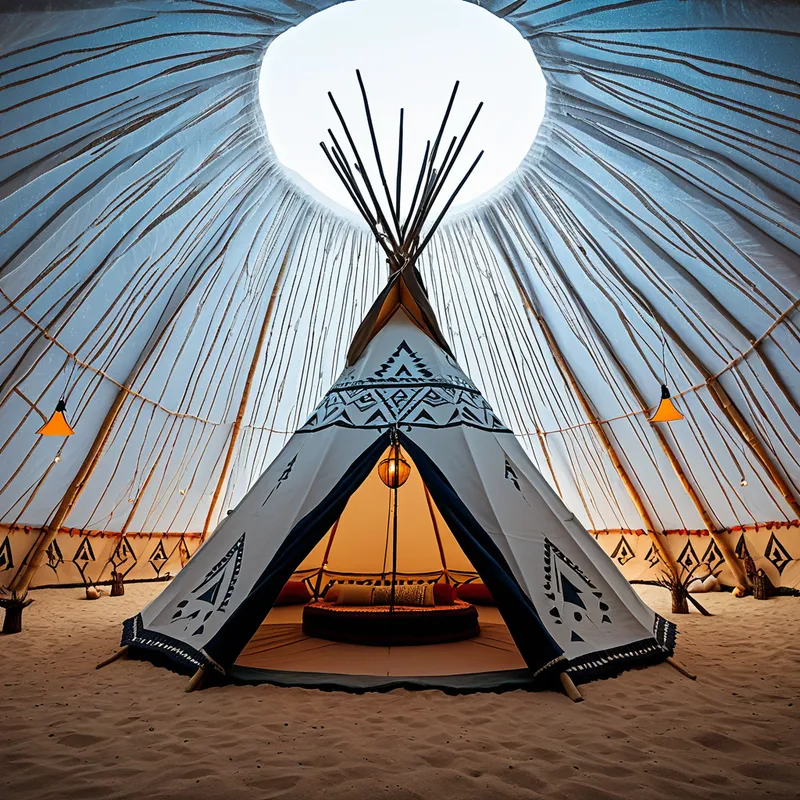
The myth of the Tipi models the alchemical process of creating the vas, the sacred vessel, for individuation. We begin with the prima materia of our scattered existence—our unintegrated experiences, inherited patterns, and raw potential, like a bundle of unbound poles and uncured hides lying on the ground.
The first and most critical operation is not adding, but binding: finding the three core, unifying principles of one’s authentic life and securing them together with conscious intention.
This is the creation of an inner tripod—a personal trinity of values, truths, or commitments from which everything else can depend. For one person, this may be honesty, compassion, and curiosity. For another, resilience, creativity, and connection. Upon this stable base, we then consciously “lean” the other aspects of our being, integrating them into a cohesive, circular identity.
The alchemical fire is lit in the center—the heat of self-reflection, emotional honesty, and passionate engagement with life. The work is to ensure this fire has an upward draft, that our sufferings and joys are transmuted into insight and connection (the smoke rising as prayer), rather than smoldering as resentment or despair. The final, ongoing operation is the careful tending of the “door” of our perception, consciously orienting ourselves toward the light of awareness, and maintaining the integrity of our boundary (the hide) without isolating ourselves from the world. We become, through this psychic architecture, both a dwelling place for the spirit and a beacon upon the landscape of the soul.
Associated Symbols
Explore related symbols from the CaleaDream lexicon: