
Tiki the First Man
In Maori tradition, Tiki is the primordial man formed from red earth by the god Tāne, representing the sacred bond between humanity and the natural world.
The Tale of Tiki the First Man
In the time before time, when [the world](/myths/the-world “Myth from Tarot culture.”/) was a womb of potential, the god Tāne walked [the earth](/myths/the-earth “Myth from Hindu culture.”/). He was the separator of sky and earth, the bringer of light, the planter of the great forests. Yet, in the vast, singing solitude of this new world, he felt a profound absence. The birds had their songs, the trees their whispers, the rivers their stories, but there was no one to hear them, no consciousness to reflect upon the beauty he had helped to shape. A longing, deep and ancestral, stirred within him—a desire for a companion, a being shaped in the image of the gods yet born of the earth itself.
Driven by this sacred impulse, Tāne journeyed to a place of potent mana. There, he found a bank of rich, red earth—oneone kura—warmed by the first sun. This was no ordinary soil; it was the primal clay, the flesh of the Earth Mother, Papatūānuku, herself. With the care of a master sculptor and the tenderness of a parent, Tāne began to form the earth. He shaped legs to walk upon her, arms to embrace her, a head to look upon her wonders. From the red clay, he fashioned the first human form, a male figure lying upon the ground.
But the figure was inert, a beautiful vessel awaiting the spark of life. Tāne then performed the ultimate act of creation. He bent over the clay form, placed his mouth upon its nostrils, and breathed—hā—his own divine breath, his own mauri (life essence), into the earth-shaped man. The breath of Tāne, the god of life and light, flowed into the red earth, and the clay shuddered. The chest rose and fell. Eyes, formed from earth, opened to see [the sky](/myths/the-sky “Myth from Persian culture.”/), [Ranginui](/myths/ranginui “Myth from Maori culture.”/), for the first time. The first sneeze of life echoed through the silent world.
This being was Tiki. He stirred, sat up, and looked upon his maker and the world around him. He was not born of a womb but shaped from the very body of the earth and animated by the breath of heaven. Tiki, the first man, stood at the intersection of all realms: born of Papatūānuku, enlivened by Tāne (son of Rangi and Papa), and destined to walk the world between. In some traditions, Tāne then created the first woman, Marikoriko (the first shimmer of light), or [Hine-ahu-one](/myths/hine-ahu-one “Myth from Maori culture.”/) (the earth-formed maid), from the same red earth, so that Tiki would not be alone. Thus, humanity began—not as an accident, but as a conscious, breath-filled act of love and longing from the gods towards the earth.
Cultural Origins & Context
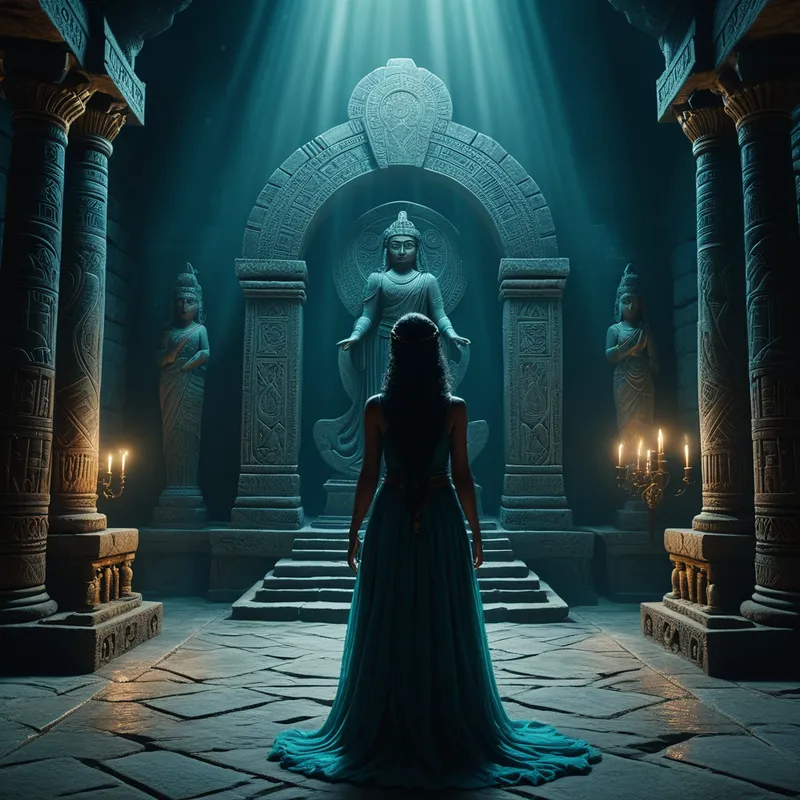
The myth of Tiki resides in the foundational layer of Māori cosmology, known as the Te Ao Mārama. It is a tradition that varies across iwi (tribes), with some narratives attributing Tiki’s creation to the god Rongo, or even to the supreme god Io. However, the most prevalent and evocative version centers on Tāne, which deeply aligns with his role as the active, generative force in the natural world.
Tiki is more than a singular ancestor; he is an archetypal prototype. The name itself is telling. “Tiki” is the common noun for the first human, but it also refers to the carved humanoid figures found throughout Polynesia. These hei tiki pendants are not mere ornaments; they are vessels of mana and ancestral connection, often representing deified ancestors or, fundamentally, the seed of humanity itself. The myth thus exists simultaneously in the realm of sacred narrative and tangible material culture. It explains the origin of people (tāngata), which etymologically connects to the earth (whenua, also meaning placenta), reinforcing the inseparable bond declared in the story: humanity is earth.
This narrative served a crucial sociological and ecological purpose. By rooting human origin in an act of deliberate, sacred creation from the land, it established an unbreakable [covenant](/myths/covenant “Myth from Christian culture.”/) of responsibility. Humans are not owners of the earth but its children, formed from its substance and entrusted with its care by the gods who shaped them. The breath of Tāne signifies [the divine spark](/myths/the-divine-spark “Myth from Gnostic culture.”/) within humanity—our consciousness, our wairua (spirit)—but the body remains earth, to which it ultimately returns. This creates a worldview of profound reciprocity, where harming the land is, in a literal sense, self-harm.
Symbolic Architecture
The myth of Tiki is a masterclass in symbolic thought, building a cosmology from elemental contrasts and unions.
The red earth is the body; the divine breath is the spirit. Tiki is the living paradox—the mortal immortal, the earthly divine. His existence declares that spirit requires matter to become manifest, and matter requires spirit to become conscious.
The primary symbols are stark and powerful. The red [earth](/symbols/earth “Symbol: The symbol of Earth often represents grounding, stability, and the physical realm, embodying a connection to nature and the innate support it provides.”/) (oneone kura) is the primal substance, the feminine, receptive principle of Papatūānuku. It is [blood](/symbols/blood “Symbol: Blood often symbolizes life force, vitality, and deep emotional connections, but it can also evoke themes of sacrifice, trauma, and mortality.”/), flesh, and [fertility](/symbols/fertility “Symbol: Symbolizes creation, growth, and abundance, often representing new beginnings, potential, and life force.”/). The divine [breath](/symbols/breath “Symbol: Breath symbolizes life, vitality, and the connection between the physical and spiritual realms.”/) (hā) is the masculine, active principle of Tāne, representing intellect, [life](/symbols/life “Symbol: The symbol of ‘Life’ represents a journey of growth, interconnectedness, and existential meaning, encompassing both the joys and challenges that define human experience.”/) force, and the invisible animating power. Their union in Tiki does not create a hybrid but a new, third [thing](/myths/thing “Myth from Norse culture.”/): a conscious being capable of bridging both realms. He is the [axis](/symbols/axis “Symbol: A central line or principle around which things revolve, representing stability, orientation, and the fundamental structure of reality or consciousness.”/) mundi in [human](/symbols/human “Symbol: The symbol of a human represents individuality, complexity of emotions, and social relationships.”/) form.
Furthermore, the act of creation is intimate and physical. Tāne does not command Tiki into being from a [distance](/symbols/distance “Symbol: Distance in dreams often symbolizes emotional separation, unattainable goals, or the need for personal space and reflection.”/); he kneels in the [soil](/symbols/soil “Symbol: Soil symbolizes fertility, nourishment, and the foundation of life, serving as a metaphor for growth and stability.”/) and breathes directly into him. This establishes kinship (whakapapa) as a physical and spiritual [lineage](/symbols/lineage “Symbol: Represents ancestral heritage, family connections, and the transmission of traits, values, and responsibilities across generations.”/) stretching directly from the land and the gods to every human. The myth negates any concept of human alienation from [nature](/symbols/nature “Symbol: Nature symbolizes growth, connectivity, and the primal forces of existence.”/); instead, it posits a familial [identity](/symbols/identity “Symbol: Identity represents the sense of self, encompassing personal beliefs, cultural background, and social roles.”/) with it. The sneeze, a common [motif](/symbols/motif “Symbol: A recurring thematic element, pattern, or design in artistic or musical works, representing underlying ideas or emotional currents.”/) in Polynesian creation [stories](/symbols/stories “Symbol: Stories symbolize the narratives of our lives, reflecting personal experiences and collective culture.”/), signifies the violent, involuntary, and miraculous [moment](/symbols/moment “Symbol: The symbol of a ‘moment’ embodies the significance of transient experiences that encapsulate emotional depth or pivotal transformations in life.”/) when life truly takes hold—the shock of incarnation.
The Dreamer’s Resonance
For the modern [psyche](/myths/psyche “Myth from Greek culture.”/), adrift in feelings of ecological and spiritual dislocation, the myth of Tiki offers a potent homecoming. It addresses the core wound of separation—from nature, from meaning, from our own bodies. Tiki’s story is an ancestral memory of a time before [the fall](/myths/the-fall “Myth from Biblical culture.”/) into alienation, a narrative template for what it means to be wholly integrated.
On a psychological level, Tiki represents the birth of individual consciousness from the collective, unconscious “earth” of the psyche. The red earth is the raw, instinctual, and often chaotic material of our inner world—our passions, our bodily drives, our inherited traumas. The breath of Tāne is the illuminating, ordering principle of awareness—[the ego](/myths/the-ego “Myth from Jungian culture.”/), or [the Self](/myths/the-self “Myth from Jungian culture.”/), that can shape this raw material into a coherent identity and breathe life into its potential. The process of individuation mirrors Tiki’s creation: we must consciously engage with our inner “clay,” our shadow and substance, and animate it with the breath of our own attention and spirit to become truly whole.
The myth also speaks to the profound human need for origin stories. We are narrative beings, and our mental health is tied to having a coherent story of where we come from. Tiki provides a story that is neither arrogant nor abject. It grants dignity (we are born of divine breath) and humility (we are made of common clay). It tells us we belong here, that our presence is intentional, and that our relationship with the world is one of sacred kinship, not dominion.
Alchemical Translation
In the alchemical vessel of the soul, the myth of Tiki describes the opus magnum—[the Great Work](/myths/the-great-work “Myth from Alchemical culture.”/). [The prima materia](/myths/the-prima-materia “Myth from Alchemical culture.”/), the worthless starting substance, is the “red earth”: our base, unrefined, and forgotten nature. [The alchemist](/myths/the-alchemist “Myth from Various culture.”/)’s labor is to lovingly work this material, to shape it with intention. The divine breath is the infusion of the [spiritus](/myths/spiritus “Myth from Alchemical culture.”/), the [quintessence](/myths/quintessence “Myth from Alchemical culture.”/), which transforms leaden matter into golden consciousness.
This is the alchemy of incarnation: the descent of spirit into matter is not a fall but a sacred marriage. The goal is not to escape the earth but to fully inhabit it, thereby sanctifying it through conscious presence.
The process is one of [solve et coagula](/myths/solve-et-coagula “Myth from Alchemical culture.”/): dissolve and coagulate. The individual ego must dissolve its illusion of separateness from the natural world (the “earth”) to remember its fundamental composition. Then, with this knowledge, it must re-coagulate, forming a new, conscious identity that includes this kinship as its foundation. Tiki, fully formed and breathing, is [the Philosopher’s Stone](/myths/the-philosophers-stone “Myth from Alchemical culture.”/)—the being who has achieved this integration. He is the proof that heaven and earth can coexist in a single, living form. For us, the work is to remember our own “Tiki-nature,” to feel the red earth in our bones and the divine breath in our lungs, and to live from that unified place.
Associated Symbols
Explore related symbols from the CaleaDream lexicon:
- Earth — The primal substance and maternal body from which all mortal life is shaped, representing physicality, origin, and enduring foundation.
- Breath — The invisible animating force, spirit, and consciousness bestowed from a divine source into inert matter.
- Clay — The malleable, foundational material of creation, awaiting the imprint of will and the spark of life to fulfill its potential.
- Root — The deep, often unseen connection to ancestral and natural origins, providing sustenance and stability to all that grows above.
- Origin — The singular, sacred point of emergence from which an entire lineage of being and identity unfolds.
- Nature — The unified, living system of which humanity is an intrinsic part, not an external observer or owner.
- Ancestor — The primordial prototype whose existence establishes the pattern, covenant, and spiritual lineage for all who follow.
- Seed — The concentrated essence of potential life, containing within it the complete pattern for a future being or consciousness.
- Fires of Creation — The passionate, generative impulse that drives a conscious being to shape something new from the raw materials of existence.
- Quill of Creation — The divine instrument or act that inscribes the first story of life onto the blank page of the primordial world.