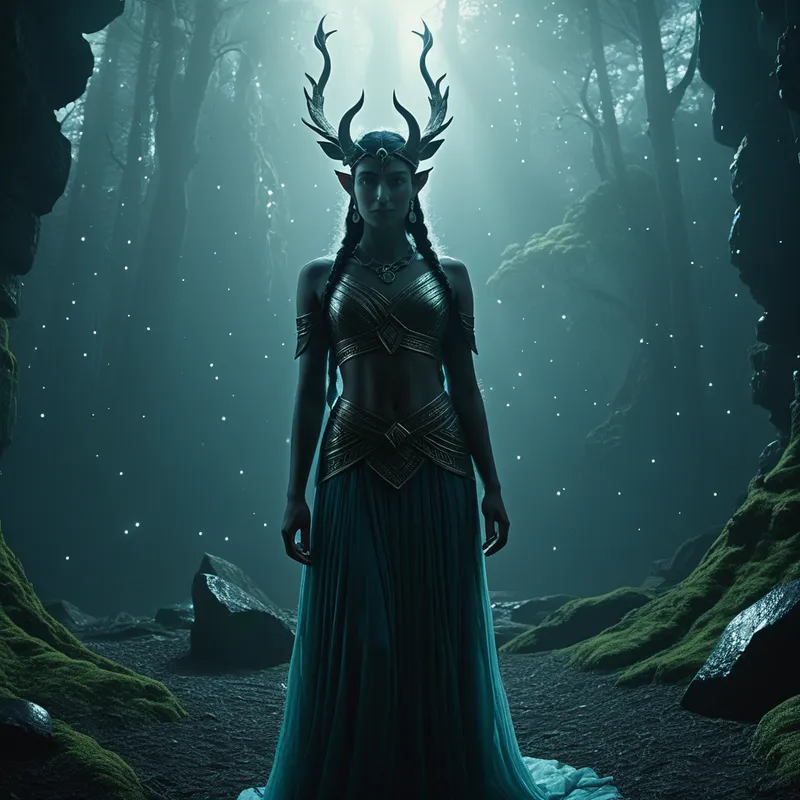
Tiamat and Apsu
Primordial deities of saltwater and freshwater whose union and conflict form the foundation of Sumerian cosmology, embodying chaos and order.
The Tale of Tiamat and Apsu
In the beginning, before the naming of things, there was only the mingled, formless deep. From this abyss, two vast and ancient beings stirred into consciousness: [Tiamat](/myths/tiamat “Myth from Mesopotamian culture.”/), the shimmering, saltwater sea, and Apsu, the sweet, silent waters beneath [the earth](/myths/the-earth “Myth from Hindu culture.”/). They were not separate, but entwined—a single, undifferentiated womb of potential where no horizon divided sky from sea, and no shore gave shape to the waters. Their union was the universe in its first, dreaming state.
From their mingled waters, the first generations were born. Lahmu and Lahamu, the silt-children, emerged, and from them came Anshar and Kishar, who formed the horizons of sky and earth. From these, in turn, rose the great gods: Anu, [the sky](/myths/the-sky “Myth from Persian culture.”/), [Enlil](/myths/enlil “Myth from Sumerian culture.”/), the storm, and Ea, the god of wisdom and the sweet waters. This new divine host, vibrant and restless, filled the primordial deep with their noise and motion. They danced in the waves of Tiamat and stirred the quiet depths of Apsu.
To Tiamat, the Mother of All, this clamor was the sound of her children at play, a tumultuous music of becoming. Her vastness could contain it. But to Apsu, the deep silence, the noise was an unbearable corruption. “Their ways are loathsome to me,” he lamented to his vizier, Mummu. “By day I find no relief, nor repose by night. I will destroy their ways and disperse them! Let silence reign again.” He desired a return to the pristine, motionless unity that existed before the children.
Tiamat was horrified. “Shall we destroy that which we have made?” she thundered. “Their ways are indeed painful, but let us endure!” She counseled patience, embodying the chaotic but ultimately creative tolerance of the generative source. But Apsu, set on a return to absolute order and stillness, would not be swayed. He and Mummu laid plans to murder the younger gods.
The plot, however, could not be hidden from the clever god Ea, who understood the currents of all waters. He wove a powerful spell of sleep, a profound stillness more absolute than Apsu himself had ever known, and cast it over the primordial father. While Apsu lay in enchanted slumber, Ea took from him his shimmering halo of power, his divine melammu. Then, with solemn finality, Ea slew Apsu. Upon the still, vast body of the freshwater deep, Ea then established his own dwelling, the sacred Apsu—now a structured, ordered realm of wisdom, built upon the pacified foundations of the old silence.
In this new, architectured order, Ea and his consort Damkina begot [Marduk](/myths/marduk “Myth from Mesopotamian culture.”/), a god of terrifying splendor and storm, born to a destiny of kingship. But the slaying of Apsu had unleashed a deeper, more terrible consequence. Tiamat, who had pleaded for her children, now raged with a mother’s betrayed fury and a primordial force’s wounded pride. The gentle, generative [chaos](/myths/chaos “Myth from Greek culture.”/) transformed into a destructive, avenging maelstrom. She took the demon-god Kingu as her new consort, placed the [Tablets of Destiny](/myths/tablets-of-destiny “Myth from Sumerian culture.”/) upon his breast, and birthed a legion of monstrous serpents, sharp-toothed dragons, and raging hounds—an army of [Chaos](/myths/chaos “Myth from Greek culture.”/) itself, to avenge her first husband and wipe away the new gods who had violated the primal bond.
The younger gods, faced with this unleashed terror, found themselves paralyzed with fear. None could stand before Tiamat’s wrath. Until, from among them, Marduk stepped forward. He agreed to confront the Mother of All, but on one condition: if victorious, he must be granted supreme and unchallenged kingship. Desperate, the gods assented, endowing him with irresistible weapons and authority.
The climactic battle was not merely a fight, but a cosmogonic act. Marduk, armed with the winds as his net, rode his storm-chariot against the roaring [dragon](/myths/dragon “Myth from Chinese culture.”/)-form of Tiamat. He drove the evil wind into her gaping maw, distending her body, and with a single arrow, he pierced her heart, severing her life and her rage. Standing upon her colossal corpse, Marduk performed [the great work](/myths/the-great-work “Myth from Alchemical culture.”/) of creation. He split her body like a clamshell, lifting half to arch the heavens and fixing the other half to form the earth. From her eyes, he caused [the Tigris and Euphrates](/myths/the-tigris-and-euphrates “Myth from Mesopotamian culture.”/) to flow. From her spittle, he made the clouds, and from her roaring, the tempests. He established the [constellations](/myths/constellations “Myth from Various culture.”/), set the rhythms of [the moon](/myths/the-moon “Myth from Tarot culture.”/) and sun, and from the blood of the defeated Kingu, he fashioned humanity to serve the gods. Order was built from the very substance of vanquished Chaos.
Cultural Origins & Context
The myth of Tiamat and Apsu is the foundational prologue of the [Enuma Elish](/myths/enuma-elish “Myth from Babylonian culture.”/), the Babylonian creation epic, which draws upon much older Sumerian cosmological concepts. While the epic’s final form elevates the Babylonian patron god Marduk, the primordial characters of Tiamat and Apsu are rooted in the Sumerian understanding of [the world](/myths/the-world “Myth from Tarot culture.”/)’s origins. In Sumerian thought, the universe began with the watery abyss, Abzu (Apsu), and the saltwater sea, Tiamat (likely related to [the word](/myths/the-word “Myth from Biblical culture.”/) tâmtu, “sea”).
This myth is not a simple bedtime story but a theological and political document. Its composition and recitation, especially during the Babylonian New Year (Akitu) festival, served to legitimize Marduk’s (and by extension, Babylon’s) supremacy, mirroring the king’s role in maintaining cosmic and social order (kittum) against the ever-present threat of chaos (chaos here meaning disorder, not evil). The narrative encodes a profound shift in worldview: from a cosmology centered on the passive, generative unity of primal waters to one defined by active, often violent, sovereign kingship that must impose structure upon the formless. The [death](/myths/death “Myth from Tarot culture.”/) of the old, quiet gods and the [triumph](/myths/triumph “Myth from Roman culture.”/) of the young, dynamic ones reflects the Mesopotamian view of a universe requiring constant vigilance and heroic effort to sustain civilization against a backdrop of primordial entropy.
Symbolic Architecture
At its core, the myth presents the fundamental [tension](/symbols/tension “Symbol: A state of mental or emotional strain, often manifesting physically as tightness, pressure, or unease, signaling unresolved conflict or anticipation.”/) of existence: the dynamic between the unformed, potential-filled Whole and the defining, limiting act that brings forth the Many. Tiamat and Apsu are not opposites, but complementary aspects of the primordial unity—the chaotic, fertile [matrix](/symbols/matrix “Symbol: A dream symbol representing the fundamental structure of reality, consciousness, or the self. It often signifies feelings of being trapped, controlled, or questioning the nature of existence.”/) and the silent, containing [depth](/symbols/depth “Symbol: Represents profound layers of consciousness, hidden truths, or the unknown aspects of existence, often symbolizing introspection and existential exploration.”/). Their initial [peace](/symbols/peace “Symbol: Peace represents a state of tranquility and harmony, both internally and externally, often reflecting a desire for resolution and serenity in one’s life.”/) represents a state of being before [consciousness](/symbols/consciousness “Symbol: Consciousness represents the state of awareness and perception, encompassing thoughts, feelings, and experiences.”/), before distinction.
The conflict begins not with Tiamat, but with Apsu’s intolerance for the noise of becoming. This is the first ego, the first desire for a return to unconscious stillness, which paradoxically sparks the chain of violence that leads to full differentiation.
The murder of Apsu by Ea is the first cosmogonic act—the [application](/symbols/application “Symbol: An application symbolizes engagement, integration of knowledge, or the pursuit of goals, often representing self-improvement and personal development.”/) of intellect (Ea is god of wisdom and magic) to subdue and [structure](/symbols/structure “Symbol: Structure in dreams often symbolizes stability, organization, and the framework of one’s life, reflecting how one perceives their environment and personal life.”/) the passive, silent [foundation](/symbols/foundation “Symbol: A foundation symbolizes the underlying support systems, values, and beliefs that shape one’s life, serving as the bedrock for growth and development.”/). But this act is a profound [betrayal](/symbols/betrayal “Symbol: A profound violation of trust in artistic or musical contexts, often representing broken creative partnerships or artistic integrity compromised.”/) of the [source](/symbols/source “Symbol: The origin point of something, often representing beginnings, nourishment, or the fundamental cause behind phenomena.”/), wounding the generative principle itself. Tiamat’s transformation from nurturing [mother](/symbols/mother “Symbol: The symbol of ‘Mother’ represents nurturing, protection, and the foundational aspect of one’s emotional being, often associated with comfort and unconditional love.”/) to vengeful [dragon](/symbols/dragon “Symbol: Dragons are potent symbols of power, wisdom, and transformation, often embodying the duality of creation and destruction.”/) is not a [character](/symbols/character “Symbol: Characters in dreams often signify different aspects of the dreamer’s personality or influences in their life.”/) change, but a [revelation](/symbols/revelation “Symbol: A sudden, profound disclosure of truth or insight, often through artistic or musical means, that transforms understanding.”/) of the other face of the primal: when the deep, creative [chaos](/symbols/chaos “Symbol: In Arts & Music, chaos represents raw creative potential, uncontrolled expression, and the breakdown of order to forge new artistic forms.”/) is violated and denied its [nature](/symbols/nature “Symbol: Nature symbolizes growth, connectivity, and the primal forces of existence.”/), it manifests as annihilating, formless rage.
Marduk’s victory and his creative dismemberment of Tiamat symbolize the necessary, yet tragic, process of civilization. Order, law, and the [human](/symbols/human “Symbol: The symbol of a human represents individuality, complexity of emotions, and social relationships.”/) world are literally built from the [body](/symbols/body “Symbol: The body in dreams often symbolizes the dreamer’s self-identity, personal health, and the relationship they have with their physical existence.”/) of the slain Mother of All. This establishes a foundational ambivalence: our world is sacred, built from divine substance, yet its very existence is predicated on an act of violence against the original, undifferentiated state of being.
The Dreamer’s Resonance
Psychologically, this myth maps the journey of individuation. The [psyche](/myths/psyche “Myth from Greek culture.”/) begins in a state of unconscious unity (the mingled waters of Tiamat and Apsu). The emergence of distinct impulses, thoughts, and energies (the younger gods) inevitably disturbs the inner silence. [The ego](/myths/the-ego “Myth from Jungian culture.”/)’s first impulse, like Apsu’s, can be to suppress this burgeoning inner life, to crave a return to numb stillness. This is the path of repression.
Ea’s act represents the necessary intervention of consciousness and cunning—the ability to confront and structure the inner depths, to build a dwelling place for the ego (the ordered Apsu) upon what was once entirely unconscious. However, if this act is done without reverence, as a mere suppression, it wounds the creative, instinctual Self (Tiamat). [The Self](/myths/the-self “Myth from Jungian culture.”/) then rises not as a source of life, but as a terrifying, monstrous complex—uncontrollable rage, depression, or psychic disintegration—that threatens to destroy the conscious personality.
The Marduk-stage is the heroic, if arduous, task of the conscious ego facing this unleashed totality of the psyche. It requires integrating immense power (the gods’ gifts to Marduk) and accepting supreme responsibility (kingship). The goal is not to destroy the primal mother, but to transform her energy. Successful individuation involves “slaying” the chaotic, overwhelming form of the unconscious so that its substance can be used to build a richer, more capacious conscious world—a psyche where the heavens of thought and the earth of instinct are distinct yet connected, fed by the rivers of deep feeling.
Alchemical Translation
In the alchemical vessel of the soul, Tiamat and Apsu represent the materia prima, the chaotic, watery beginning of the opus. Their union is the [coniunctio](/myths/coniunctio “Myth from Alchemical culture.”/) of the primal opposites—solvent (the dissolving sea) and coagula (the fixing abyss)—still in a state of [nigredo](/myths/nigredo “Myth from Alchemical culture.”/), the black, undifferentiated mass.
The killing of Apsu by Ea is the separatio, the necessary division that begins the work. It is the application of ars (art, wisdom) to fix the volatile, to give a base upon which to work. But this fixation alone is sterile.
Tiamat’s rage is the [putrefactio](/myths/putrefactio “Myth from Alchemical culture.”/), the stage of dissolution and blackening that must follow separation. The primal matter rebels, becomes monstrous, and threatens to consume all. This is the darkest night of the soul, where the material seems utterly hostile.
Marduk’s confrontation is the fierce fire of [calcinatio](/myths/calcinatio “Myth from Alchemical culture.”/)—the battle with [the dragon](/myths/the-dragon “Myth from Chinese culture.”/), the subjection of the matter to extreme tension and heat. His victory and creative act embody the [coagulatio](/myths/coagulatio “Myth from Alchemical culture.”/) and the final stages. He does not reject the slain chaos; he transmutes it. The body of Tiamat is subjected to a divine distillatio (separating heaven and earth, waters above and below) and sublimatio (making the clouds from spittle, the winds from breath). The monstrous is restructured into the cosmic order. The [lapis philosophorum](/myths/lapis-philosophorum “Myth from Alchemical culture.”/), the perfected world and the integrated Self, is fashioned from the very substance of the defeated dragon. The work is complete only when the chaos is not discarded, but redeemed and given glorious, stable form.
Associated Symbols
Explore related symbols from the CaleaDream lexicon:
- Primordial Chaos — The undifferentiated, potential-filled state of existence before creation, embodied by the mingled waters of Tiamat and Apsu.
- Ocean — The vast, saltwater body of Tiamat, representing the unconscious, the generative and terrifying feminine, the source of all life and all monsters.
- Dragon — The form Tiamat assumes in her wrath, symbolizing the unleashed, destructive potential of chaos and the formidable power of the wounded Great Mother.
- Order — The principle established by Marduk’s victory, representing cosmos, structure, law, and civilization imposed upon the formless deep.
- Conflict — The essential tension between the desire for silent unity and the noisy process of becoming, driving the entire cosmic drama from Apsu’s complaint to the final battle.
- Mother — Tiamat as the Mother of All Gods, the primal source who transforms from nurturing womb to avenging destroyer.
- Creation — The act of forming the known world, achieved not from nothing, but from the sacred, dismembered body of the vanquished primordial being.
- [Water](/myths/water “Myth from Chinese culture.”/) — The fundamental element of the myth, appearing as both the silent, sweet Apsu and the chaotic, salty Tiamat, representing the fluidity of pre-form and the source of life.
- Serpent — As one of the monster-species birthed by Tiamat, embodying chthonic power, chaos, and the untamed, coiling energies of the deep.
- Sacrifice — The violent death of the primordial beings, whose substance becomes the material for the created universe, a foundational sacrifice that establishes cosmic order.
- Structured Chaos — The resulting cosmos itself, which is not the absence of chaos, but chaos given form, rhythm, and boundary, as seen in the weather and rivers born from Tiamat.
- Sumerian Tablet — The medium of the myth’s preservation, representing the act of inscribing order (cuneiform) onto a clay foundation, mirroring Marduk’s imposition of cosmos onto the primal clay of Tiamat’s body.