
Thunderbird Myth Meaning & Symbolism
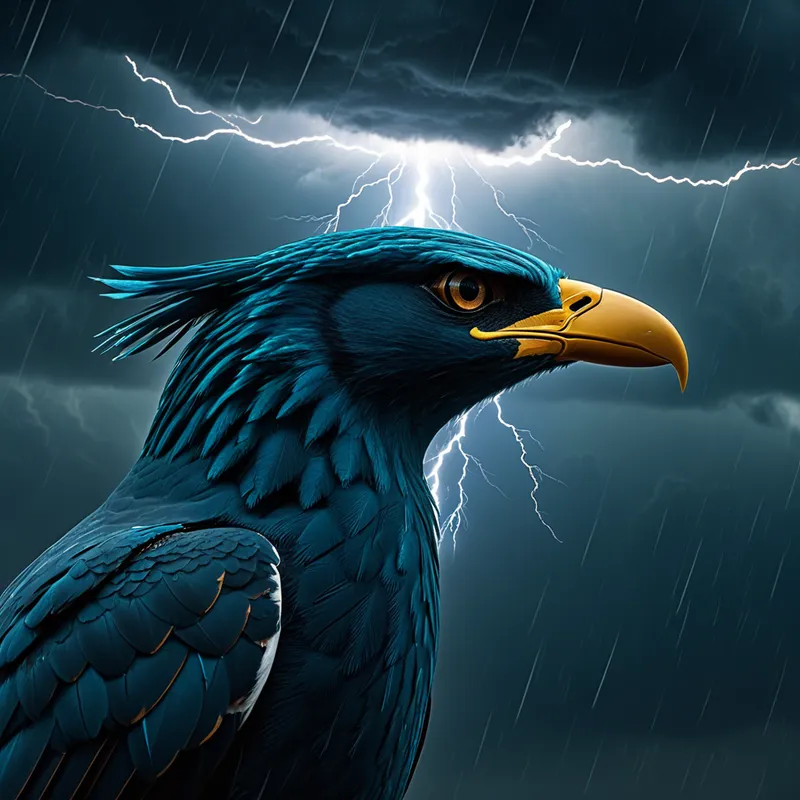
A colossal, sky-dwelling spirit of immense power whose wings create thunder and eyes flash lightning, embodying cosmic balance and transformative renewal.
The Tale of Thunderbird
In the time before time, when [the world](/myths/the-world “Myth from Tarot culture.”/) was raw and the mountains still dreamed of being tall, [the sky](/myths/the-sky “Myth from Persian culture.”/) was a silent, empty bowl. The people below lived in a quiet land, but it was a thirsty quiet. The rains were capricious, hiding for seasons, and the great serpents of the waters grew bold and gluttonous, coiling in the deep lakes and rivers, threatening to swallow the world whole.
Then, from the far north where the sky touches [the earth](/myths/the-earth “Myth from Hindu culture.”/), a shadow fell that was not a shadow, but an absence of light so profound it became a presence. The air grew heavy, charged with the scent of ozone and wet stone. A sound began, not from the earth, but from the very fabric of the heavens—a slow, deep drumbeat that shook the bones of the mountains. It was the first wingbeat.
He emerged not as a bird is born, but as a storm is conceived. Thunderbird, they would name him. His wings, when they stretched, blotted out the sun and scraped the ceilings of the clouds. Each feather was a shard of the night sky, tipped with the promise of dawn. His eyes were not eyes, but captured lightning, swirling with primordial fire and cold, distant intelligence.
He saw the suffering below. He saw the coiled, scaled forms of the Underwater Panthers or the great serpents, hoarding the waters, bringing drought and fear. A rumble built in his chest, a low growl of the gathering storm. This was the conflict written in the elements: the Sky against the Deep, the Bringer of Rain against the Hoarder of Waters.
With a cry that split the silence—a crack that echoed into the very concept of sound—he dove. [The wind](/myths/the-wind “Myth from Various culture.”/) of his descent became a gale, flattening the forests. The friction of his feathers against the sky sparked, and lightning leapt from his pinions, striking the earth, splitting ancient trees. He found the serpent in its lake, a monstrous [thing](/myths/thing “Myth from Norse culture.”/) of scales and cold hunger. The battle shook the world. Thunder was the sound of their collision; lightning was the flash of claw against scale. The serpent, lashing with its tail, sought to drag the sky-being into the murky depths, to drown the storm in still [water](/myths/water “Myth from Chinese culture.”/). But Thunderbird, master of the tempest, called the winds to his back and the fire from the clouds. He seized the great serpent, his talons piercing its hide, and carried the struggling monster high, high into the storm-lashed sky.
And then, he let it fall. The serpent’s body struck the mountains, breaking them into new shapes, and from its wounds flowed not blood, but rivers and streams. The rains, held back by the creature’s influence, now fell in torrents from the clouds churned by Thunderbird’s wings, nourishing the parched land. His work done, he ascended, his form melting back into the swirling clouds, leaving behind the cleansing scent of rain and the echoing promise of his return in every future storm.
Cultural Origins & Context
The Thunderbird is not a singular myth from one tribe, but a profound and widespread archetypal being found across many Native American cultures, from the Kwakwaka’wakw of the Pacific Northwest to the Lakota of the Plains and the Algonquian peoples of the Northeast. Its story was not written, but breathed—passed down through oral tradition by elders and storytellers around winter fires and during ceremonial gatherings. These narratives were not mere entertainment; they were cosmological maps, ethical teachings, and explanations of the natural world’s most powerful forces.
The myth functioned as a foundational theory of meteorology and ecology. Thunder was the flap of its immense wings; lightning the flash from its eyes or the gleam of its serpent-slaying talons. The rains it brought were a direct result of its cosmic struggle, linking the community’s survival to a grand, celestial drama. It taught respect for the terrifying yet life-giving power of storms and reinforced the concept of balance: the sky powers must keep the earth and water powers in check for life to flourish. To depict the Thunderbird on totem poles, masks, or shields was to invoke its protective power, its role as a guardian spirit of the clan and a mediator between the upper world and the world of humans.
Symbolic Architecture
At its core, the [Thunderbird](/symbols/thunderbird “Symbol: A powerful mythological creature from various indigenous North American traditions, often depicted as a giant bird that creates thunder with its wings and lightning with its eyes.”/) is the ultimate [symbol](/symbols/symbol “Symbol: A symbol can represent an idea, concept, or belief, serving as a powerful tool for communication and understanding.”/) of sovereign, transformative power. It is not brute force, but power with [purpose](/symbols/purpose “Symbol: Purpose signifies direction, meaning, and intention in life, often reflecting personal ambitions and core values.”/)—a celestial [authority](/symbols/authority “Symbol: A symbol representing power structures, rules, and control, often reflecting one’s relationship with societal or personal governance.”/) that acts to restore balance and ensure renewal.
The Thunderbird does not create the storm; it is the storm made conscious. Its violence is not chaotic, but a necessary catalysis for the world’s rebirth.
Psychologically, it represents the awesome, often frightening, power of [the Self](/myths/the-self “Myth from Jungian culture.”/)—the central [archetype](/symbols/archetype “Symbol: A universal, primordial pattern or prototype in the collective unconscious that shapes human experience, behavior, and creative expression.”/) in Jungian [psychology](/symbols/psychology “Symbol: Psychology in dreams often represents the exploration of the self, the subconscious mind, and emotional conflicts.”/) that orchestrates the process of individuation. Its adversary, the great [serpent](/symbols/serpent “Symbol: A powerful symbol of transformation, wisdom, and primal energy, often representing hidden knowledge, healing, or temptation.”/) or Underwater Panther, symbolizes the unconscious in its devouring, undifferentiated state: instinctual energies, primal fears, and psychic contents that can flood and paralyze the conscious mind ([drought](/symbols/drought “Symbol: Drought signifies a period of emotional scarcity, lack of resources, or feelings of deprivation leading to anxiety or intense longing.”/) paradoxically representing a stagnation of the [life](/symbols/life “Symbol: The symbol of ‘Life’ represents a journey of growth, interconnectedness, and existential meaning, encompassing both the joys and challenges that define human experience.”/)-giving flow of the unconscious). The epic battle is the [psyche](/myths/psyche “Myth from Greek culture.”/)‘s necessary conflict, where conscious [awareness](/symbols/awareness “Symbol: Conscious perception of self, surroundings, or internal states. Often signifies awakening, insight, or heightened sensitivity.”/) (sky) must engage with and transform the chaotic, latent power of the unconscious ([water](/symbols/water “Symbol: Water symbolizes the subconscious mind, emotions, and the flow of life, representing both cleansing and creation.”/)) to release new [energy](/symbols/energy “Symbol: Energy symbolizes vitality, motivation, and the drive that fuels actions and ambitions.”/) and [insight](/symbols/insight “Symbol: A sudden, deep understanding of a complex situation or truth, often arriving unexpectedly and illuminating hidden connections.”/) (rain).
The Thunderbird’s dual [nature](/symbols/nature “Symbol: Nature symbolizes growth, connectivity, and the primal forces of existence.”/)—both [destroyer](/symbols/destroyer “Symbol: A figure or force representing radical change through dismantling existing structures, often evoking fear and awe.”/) and life-giver—embodies the essential [paradox](/symbols/paradox “Symbol: A contradictory yet true concept that challenges logic and perception, often representing unresolved tensions or profound truths.”/) of growth. True transformation requires the [lightning](/symbols/lightning “Symbol: Lightning symbolizes sudden insights or revelations, often accompanied by powerful emotions or disruptive change.”/) strike that shatters old forms and the [deluge](/symbols/deluge “Symbol: A massive, overwhelming flood representing cleansing, destruction, or emotional inundation.”/) that washes away what is no longer needed, so that new life can emerge from the mud.

The Dreamer’s Resonance
When the Thunderbird storms into modern dreams, it heralds a period of intense psychic activation. The dreamer may be on the cusp of a major life change, grappling with a powerful internal conflict, or feeling a buildup of creative or emotional pressure that seeks a monumental release.
Somatically, this can feel like a gathering tension in the chest or a feeling of being electrically charged. The dream imagery might be literal—a vast bird in a turbulent sky—or symbolic: sudden, shocking insights (lightning), a looming sense of destiny or confrontation (the approaching storm), or a feeling of being called to a great and daunting responsibility. To dream of the Thunderbird is to feel the rumble of your own latent sovereignty. It asks the dreamer: What serpentine pattern in your life—be it a habit, a fear, or a stagnant situation—needs to be confronted and lifted into the light of consciousness? What life-giving rain are you, or is your environment, currently withholding?
The dream is an invitation to stop fearing your own power and to begin the alchemical work of directing it, not for domination, but for the restoration of inner and outer balance.

Alchemical Translation
The myth of the Thunderbird provides a flawless blueprint for psychic transmutation. The process begins with the recognitio: the awareness of imbalance. The “drought” in one’s life—creative, emotional, or spiritual—signals that the nourishing waters of the unconscious are being blocked by a serpentine complex (a knot of trauma, a limiting belief, an unintegrated shadow aspect).
The first wingbeat of thunder is the soul’s announcement that the time for polite negotiation is over. The storm will come.
The confrontatio is the dive into battle. This is the difficult, often terrifying, inner work of engaging directly with that complex. It requires the courage of the Thunderbird to face the depths of one’s own psyche. The lightning represents the brilliant, painful flashes of self-awareness that illuminate the true nature of the problem. The thunder is the emotional and somatic release that accompanies this insight.
The transformatio is the lifting and the release. The Thunderbird does not destroy the serpent utterly; it transforms its function. The serpent’s body becomes the landscape—its energy is not eliminated, but integrated and redirected. In the individual, this is the moment where a raw, problematic drive (like anger or envy) is understood, mastered, and its energy repurposed into a conscious force for protection or assertive action. The released “rains” are [the flood](/myths/the-flood “Myth from Biblical culture.”/) of new vitality, creativity, and emotional fluidity that follows a successful integration.
Finally, the ascensio: the Thunderbird returns to the sky. The work is done, balance is restored, but the power remains accessible. The individual does not become the storm permanently, but now knows they can call upon that sovereign, transformative authority when needed. They carry within them the cleansed earth and the flowing rivers, having learned that their greatest power lies not in avoiding the storm, but in understanding they are an essential part of its necessary, renewing cycle.
Associated Symbols
Explore related symbols from the CaleaDream lexicon: