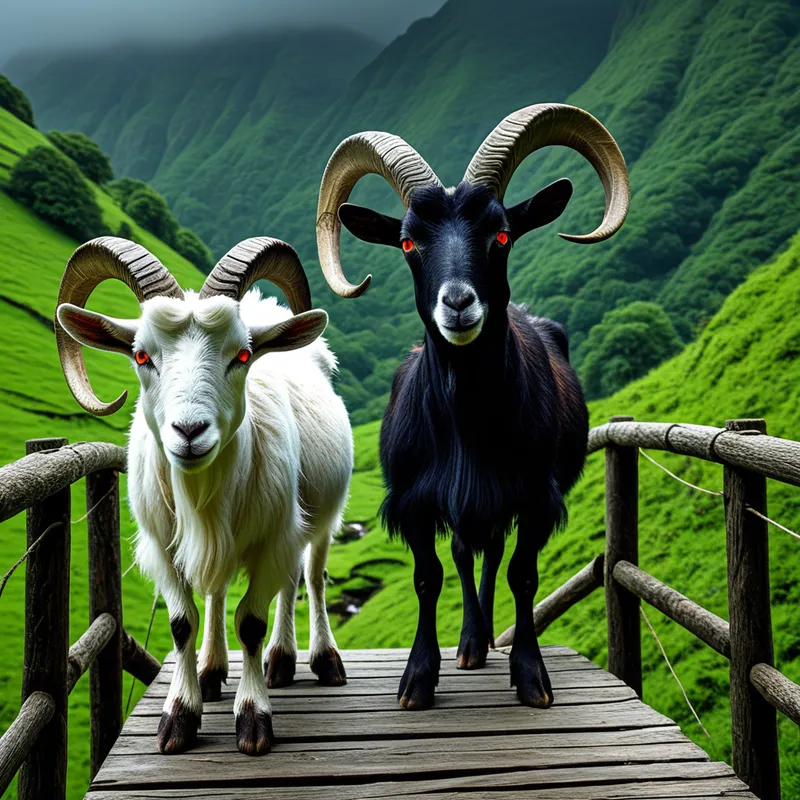
Three Billy Goats Gruff Myth Meaning & Symbolism
Three brothers, a hungry troll, and a perilous crossing. A myth of escalating confrontation, strategic courage, and claiming one's rightful pasture.
The Tale of Three Billy Goats Gruff
Listen, and hear a tale of hunger and crossing.
Once, on a mountainside grown lean and thin, where the grass was nibbled to dust and [the earth](/myths/the-earth “Myth from Hindu culture.”/) showed through like bone, there lived three brothers. They were billy goats, and they shared a single name: Gruff. The youngest was slight, his horns mere buds. The middle brother was sturdy, his flanks firm. The eldest was a creature of grandeur, with horns like carved oak and a beard like a waterfall of frost. Their bellies were hollow, a constant drum of want. But across [the river](/myths/the-river “Myth from Buddhist culture.”/), in the eye of the sun, they could see it: a high meadow, a pasture of such green it hurt to look upon. Lush, untouched, abundant. To reach it, they must cross a bridge.
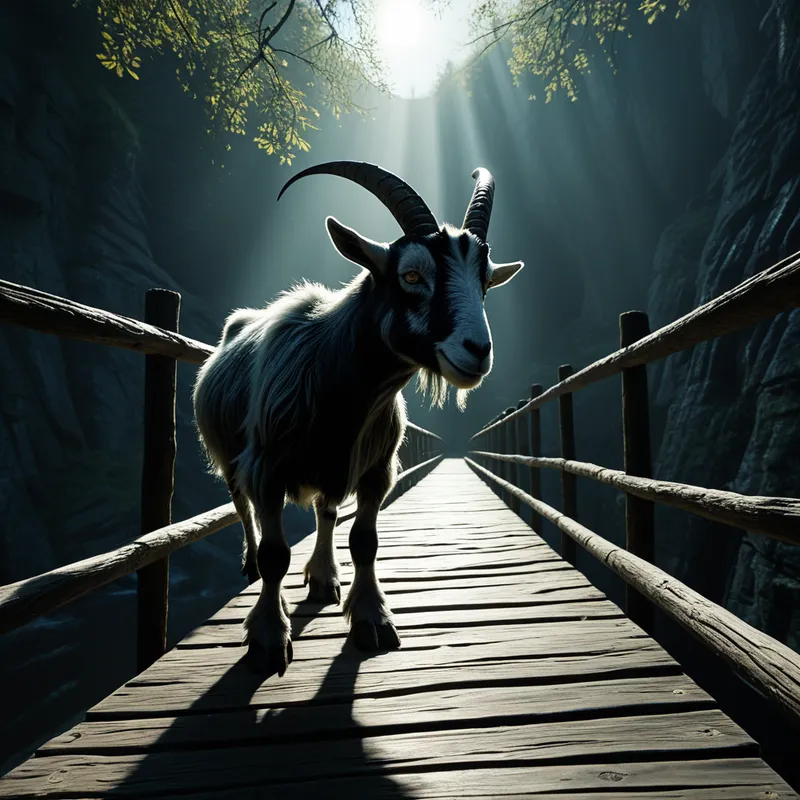
But this was no ordinary crossing. It was an old, wooden bridge that sang a mournful song with every step, arching over a river that ran black and swift far below. And in the dark space beneath that bridge, in the damp and the perpetual twilight, there lived a Troll. He was all appetite and malice, a [thing](/myths/thing “Myth from Norse culture.”/) of gnarled limbs and eyes like cold stones. His law was simple: Who trips over my bridge? For he was always hungry.
The time came. The little Billy Goat Gruff set his small hooves upon the planks. Trip, trap! Trip, trap! went the bridge. A voice like grinding rocks roared from the chasm: “WHO’S THAT TRIPPING OVER MY BRIDGE?” The little goat’s heart became a bird in a cage. But he found a voice, thin but clear. “It is I, the tiniest Billy Goat Gruff. I go to the hillside to make myself fat.” “No, I am coming to gobble you up!” bellowed the Troll. “Oh, no! Pray, do not take me. I am too little. Wait for my second brother. He is much bigger.” The Troll, whose greed was only matched by his stupidity, grunted. “Well, be off with you.” And the smallest brother crossed, his trip-trapping fading into the promise of the green.
Soon came the sound: TRIP, TRAP! TRIP, TRAP! “WHO’S THAT TRIPPING OVER MY BRIDGE?” thundered the Troll. “It is I, the second Billy Goat Gruff. I go to the hillside to make myself fat,” said the middle brother, his voice steady. “No, I am coming to gobble you up!” “Oh, no! Do not take me. Wait for my big brother. He is much bigger still.” The Troll, salivating at the thought of a greater feast, snarled, “Very well, be off.” And the second brother passed over, his shadow falling across the Troll’s den.
Then, the earth seemed to shake. TRIP, TRAP! TRIP, TRAP! The bridge groaned under a mighty weight. “WHO’S THAT TRIPPING OVER MY BRIDGE?” roared the Troll, but this time, there was a thread of uncertainty in his fury. The Great Billy Goat Gruff looked down into the gloom. His voice was not loud; it was final, like stone settling. “It is I. The Great Billy Goat Gruff.” “I AM COMING TO GOBBLE YOU UP!” screamed the Troll, scrambling up the side. And the Great Billy Goat Gruff did not bargain. He did not plead. He lowered his head, where his horns were not ornaments but weapons of seasoned oak and iron intent. He charged. There was a terrible sound of impact, of splintering and roaring. He tossed the Troll high into the air, over the side of the bridge. The Troll fell, down, down into the black, rushing [water](/myths/water “Myth from Chinese culture.”/), and was seen no more.
Then the Great Billy Goat Gruff went up to the hillside. There, his brothers were already growing fat. The grass was sweet, the sun was warm, and the bridge lay silent behind them, a crossing now safe, its old song just [the wind](/myths/the-wind “Myth from Various culture.”/) in the ropes.
Cultural Origins & Context
This is a fairy tale from the oral traditions of Norway, collected by the folklorists [Peter](/myths/peter “Myth from Biblical culture.”/) Christen Asbjørnsen and Jørgen Moe in the 19th century. It belongs to the vast body of Nordic folklore where the landscape itself is a character—forbidding mountains, deep fjords, and dense forests that harbor hidden beings. Told by [the hearth](/myths/the-hearth “Myth from Norse culture.”/) during long winters, it functioned as both entertainment and instruction. For children, it was a thrilling, repetitive drama with a clear villain and triumphant heroes. For the community, it encoded vital lessons about resource scarcity, communal strategy, and the necessity of confronting the monstrous things that block access to prosperity. The troll under the bridge is a quintessential figure in Scandinavian lore, often guarding passages or hoarding treasure, representing the untamed, dangerous, and possessive spirit of a specific place that must be dealt with to ensure safe passage and growth.
Symbolic Architecture
The myth’s power lies in its stark, almost mathematical [symbolism](/symbols/symbolism “Symbol: The use of symbols to represent ideas or qualities, often conveying deeper meanings beyond literal interpretation. In dreams, it’s the language of the unconscious.”/). It is a parable of strategic confrontation and graduated [maturation](/symbols/maturation “Symbol: The process of developing toward a more advanced, complete, or effective state, often involving growth, learning, and integration of experiences.”/).
The Three Billy Goats represent stages of [the self](/myths/the-self “Myth from Jungian culture.”/) or a [community](/symbols/community “Symbol: Community in dreams symbolizes connection, support, and the need for belonging.”/): the vulnerable, nascent potential (the smallest); the competent, developing [strength](/symbols/strength “Symbol: ‘Strength’ symbolizes resilience, courage, and the ability to overcome challenges.”/) (the middle); and the fully integrated, formidable power (the greatest). Their shared name, Gruff, signifies they are aspects of a single entity—the evolving [psyche](/myths/psyche “Myth from Greek culture.”/) or the familial/social [unit](/symbols/unit “Symbol: Represents wholeness or completeness within the dream narrative.”/).
The bridge is the classic liminal space, the critical juncture between a state of lack (the barren hillside) and a state of abundance (the lush meadow). To cross it is to undergo a rite of passage.
The [Troll](/symbols/troll “Symbol: Trolls often represent the darker, hidden aspects of oneself or society, embodying fear and the unknown.”/) is the [Shadow](/symbols/shadow “Symbol: The ‘shadow’ embodies the unconscious, repressed aspects of the self and often represents fears or hidden emotions.”/) [guardian](/symbols/guardian “Symbol: A protector figure representing safety, authority, and guidance, often embodying parental, societal, or spiritual oversight.”/) of this threshold. He is not random evil, but a specific kind of obstruction: brutish, possessive, and insatiably hungry. He symbolizes the psychic “toll” demanded by growth—the fear, the inertia, the internal critic, or the external [oppressor](/symbols/oppressor “Symbol: A figure representing external control, domination, or unjust authority that suppresses freedom, autonomy, or self-expression.”/) that claims ownership over our paths and demands we sacrifice our vitality. His home under the bridge marks him as a [creature](/symbols/creature “Symbol: Creatures in dreams often symbolize instincts, primal urges, and the unknown aspects of the psyche.”/) of the unconscious, the repressed, that which must be brought to light and faced.
The goats’ [strategy](/symbols/strategy “Symbol: A plan of action designed to achieve a long-term or overall aim, often involving competition, resource management, and foresight.”/) is profound. The smaller ones do not fight; they defer, using the promise of a greater prize to bypass immediate annihilation. This is the wisdom of the weak: knowing when to negotiate and buy time. The final confrontation is inevitable, but it must be met with commensurate force. The Great [Goat](/symbols/goat “Symbol: The goat symbolizes independence, resilience, and various traits associated with adaptability across diverse cultures.”/) does not argue; he embodies the full, assertive power that has been cultivated through the earlier stages. His victory is not clever but absolute.
The Dreamer’s Resonance
When this myth patterns a modern dream, the dreamer is at a psychological crossroads, sensing a “green pasture” of potential—a new job, a creative project, a deeper relationship, a state of psychological health—on the other side of a feared transition. The somatic feeling is often one of tension on a threshold: heart pounding at the foot of a bridge, at the door of an interview, at the start of a difficult conversation.
The Troll in the dream may appear as a monstrous figure, but more often it manifests as the voice from below: a booming internal criticism, the intimidating authority of a boss or parent, the paralyzing fear of failure, or a looming, undefined anxiety that claims, “This is mine, you cannot pass.” The dream’s action reveals the dreamer’s current relationship to this obstruction. Are they the trembling first goat, aware of the danger but mustering the voice to speak? Are they the second, negotiating from a place of growing strength? Or are they approaching the moment of being the Great Goat, where negotiation ends and embodied, decisive action begins? The dream is a map of the escalation required to integrate [the shadow](/myths/the-shadow “Myth from Jungian culture.”/) and claim one’s nourishment.
Alchemical Translation
In the alchemical vessel of individuation, this myth models the process of psychic transmutation through phased confrontation. The barren hillside is the [nigredo](/myths/nigredo “Myth from Alchemical culture.”/), the initial state of felt lack and dissatisfaction. The green meadow is the albedo or citrinitas, the state of clarity, nourishment, and realized potential.
The journey from one to the other requires crossing the nigredo bridge, where the base material (the unintegrated shadow/Troll) must be encountered and transformed.
The three goats are the alchemical stages themselves. The first goat is calculation—assessing the obstacle and employing cunning ([mercury](/myths/mercury “Myth from Roman culture.”/)). The second is coagulation—building and consolidating inner substance (salt). The third is the [rubedo](/myths/rubedo “Myth from Alchemical culture.”/)—the reddening, the fierce, solar force of the integrated will ([sulfur](/myths/sulfur “Myth from Alchemical culture.”/)) that performs the final, transformative act. The Troll is not destroyed in an ethical sense but is dissolved (thrown into the transformative waters) and its energy, its possessive claim over the path, is broken.
For the modern individual, this translates to any endeavor where growth is blocked by an internal or external “troll.” First, we acknowledge it with a small, truthful voice. Then, we build our resources and negotiate from greater strength. Finally, we must embody our full authority and charge, not with blind rage, but with the focused power of our accumulated experience and truth. The [triumph](/myths/triumph “Myth from Roman culture.”/) is not the death of a part of ourselves, but the dissolution of its tyrannical control, freeing its energy. The bridge, once a site of terror, becomes simply a path. And on the other side, all aspects of the self—the small, the middle, and the great—feast together on the hard-won bounty of wholeness.
Associated Symbols
Explore related symbols from the CaleaDream lexicon: