Thors fishing hook Myth Meaning & Symbolism
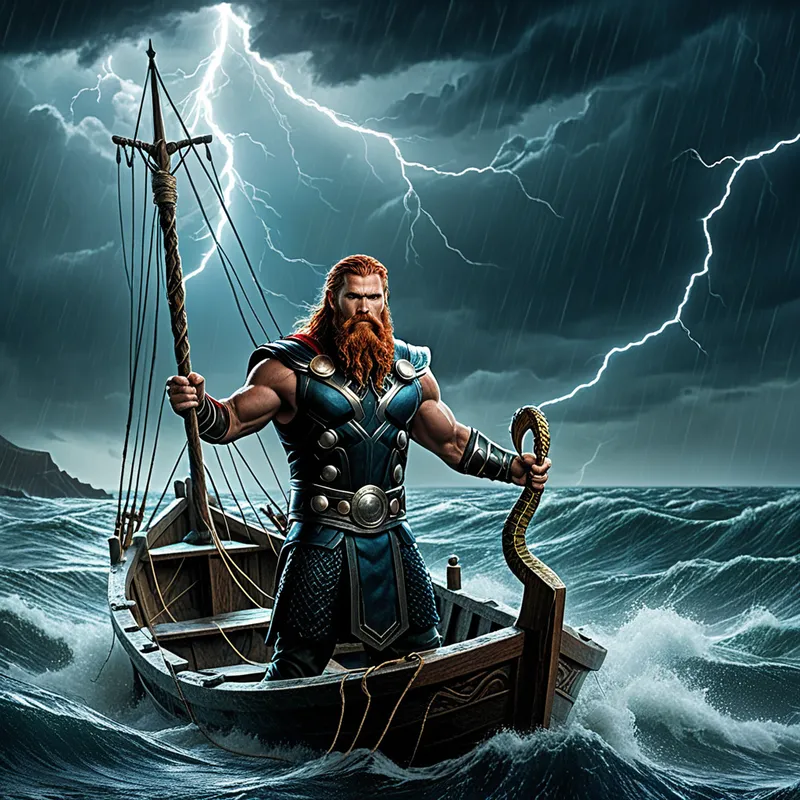
Thor, the thunder god, baits his fishing hook with an ox head to catch Jörmungandr, the World Serpent, in a primal struggle of order against chaos.
The Tale of Thors fishing hook
[The sea](/myths/the-sea “Myth from Greek culture.”/) was not [water](/myths/water “Myth from Chinese culture.”/) that day, but a slab of hammered lead, cold and heaving under a sky the color of a fresh bruise. Thor, whose breath was the storm and whose voice was the cliff-shattering crack, stood not in his chariot but in a boat—a laughable shell of wood on the back of such an ocean. His companion was no god, but the giant Hymir, whose face was as stony and grim as the fjords.
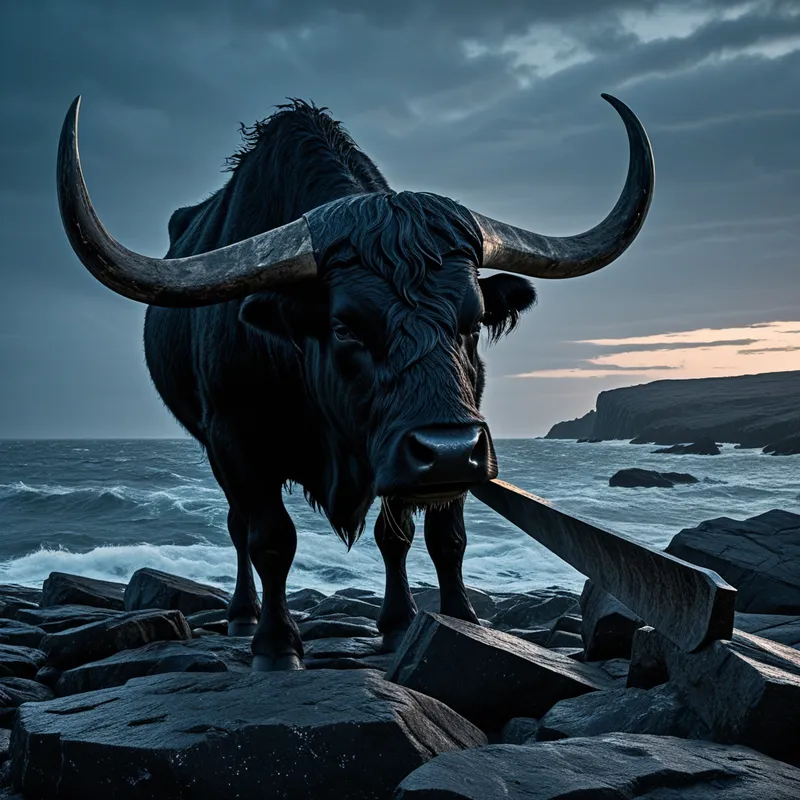
They had come to fish, but this was no quest for supper. Thor’s eyes, like chips of summer sky trapped in a tempest, were fixed on [the abyss](/myths/the-abyss “Myth from Kabbalistic culture.”/). “We need bait,” Hymir grunted, pointing to his own herd. “Take one of my cattle.” Thor said nothing. He walked to the finest of Hymir’s bulls, a beast of midnight hide and breath like forge-smoke. In one terrible, merciful motion, he wrenched the great head from its shoulders. The sound was not of tearing, but of a mountain root giving way.
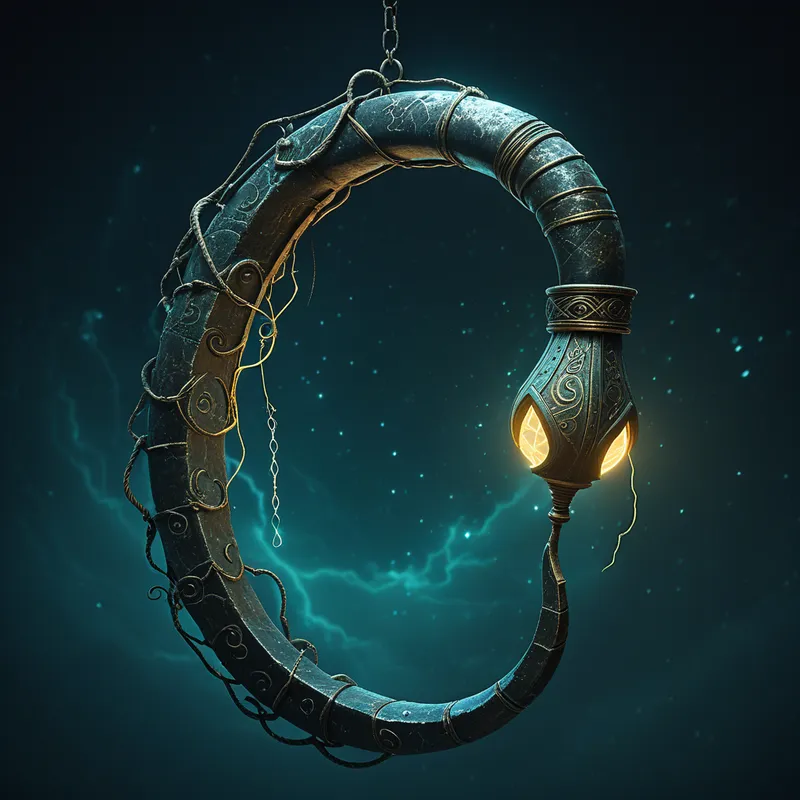
The boat creaked as they rowed beyond where any sane being would dare, to waters where the sea-floor fell away into [the Ginnungagap](/myths/the-ginnungagap “Myth from Norse culture.”/) of old. Hymir, in the stern, caught two whales, his face grim with a foreknowledge that tasted of iron. Thor, in the prow, prepared his line. He took the ox head, still warm, and impaled it upon a hook forged not for fish, but for fate. The line he cast was no simple cord, but the guts of destiny itself.
He cast the hook. It sank, a falling star into [the underworld](/myths/the-underworld “Myth from Greek culture.”/) of the sea. And then they waited. [The world](/myths/the-world “Myth from Tarot culture.”/) held its breath.
The strike did not come as a tug. It came as the end of the world. The boat shuddered, its timbers screaming. The sea erupted. Thor’s feet planted, his divine sinews becoming cables of creation, and he pulled. He pulled against the weight of all encircling dread. The line sang a note that threatened to shatter [the sky](/myths/the-sky “Myth from Persian culture.”/). And from the ink-black depths, rising in a maelstrom of foam and primordial slime, came the head.
It was a mountain range given life, a continent of scale and fang. Eyes like drowned suns, cold and ancient and utterly mad, locked with Thor’s. It was [Jörmungandr](/myths/jrmungandr “Myth from Norse culture.”/), the [World Serpent](/myths/world-serpent “Myth from Global culture.”/), [the Ouroboros](/myths/the-ouroboros “Myth from Alchemical culture.”/) of [Midgard](/myths/midgard “Myth from Norse culture.”/), pulled from its dreaming bed. The poison of its breath hissed in the air, and the very sea boiled where its body breached.
Thor roared, a sound of pure, exultant defiance. He hauled, the muscles in his arms standing like bedrock, and the serpent rose higher, its gaping maw descending toward the boat—toward the world. This was the moment. The hook was set. The god and the chaos at the root of things were joined in a single, straining line.
Hymir, his courage as shattered as the sea, saw only doom. With a cry not of battle but of terror, he lunged forward and severed the line. The sound was a universe sighing. The serpent, with a look that was almost recognition, sank back into the abyss, a ripple moving across the world. Thor’s hammer, [Mjölnir](/myths/mjlnir “Myth from Norse culture.”/), was already in his hand, flashing forward, but it struck only the vanishing crest of a wave where the great head had been. The sea swallowed the echo of the blow, and the boat was left rocking on the sudden, terrible calm.
Cultural Origins & Context
This mighty tale comes to us primarily from the Hymiskviða and is echoed in the Prose Edda of Snorri Sturluson. It was not scripture, but story—a vital thread in the oral tapestry woven by skalds and told in the fire-lit halls of the Viking Age. Its function was multifaceted: a thrilling adventure of their greatest protector, a cosmological map showing the fragile order of Midgard besieged by primal chaos, and a sobering lesson in the limits of even divine might.
The myth lives in the space between the heroic and the tragic. It showcases Thor’s essential role—he is the one who actively confronts the encroaching entropy symbolized by the serpent. Yet, the tale is passed down with the ending intact: he is thwarted, not by the monster, but by human-scale fear (embodied by Hymir). This reflects a profound Norse worldview where glory is found in the struggle itself, drengskapr, even in the face of a foretold and inevitable doom ([Ragnarök](/myths/ragnark “Myth from Norse culture.”/)). The story was a cultural container for acknowledging the terrifying scale of the world’s dangers while championing the courage to face them, hook in hand.
Symbolic Architecture
The myth is a masterclass in symbolic compression. Every element is a psychic [actor](/symbols/actor “Symbol: An actor represents roles, transformation, and the performance of identity in dreams.”/).
Thor is not merely a strong god; he is the archetypal principle of conscious, structured force—[the ego](/myths/the-ego “Myth from Jungian culture.”/) that seeks to impose order, to defend boundaries, to know what lurks in the [depths](/symbols/depths “Symbol: Represents the subconscious, hidden emotions, or foundational aspects of the self, often linked to primal fears or profound truths.”/) by confronting it directly. His [fishing hook](/symbols/fishing-hook “Symbol: Fishing hooks signify the pursuit of one’s desires, capturing both the literal and metaphorical ambition to reel in opportunities.”/), baited with the head of the ox (a [symbol](/symbols/symbol “Symbol: A symbol can represent an idea, concept, or belief, serving as a powerful tool for communication and understanding.”/) of brute [strength](/symbols/strength “Symbol: ‘Strength’ symbolizes resilience, courage, and the ability to overcome challenges.”/) and sacrifice), represents the focused [application](/symbols/application “Symbol: An application symbolizes engagement, integration of knowledge, or the pursuit of goals, often representing self-improvement and personal development.”/) of will. It is the crafted tool of [consciousness](/symbols/consciousness “Symbol: Consciousness represents the state of awareness and perception, encompassing thoughts, feelings, and experiences.”/) used to probe the unconscious.
The hook is the question we dare to ask of the deep, baited with the best of our conscious understanding.
The sea is the unconscious itself—vast, unknown, and teeming with [life](/symbols/life “Symbol: The symbol of ‘Life’ represents a journey of growth, interconnectedness, and existential meaning, encompassing both the joys and challenges that define human experience.”/) both nurturing and monstrous. Jörmungandr, the [serpent](/symbols/serpent “Symbol: A powerful symbol of transformation, wisdom, and primal energy, often representing hidden knowledge, healing, or temptation.”/) encircling Midgard, is the ultimate [shadow](/symbols/shadow “Symbol: The ‘shadow’ embodies the unconscious, repressed aspects of the self and often represents fears or hidden emotions.”/) of that unconscious: [the self](/myths/the-self “Myth from Jungian culture.”/)-devouring cycle of unintegrated [trauma](/symbols/trauma “Symbol: A deeply distressing or disturbing experience that overwhelms the psyche, often manifesting in dreams as unresolved emotional wounds or psychological injury.”/), the primal fear that undergirds [reality](/symbols/reality “Symbol: Reality signifies the state of existence and perception, often reflecting one’s understanding of truth and life experiences.”/), the chaotic potential that exists just below the surface of our ordered world. To “fish” for it is the ultimate act of psychological bravery—to deliberately engage with what we have been content to let sleep.
The severed line is the critical [moment](/symbols/moment “Symbol: The symbol of a ‘moment’ embodies the significance of transient experiences that encapsulate emotional depth or pivotal transformations in life.”/) of [rupture](/symbols/rupture “Symbol: A sudden break or tear in continuity, often representing abrupt change, separation, or the shattering of established patterns.”/). It symbolizes the ego’s limit, the point where the conscious mind, terrified by the sheer [magnitude](/symbols/magnitude “Symbol: A measure of scale, intensity, or importance, often reflecting one’s perception of significance, impact, or overwhelming force in life.”/) of what it has summoned, retreats. The [integration](/symbols/integration “Symbol: The process of unifying disparate parts of the self or experience into a cohesive whole, often representing psychological wholeness or resolution of internal conflict.”/) is incomplete. The [monster](/symbols/monster “Symbol: Monsters in dreams often symbolize fears, anxieties, or challenges that feel overwhelming.”/) is seen, acknowledged, even wounded (by the subsequent blow from Mjölnir), but not assimilated. It returns to the deep, now forever conscious of the god, and the god forever conscious of it—a [relationship](/symbols/relationship “Symbol: A representation of connections we have with others in our lives, often reflecting our emotional state.”/) of eternal, tense recognition.
The Dreamer’s Resonance
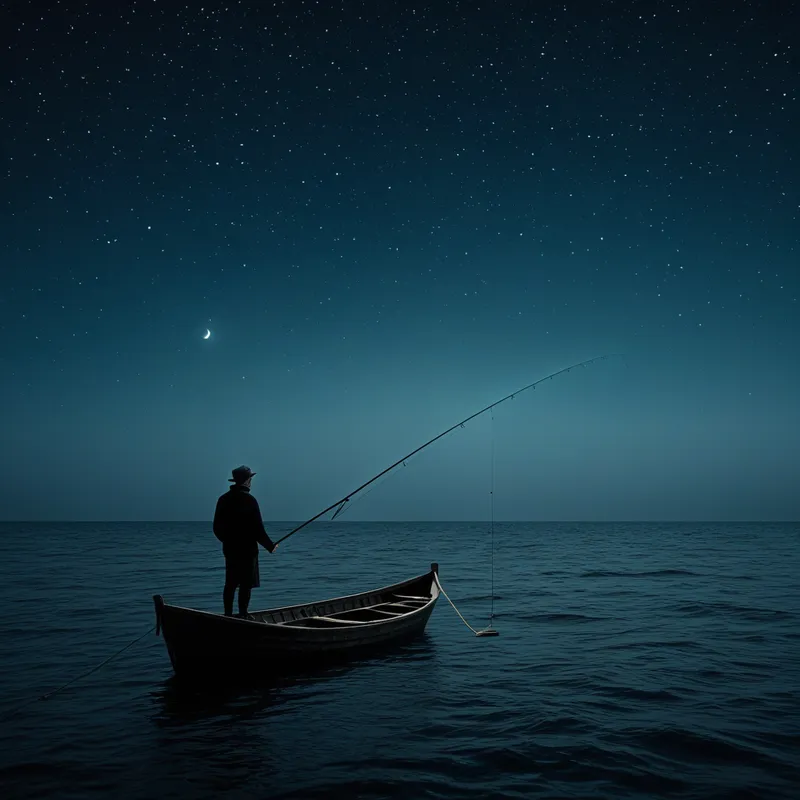
When this myth stirs in the modern soul, it often surfaces in dreams of profound, somatic tension. You may dream of fishing in a dark lake and catching something impossibly heavy—a car, a sunken log that feels alive, a force that begins to pull you in. The dream-body experiences this as a visceral strain in the shoulders and back, a grounding of the feet, a mixture of terror and exhilaration.
Psychologically, this is the process of a nascent strength—a new aspect of the ego—attempting to “hook” and bring to the surface a major complex or shadow content. It is the dream of the entrepreneur about to launch a venture that brings up deep fears of failure. It is the artist preparing to unveil work that touches a raw, personal truth. It is anyone on the brink of a confrontation with a foundational anxiety. The dream does not promise success; it maps the attempt. The feeling upon waking—whether of frustration (the line severed) or awe (having seen the serpent’s head)—tells you where you are in that process of engagement.
Alchemical Translation
The alchemical journey is one of [solve et coagula](/myths/solve-et-coagula “Myth from Alchemical culture.”/)—to dissolve the old, rigid form and reconstitute it into a higher, integrated one. Thor’s fishing expedition is a supreme act of solve. He dissolves the boundary between the known world (the boat, the sky) and the unknown (the chaotic sea). He willingly enters the [nigredo](/myths/nigredo “Myth from Alchemical culture.”/), the blackening, the sea of despair and primal matter, to retrieve the [prima materia](/myths/prima-materia “Myth from Alchemical culture.”/)—the serpent, which is both poison and potential.
The god must risk being swallowed by the chaos to discover the true measure of his hammer.
For the modern individual, this myth models the necessary, terrifying stage of active shadow-work. We must forge our own hook—our focused intention, our therapy, our creative practice, our difficult conversation. We must bait it with something of true value, a sacrifice of our comfort or a cherished self-image (the ox head). Then we must cast it into our own depths and hold on.
The [triumph](/myths/triumph “Myth from Roman culture.”/) in the alchemy of this myth is not in killing the serpent. That is for Ragnarök, the final conflagration. The triumph here is in the seeing. It is in the moment of eye contact between god and monster. That moment is the coniunctio, [the sacred marriage](/myths/the-sacred-marriage “Myth from Various culture.”/) of opposites—consciousness and unconscious, order and chaos, self and shadow. In that locked gaze, both are changed forever. The ego learns it is not all-powerful, but it is resilient. [The shadow](/myths/the-shadow “Myth from Jungian culture.”/) is brought into the light of awareness, where its terrifying power can begin to be transmuted from world-encircling poison into a source of immense, coiled energy for life.
The severed line is not a failure, but a promise. It tells us the work is iterative. We see the serpent, we lose it, we integrate the shock of the encounter, and we prepare to fish again. Each time, we can pull it a little closer to the surface, hold the gaze a little longer, until what was monstrous becomes a fundamental, acknowledged part of our own world-spanning [psyche](/myths/psyche “Myth from Greek culture.”/).
Associated Symbols
Explore related symbols from the CaleaDream lexicon: