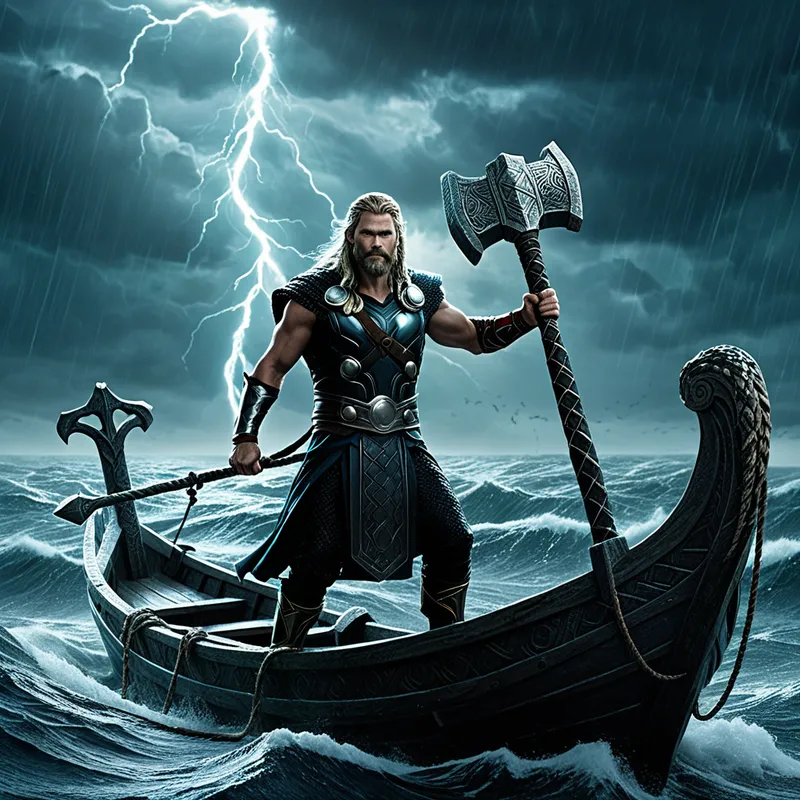
Thor vs. Jörmungandr Myth Meaning & Symbolism
The thunder god's destined battle with the world serpent, a cosmic clash of order against chaos, hero against shadow, and the inevitable cycle of destruction and renewal.
The Tale of Thor vs. Jörmungandr
Hear now the tale of the last fishing trip, a story not of gentle waters but of the abyss itself. The air in Asgard was thick with the boastful laughter of the thunder-lord, Thor. His companion, the cunning Loki, spun a tale of a giant, Hymir, who possessed a boat sturdy enough to sail into the very waters where the great ones dwell. Thor’s blood, ever quick to fire, was stirred. He sought not mere fish, but a challenge worthy of his arm.
They journeyed to the edge of the world, to Hymir’s hall of stone and frost. The giant’s eyes were cold, his words few, but he saw the god’s unspoken hunger. At dawn, they pushed the boat onto a sea the color of lead and old bruises. Hymir, with a practiced hand, caught two great whales, their bulk like islands of flesh. Thor watched, his impatience a living heat. He demanded the giant’s strongest line. With a grunt, Hymir pointed to his herd—take a head for bait, if you dare. Thor did not hesitate. He wrenched the head from the mightiest ox, a beast named Himinrjót, whose power once shook the sky. This was no bait for fish. This was a lure for legends.
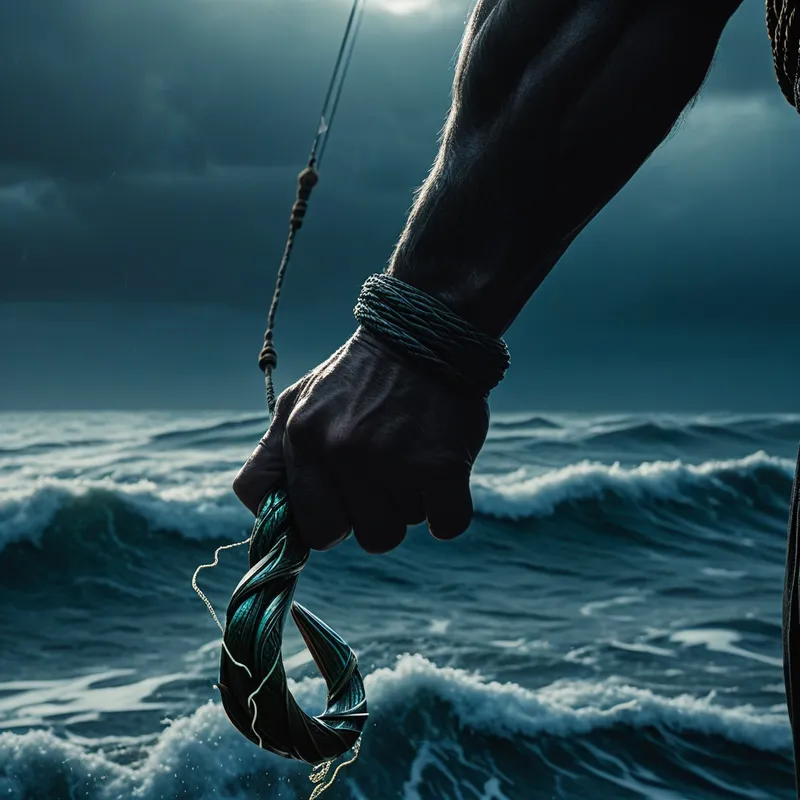
He fastened the ox-head to a hook of iron, cast it overboard, and let the line run through his godly fingers into the deep, dark silence. The boat drifted. The sea grew still, a mirror of the heavy sky. Then, a tug. Not a fish’s nibble, but a pull that spoke of mountains shifting in their sleep. Thor’s muscles corded, his feet braced against the planks. The line screamed. He hauled, and the sea began to boil.
From the ink-black depths, a shape emerged—a coil wider than a fjord, scales like tarnished shields the size of houses. Then the head, a nightmare of teeth and cold, intelligent eyes that held the void of the ocean floor. It was Jörmungandr, the World Serpent, whose body girdles all of Midgard. The ox-head was lodged in its jaw. The serpent’s breath was poison, steaming the air, and its hiss was the sound of continents grinding.
Thor roared, a sound of cracking ice and splitting rock. He pulled, his divine strength pitted against the weight of the deep. The serpent rose, a tower of scaled flesh, and the little boat groaned, taking on water. The sea heaved. Thor reached for Mjölnir, his fingers closing on the short haft. His arm drew back, lightning gathering in his fist, in his eyes, in the very air. This was the moment foretold in the whispers of the Norns—the god and his doom, face to face.
But as the hammer began its death-arc, Hymir, pale with a terror deeper than fear of the serpent, moved. His knife flashed. He cut the line. The connection snapped. With a sound like a collapsing world, Jörmungandr sank, its monstrous eye holding Thor’s gaze for one last, eternal second before vanishing into the gloom. The sea settled, leaving only the god, his hammer still raised, standing in a sinking boat, the taste of a victory stolen and a destiny postponed thick in his mouth. The battle was over, but the war was merely waiting.
Cultural Origins & Context
This myth, preserved primarily in the Poetic Edda poem Hymiskviða and referenced in the Prose Edda, was not mere entertainment. It was a cosmological anchor for a people intimately acquainted with a world of sublime beauty and brutal, indifferent power. Told in halls smoky with firelight, the saga of Thor’s fishing trip served multiple vital functions. It reinforced the image of Thor as the indefatigable protector of the human realm (Midgard) from the chaotic, untamable forces that surrounded it, embodied by giants and monsters like Jörmungandr.
The story also functioned as a profound teaching on the nature of fate, or ørlög. The audience knew the prophecy: at Ragnarök, Thor and the World Serpent would meet again and slay each other. This fishing trip was a terrifying, exhilarating preview of that final doom. It created a narrative tension—the hero confronts his ultimate adversary, yet the climax is brutally interrupted. This deferral taught that destiny is inescapable, but its timing is held in the hands of forces even the gods cannot fully control. The storyteller, perhaps a skald weaving history and myth, used this tale to bind the community to a shared understanding of their place in a cyclical universe of creation, struggle, and inevitable destruction.
Symbolic Architecture
At its core, this myth is a masterful depiction of the psyche’s central drama: the conscious ego’s necessary and perpetual struggle with the unconscious shadow.
Thor represents the archetypal ego in its heroic aspect—the force of order, clarity, action, and defined boundaries. He is willpower, thunderous intention, and the drive to protect the known world from disintegration. His hammer, Mjölnir, is the tool of differentiation, the power to shape, define, and break that which threatens form.
Jörmungandr is the ultimate shadow—not a personal flaw, but the impersonal, primordial chaos that underlies all reality. It is the undifferentiated, the boundless, the instinctual and chthonic power that encircles the world of consciousness. It does not think; it is. Its poison is the dissolving agent of entropy, the return to the formless womb of the deep.
Their battle is thus the eternal tension between the principle of form and the principle of the formless. The fishing line is the tenuous connection, the nervus rerum (nerve of things), that links consciousness to the depths it both fears and needs. Thor’s bait, the head of the sky-shaking ox, is symbolic of the inflated ego’s pride—it is this very self-importance that lures the deepest shadow to the surface. The giant Hymir’s act of cutting the line is not mere cowardice; it is the psyche’s self-preservation mechanism, a forced repression when the confrontation with the shadow becomes too catastrophic to integrate in a single moment.
The Dreamer’s Resonance
When this mythic pattern stirs in the modern dreamer, it signals a profound somatic and psychological process: the ego is being called to grapple with a systemic, overwhelming aspect of the personal or collective unconscious. This is not a dream of arguing with a boss or fearing a spider. This is a dream of tectonic scale.
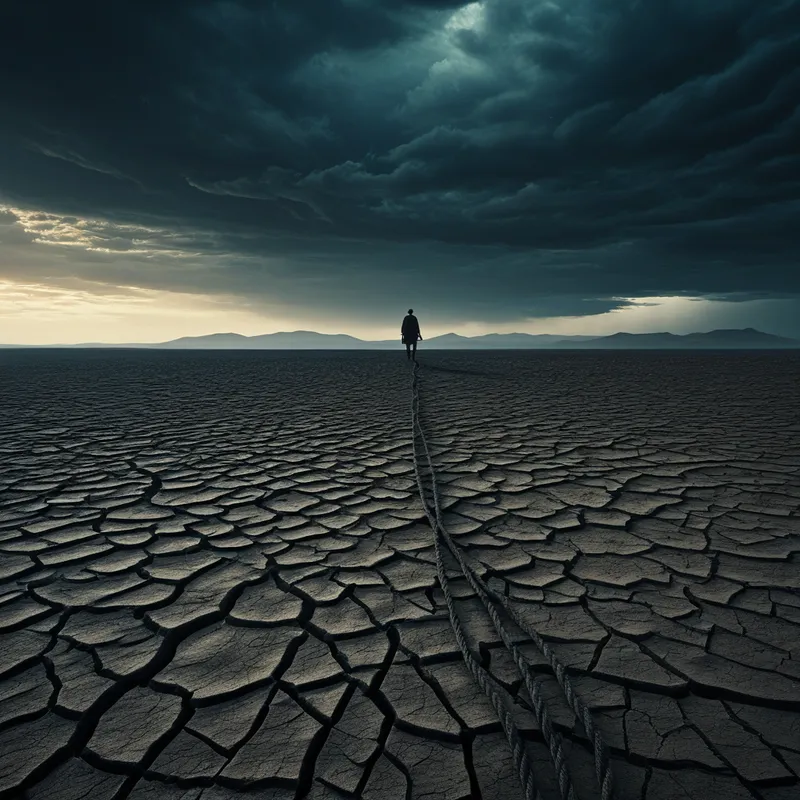
The dreamer may find themselves hauling on a rope attached to something unimaginably heavy in dark water, or standing on ground that trembles with a subterranean presence. There is a sense of immense, latent power—a financial debt that feels oceanic, a repressed grief as vast as a sea, or a creative potential so massive it threatens to capsize one’s current life. The somatic resonance is key: a feeling of strain in the shoulders and back, a clenching jaw, a knot in the gut—the body bearing the weight the mind has hooked.
The dream is an announcement. The World Serpent of the psyche has been snagged. The old, prideful bait of the ego (a rigid identity, a controlling narrative) has attracted something far greater than it bargained for. The dreamer is in the boat, feeling it take on water. The psychological process underway is one of terrifying encounter with the foundational, often chaotic, energies that underpin their existence. The outcome in the dream—whether they land the beast, are swallowed, or the line is cut—reveals the psyche’s current capacity for this integration.
Alchemical Translation
The alchemical journey modeled here is the opus contra naturam—the work against nature, which is really the work of transforming nature (the primal, unconscious serpent) into spirit (the conscious, wielded power of the god). It is the process of psychic transmutation, or individuation.
The first stage is nigredo, the blackening. This is the voyage onto the leaden sea, the confrontation with the murky, depressive, and overwhelming material of the unconscious (the serpent in the depths). Thor’s initial, brute-force hauling represents the ego’s first, often clumsy, attempt to integrate this material by sheer will—to drag it into the light and smash it. This inevitably fails or is interrupted (the cut line), leading to a fall back into the depths.
The true alchemy begins in the failure of the heroic ego. The serpent is not to be killed prematurely, but to be known. The poison it breathes is the prima materia, the corrosive substance that dissolves old, rigid structures of the self, making transformation possible.
The deferred final battle at Ragnarök is key. It signifies that this confrontation is not a one-time event, but a cyclical process essential to the renewal of the psyche. Each time we “go fishing” in our depths—through therapy, creative work, or deep introspection—we engage in a smaller-scale Ragnarök. We haul up a fragment of our personal Jörmungandr, face its poison, and in doing so, we integrate a piece of our boundless, instinctual shadow into our conscious identity. Thor’s final, fatal victory over the serpent at the world’s end symbolizes the ultimate goal: the conscious ego, fully expanded and tempered by countless encounters with the deep, finally merges with the totality of the Self, achieving wholeness even in the act of dissolution and renewal. The myth teaches that we are both the fisherman and the serpent, the defender of order and the encircling chaos, and our wholeness depends on the sacred, straining tension of the line between them.
Associated Symbols
Explore related symbols from the CaleaDream lexicon: