Thor fishing for Jörmungandr Myth Meaning & Symbolism
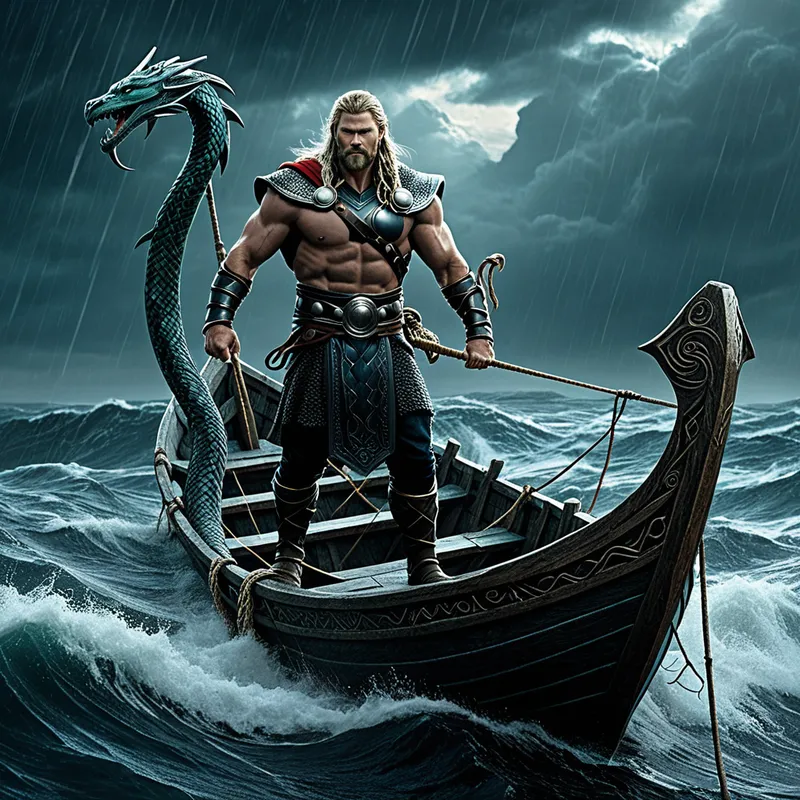
The god Thor, on a fishing trip with the giant Hymir, attempts to haul the world-serpent Jörmungandr from the ocean's abyss, nearly ending the world.
The Tale of Thor fishing for Jörmungandr
The mead-halls of the gods are not always filled with laughter. Sometimes, a restless silence falls, a quiet that speaks of deeds undone and challenges unmet. It was in such a silence that Thor, whose red beard bristled with impatience, sought an adventure to match the storm in his heart. He journeyed not to the golden halls of Asgard, but east, to the edge of the world, to the hall of the surly giant Hymir.
Hymir’s hall was cold, hewn from ice and shadow. Thor, disguised as a youth, was met with a giant’s scorn. To prove his worth for a feast, he was tasked with providing the catch. At dawn, they pushed Hymir’s boat onto a sea the color of lead and old bruises. The giant rowed far, past where any sane fisherman would dare, to his own fishing grounds where the ocean floor fell away into the abyss.
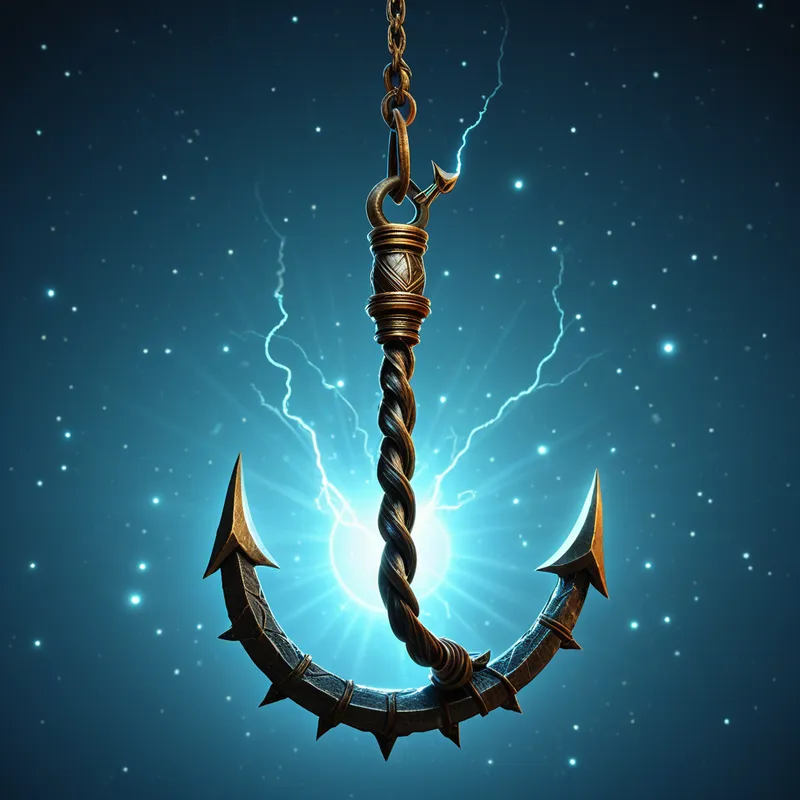
Hymir caught two whales with ease, a feat that drew only a grunt from Thor. The Thunder God’s eyes were fixed on the horizon, on the line where sea met sky—the girdle of the world. “I need bait,” Thor rumbled, and with a strength that made the boat groan, he wrenched the head from Hymir’s largest ox. He fastened the bloody prize to a hook forged not by mortal hands, but by the cunning dwarves, a hook named “The Bane of Serpents.”
Then, with a cast that split the silence like thunder, he hurled the line. It unspooled into the deep, down past the realms of fish and kraken, down to where the ocean holds its breath. The hook sank into the murk, past the bones of leviathans, and found its mark.
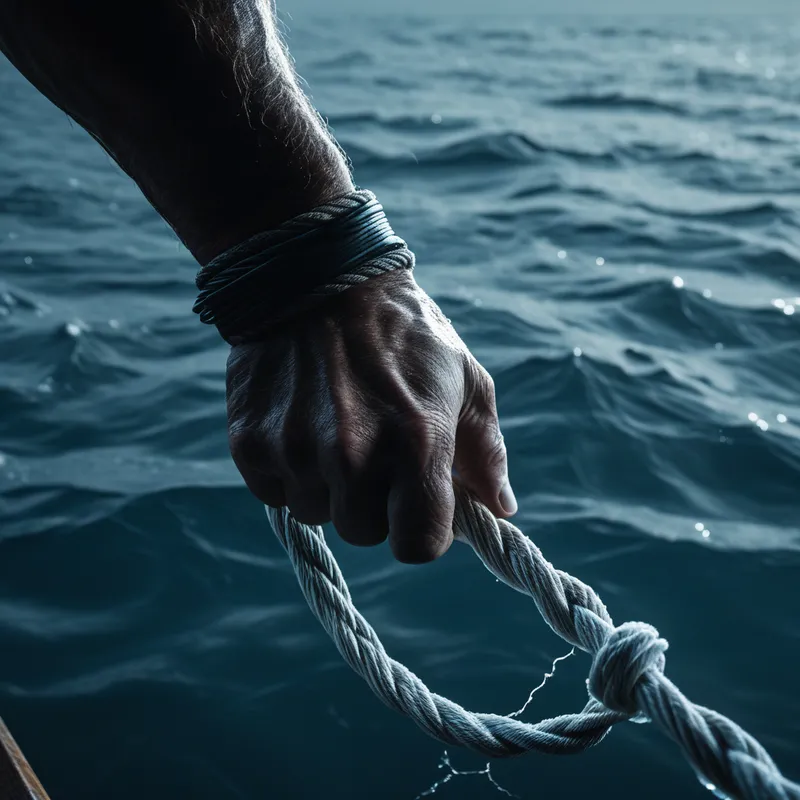
The sea did not boil; it tightened. The line went rigid, a bar of iron. The small boat shuddered, its timbers screaming. Thor braced himself, his feet driving into the planks, every tendon in his arms and back standing out like mountain ridges. He began to haul. The sea bulged. A darkness rose from the depths, a darkness that was not absence of light, but a terrible, scaled presence. The water parted, and the world held its breath.
The head of Jörmungandr broke the surface. Eyes like cold, green moons fixed upon Thor. Venom dripped from fangs longer than spears, hissing as it hit the sea. The serpent’s body, vast beyond comprehension, coiled in the abyss below. Here was the beast that encircled Midgard, the embodied chaos that Thor was born to fight.
Thor heaved, and the serpent rose higher. The sky darkened. The very fabric of the world strained. Thor reached for his hammer, Mjölnir, his knuckles white on the line, ready to deliver the blow that would end the age-old feud. In that eternal moment, poised between triumph and catastrophe, the giant Hymir, seized by a terror deeper than the sea, lunged forward. With a cry, he cut the fishing line.
The snap echoed across the worlds. Jörmungandr, with a look of ancient malice, sank back into the abyss. The waters crashed together, and the boat rocked violently. Thor, in a rage that shook the heavens, struck Hymir so hard the giant tumbled overboard. But the moment was lost. The serpent was gone, and the final battle was postponed, destined for another day—Ragnarök.
Cultural Origins & Context
This myth survives primarily in the Hymiskviða, a poem found in the Poetic Edda, and is referenced in the later Prose Edda. These texts are our fragile windows into a worldview where myth was not mere story, but a living cosmology. The tale would have been recited in halls by skalds, the poets who were the memory-keepers of their people. Its function was multifaceted: it was entertainment, a reaffirmation of cosmic order, and a theological exploration.
In the harsh, sea-faring world of the Norse, the ocean was both provider and ultimate peril—a literal abyss of chaos. Thor, as the protector of gods and humans, was the divine bulwark against this chaos. The myth served to explain why the world, though perilous, remains intact: because the final confrontation is held in check, not by victory, but by a precarious, temporary suspension. It reinforced Thor’s role as the tireless defender while also acknowledging a fate even he could not yet overcome. The story taught resilience in the face of insurmountable odds and honored the courage to confront the deepest terrors, even if victory is not assured.
Symbolic Architecture
At its core, this is a myth of the heroic ego confronting the totality of the unconscious. Thor represents the conscious will, the force of order, discipline, and action. He is the part of the psyche that builds, defends, and asserts.
Jörmungandr is the ultimate shadow—not a personal flaw, but the impersonal, archetypal chaos that undergirds reality itself. It is the unformed potential, the latent trauma of existence, the psychic “background radiation” of the world.
The fishing expedition is a deliberate, perilous act of nettling the unconscious. Thor does not stumble upon the serpent; he seeks it out with the proper bait (the ox’s head, a symbol of brute strength and sacrifice) and the proper tool (the dwarven hook, representing crafted, focused intention). The ocean is the collective unconscious, and the line is the thread of attention or consciousness he lowers into it.
The climax is profoundly ambivalent. Thor nearly succeeds, but is thwarted by Hymir, who represents the instinct for self-preservation, the fear of totality, the part of us that cuts the line when the confrontation becomes too real. The myth thus symbolizes a necessary failure. To fully haul the world-serpent into the light of consciousness would be to bring about Ragnarök—a psychic cataclysm where the conscious mind is overwhelmed by the contents of the unconscious. The ego is not yet strong enough to integrate the whole serpent.
The Dreamer’s Resonance
When this myth stirs in modern dreams, it rarely appears as a literal god and monster. Its pattern manifests more subtly. The dreamer may find themselves in a small boat (a fragile sense of self) on a vast, dark body of water. They may be hauling on a rope, a chain, or a fishing line attached to something immense and unseen below. There is a somatic sensation of immense strain, of a titanic struggle, mixed with awe and dread.
This dream signals that the dreamer is engaged in a profound process of “fishing” in their own depths. They have cast a line—perhaps through therapy, artistic creation, deep reflection, or a life crisis—and have hooked something foundational. It could be a core trauma, a repressed complex, or a vast, creative potential that feels monstrous in its size and power. The struggle is the ego’s attempt to “land” this content, to understand and integrate it.
The terror of the dream, the feeling that the boat might capsize, mirrors Hymir’s fear. It is the psyche’s warning system: You have hooked something bigger than you are ready for. The dream may end with the line snapping, the thing slithering away, or the dreamer waking in panic. This is not a failure, but a regulation. The unconscious is indicating the limits of what can be consciously borne at this time, preserving the integrity of the self while acknowledging the titanic nature of the work underway.

Alchemical Translation
In the alchemy of the soul, this myth maps the stage of mortificatio and the peril of premature coniunctio—the death of the old attitude and the dangerous union of opposites. Thor’s journey to the giant’s realm is a descent into the prima materia, the base, “giantish” or instinctual layer of the psyche.
The act of fishing is the opus, the great work. The bait is the sacrifice of a familiar strength (the ox) to lure forth the hidden truth. The hook is the focused, penetrating question or intention that can actually “catch” the elusive shadow content.
Pulling the serpent to the surface is the moment of revelation, where a hidden complex or archetypal force begins to emerge into awareness. The intense strain is the psychic labor of holding this tension between conscious and unconscious. This is the critical, transformative fire.
The myth teaches that the goal is not necessarily to “kill” the serpent (to annihilate the unconscious), nor to fully “land” it (to completely rationalize it). The transformative moment is the straining tension itself. It is in that liminal space, with the monster’s head above water and its body in the abyss, that the ego is tested, humbled, and ultimately changed. Hymir’s cutting of the line is, paradoxically, a part of the wisdom. It represents the necessity of rhythm—of engaging the depths, then retreating to integrate the shock, to prevent a psychotic breakdown (a personal Ragnarök).
For the modern individual, the allegory is clear: we must have the courage of Thor to bait the hook and cast our line into our own depths. We must endure the terrifying strain of seeing what we have hooked. But we must also have the humility to accept that some truths are so vast they cannot be fully owned, only acknowledged. The victory lies not in slaying the chaos, but in having stood, muscles cracking, eyes wide open, and faced it. In that confrontation, the ego is forged into something less brittle, more resilient, and paradoxically, more at peace with the serpent that sleeps in the deep.
Associated Symbols
Explore related symbols from the CaleaDream lexicon: