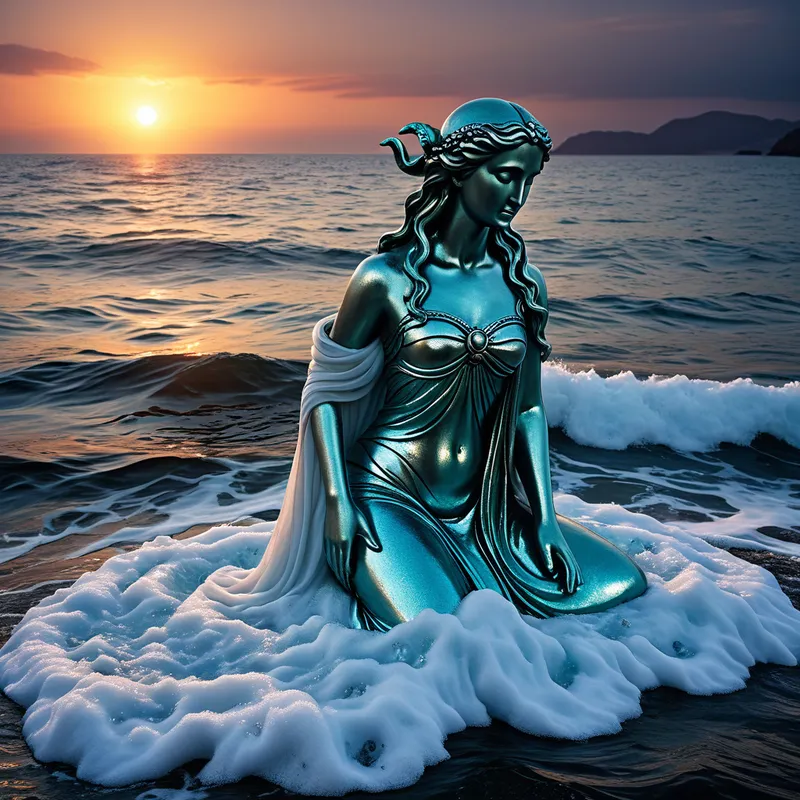
Thetis Myth Meaning & Symbolism
A sea goddess, bound by prophecy to bear a world-changing son, is forced into a mortal marriage, weaving a fate of glory and infinite grief.
The Tale of Thetis
Hear now the song of the silver-footed one, she who was born of the ancient salt, daughter of Nereus. Her name was Thetis, and the sea itself moved to her will. In the sun-dappled deeps, she danced with her fifty sisters, a constellation of grace in the eternal blue. But the Fates, those three stern spinners, had woven for her a thread of terrible brilliance.
A whisper began, first in the halls of Zeus, then among all the Olympians: a prophecy, cold and clear as mountain ice. The child of Thetis, it was foretold, would become greater than his father. In the golden courts of the gods, this was not a promise, but a threat. Zeus himself, who had overthrown his own father Cronus, felt the chill of destiny’s wheel turning. His lightning bolt felt suddenly less sure in his grasp. The lord of the sky looked upon the lovely sea-nymph and saw not beauty, but the seed of his own downfall.
So, in counsel grim, the gods decided. Thetis, the desired, must be given not to a god, but to a mortal. Her destiny was to be bound, her divine potential shackled to the brief, burning candle of a human life. They chose for her Peleus, a hero of Thessaly, strong and noble, but dust to her eternity. Thetis, knowing her fate, resisted. When Peleus came to claim her on the lonely shore, she shifted her form—becoming fire, a lioness, a slithering serpent, a cuttlefish clouding the water. She was the very essence of transformation, refusing to be pinned. But Peleus, instructed by the wise centaur Chiron, held fast, his mortal grip an anchor against her fluid might. In the end, exhausted by the struggle against a decree written by the universe itself, she yielded.
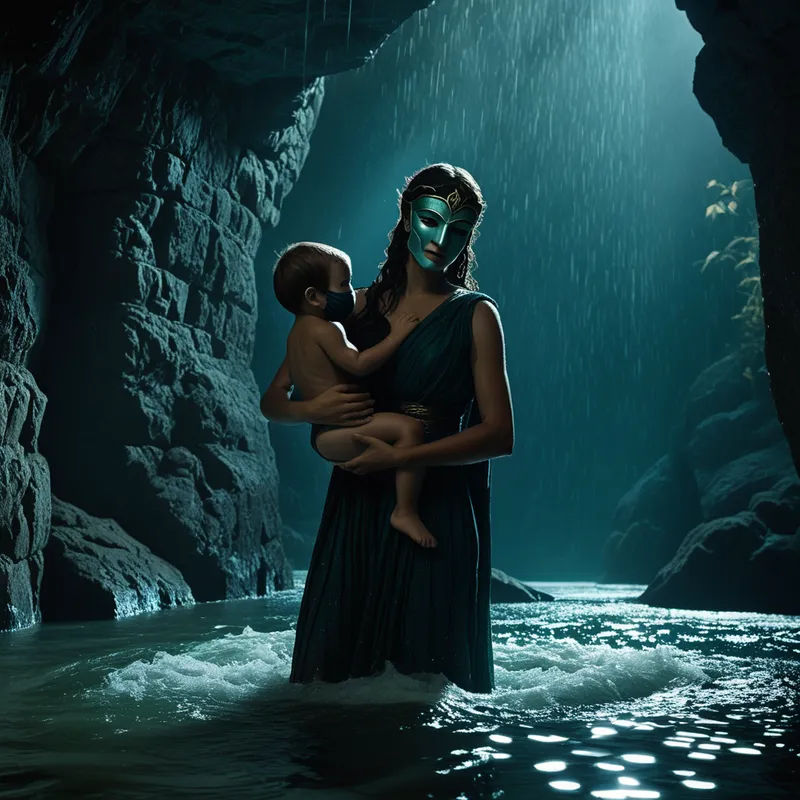
Their wedding was a spectacle for the ages, held on Mount Pelion. All the gods attended, all but one—Eris, whose uninvited golden apple would later set the world aflame. For a moment, it seemed a happy union. But Thetis’s heart remained in the deep, her spirit mourning the immortal match she was denied. When her son was born, she named him Achilles. And knowing the prophecy now had a name and a face, she acted with a mother’s desperate, ruthless love. She journeyed to the underworld, to the banks of the Styx. There, she dipped the infant, holding him by one heel, into the black, sacred waters. His skin became invulnerable, a living armor. But where her fingers gripped, the water did not touch. A tiny patch of mortality remained, a secret flaw written in his flesh.
This was her gift and her curse to him: a short, glorious life instead of a long, obscure one. She sent him, disguised as a girl, to the court of King Lycomedes to hide him from the coming war she foresaw. But the heroes found him. And Thetis, standing on a wave-crest, watched her shining son sail toward Troy, knowing she had armored him for slaughter and sealed his fame with her own endless grief. She, the shapeshifter, could not change this one, fixed point: the death of her child, the price of a destiny greater than any god dared to father.
Cultural Origins & Context
The myth of Thetis is woven from the oldest threads of Greek tradition, appearing in the epic cycles that predate Homer. Her story is integral to the saga of the Trojan War, serving as its divine, sorrowful prologue. As a Nereid, she belongs to a class of deities older and more elemental than the Olympians—spirits of the sea’s particular aspects, revered by coastal communities and sailors. Her tale was likely propagated through oral bardic poetry, the kind that culminated in Homer’s Iliad, where she appears as a poignant, recurring figure: the goddess who intercedes with Zeus on behalf of her doomed son.
Societally, her myth functioned on multiple levels. It explained the divine origins of the great hero Achilles, grounding his superhuman abilities in a cosmic drama. It also reinforced the hierarchical and fearful order of the Olympian pantheon, demonstrating that even the supreme Zeus was subject to the higher, impersonal laws of the Moirai (Fates). Furthermore, Thetis’s forced marriage to a mortal illustrated a recurring theme: the gods managing threats to their power by strategically limiting the potential of other powerful beings, often through unions that diluted divinity. Her story is a cornerstone of the tragic worldview that permeates Greek myth, where glory and grief are two sides of the same coin, forged in the crucible of an inescapable fate.
Symbolic Architecture
At its core, the myth of Thetis is a profound exploration of constrained power and sacrificial love. Thetis symbolizes the potential that is too great to be allowed to flourish—the transformative, creative, or revolutionary force that the established order must neutralize. She is the fluid, adaptive, primal energy (the sea) forced into a rigid, mortal container (marriage to Peleus, human life).
The greatest power is often bound not by chains, but by a responsibility it did not choose.
Her shapeshifting represents the psyche’s attempt to evade a fate that feels like a violation of its essential nature. Each transformation—fire, beast, serpent—is an expression of a different aspect of her wild divinity, a refusal to be defined or captured. Peleus’s stubborn grip symbolizes the relentless pressure of societal decree, prophecy, or “the way things must be,” which eventually forces the dynamic spirit into a static role.
The dipping of Achilles in the Styx is the ultimate alchemical act of a mother. It is the attempt to transmute the beloved’s inherent vulnerability (mortality) into invincibility (glory). Yet, the retained vulnerability—the heel—signifies that total invulnerability is an illusion. The flaw is always part of the gift; the wound is inseparable from the strength. Thetis, in trying to circumvent fate, precisely fulfills it, creating the conditions for her son’s legendary, yet tragically finite, life.
The Dreamer’s Resonance
When the pattern of Thetis surfaces in modern dreams, it often signals a profound psychological process related to fate, sacrifice, and the containment of one’s own power. One might dream of a vast, beautiful force (an ocean, a storm, a radiant light) being trapped, bottled, or married to something mundane and limiting. This can reflect the dreamer’s experience of their own talents, creativity, or transformative energy being stifled by external obligations, fears, or societal expectations—a “forced marriage” to a safe but soul-deadening path.
Dreams of holding a child or a precious, fragile project by a single vulnerable point, while immersing it in something potent and dangerous, speak to the Thetis complex. It is the somatic feeling of the caregiver who must prepare their creation for a harsh world, armoring it as best they can, while knowing a core vulnerability remains. There is immense anxiety, love, and fatalism in this gesture. The dreamer is in the grip of preparing for a destined struggle, trying to confer protection, yet acutely aware that total safety is impossible and that the very act of loving or creating entails inevitable risk and potential loss.
Alchemical Translation
For the modern individual, Thetis’s journey models the painful alchemy of integrating immense potential with the realities of limitation and mortal consequence. The initial stage is the recognition of one’s own “divine” potential—the inner shapeshifter, the fluid, creative, boundless self. The prophecy—the inner knowing that this potential could change everything—often triggers a crisis. The ego, or the internalized “Olympian order” (our internal critic, societal norms, fear of upheaval), moves to neutralize this threat by forcing it into a “safe” container: a conventional career, a limiting self-concept, a relationship that dampens one’s fire.
Individuation requires the marriage of the boundless sea-nymph and the steadfast mortal king within us—the union of infinite potential with grounded, human action.
The alchemical work is not to reject this “marriage” outright, but to consciously endure it, to hold the tension between the limitless self and the limited circumstances. Peleus, the mortal king, represents the necessary principle of form, commitment, and embodiment. The true transmutation begins when, like Thetis, we use our constrained position not for resentment, but for a sacred, focused act of creation—our “Achilles.” This creation, born of both divinity and humanity, is dipped in the waters of our deepest commitments and sacrifices (the Styx). We make it resilient, we give it our all, but we must accept that it will carry a heel—a point of vulnerability, a connection to the mortal world that makes it real, meaningful, and ultimately, subject to the laws of life and death.
The triumph is not in evading fate, but in loving and creating so profoundly within its bounds that the resulting story—though it may end in personal grief—adds something immortal to the tapestry of the world. Thetis’s ultimate individuation is found not in ruling Olympus, but in becoming the eternal, sorrowing, and majestic mother of meaning itself.
Associated Symbols
Explore related symbols from the CaleaDream lexicon: