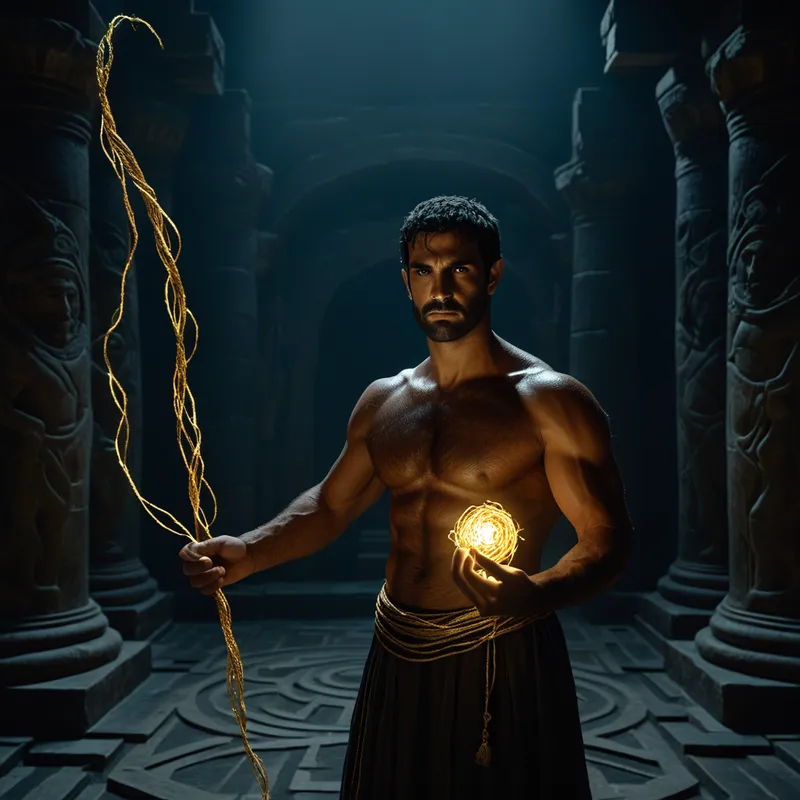
Theseus' Thread Myth Meaning & Symbolism
A hero enters a monstrous labyrinth, guided by a thread of love to slay his inner beast and find his way back to consciousness.
The Tale of Theseus’ Thread
Hear now the tale of [the labyrinth](/myths/the-labyrinth “Myth from Greek culture.”/), a stone-throated beast built by the cunning of Daedalus. Its coils lay beneath the palace of [Minos](/myths/minos “Myth from Greek culture.”/), a king whose pride was as vast as his dominion and whose wrath was born from a broken vow to [the sea](/myths/the-sea “Myth from Greek culture.”/)-god [Poseidon](/myths/poseidon “Myth from Greek culture.”/). From that divine insult sprang the [Minotaur](/myths/minotaur “Myth from Greek culture.”/), a creature of rage and shame, fed on the flesh of Athenian youths and maidens sent as tribute.
Into this world of stone and sorrow sailed a ship with black sails. At its prow stood [Theseus](/myths/theseus “Myth from Greek culture.”/), son of Poseidon or perhaps of a mortal king, his heart ablaze with the fire of a hero’s purpose. He came not as tribute, but as its end. The salt air of Crete was thick with the scent of oleander and despair. In the sun-drenched courtyards, he was seen by a princess whose eyes held the same trapped light as the stars. Ariadne looked upon [the stranger](/myths/the-stranger “Myth from Biblical culture.”/) and saw not just a man, but the key to her own gilded cage.
In the deep silence before dawn, she came to him. Not with a sword, for no mortal blade could promise victory in the endless dark. She brought a skein of thread, simple and strong. Her voice was a whisper against the coming storm. “Fasten this end to the stone of the entrance,” she instructed, her fingers brushing his. “Let it unspool behind you, a lifeline through the forgetting. It will remember [the way](/myths/the-way “Myth from Taoist culture.”/) when your mind cannot.”
The [labyrinth](/myths/labyrinth “Myth from Various culture.”/)’s mouth was a maw of shadow, cold and breathless. [The world](/myths/the-world “Myth from Tarot culture.”/) of sun and sound died at its threshold. Theseus stepped in, the stone swallowing him whole. The only sound was the scuff of his sandals and the soft, persistent hiss of the thread paying out behind him. The path was a madness of turns, identical corridors that doubled back on themselves, a geometry designed to devour hope. The air grew heavy with the smell of damp earth, old blood, and a bestial musk that tightened the chest.
He followed the scent of the beast. Deeper, always deeper, until the darkness itself seemed to pulse. Then, a sound—a wet, grinding breath. A shape detached from the greater shadow, massive and wrong, a monument of fused rage. The battle was not of epic flourishes, but of desperate, close-quarter violence in the absolute dark, the hero’s senses reduced to the roar of the monster, the heat of its breath, and the unwavering, slender presence of the thread connecting his hand to the world.
With a final, guttural cry that echoed through the stone intestines, [the Minotaur](/myths/the-minotaur “Myth from Greek culture.”/) fell. Silence rushed in, more profound than before. But the victory was hollow without escape. In the pitch black, disoriented and adrenaline-sick, Theseus did the only sane [thing](/myths/thing “Myth from Norse culture.”/). He turned, and with a hand that trembled not from fear but from awe, he found the thread. He began to follow it back. The same path that led to the heart of terror now led him out, the thread a patient, infallible guide, pulling him from the belly of the beast, through the maze of confusion, and finally, blessedly, into the blinding, painful, glorious light of day.
Cultural Origins & Context
This core narrative is woven from threads spun by poets like Hesiod and later intricately embroidered by Athenian dramatists and historians, including Sophocles and Plutarch. It is fundamentally an Athenian myth, a foundational story used to articulate and celebrate the city-state’s identity. Theseus, the unifying king, slays the chaotic, monstrous “other” from Crete, a former maritime rival. The myth served a societal function far beyond entertainment; it was a ritual of civic identity.
The tale was likely recounted during festivals like the Panathenaia, reinforcing values of cunning ([metis](/myths/metis “Myth from Greek culture.”/)) over brute force, and the civilized Athenian order over primal chaos. The labyrinth itself may echo the complex, ritualistic dances (the geranos, or “crane dance”) performed in Minoan-influenced ceremonies, symbolizing a ritualized path to a sacred center and back. The story was a cultural map, teaching that the journey into chaos (whether war, a rite of passage, or the unknown) requires not just courage, but a technē—a craft, a clever device—and a connection to something outside oneself to ensure return and reintegration.
Symbolic Architecture
The myth presents a perfect symbolic [architecture](/symbols/architecture “Symbol: Architecture in dreams often signifies structure, stability, and the framing of personal identity or life’s journey.”/) for the [psyche](/myths/psyche “Myth from Greek culture.”/)‘s [journey](/symbols/journey “Symbol: A journey in dreams typically signifies adventure, growth, or a significant life transition.”/) into its own [depths](/symbols/depths “Symbol: Represents the subconscious, hidden emotions, or foundational aspects of the self, often linked to primal fears or profound truths.”/). The [Minotaur](/symbols/minotaur “Symbol: The Minotaur, a creature from Greek mythology, is often interpreted as a symbol of inner turmoil and the struggle between human and beast.”/) is not merely a [monster](/symbols/monster “Symbol: Monsters in dreams often symbolize fears, anxieties, or challenges that feel overwhelming.”/); it is the incarnate [shadow](/symbols/shadow “Symbol: The ‘shadow’ embodies the unconscious, repressed aspects of the self and often represents fears or hidden emotions.”/) of [King](/symbols/king “Symbol: A symbol of ultimate authority, leadership, and societal order, often representing the dreamer’s inner power or external control figures.”/) Minos, the denied and monstrous [offspring](/symbols/offspring “Symbol: Represents legacy, responsibility, and the future self. Often symbolizes creative projects or personal growth.”/) of a broken sacred [oath](/symbols/oath “Symbol: A solemn promise or vow, often invoking a higher power or sacred principle, binding individuals to specific actions or loyalties.”/). It represents the repressed, bestial, and chaotic aspects of [the self](/myths/the-self “Myth from Jungian culture.”/) that are locked away in darkness and fed on our vital energies (the Athenian youths).
The [Labyrinth](/symbols/labyrinth “Symbol: The labyrinth represents a complex journey, symbolizing the intricate path toward self-discovery and understanding one’s life’s direction.”/) is the convoluted [structure](/symbols/structure “Symbol: Structure in dreams often symbolizes stability, organization, and the framework of one’s life, reflecting how one perceives their environment and personal life.”/) of the unconscious mind itself—a place where [logic](/symbols/logic “Symbol: The principle of reasoning and rational thought, often representing order, structure, and intellectual clarity in dreams.”/) fails, time distorts, and [the ego](/myths/the-ego “Myth from Jungian culture.”/) loses its way. It is not a [prison](/symbols/prison “Symbol: Prison in dreams typically represents feelings of restriction, confinement, or a lack of freedom in one’s life or mind.”/) with walls, but a prison of [confusion](/symbols/confusion “Symbol: A state of mental uncertainty or disorientation, often reflecting internal conflict, lack of clarity, or overwhelming choices in waking life.”/).
Ariadne represents the [anima](/symbols/anima “Symbol: The feminine archetype within the male unconscious, representing soul, creativity, and connection to the inner world.”/), the mediating, connective feminine principle within the masculine psyche (and vice versa in other configurations). She is [intuition](/symbols/intuition “Symbol: The immediate, non-rational understanding of truth or insight, often described as a ‘gut feeling’ or inner knowing that bypasses conscious reasoning.”/), love, and the insightful “thread” of [consciousness](/symbols/consciousness “Symbol: Consciousness represents the state of awareness and perception, encompassing thoughts, feelings, and experiences.”/) that can link the heroic ego to a [source](/symbols/source “Symbol: The origin point of something, often representing beginnings, nourishment, or the fundamental cause behind phenomena.”/) beyond itself. Her thread is not a [weapon](/symbols/weapon “Symbol: A weapon in dreams often symbolizes power, aggression, and the need for protection or defense.”/), but a tool of remembrance and [relationship](/symbols/relationship “Symbol: A representation of connections we have with others in our lives, often reflecting our emotional state.”/).
The thread is the symbol of conscious connection in a realm designed to sever it. It is the slender, persistent line of meaning, memory, or love that we pay out behind us as we descend into our own darkness, trusting it will lead us back to who we were, transformed.
Theseus is the heroic ego, the part of the psyche that consciously undertakes the perilous journey of [integration](/symbols/integration “Symbol: The process of unifying disparate parts of the self or experience into a cohesive whole, often representing psychological wholeness or resolution of internal conflict.”/). His victory is not the end; the crucial, often overlooked part of his labor is the return, facilitated solely by the thread. The black-sailed ship of his forgetfulness on the return voyage, leading to Ariadne’s [abandonment](/symbols/abandonment “Symbol: A dream symbol representing feelings of being left behind, isolated, or emotionally deserted, often tied to primal fears of separation and loss of support.”/) and his [father](/symbols/father “Symbol: The father figure in dreams often symbolizes authority, protection, guidance, and the quest for approval or validation.”/)‘s [death](/symbols/death “Symbol: Symbolizes transformation, endings, and new beginnings; often associated with fear of the unknown.”/), is the myth’s poignant reminder that even with the thread, the journey exacts a cost, and integration is never complete.
The Dreamer’s Resonance
When this myth pattern stirs in the modern dreamer, it signals a profound descent into [the personal unconscious](/myths/the-personal-unconscious “Myth from Jungian Psychology culture.”/) is underway. To dream of being in a maze, basement, or endless complex, especially while searching for something or fleeing a looming presence, is to dream the labyrinth. The somatic feeling is one of visceral anxiety, claustrophobia, and heart-pounding urgency—the body knows it is in psychic territory where it is not meant to linger.
The Minotaur in a dream may not appear as a literal bull-man. It may be a threatening figure, an overwhelming emotion (like rage or shame), a forgotten trauma, or even a powerful, rejected aspect of one’s own talent or desire that has turned monstrous through neglect. The dream-ego’s task is not necessarily to “slay” it, but to confront it—to acknowledge its existence in the personal labyrinth.
The appearance of a thread, a string of light, a voice from outside, or a guiding figure in such a dream is the manifestation of Ariadne’s gift. It represents an emerging capacity for self-reflection, a therapeutic insight, a grounding memory, or a supportive relationship that provides orientation. The dream is modeling the psyche’s own attempt to create a lifeline, showing the dreamer that even in the deepest confusion, a part of the mind holds the way back to coherence.

Alchemical Translation
In the alchemical vessel of individuation, the myth of the thread maps the process of [nigredo](/myths/nigredo “Myth from Alchemical culture.”/)—the descent into the blackness, the confrontation with the [prima materia](/myths/prima-materia “Myth from Alchemical culture.”/) of [the shadow](/myths/the-shadow “Myth from Jungian culture.”/)—and the subsequent albedo, the washing clean and reintegration.
The conscious ego (Theseus) must voluntarily enter the vas or vessel (the labyrinth) of the unconscious. This is an act of immense courage, often precipitated by a crisis. There, it encounters the shadow (the Minotaur), the unintegrated, animalistic content that holds both destructive power and locked-away vitality. To “slay” it is not to destroy it, but to break its compulsive, autonomous hold, to bring its energy under the dominion of consciousness.
The alchemical gold is not found in the monster’s death, but in the hero’s successful return, guided by the thread. The treasure is the transformed self who has been to the center and back, now carrying a map of the interior.
Ariadne’s thread is the filum Ariadis of the alchemists—the guiding principle, the continuous, patient application of conscious attention (the theoria) throughout the chaotic work. It is the observing ego that does not get fully identified with the turmoil. It is the analytic hour, the journal entry, the mindful breath, the symbol that retains its meaning. It ensures the solve (the dissolution into the unconscious) is followed by the coagula (the re-coagulation into a renewed conscious stance).
For the modern individual, the myth instructs that healing and wholeness are not achieved by avoiding our personal labyrinths, but by entering them with a prepared thread. Our “thread” may be a commitment to truth, a creative practice, a spiritual discipline, or the container of a trusting relationship. It is what allows us to confront our inner Minotaurs—our addictions, depressions, rages, or fears—not to be lost forever in their domain, but to reclaim their energy and find our way back, wiser and more complete, to the daylight world of our lives.
Associated Symbols
Explore related symbols from the CaleaDream lexicon: