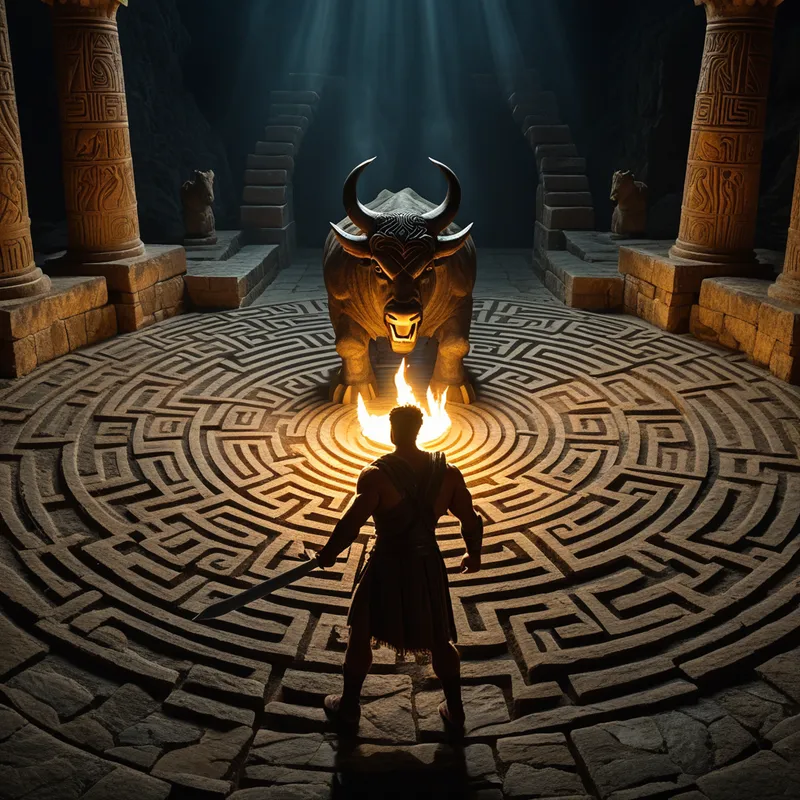
Theseus in the Labyrinth Myth Meaning & Symbolism
A hero enters a maze to slay a beast, guided by a thread. It is a timeless map for navigating the unconscious and confronting the monstrous self.
The Tale of Theseus in the Labyrinth
Hear now the tale of the labyrinth, a story of stone and shadow, of a debt paid in blood and a thread spun from love. In the age when gods walked close to men, the great king Minos of Crete ruled the waves. His pride was a palace of wonders, and his shame was a monster. For his queen, Pasiphaë, cursed by Poseidon, had borne a child of unnatural desire: the Minotaur, Asterion, a creature with the body of a man and the head of a bull, whose breath was rage and whose hunger knew no satiation.
To hide his disgrace, Minos commanded the genius Daedalus to build a prison from which none could escape. And so Daedalus, with hands that understood the secrets of stone and space, fashioned the Labyrinth. It was not merely a maze but a living puzzle, a twisting, turning brain of corridors where left became right, up became down, and memory itself was swallowed by the endless, echoing dark. Here, in its stony heart, the Minotaur roamed, fed on a terrible tribute.
For Minos’s son had been killed in Athens, and his wrath demanded a price. Every nine years, seven Athenian youths and seven maidens were forced onto a black-sailed ship, sent across the wine-dark sea to be cast into the Labyrinth as prey for the beast. The very walls of Athens wept with the sound of the choosing.
Then came a prince with sand in his hair and the fire of two fathers in his veins: Theseus, son of Aegeus. He would be no bystander to his city’s sorrow. He volunteered to be among the fourteen, swearing to his father that if he succeeded, he would return with white sails, a signal of life against the mourning black.
The ship arrived in Crete, a cage of sorrow on the water. In the court of Minos, the king’s daughter, Ariadne, saw Theseus. In his eyes, she saw not just a victim, but a will that could defy the dark. Love, or perhaps a deeper compassion for an end to the cycle of blood, moved her. In secret, she sought out Daedalus, the maze’s maker, and learned its one weakness: you could not think your way out, but you could remember your way back.
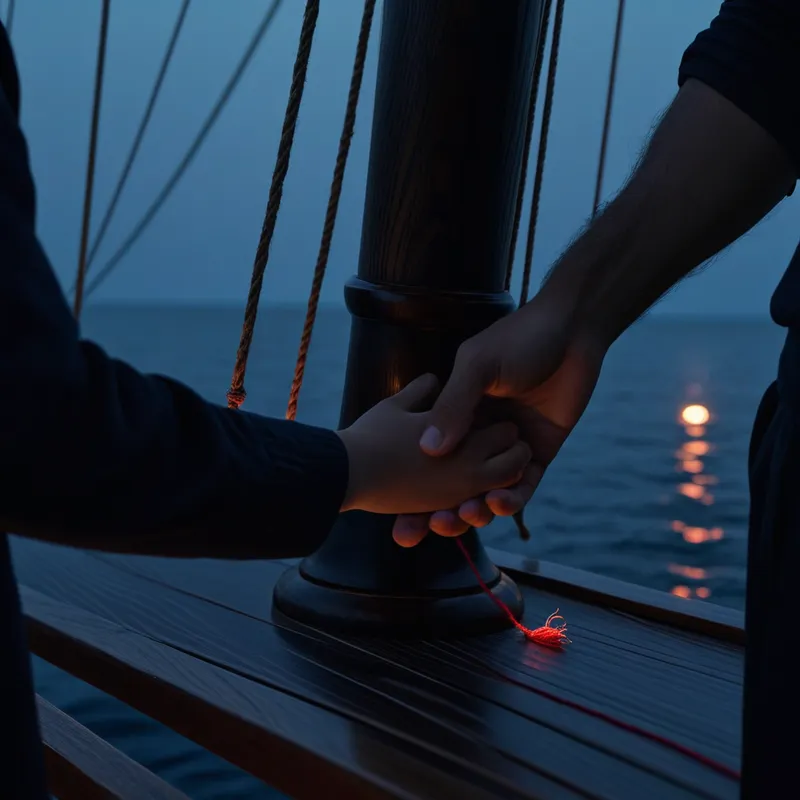
She came to Theseus in the dead of night. Into his hands she pressed a simple wooden spindle, around which was wound a long, strong thread. “Tie this to the stone at the entrance,” she whispered, her voice a thread of hope itself. “Unwind it as you go. It will be your memory. It will be your way back to the light.”
The great bronze doors groaned open. Theseus stepped into the throat of the Labyrinth. The air was cold, thick with the smell of damp stone and something older, something animal. The light from his torch danced on walls that leaned in, corridors that doubled back on themselves in impossible geometry. He could hear, in the distance, a heavy snorting, the scrape of a hoof on stone. He tied the thread, and began his descent, the red line spooling out behind him like a vein connecting him to the world of the living.
Deeper he went, the roars growing louder, shaking dust from the ceiling. And then, in a vast, dark chamber, he found it. The Minotaur was not just a beast; it was a tragedy made flesh, a hulking monument to divine punishment and human shame, its eyes burning with a pain it could not understand. There was no parley, only the primal clash. Man and monster fought in the absolute dark, illuminated only in flashes by the fallen torch. It was a battle of sinew and will, until finally, with a cry that echoed through the stone intestines of the maze, Theseus drove his blade home.
Silence fell, deeper than before. Then, gripping the blood-slick thread, Theseus began the journey back, following the lifeline Ariadne had given him. He retraced his steps through the winding darkness, the thread pulling him not just toward the exit, but toward his own humanity, which he had not lost in the beast’s lair. He emerged, blinking, into the blinding sun of Crete, a conqueror, a killer, a man reborn from the underworld of the self.
He took Ariadne and the weeping Athenian youths and maidens, and they fled for the ship. But the story’s thread was not yet fully wound. In his triumph, or his haste, Theseus forgot his promise. The black sails of mourning remained hoisted. From the cliffs of Athens, old King Aegeus saw the dark shape on the horizon and, believing his son dead, cast himself into the sea that bears his name to this day. The hero returned to a kingdom crowned with a personal tragedy, the final cost of his labyrinthine journey.
Cultural Origins & Context
This myth is a foundational narrative of Athenian identity, emerging from the rich oral traditions of the Bronze Age and Archaic Greece. It was crystallized in the works of later poets and playwrights like Bacchylides and Sophocles, and recounted by historians such as Plutarch. The story functioned on multiple cultural levels. For Athens, it symbolized their political and moral triumph over the earlier, more powerful Minoan civilization (represented by Crete), transforming a history of subjugation into a legend of heroic resistance. The myth also served as an aetiology for the theoria, the sacred embassy of Athenian youths sent to Delos, which was connected to Theseus’s voyage.
On a societal level, it was a coming-of-age parable for the Athenian citizen-soldier: the young man must leave home, confront a monstrous “other,” and return to assume his role in the polis. The telling of this tale around fires and in symposia was not mere entertainment; it was a transmission of civic values—courage, cunning, filial duty, and the tragic consequences of forgetfulness.
Symbolic Architecture
The Labyrinth is the master symbol. It is not a prison one is placed into, but the convoluted structure of the unconscious psyche itself. We all carry a labyrinth within—a tangle of repressed memories, inherited traumas, instinctual drives, and shadow aspects we dare not face in the light of day.
The Minotaur is not a foreign monster, but the native inhabitant of our deepest self. It is the embodied shadow, the unacceptable hybrid of our animal nature and our conscious identity, raging in the dark because it has been denied and fed on sacrifices.
Theseus represents the conscious ego, the part of the self that must voluntarily descend into this inner chaos with a purpose. His sword is the discriminating power of consciousness, the ability to make decisive cuts, to differentiate self from not-self. But the sword alone is useless in the maze. The critical element is Ariadne’s thread.
The thread is the symbol of relatedness and connection. It is the sustaining link to the outer world (Ariadne, love, compassion), to logic (Daedalus’s intellect), and to consciousness itself. It represents the thin, continuous line of awareness we must maintain when navigating our own depths. Without it, the hero is lost forever, consumed by the very chaos he sought to conquer. The victory is not just in the slaying, but in the return.
The Dreamer’s Resonance
When this myth pattern arises in modern dreams, the dreamer is navigating a profound process of psychological disorientation and re-orientation. Dreaming of being lost in a maze or complex building signals a confrontation with a life situation or an internal state that feels impossibly complex, with no clear entry or exit. The somatic feeling is often one of anxiety, claustrophobia, and a racing heart—the body’s echo of the psyche’s frantic search for a path.
If the Minotaur appears, it often manifests not as a literal bull-man, but as a terrifying, overwhelming presence—a looming figure, a monstrous animal, or even an engulfing wave of emotion like rage or shame. This is the dream-ego encountering a concentrated form of the personal shadow, a bundle of energy and identity that has been walled off and has grown powerful in its isolation. The dream is the psyche’s imperative to stop sacrificing parts of oneself (the seven youths and maidens) to this inner monster and to instead send the conscious self (Theseus) in to face it.
Finding or holding a thread, a string, or a wire in such a dream is a profoundly hopeful sign. It indicates the nascent emergence of a guiding principle—perhaps a new insight, a therapeutic connection, a creative idea, or a commitment to self-compassion—that can lead the dreamer back to integration.

Alchemical Translation
The myth of Theseus is a perfect allegory for the Jungian process of individuation, the psychic alchemy of transforming base, unconscious material into the gold of a realized self. The journey is one of nigredo, the blackening: the voluntary descent into the dark, chaotic labyrinth of the unconscious (the shadow realm).
The confrontation with the Minotaur is the crucial stage of separatio and coniunctio. One must separate from the identification with the monster (the unintegrated shadow) through a decisive act of consciousness (the sword), yet this slaying is also a paradoxical union. By facing and “defeating” the shadow, one does not destroy it, but assimilates its power. The brute strength, the primal instinct of the Minotaur is reclaimed by the hero. This is the albedo, the whitening, the illumination that follows the dark night.
The thread is the filum Ariadnes, the guiding principle of the Self, the transcendent function that mediates between the opposites of conscious and unconscious, ensuring the process leads to wholeness, not psychosis.
The final stage, however, is often overlooked: the return and its consequence. Theseus emerges transformed, but his forgetfulness—the black sails—causes the death of his father, the old king. In alchemical terms, this signifies that the transformation of the self inevitably alters, and sometimes severs, one’s old relationships and identity structures (the “old king”). The new, integrated self cannot fully return to the shore it left; it must found a new order. The journey through the personal labyrinth is, therefore, not a neat hero’s tale with a clean happy ending, but a costly, transformative ordeal that forever changes the map of one’s world. One slays the monster of the past only to sail home under the shadow of a necessary, transformative loss, ready to rule a new, more conscious inner kingdom.
Associated Symbols
Explore related symbols from the CaleaDream lexicon: