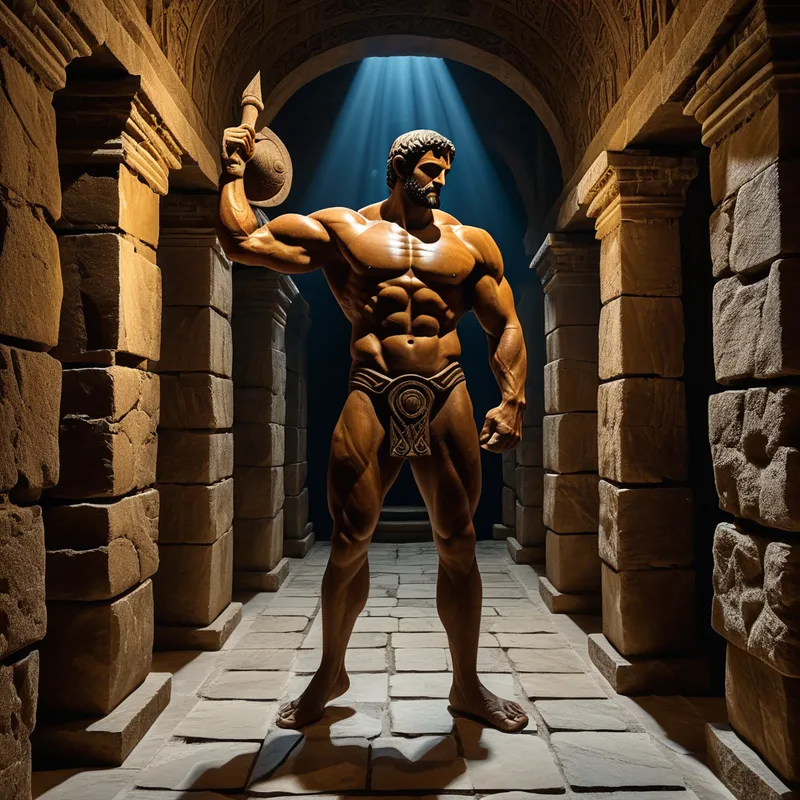
Theseus Myth Meaning & Symbolism
A hero, born of dual heritage, claims his destiny by slaying monsters, navigating a deadly labyrinth, and confronting the shadows of his own lineage.
The Tale of Theseus
Hear now the tale of the son of two fathers, a child born of the sea’s embrace and a king’s secret shame. In the land of Attica, a princess named Aethra walked by moonlight to the shore. There, the god Poseidon and the mortal king Aegeus both claimed her, and from that union a boy was conceived. His name was Theseus.
The boy grew strong beneath the rock where his father had hidden a sword and sandals. When his strength matched his destiny, he lifted the stone, claimed the tokens, and set out on the perilous road to Athens. The coastal path was a gauntlet of monstrous cruelty. At the Pine-Bender, he met the giant who tore travelers apart with bent trees, and gave him a taste of his own savage justice. At the cliffs of Sciron, he sent the wicked one to be devoured by the very tortoise he had fed. He cleansed the road, monster by monster, his journey a forging of his heroic nature.
He arrived in Athens unknown, a stranger in his father’s hall. The sorceress-queen Medea, sensing a threat, persuaded King Aegeus to poison the youth. But as the cup touched Theseus’s lips, the sun caught the ivory hilt of his sword. Aegeus saw his own token, dashed the poison, and embraced his son with tears of joy and terror. For Athens was in the shadow of a great grief. Every nine years, seven youths and seven maidens were sent across the wine-dark sea to Crete, tribute to the insatiable Minotaur.
Theseus volunteered to be among them. “I will go,” he said, “and I will end this.” In Crete, in the palace of the labyrinth-builder Minos, the king’s daughter Ariadne saw the Athenian prince and her heart was ensnared. She came to him in secret, offering a sword and a clew of thread. “Tie this to the door,” she whispered, “and let it unwind behind you. It will be your guide back from the darkness.”
Into the Labyrinth he went, the stone swallowing him whole. The air was thick with the smell of damp earth, old blood, and beast. He followed the thread into the heart of the maze, where the sound of heavy breath and the scrape of horn on stone echoed. In the absolute dark, the Minotaur charged. It was not a battle of light, but of touch and sound and desperate strength. Theseus found the monster’s neck, and with the gift of Ariadne, he drove the blade home.
Silence. Then, hand on the blood-warm thread, he retraced his steps, leading the weeping Athenian children back to the world of sun and salt air. They fled Crete with Ariadne, but fate is a fickle wind. On the isle of Naxos, she was left sleeping, and the god Dionysus claimed her for his own. Grief-stricken and weary, Theseus sailed for home, forgetting the signal promised to his father—to change the ship’s black sail of mourning to a white one of victory.
From the cliffs of the Acropolis, old Aegeus saw the black sail on the horizon. Believing his son dead, he cast himself into the sea that bears his name to this day. Theseus returned a hero and a king, his triumph forever stained with the salt of his father’s tears.
Cultural Origins & Context
The myth of Theseus is a foundational narrative for Athens, a city-state that saw itself as the civilizing heart of Hellas. Unlike the older, god-drenched tales of Achilles or Odysseus, Theseus is a distinctly political hero. His stories were compiled and popularized in the 5th century BCE, Athens’s golden age, by poets and playwrights like Euripides and in the works of historians. He was the mythic prototype of the ideal Athenian citizen-king: brave, clever, a unifier and lawgiver who subdued the wild, bandit-ridden countryside and consolidated the scattered villages of Attica into a single political entity under Athens—a process known as synoikismos.
The myth served multiple societal functions. It explained Athenian hegemony and its rivalry with the maritime power of Crete. It provided an origin story for Athenian festivals like the Panathenaia. Most importantly, it was a story of initiation for young Athenian males. Theseus’s journey from Troezen to Athens, his confrontations on the road, his descent into the Labyrinth, and his ascension to kingship mapped the path from adolescence to responsible manhood and citizenship. The tale was not frozen in epic verse but was a living, evolving narrative, adapted to reflect the city’s current ideals and anxieties.
Symbolic Architecture
At its core, the myth of Theseus is a profound drama of identity and integration. He is the hero who must consciously forge his own lineage from the dual strands of his heritage: the divine, unpredictable power of Poseidon (the unconscious, chaotic depths) and the mortal, political legacy of Aegeus (the conscious, social order).
The Labyrinth is not a prison built to contain a monster, but a psychic structure built to contain the Self. One must get lost within it to find what lies at the center.
The monsters on the road—Sinis, Sciron, Procrustes—represent the fragmented, brutal, and unconscious aspects of the world (and the psyche) that must be confronted and mastered on the path to maturity. They are the “old ways” of brute force and cruelty that the hero, as a representative of a new order, must overcome.
The Minotaur, born of a queen’s transgression and a king’s hubris, is the ultimate shadow. It is the bestial, untamed, and shameful progeny of the unconscious. It is not merely an external foe but the hidden, monstrous result of unintegrated desires and familial secrets. To slay it is not an act of simple violence, but of painful self-recognition and the courage to face what one’s own “house” has produced.
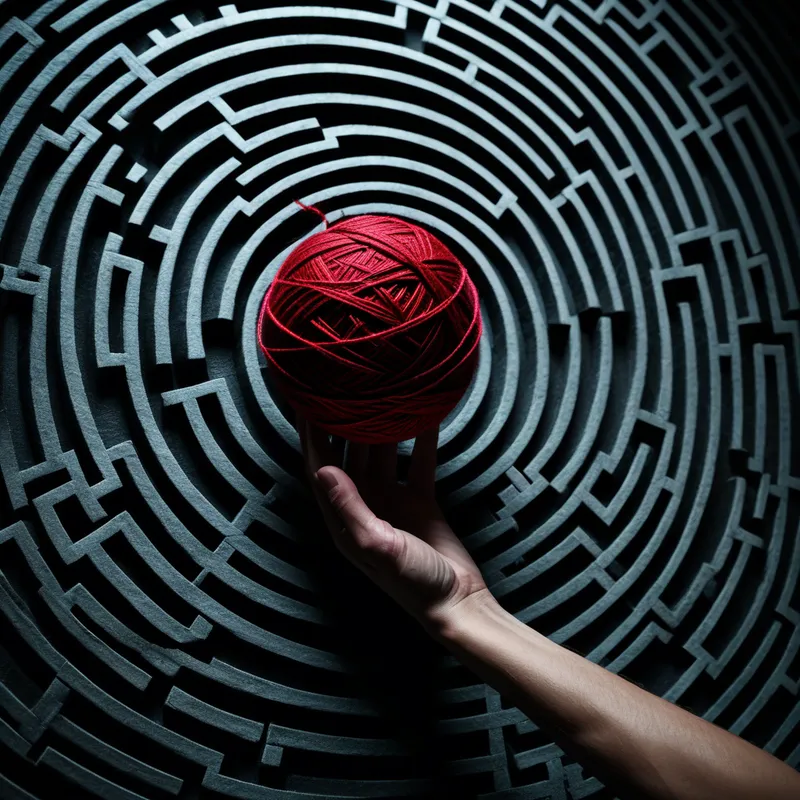
Ariadne’s thread is the symbol of relatedness and the guiding principle of consciousness—be it love, intuition, or a plan. It represents the fragile but essential connection to the outer world that allows one to venture into the inner chaos and return, transformed but not annihilated.
The Dreamer’s Resonance
When the pattern of Theseus stirs in the modern dreamer, it signals a profound initiation into the complexities of selfhood. To dream of walking a lonely, dangerous road suggests the somatic feeling of stepping into one’s own authority, often accompanied by anxiety in the gut and a heightened alertness. The body prepares for ordeal.
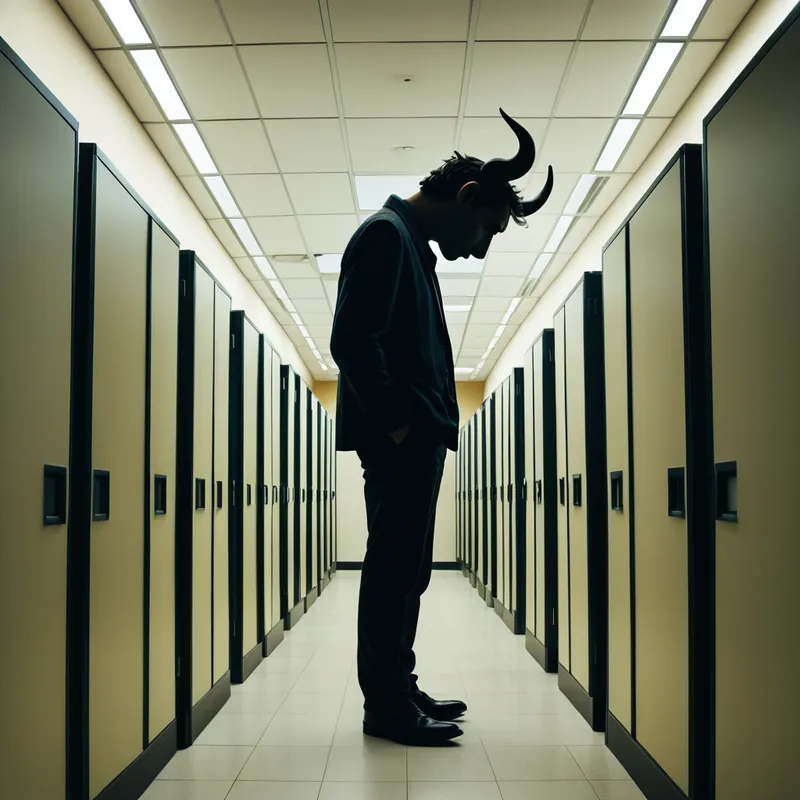
Dreams of labyrinths—endless hallways, shifting office complexes, or tangled forests—are somatic maps of a psychic process. The feeling of being lost, of walls closing in, mirrors the psychological state of confronting a problem or a part of the self that seems inescapable and confusing. The Minotaur in today’s dreams rarely appears as a literal bull-man. It may be a terrifying figure that is somehow familiar, a overwhelming rage or desire, or a looming, irrational fear that blocks the center of one’s mental maze. The dream is the psyche’s way of constructing the Labyrinth, presenting the thread (often a helpful figure, a voice, or a sudden insight), and demanding the confrontation.
Forgetting to change the black sails to white is a classic dream motif of tragic oversight—the exam you didn’t study for, the speech you’re not prepared to give. Psychologically, it speaks to the unavoidable shadow of our triumphs; every conscious achievement can be tinged with an unconscious cost, often related to the “father” or the internalized authority we seek to please or surpass.
Alchemical Translation
The Theseus myth is a precise alchemical manual for individuation. The journey begins with the nigredo, the blackening: lifting the heavy stone of one’s obscured origins (the sword and sandals of true identity) and setting out on the perilous road. This is the stage of confronting the personal shadow—the Procrustean beds we force ourselves into, the “pines” that threaten to tear us apart.
The hero is not the one who never feels fear in the labyrinth, but the one who trusts the thread of consciousness enough to walk into the fear.
The descent into the Labyrinth is the solutio and coagulatio—dissolution into the chaotic waters of the unconscious and the subsequent coagulation of a new form. Here, in the dark, the prima materia of the psyche—the monstrous, hybrid Minotaur (the unintegrated animal nature and divine aspiration)—is encountered and “slain.” This slaying is better understood as a sacred integration. The beast is not ejected but transformed through conscious engagement; its raw power is assimilated into the hero’s strength.
Ariadne’s thread is the filum Arietis, the “thread of the Ram,” a guiding spirit or the transcendent function that connects conscious intention to unconscious process. Abandoning Ariadne represents the painful but necessary sacrifice of the purely personal, romantic, or dependent solution for a more complex, divine order (her union with Dionysus).
The final stage is the return, the rubedo or reddening: the achievement of kingship, of a unified Self. Yet the alchemy is never pure. The black sail, the forgotten promise, and the father’s death ensure the gold of the achievement is alloyed with grief. This is the ultimate teaching: individuation is not about achieving perfection, but about achieving a responsible, authentic Self, fully conscious of its origins, its actions, and their inevitable, mortal cost. One becomes sovereign, but the sea of the unconscious, named for the father, forever laps at the shores of the kingdom.
Associated Symbols
Explore related symbols from the CaleaDream lexicon:
- Teenager
- Major
- Graduation
- Midst
- Issue
- Director
- Hockey
- Pick
- Plot
- Teen
- Kilt
- Clipped Nails
- Exploring Dark Corners
- Balancing on a Tightrope
- Wrestling Shadows
- Labyrinth of Ideas
- Minotaur
- Gilded Crown
- Vanishing Highway
- Unmarked Path
- Torn Map
- Beryl Compass
- Tellurium Trail
- Minotaur Labyrinth
- Map of Dreams
- Epic Quest Map
- Minotaur’s Labyrinth
- Training Cone
- Boxing Ring
- Jigsaw Puzzle
- Action Figure
- Alexander the Great’s Map
- Scotsman Kilt
- Lincoln’s Emancipation Proclamation
- Fragmented Story
- Literary Labyrinth
- Metal Detector
- Steak Knife
- Candlelit Basement
- Gloomy Dungeon
- Secluded Alleyway
- Sidewalk Cracks
- City Map Kiosk
- Deserted Catacombs
- Reveal of Hidden Chambers
- Fragments of Mosaic Tiles
- Lantern-lit Pathway
- Unfinished Puzzle
- Tattered Map
- Labyrinth Path
- Thicket of Thorns
- Muddy Footprints
- Fossilized Footprint
- Weathered Journey Map
- Footprints in the Sand
- Number 21
- Ordered Labyrinth
- Soul’s Calling
- Citizenship
- Extradition
- Debug
- Puzzle
- Tunneling