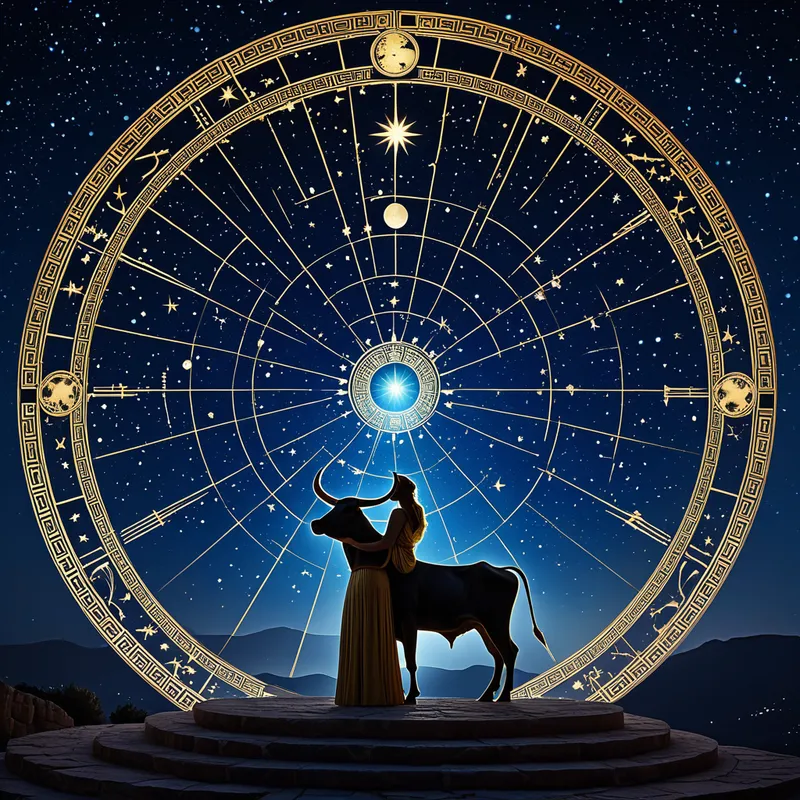
The Zodiac Myth Meaning & Symbolism
A cosmic story where the gods immortalize a mortal girl and her rescuer among the stars, creating a celestial wheel to guide and remember.
The Tale of The Zodiac
Listen, and let your mind wander to a time when the sky was a dark, blank cloak, and the stories of the world were yet unwritten in light. The great Zeus, whose heart was as vast and turbulent as the heavens he commanded, looked down upon the green earth. There, by the sun-dappled shores of Phoenicia, he saw her: Europa, daughter of a king, laughing with her companions as she gathered sea-hyacinths, her form more graceful than any goddess’s dance.
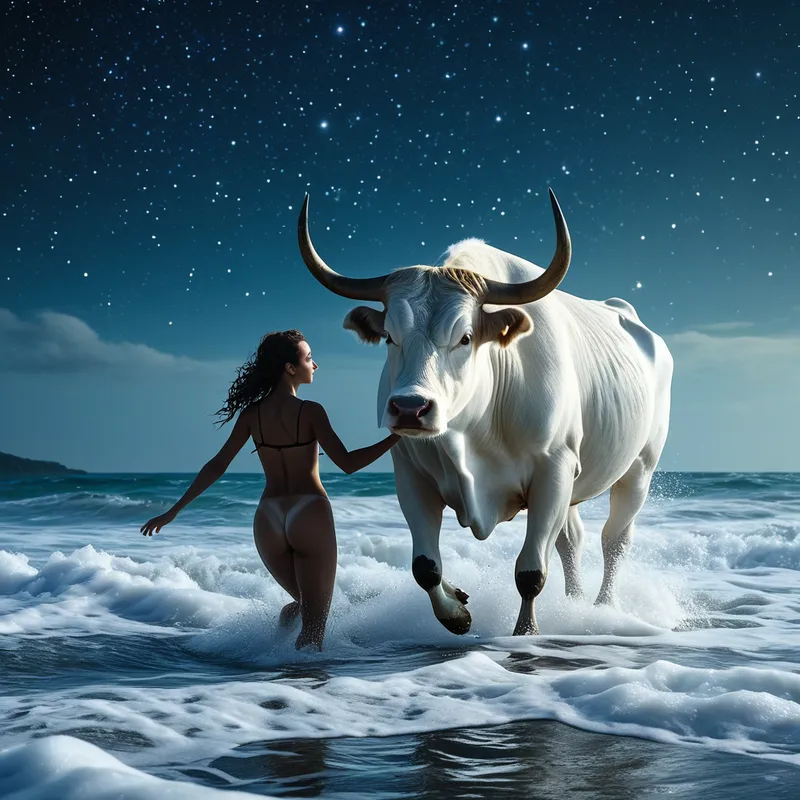
A fire, not of thunder but of longing, ignited in the god’s breast. Yet he knew the terror his true form would bring. So, weaving deception from desire, he transformed. His immense power condensed into a form of stunning beauty: a bull, but unlike any that plowed the earth. His coat was the white of sun-bleached marble, his horns curved like a crescent moon dipped in pearl, and his eyes held the deep, gentle intelligence of the ages. He ambled from the myrtle grove, his breath sweet with the scent of meadow saffron.
The maidens gasped, not in fear, but in wonder. This creature was peace incarnate. He knelt before Europa. Drawn by a fate she could not name, she wove garlands for his noble neck, and finally, daringly, she climbed upon his broad, warm back. The moment she settled, the bull surged forward—not toward the pasture, but into the wine-dark sea. Europa cried out, clutching his neck, as the foam parted before them and the shore receded into a memory. For days and nights, they traveled, the bull swimming with divine strength, a steadfast island in the roaring waves, carrying his precious cargo across the boundless deep.
He brought her to a new land, Crete, and there, beneath an ancient plane tree, he revealed his true form. From the bull emerged Zeus, radiant and mighty. In that sacred grove, their union forged a lineage of kings. But what of the bull? His service was done, his form a discarded shell. He might have faded into the forgotten tales of a single seaside village.
But the Queen of Heaven, Hera, whose eyes missed little, saw it all. Her wrath was not hot, but cold—a glacial bitterness at her husband’s endless infidelities. Yet her vengeance was not aimed at the innocent girl, now a queen in her own right. It was aimed at the instrument. She would punish the beautiful form that had facilitated the betrayal. With a word, she sent a madness upon the white bull, driving him rampaging across the continent, a creature of terror where once was gentleness.
His salvation came from an unexpected quarter: Heracles, on his seventh labor, was tasked with capturing this very Cretan Bull. In a titanic struggle of strength against cursed strength, Heracles subdued him. But even the hero’s might could not calm the divine madness. The bull was set loose again, a plague upon the lands of Attica, until another hero, Theseus, finally offered him release in sacrifice.
And here, in the aftermath, Zeus acted not as a lover, but as a sovereign. Looking upon the noble beast who had borne his love and borne his wife’s wrath, he felt a pang of something akin to gratitude. He would not let this story end in dust and oblivion. Reaching into the vault of night, he gathered the brightest, most steadfast sparks of light. With a god’s gesture, he arranged them, tracing the powerful shoulders, the sweeping horns, the sturdy flanks of the magnificent white bull. And so, the Taurus was fixed forever in the celestial sphere.
But the story was not complete. A constellation for the beast, but what of the maiden? Could her memory be left to fade? No. Beside the Bull, Zeus set another pattern of stars: the Virgo, holding a sheaf of wheat, an eternal queen of the harvest sky. And around them, he and the other gods placed the other great figures of story and deed—the twins, the lion, the scorpion, the archer—until a great wheel of twelve luminous signs encircled the earth. It was a promise, a map, and a tombstone all in one: a promise that great stories are remembered, a map for sailors and shepherds, and a monument to love, jealousy, sacrifice, and the eternal, turning dance of fate.
Cultural Origins & Context
The Greek zodiac, as a coherent system of twelve equal signs, was not born fully formed from Homeric verse. It was a brilliant synthesis, a cultural alchemy. The Greeks inherited star-lore and constellation patterns from the sophisticated celestial observers of Babylon. But where the Babylonians saw omens for kings and empires in the “pathway of the moon,” the Greeks saw a stage for their pantheon.
Hellenistic poets and astronomers, like Aratus, wove these imported star-patterns into the rich tapestry of existing Greek myth. The crab became the Cancer that pinched Heracles; the scorpion, the Scorpio of eternal rivalry. The zodiac became a celestial catalogue raisonné of their mythology. It was passed down not just by priests, but by sailors using it for navigation, farmers using it to mark the seasons (the “zodiac” means “circle of little animals”), and philosophers like Ptolemy who systematized it, seeking a rational order in the divine. Its function was multifaceted: a practical calendar, a theological assertion of cosmic order (cosmos itself means “order” or “adornment”), and a profound narrative tool that placed human stories—of love, labor, and conflict—into the very fabric of the universe.
Symbolic Architecture
At its core, the myth of the zodiac’s establishment is a story about pattern-making in the face of chaos and transience. The raw materials are chaos (the formless night sky), passion (Zeus’s desire), betrayal (Hera’s wrath), and violence (the bull’s madness and death). The divine resolution is not to undo these events, but to re-contextualize them into an eternal, meaningful structure.
The stars are the gods’ handwriting; the zodiac is the sentence they formed from the scattered words of human suffering and joy.
The Bull (Taurus) and the Maiden (Virgo) represent a fundamental duality frozen in celestial amber: the instinctual, powerful, and possessive drive (the bull) and the innocent, fertile, and cultivated principle (the maiden). Their separation in the sky, yet proximity in the seasonal cycle, speaks of a union that is eternally potential, eternally remembered, but never again physically consummated. The wheel of the twelve signs that surrounds them symbolizes the complete cycle of experience—the full spectrum of archetypal energies (the hero, the twins, the scales of justice) that must be engaged with as life progresses. It transforms linear, tragic narrative into a cyclical, symbolic map.
The Dreamer’s Resonance
To dream of the zodiac wheel, especially in a personal or transformative context, is to dream of the Self seeking order. When this pattern emerges from the deep unconscious, it often signifies a period where the dreamer’s life feels fragmented—a series of disjointed events (passions, failures, labors) without a unifying narrative. The somatic sensation can be one of vertigo or spinning, reflecting the wheel’s motion.
A dream of a specific zodiac sign, particularly one not related to the dreamer’s solar birth sign, may indicate that the archetypal energy of that sign is demanding integration. Dreaming of the Taurus bull might call one to connect with the body, resilience, or stubborn persistence. Dreaming of the Virgo maiden could point to a need for discernment, service, or integrating a sense of personal purity and analysis. The dream is the psyche’s attempt to do what Zeus did: take the raw, often chaotic events of the personal unconscious and begin to constellate them, to see them as part of a larger, purposeful pattern within one’s own life.
Alchemical Translation
The alchemical process mirrored here is coagulatio—the making solid, the fixing of the volatile. In psychological terms, this is the stage of individuation where insights and experiences from the unconscious are stabilized into a lasting structure of the personality. The “prima materia” is the leaden confusion of one’s personal history—our own Europa moments of abduction by fate, our Hera-like moments of bitter resentment, our Heraclean labors.
Individuation is the ego learning to become the astronomer of its own soul, charting the fixed points in its personal night sky.
The modern individual undergoes this transmutation by becoming the mythographer of their own life. It involves looking back at the pivotal, often painful or passionate turning points—the “bulls” that carried us away, the “madnesses” we had to overcome—and not erasing them, but constellating them. We find the symbolic meaning in our trials. What does that failed relationship represent in our inner pantheon? What does that period of relentless work correspond to in our heroic journey? By consciously engaging in this symbolic interpretation, we perform the Zeus-like act. We take the scattered, luminous fragments of our experience and arrange them into a coherent, rotating mandala of the Self—a personal zodiac that provides orientation, meaning, and the profound understanding that our story, in all its light and shadow, is part of a beautiful, eternal design.
Associated Symbols
Explore related symbols from the CaleaDream lexicon: