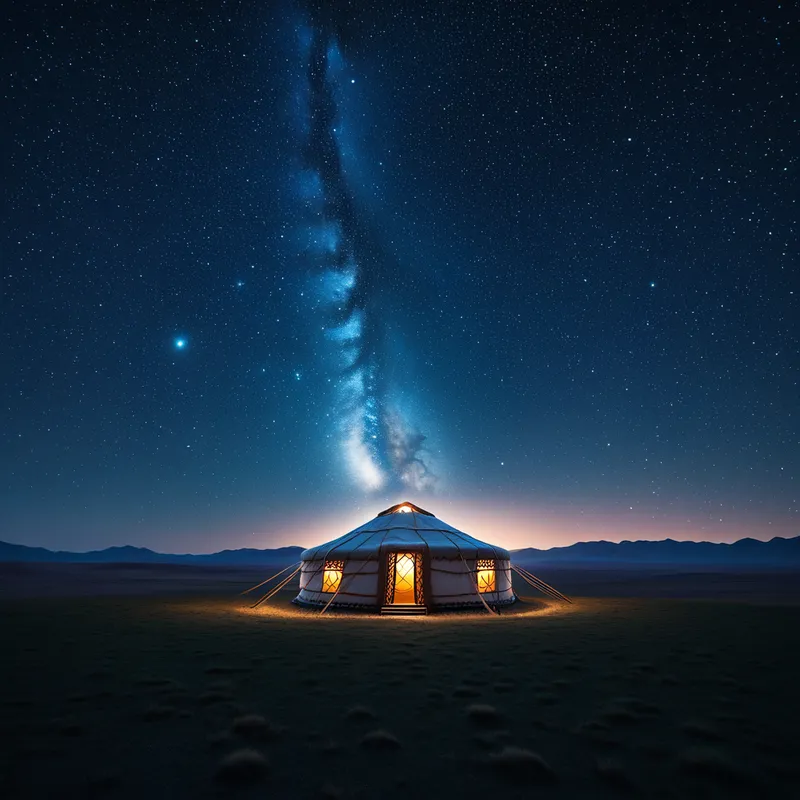
The Yurt Myth Meaning & Symbolism
A myth of how the first shelter was woven from the breath of the sky and the bones of the earth, teaching the art of carrying home within.
The Tale of The Yurt
Listen. Listen to [the wind](/myths/the-wind “Myth from Various culture.”/) that has no home, and you will hear the beginning.
In the time before time, when the Tengri was a raw, open wound of blue and the Etugen was a formless, sleeping giant, the people were naked to [the world](/myths/the-world “Myth from Tarot culture.”/). They were children of the great hunt, footprints on the grass, shadows that the sun erased by day and the cold moon stole by night. They had no place. The wind scoured their spirits; the rain dissolved their hopes. They were scattered, like seeds from a broken pod.
Then came Ulagan, whose eyes were two different colors: one the brown of [the earth](/myths/the-earth “Myth from Hindu culture.”/), one the grey of the storm. He walked until his feet bled, seeking an answer in the whisper of the grass and the groan of the mountain. He climbed the Sumeru, the spine of the world, and at its peak, he did not pray. He waited. He became so still that lichen grew on his skin.
For three days and three nights, the spirits tested him. The Wind Horse tried to blow him into [the abyss](/myths/the-abyss “Myth from Kabbalistic culture.”/). The Ice Mother tried to freeze his heart. But Ulagan was empty, a vessel waiting to be filled. On the fourth dawn, as the sun pierced [the veil](/myths/the-veil “Myth from Various culture.”/), he saw a vision not with his eyes, but in the space between his ribs. He saw the skeleton of a great bird fallen from Tengri, its ribs forming a perfect circle. He saw the hide of the sacred white mare, Kökö Bayan, stretched and softening in the rain. He saw [the crown](/myths/the-crown “Myth from Various culture.”/) of a tree, its branches reaching up and weaving together into a single, open eye.
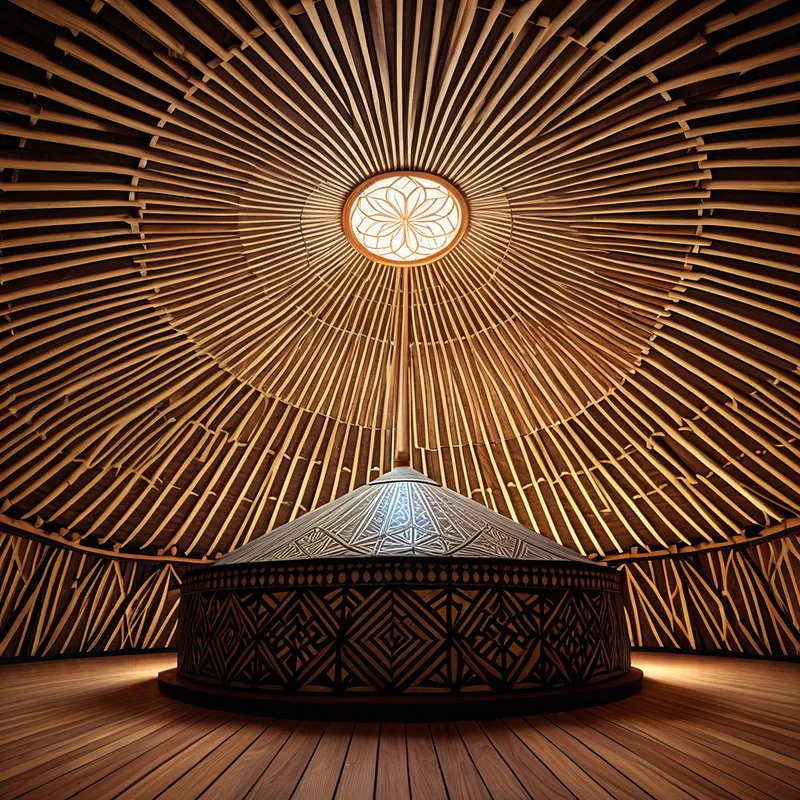
He descended, his mind afire with the pattern. He went to the forest and chose [the willow](/myths/the-willow “Myth from Celtic culture.”/), not for its strength, but for its suppleness—the quality of yielding without breaking. He bent it into a circle, a wheel without end, the khanas. “This is the family,” he whispered, “each member supporting the other.” From the center, he raised poles, curving them upward like reaching arms. These were the uni, the paths between earth and sky. At the very top, he placed the toono, a wheel with a hole at its heart. “This is the eye,” he said, “through which we see the face of Tengri and send our prayers on the smoke.”
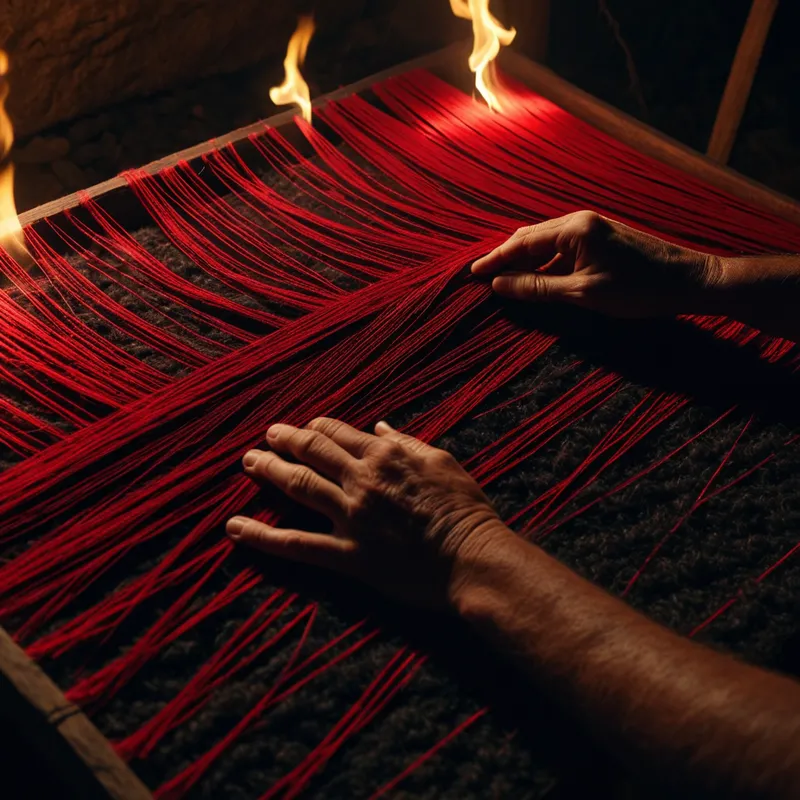
But the skeleton was bare. It was a ghost of a home. So Ulagan called the women. He did not command; he showed them the vision. And the women understood the language of covering, of warmth, of the inner world. They took the wool of the herd, felted it with hot [water](/myths/water “Myth from Chinese culture.”/) and song, beating it until it became a single, dense skin. They stretched this skin over the wooden bones, and suddenly, the wind had a voice—a deep, humming song as it flowed over the curves. The rain found a path, sliding down the sides. Inside, a space was born. It was not large, but it was whole. A world within the world.
They lit the first fire in the center, beneath the toono. The smoke rose, a twisting column connecting [the hearth](/myths/the-hearth “Myth from Norse culture.”/) of Etugen to the vastness of Tengri. And in that moment, the people felt it: they were no longer outside. They were within. They had made a universe that could travel.
Cultural Origins & Context
This myth, in its countless local variations, is the foundational narrative of the steppe nomads. It was not recited in grand temples but spoken in the intimate dark of the yurt itself, passed from elder to child, from mother to daughter, during the long winter nights. The teller was often the uychi, the master yurt-maker, or the grandmother who knew the patterns in the felt.
Its function was profoundly practical and sacred. It was an oral blueprint, encoding the precise instructions for construction—the number of khanas, the angle of the uni. But more importantly, it was a cosmological map and a social contract. It explained why the door always faces south (to greet the sun), why the space inside is divided into male and female sides, and why the central hearth is inviolable. The myth taught that the home is not a given; it is a ritual act of co-creation with the natural and spiritual world. It transformed the yurt from a mere shelter into a living, breathing microcosm, a portable axis mundi that allowed a people to inhabit the infinite without being consumed by it.
Symbolic Architecture
The [yurt](/symbols/yurt “Symbol: A portable, circular dwelling used by nomadic peoples, symbolizing adaptability, community, and connection to nature.”/) is not a building; it is a diagram of a complete [psyche](/myths/psyche “Myth from Greek culture.”/). Its [symbolism](/symbols/symbolism “Symbol: The use of symbols to represent ideas or qualities, often conveying deeper meanings beyond literal interpretation. In dreams, it’s the language of the unconscious.”/) is a profound [meditation](/symbols/meditation “Symbol: Meditation represents introspection, mental clarity, and the pursuit of inner peace, often providing a pathway for deeper self-awareness and spiritual growth.”/) on containment and [connection](/symbols/connection “Symbol: Connection symbolizes relationships, communication, and bonds among individuals.”/).
The circle of the khanas is the boundary of the Self—not a wall, but a flexible, resilient membrane that defines an inner world from the outer chaos.
The toono is the transcendent function, the opening in the roof of [consciousness](/symbols/consciousness “Symbol: Consciousness represents the state of awareness and perception, encompassing thoughts, feelings, and experiences.”/) through which the numinous—inspiration, [spirit](/symbols/spirit “Symbol: Spirit symbolizes the essence of life, vitality, and the spiritual journey of the individual.”/), the divine—can enter and exit. The hearth directly beneath it represents the central, transformative fire of the [soul](/symbols/soul “Symbol: The soul represents the essence of a person, encompassing their spirit, identity, and connection to the universe.”/), where raw experience (fuel) is alchemized into warmth and light (meaning). The upward [journey](/symbols/journey “Symbol: A journey in dreams typically signifies adventure, growth, or a significant life transition.”/) of the smoke signifies the process of [sublimation](/symbols/sublimation “Symbol: Transforming base impulses into creative or socially acceptable outlets, often seen in artistic expression.”/), of raising base [material](/symbols/material “Symbol: Material signifies the tangible aspects of life, often representing physical resources, desires, and the physical world’s influence on our existence.”/) into spiritual [awareness](/symbols/awareness “Symbol: Conscious perception of self, surroundings, or internal states. Often signifies awakening, insight, or heightened sensitivity.”/).
Psychologically, the [hero](/symbols/hero “Symbol: A hero embodies strength, courage, and the ability to overcome significant challenges.”/) Ulagan represents the synthesizing function of consciousness. His two-colored eyes symbolize the necessity of holding dualities—[earth](/symbols/earth “Symbol: The symbol of Earth often represents grounding, stability, and the physical realm, embodying a connection to nature and the innate support it provides.”/) and sky, inner and outer, masculine [structure](/symbols/structure “Symbol: Structure in dreams often symbolizes stability, organization, and the framework of one’s life, reflecting how one perceives their environment and personal life.”/) (the [wood](/symbols/wood “Symbol: Wood symbolizes strength, growth, and the connection to nature and the environment.”/)) and feminine [enclosure](/symbols/enclosure “Symbol: A bounded space representing psychological containment, social boundaries, or existential limitations. It can symbolize both safety and restriction.”/) (the felt). His journey up the Sumeru is an [inward](/symbols/inward “Symbol: A journey toward self-awareness, introspection, and the exploration of one’s inner world, thoughts, and unconscious mind.”/) [ascent](/symbols/ascent “Symbol: Symbolizes upward movement, progress, spiritual elevation, or striving toward higher goals, often representing personal growth or transcendence.”/) to a state of receptive [emptiness](/symbols/emptiness “Symbol: Emptiness signifies a profound sense of void or lack in one’s life, often related to existential fears, loss, or spiritual quest.”/), where the archetypal [pattern](/symbols/pattern “Symbol: A ‘Pattern’ in dreams often signifies the underlying structure of experiences and thoughts, representing both order and the repetitiveness of life’s situations.”/) of “home” can be perceived. He does not build alone; he catalyzes the [community](/symbols/community “Symbol: Community in dreams symbolizes connection, support, and the need for belonging.”/) (the women) to enact the [vision](/symbols/vision “Symbol: Vision reflects perception, insight, and clarity — often signifying the ability to foresee or understand deeper truths.”/). This reflects the psychological [truth](/symbols/truth “Symbol: Truth represents authenticity, honesty, and the quest for knowledge beyond mere appearances.”/) that individuation, the creation of a coherent Self, is not a solitary act but requires integrating the resources of one’s inner collective—the various subpersonalities and inherited patterns.
The Dreamer’s Resonance
When the yurt appears in a modern dream, it rarely comes as a quaint cultural artifact. It arrives as a profound somatic signal. To dream of building a yurt, struggling with its poles or felt, often coincides with a life phase where one is consciously attempting to construct a sense of inner stability, a “container” for a new identity—perhaps after a divorce, a move, a career shift, or a spiritual awakening. The dreamer is their own Ulagan, seeking the pattern.
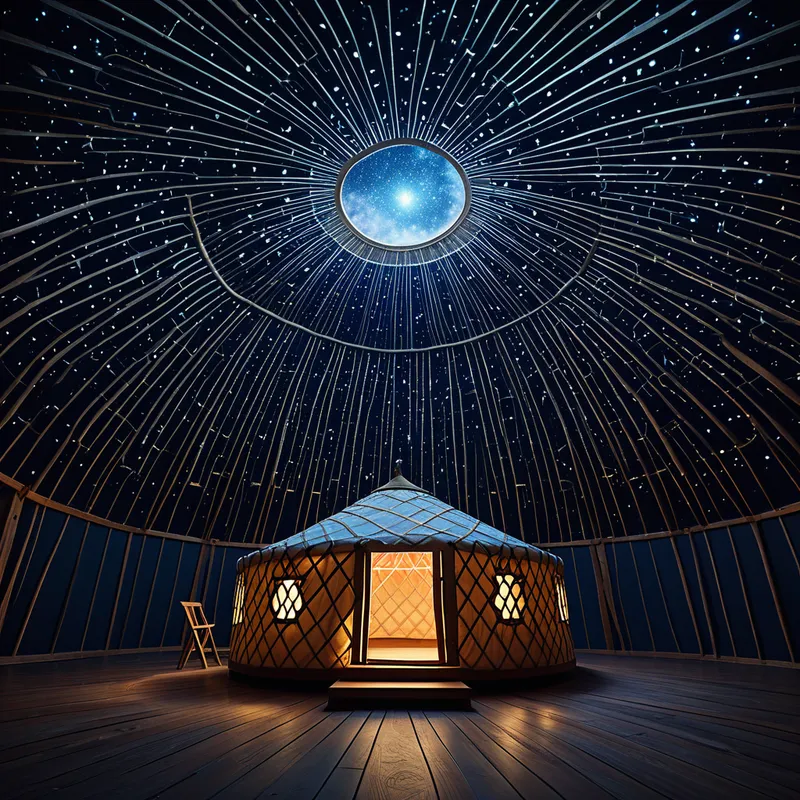
Dreaming of being inside a yurt, feeling its warmth and hearing the wind outside, speaks to a achieved, if temporary, state of psychic integration. One feels held, centered, and protected amidst life’s storms. Conversely, a dream of a yurt collapsing, its felt torn, or its toono blocked, is a urgent message from the unconscious. It indicates a breakdown of personal boundaries, a loss of connection to one’s spiritual center (the blocked smoke hole), or a feeling that the structures of one’s life are no longer flexible enough to withstand internal or external pressure. The body may feel this as anxiety, a literal sense of being “exposed” or “uncontained.”
Alchemical Translation
The myth of the Yurt is a masterclass in psychic transmutation. It models the entire process of individuation—the Jungian journey toward wholeness.
The first stage is the nigredo: the “nakedness to the world,” the scattered, suffering state of the people. This is the necessary dissolution of old, outworn identities.
Ulagan’s ascent is the albedo, the whitening or purification. He empties himself of ego-driven seeking and becomes a vessel. His vision on the mountain is the reception of the archetypal imago, the sacred blueprint of [the Self](/myths/the-self “Myth from Jungian culture.”/). This is the moment of insight, where the chaotic elements of one’s life (the scattered bones, the raw hide) suddenly reveal their latent, unifying pattern.
The construction phase is the citrinitas, the yellowing or realization. Here, the insight must be made manifest in the real world. The willow (suppleness) must be bent, the wool (the raw material of one’s life experiences) must be felted through effort and “song”—the applied energy of consciousness. This is often the hardest work, requiring discipline, community (the internal “women” or nurturing, creative functions), and respect for the materials at hand.
Finally, the lighting of the hearth and the rising smoke signify the [rubedo](/myths/rubedo “Myth from Alchemical culture.”/), the reddening or completion. The microcosm is complete and functional. The inner fire of the psyche burns steadily, and its products (thoughts, feelings, creations) are successfully offered up and connected to the transcendent (Tengri). The individual is no longer a victim of the elements but has created a sacred, mobile order within them. They have learned the ultimate alchemical secret: that the true home is not a location, but a state of being—a resilient, sacred space that you carry within, and can erect anywhere on the landscape of your life.
Associated Symbols
Explore related symbols from the CaleaDream lexicon: