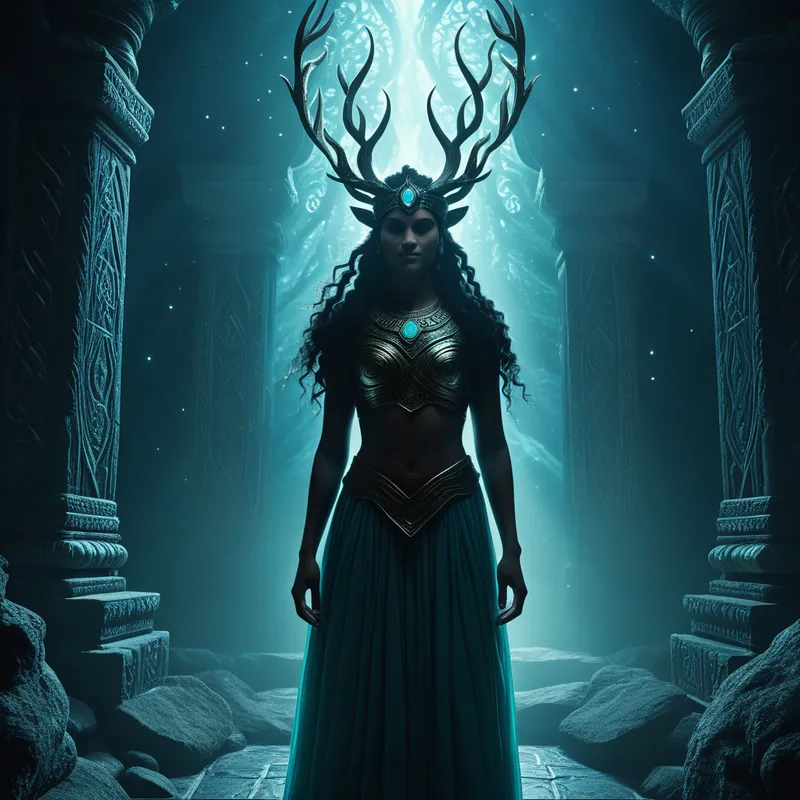
The Yeti Migou
A mysterious, ape-like creature of the Himalayas, revered in Tibetan Buddhist tradition as a protector of remote mountains and spiritual realms.
The Tale of The Yeti Migou
The story does not begin with a roar, but with a silence so profound it has weight. High on [the wind](/myths/the-wind “Myth from Various culture.”/)-scoured shoulders of the Himalayas, where the air thins to a crystalline sharpness and the snow holds the memory of millennia, there is a presence. The Migou is not seen; it is felt. It is the sudden stillness of the marmot, the prickling on the neck of the solitary monk, the deep, resonant print in virgin snow that appears where no human could tread.
One tale, whispered by elders in the flickering light of a butter lamp, tells of a revered yogi who sought the ultimate solitude for his meditation. He climbed beyond the last gnarled juniper, beyond the paths of blue sheep, into a realm of pure rock and ice. For years, he sat in a shallow cave, his breath becoming one with the mountain’s exhalation. His mind began to perceive the subtle fabric of [the world](/myths/the-world “Myth from Tarot culture.”/)—the hum of stone, the song of falling ice. One night, during a storm that screamed like a thousand demons, he felt a vast warmth at [the cave](/myths/the-cave “Myth from Platonic culture.”/) mouth. Opening his eyes, he saw not a monster, but a towering, fur-clad figure blocking the blizzard’s fury. Its eyes held the ancient, patient calm of the mountains themselves. It placed a chunk of rare, medicinal rock salt beside him, a gift of [the earth](/myths/the-earth “Myth from Hindu culture.”/)‘s essence, and then melted back into the swirling snow, leaving only peace in its wake.
Another narrative speaks of the Migou as a guardian of thresholds. Pilgrims circling the sacred peak of Kang Rinpoche might find their way mysteriously barred by a fresh rockslide or an impassable crevasse. Only later would they understand: the Migou had steered them from a path of hidden peril, or from a place too pure for their current state of mind. Its interventions are never violent, but profoundly corrective, enforcing the natural and spiritual law of the high wilderness. It is the embodiment of the mountain’s will—a silent, non-human intelligence that maintains the sacred boundaries between the mundane world and the realm of the gods.
Cultural Origins & Context
The Yeti Migou is a creature born from the intersection of immense landscape and profound cosmology. In Tibetan Buddhist and pre-Buddhist Bön worldviews, the environment is not inert. Mountains are deities (yul lha); rivers are serpentine spirits (klu); every valley and cliff possesses consciousness. The Migou inhabits the most extreme and liminal of these spaces—the eternal snows (gangs ri). This is not a habitat for biological curiosity, but a spiritual designation. It dwells in the borderland between the human realm and the pure lands of bodhisattvas.
Its reported appearances to hermits and pilgrims are consistent with a core Tibetan Buddhist principle: that advanced spiritual practice alters perception. The purified mind begins to perceive the myriad forms of sentience that conventional reality obscures. The Migou, therefore, is less a biological cryptid and more a nirmanakaya of [the wilderness](/myths/the-wilderness “Myth from Biblical culture.”/) itself—a tangible manifestation of the mountain’s protective, awakened quality. It exists in the collective [psyche](/myths/psyche “Myth from Greek culture.”/) as a reminder that the most remote, challenging places are often the most sacred, and are guarded by intelligences beyond human comprehension.
Symbolic Architecture
The Migou is a living [paradox](/symbols/paradox “Symbol: A contradictory yet true concept that challenges logic and perception, often representing unresolved tensions or profound truths.”/), a [symbol](/symbols/symbol “Symbol: A symbol can represent an idea, concept, or belief, serving as a powerful tool for communication and understanding.”/) built from opposing forces that find unity in the high, cold air. It is both tangible and elusive, leaving physical traces (footprints, [hair](/symbols/hair “Symbol: Hair often symbolizes identity, power, and self-expression, reflecting how we perceive ourselves and how we wish to be perceived by others.”/)) while remaining essentially unseen. It embodies immense power and profound gentleness, capable of terrifying [strength](/symbols/strength “Symbol: ‘Strength’ symbolizes resilience, courage, and the ability to overcome challenges.”/) yet associated with gifts of [salt](/symbols/salt “Symbol: Salt represents purification, preservation, and the essence of life. It is often tied to the balance of emotions and spiritual cleansing.”/) and protection. It represents the [wilderness](/symbols/wilderness “Symbol: Wilderness often symbolizes the untamed aspects of the self and the unconscious mind, representing a space for personal exploration and discovery.”/) that judges and the wilderness that nurtures.
It is the embodied conscience of the landscape, enforcing the dharma of the mountains. Where humans transgress—through spiritual arrogance, ecological carelessness, or mere ignorant intrusion—the Migou manifests as a corrective barrier, a symbol of nature’s ultimate sovereignty.
Psychologically, it occupies the position of the Self in its most archaic, non-human form. It is not the personalized soul, but the raw, archetypal ground of being that exists before and beyond individual identity—the “mountain” of the psyche that must be respected, not conquered.
Its elusive [nature](/symbols/nature “Symbol: Nature symbolizes growth, connectivity, and the primal forces of existence.”/) is key. The Migou cannot be captured, catalogued, or owned. To seek it with the tools of empirical [science](/symbols/science “Symbol: Science symbolizes the pursuit of knowledge and understanding through observation and experimentation, representing logic and rationality.”/) is to fundamentally misunderstand its [reality](/symbols/reality “Symbol: Reality signifies the state of existence and perception, often reflecting one’s understanding of truth and life experiences.”/). It reveals itself only on its own terms, in the context of [relationship](/symbols/relationship “Symbol: A representation of connections we have with others in our lives, often reflecting our emotional state.”/) and respect, mirroring the Buddhist [truth](/symbols/truth “Symbol: Truth represents authenticity, honesty, and the quest for knowledge beyond mere appearances.”/) that ultimate [reality](/symbols/reality “Symbol: Reality signifies the state of existence and perception, often reflecting one’s understanding of truth and life experiences.”/) (tathata) cannot be grasped by the conceptual mind, only directly experienced.
The Dreamer’s Resonance
When the image of the Migou stirs in the modern psyche, it is not merely a relic of folklore. It emerges as an archetypal response to profound dislocation. In a world of digital saturation and environmental alienation, the Migou represents the call of the untamed Self. Its appearance in dreams or imagination can signal a deep need to reconnect with the foundational, instinctual, and sacred layers of one’s own being that have been buried under civilization’s noise.
The creature often appears when one is approaching a significant inner threshold—a “high place” of potential spiritual insight or psychological transformation. The feeling it evokes—awe tinged with fear—is the exact sensation of standing before the numinous. The Migou may block a dreamed path, not as a monster, but as a threshold guardian. It asks the dreamer: Are you prepared? Have you shed the unnecessary baggage? Do you approach with respect or with conquest in your heart? Its message is that certain realms of experience require proper orientation, humility, and inner purity to access safely.

Alchemical Translation
The alchemical process here is not of lead to gold, but of human arrogance to humble integration. The encounter with the Migou is an opus of the high mountains. The initial stage is [nigredo](/myths/nigredo “Myth from Alchemical culture.”/)—the confrontation with the terrifying “other,” [the shadow](/myths/the-shadow “Myth from Jungian culture.”/) of the wild projected onto a hairy giant. This is [the ego](/myths/the-ego “Myth from Jungian culture.”/)‘s fear of dissolution into the vast, non-human unknown.
The transformative moment is the realization that this “monster” is not hostile, but protective. The gift of salt—a mineral essential for life and a preservative—is the gift of the essential. It symbolizes the wisdom of the earth itself, offered to those who can sit in stillness and receive it. This is the albedo, the whitening, where fear turns to awe.
The final stage is integration. The Migou does not become a pet or a companion; it remains wild and separate. The goal is not to possess the symbol, but to internalize its law. One learns to become a guardian of one’s own inner sacred landscapes—to respect the wild, untamed depths of the unconscious, to set boundaries against psychic profanation, and to understand that true power lies in alignment with a greater, natural order, not in domination over it. [The pilgrim](/myths/the-pilgrim “Myth from Christian culture.”/) returns from the mountain changed, carrying the Migou’s silent, imposing presence within as a principle of sacred sovereignty.
Associated Symbols
Explore related symbols from the CaleaDream lexicon:
- Mountain — The ultimate symbol of spiritual ascent, enduring truth, and the challenging journey toward enlightenment; the sacred abode of deities and protectors.
- Threshold — A point of transition and testing, representing the sacred boundaries between states of being that are guarded by powerful forces.
- Guardian — An archetypal protector of sacred spaces, hidden knowledge, or spiritual integrity, often manifesting at the limits of the known world.
- Shadow — The vast, unknown, and potentially terrifying aspect of the psyche or the world, which holds transformative power when approached with respect.
- Wilderness — The primordial, untamed state of both nature and the unconscious, a realm of raw power, purity, and non-human law.
- Silence — The profound, generative emptiness from which true understanding and numinous encounters emerge, beyond the realm of language.
- Footprint — A trace or sign of a transcendent presence, evidence of a reality that remains just beyond direct perception, inviting contemplation.
- Gift — An unconditional offering from a deeper layer of reality, often symbolizing essential wisdom or sustenance for the spiritual journey.
- Stone — The enduring, foundational element of the earth, representing permanence, the bones of the world, and the condensed wisdom of ages.
- Bone — The essential structure, the lasting remnant, and a symbol of the core, indestructible truth that remains after all else is stripped away.